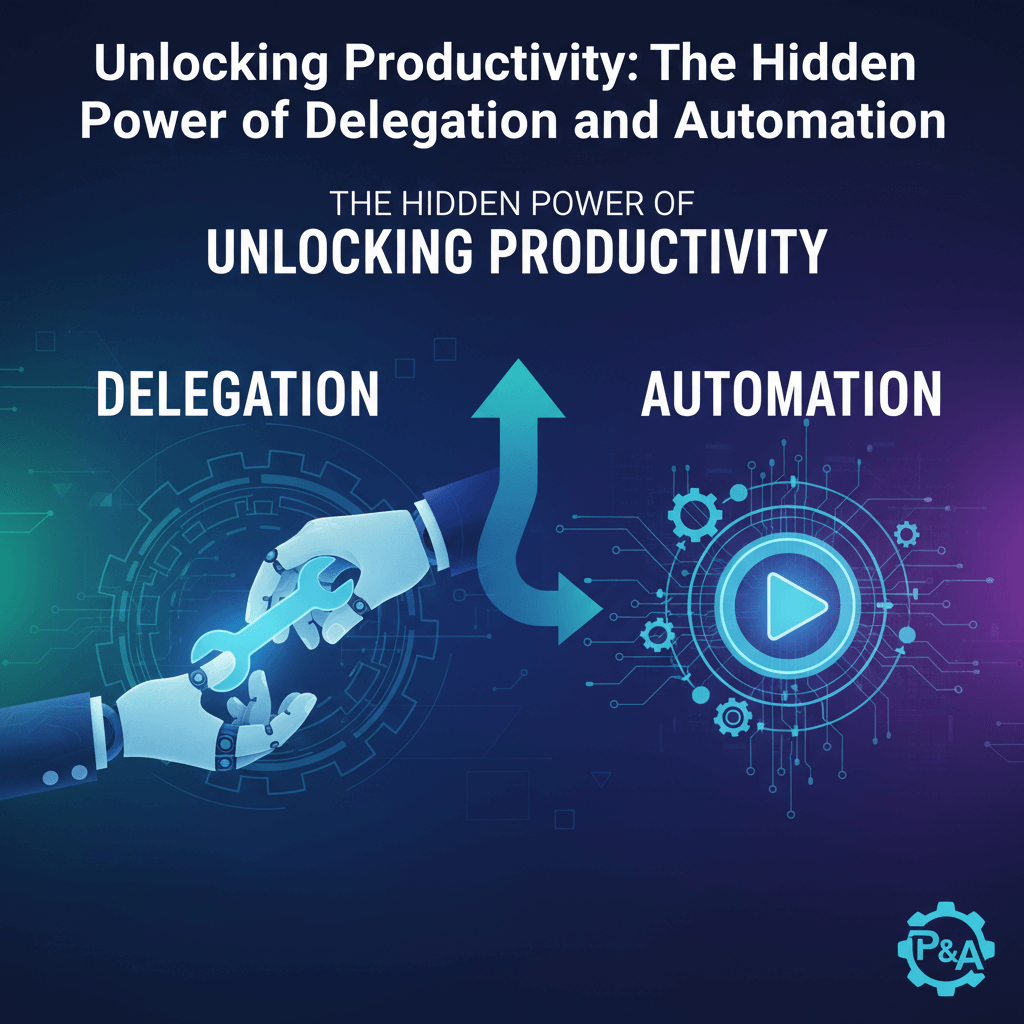
Three years ago, I found myself working 70-hour weeks, perpetually exhausted, and still falling behind on deadlines. My inbox had become a bottomless pit, my calendar was a battlefield of competing priorities, and the elusive work-life balance felt like a luxury for other people. Sound familiar?
That breaking point led me to a revelation that transformed my professional life: the extraordinary power of delegation and automation. What I discovered wasn’t just a way to manage my workload—it was a complete paradigm shift in how I approached productivity itself.
In today’s remote-first world, where digital communication has exploded and boundaries between work and personal life have blurred, mastering these twin productivity engines isn’t just helpful—it’s essential. Research from McKinsey suggests that 45% of paid activities could be automated using existing technologies, while Gallup reports that executives who delegate effectively generate 33% higher revenue. Yet surprisingly, most of us still resist these powerful productivity levers.
The Productivity Paradox: Why We Resist Our Most Powerful Tools
When Sarah, a marketing director at a mid-sized tech company, first considered delegating parts of her workload to a virtual assistant, she hesitated. “I kept thinking, ‘By the time I explain how to do it, I could have done it myself,'” she told me. This mindset—what productivity experts call the “delegation paradox”—keeps countless professionals trapped in cycles of overwork.
The same resistance applies to automation. A 2022 Zapier study found that while 94% of workers perform repetitive, time-consuming tasks, only 33% use automation tools to address them.
The Psychology Behind Our Resistance
Our reluctance typically stems from three psychological barriers:
- Control bias: The belief that we must personally handle tasks to ensure quality
- Short-term thinking: Focusing on immediate time costs rather than long-term gains
- Identity attachment: Defining ourselves by the tasks we perform rather than the outcomes we create
Breaking through these mental barriers requires recognizing a fundamental truth: productivity isn’t about doing more things—it’s about achieving more meaningful results.
Delegation: The Art of Multiplying Your Impact
Michael, a software developer turned startup founder, credits strategic delegation with helping his company survive its critical first year. “I was coding, managing clients, and handling operations—essentially three full-time jobs,” he explains. “Learning to delegate wasn’t optional; it was existential.”
Michael’s breakthrough came when he created a simple but effective delegation framework:
The 3-Tier Delegation System
- Tier 1: Tasks anyone can do with minimal instruction (scheduling, data entry, basic research)
- Tier 2: Tasks requiring specific skills but not your unique expertise (content creation, customer support, financial reporting)
- Tier 3: Strategic work only you can do (key client relationships, core business decisions, specialized expertise)
By methodically moving Tier 1 and 2 tasks off his plate, Michael reclaimed over 30 hours weekly—time he reinvested in high-leverage activities that tripled his company’s growth rate.
Effective Delegation in Practice
The most successful delegators follow these principles:
- Start with clear outcomes, not just tasks (“I need a report showing Q3 performance trends” versus “Make me a spreadsheet”)
- Provide context, not just instructions (explaining why something matters improves decision-making)
- Establish feedback loops to improve future delegation
According to a Harvard Business Review study, executives who excel at delegation deliver 33% higher revenue than those who struggle with it. The message is clear: delegation isn’t just about offloading work—it’s about strategic leverage.
Automation: Your Digital Workforce
While delegation multiplies your impact through people, automation creates systems that work for you 24/7. Elena, a freelance graphic designer, transformed her business by automating her client onboarding process.
“I was spending 10+ hours weekly on administrative tasks,” she recalls. “Now my automation system handles everything from sending welcome packets to scheduling kick-off calls and collecting initial feedback. It’s like having a full-time assistant who never sleeps.”
The Automation Opportunity Matrix
The most effective approach to automation follows a simple matrix:
- High frequency + low complexity = Immediate automation priority (email sorting, meeting scheduling, data transfers)
- High frequency + high complexity = Partial automation opportunity (client communications, reporting, content distribution)
- Low frequency + low complexity = Batch for occasional automation (quarterly reporting, annual planning)
- Low frequency + high complexity = Keep manual with process documentation
Research from Forrester indicates that implementing even basic automation reduces errors by 57% while improving productivity by 35%. The compound effect is substantial: automating just three hours of weekly tasks recovers 156 hours annually—nearly four work weeks reclaimed.
No-Code Automation Tools Anyone Can Use
Today’s automation revolution is democratized through user-friendly tools requiring no technical expertise:
- Email management: Tools like SaneBox or Clean Email automatically categorize and prioritize messages
- Workflow automation: Zapier and IFTTT connect applications to create custom workflows
- Document automation: TextExpander and PandaDoc streamline repetitive writing and document creation
- Meeting scheduling: Calendly and Acuity eliminate scheduling ping-pong
The key is starting small: identify one repetitive process consuming disproportionate time, then build an automation solution. Success breeds motivation for tackling the next opportunity.
The Synergy Effect: When Delegation Meets Automation
The true productivity breakthrough happens when delegation and automation work together. Consider how James, a financial advisor, transformed his practice:
“I built automated systems for client onboarding and regular reporting, then delegated the management of those systems to my assistant. The result was exponential—automation multiplied my capacity, while delegation ensured those systems kept improving without consuming my attention.”
Creating Your Productivity Ecosystem
The most effective productivity ecosystem follows this framework:
- Automate the routine: Build systems for predictable, repeating processes
- Delegate the variable: Assign tasks requiring human judgment but not your specific expertise
- Focus on the exceptional: Reserve your time for work that leverages your unique capabilities
A Stanford study found that this integrated approach doesn’t just improve productivity—it significantly reduces burnout by eliminating the cognitive load of task-switching and decision fatigue.
Overcoming Implementation Challenges
Despite the clear benefits, implementing delegation and automation isn’t without challenges. Let’s address the most common obstacles:
The Perfectionism Trap
When Lisa, a marketing consultant, first delegated content creation, she was disappointed with the results. “It wasn’t bad, but it wasn’t how I would have done it,” she explained. This perfectionism nearly led her back to doing everything herself.
The breakthrough came when she reframed her thinking: “I realized that 80% quality at 20% of my time investment was actually a massive win. It freed me to focus on strategy, which dramatically improved our overall results.”
This “good enough” threshold varies by task. Critical client deliverables might require 95% perfection, while internal documents might need only 75%. Defining these thresholds in advance makes delegation decisions more rational and less emotional.
Building Progressive Trust
Effective delegation and automation require a progressive trust-building approach:
- Start with low-risk tasks where mistakes have minimal consequences
- Create clear quality standards and feedback mechanisms
- Gradually increase responsibility as confidence grows
Research from the Project Management Institute shows that teams using this graduated approach achieve successful delegation 3x faster than those attempting to delegate complex responsibilities immediately.
Your 30-Day Productivity Transformation Plan
Ready to unlock the hidden power of delegation and automation? Here’s a structured 30-day plan to get started:
Days 1-7: Discovery and Documentation
- Conduct a time audit: Track where your hours actually go for one week
- Identify your top 3 “time drains” that don’t require your unique expertise
- Document one process you perform repeatedly, breaking it into clear steps
Days 8-14: First Automation Wins
- Implement one email automation (filters, templates, or auto-responders)
- Set up calendar boundaries using scheduling tools
- Create your first Zapier or IFTTT automation for a repetitive task
Days 15-22: Delegation Initiation
- Identify one Tier 1 task to delegate (internally or to a virtual assistant)
- Create clear instructions with outcomes, not just processes
- Establish a feedback mechanism to refine the delegation
Days 23-30: Integration and Expansion
- Review results from initial delegation and automation efforts
- Identify one task where automation and delegation can work together
- Calculate time saved and determine how to reinvest it for maximum impact
The Ultimate Productivity Question
As we conclude this exploration of delegation and automation, I’d like to leave you with the question that transformed my own relationship with productivity: What would become possible if you had 20 more hours each week?
Would you develop that business idea you’ve been postponing? Deepen client relationships? Create that course or book you’ve been meaning to write? Or perhaps simply be more present with your family and friends?
The hidden power of delegation and automation isn’t just about doing more—it’s about creating space for what truly matters. It’s about shifting from being busy to being impactful.
Your challenge, should you choose to accept it: Identify one task this week that you’ll either delegate or automate. Take that first step toward reclaiming your time and attention. The compound effect of this single change might surprise you—it could be the beginning of your own productivity transformation.
The most valuable resource isn’t money—it’s focused time. Delegation and automation aren’t just productivity techniques; they’re the levers that can help you reclaim yours.
Where This Insight Came From
This analysis was inspired by real discussions from working professionals who shared their experiences and strategies.
- Share Your Experience: Have similar insights? Tell us your story
At ModernWorkHacks, we turn real conversations into actionable insights.
![[Workflow Included] A simple 5-node Instagram posting workflow for beginners](https://modernworkhacks.com/wp-content/uploads/2026/04/workflow-included-a-simple-5-node-instagram-posting-workflow-for-beginners-1024x675.png)





0 Comments