Last month, Sarah, a software developer at a Fortune 500 company, received an all-staff email announcing the end of their remote work policy. The message cited “collaboration challenges” and “cultural erosion” as key factors. Yet Sarah had met all her performance goals while working remotely for two years, and team surveys showed satisfaction at an all-time high. “Something doesn’t add up,” she told me. “It feels like they’re not being honest about why they want us back.”
Sarah isn’t alone. Across industries, employees are questioning the corporate narrative around returning to the office. As companies roll back remote work policies established during the pandemic, a growing chorus of voices is challenging the authenticity of the messaging. The disconnect between corporate statements and employee experiences has created a trust gap that threatens workplace cultures everywhere.
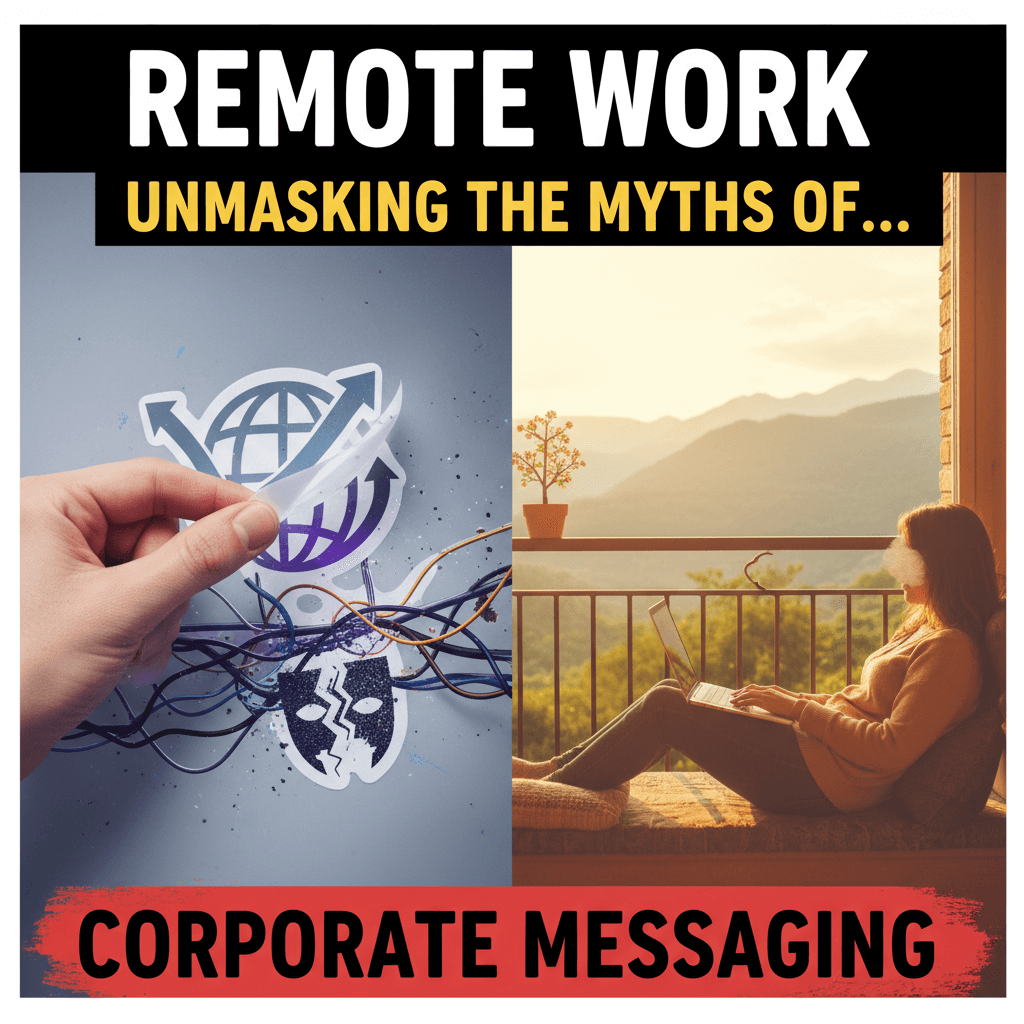
Is the push back to office spaces truly about collaboration and culture, or is something else at play? Let’s unmask the myths in corporate messaging around remote work and examine what’s really driving this tension.
The Collaboration Myth: Unpacking the First Line of Defense
“We need to be together to collaborate effectively” stands as perhaps the most common justification for office returns. This messaging appears logical on the surface—after all, isn’t it easier to work together when physically present?
What Research Actually Shows About Remote Collaboration
A 2022 study from Stanford University found that well-implemented remote work setups showed no significant decrease in collaboration quality compared to in-person environments. In fact, researchers noted that digital collaboration tools often created more equitable participation patterns, especially for introverted team members.
Microsoft’s 2023 Work Trend Index revealed that remote teams actually had 32% more cross-department collaboration than their in-office counterparts, likely because digital environments removed physical barriers between departments.
The data suggests that collaboration concerns may be overblown or, at minimum, addressable through thoughtful implementation of remote work practices.
The Hidden Infrastructure Costs
What often goes unmentioned in back-to-office mandates is the substantial investment many companies have in physical real estate. A mid-sized company typically spends $5,000-$15,000 per employee annually on office space—a massive expense that becomes difficult to justify when employees work remotely.
Case in point: Commercial real estate firm JLL reported that office vacancy rates in major U.S. cities hit 19.2% in Q1 2023, the highest level since the 1980s recession. For companies with long-term leases or owned buildings, empty offices represent millions in sunk costs.
- Actionable insight: Ask specific questions about how collaboration will improve in-office versus your current remote setup.
- Actionable insight: Document your team’s collaboration successes while working remotely with concrete examples and metrics.
- Actionable insight: Propose hybrid models that balance genuine collaboration needs with remote flexibility.
The Culture Conundrum: Building Community at a Distance
“We’re losing our company culture” ranks second in the corporate playbook for justifying office returns. This concern feels more nebulous but potentially more significant—after all, culture drives engagement, retention, and ultimately, results.
Redefining What “Culture” Really Means
Traditional views of company culture often center around physical manifestations: office perks, impromptu conversations by the coffee machine, and team happy hours. But is this truly what creates meaningful culture?
Airbnb’s CEO Brian Chesky challenged this notion when he announced the company’s permanent shift to remote-first work in 2022. “Culture isn’t ping pong tables and free snacks,” he stated. “It’s how we treat each other, the values we embody, and the mission that unites us.”
Companies like GitLab, which has been fully remote since its inception, demonstrate that strong cultures can thrive without physical offices. GitLab’s extensively documented remote work handbook has become a resource for other organizations, showing that intentional culture-building works remotely.
The Trust Element in Remote Work
What many corporate messages inadvertently reveal is a fundamental trust issue. The unstated concern often isn’t about culture but control—the ability to visibly monitor employee activity.
A 2023 survey by Owl Labs found that 85% of managers worry about whether remote employees are working their full hours, despite productivity data suggesting remote workers often put in more time than their in-office counterparts.
- Actionable insight: Help redefine culture in terms of outcomes and values rather than physical presence.
- Actionable insight: Create and participate in virtual culture-building activities that demonstrate community doesn’t require physical proximity.
- Actionable insight: Document how remote work has positively impacted your work-life integration and overall wellbeing.
The Productivity Paradox: Data vs. Perception
When direct appeals to collaboration and culture fall short, many companies turn to productivity concerns. “We’re more productive when we’re together” becomes the rallying cry, despite mounting evidence to the contrary.
What the Numbers Actually Say
The productivity question should be the easiest to settle with data, yet corporate messaging often relies on anecdotes rather than metrics. A comprehensive 2-year study by Nicholas Bloom at Stanford University involving 16,000 workers found a 13% performance increase among remote workers, attributed to more minutes worked per shift (fewer breaks and sick days) and more calls per minute (attributed to a quieter working environment).
Similarly, a 2022 Gartner analysis of 10,000 digital workers and their managers found no significant difference in productivity between remote and in-office employees when measured by objective output metrics.
The Presenteeism Problem
What often goes unacknowledged is how in-office environments can foster presenteeism—the practice of being physically present but not fully productive. A 2023 study in the Journal of Occupational Health Psychology found that workers report spending an average of 2.1 hours per day on non-work activities in the office, compared to 1.6 hours while working from home.
The case of Dropbox illustrates this tension. After announcing a permanent “Virtual First” policy, the company redesigned its offices as “Studios” for collaboration rather than daily work. Their internal data showed team productivity remained consistent while employee satisfaction increased by 22%.
- Actionable insight: Track and document your personal productivity metrics while working remotely.
- Actionable insight: Request that return-to-office decisions be based on objective performance data rather than subjective perceptions.
- Actionable insight: Propose productivity measurement systems that focus on outcomes rather than visibility.
The Hidden Costs: What Corporate Messaging Doesn’t Acknowledge
Perhaps the most telling omission in corporate return-to-office messaging is any acknowledgment of the significant costs being shifted back to employees.
The Financial Burden
The average American commuter spends between $2,000 and $5,000 annually on transportation costs. When factoring in the time value of commuting—an average of 55 minutes per day according to the U.S. Census Bureau—the true cost climbs even higher.
During the remote work era, many employees relocated to more affordable areas, restructured childcare arrangements, or sold vehicles. A sudden return to office mandate creates financial hardship that companies rarely address in their messaging.
When consulting firm Deloitte surveyed workers about return-to-office concerns, financial impact ranked as the top worry for 65% of respondents, ahead of both productivity concerns (48%) and work-life balance (52%).
The Mental Health Equation
The mental health benefits of remote work flexibility rarely feature in corporate return messaging, despite substantial evidence of their importance. A 2023 American Psychological Association survey found that 81% of workers cited the ability to work flexibly as a key factor in their mental wellbeing.
The case of Ernst & Young (EY) stands out as a counterexample to the return trend. After initially pushing for office returns, the company reversed course after internal surveys revealed concerning mental health impacts and resignation threats. Their revised “EY@Work” model emphasizes choice and flexibility, acknowledging that wellbeing drives performance.
- Actionable insight: Calculate and communicate the personal costs (financial, time, and wellbeing) that office returns impose on you.
- Actionable insight: Advocate for wellbeing metrics to be included in workplace policy decisions.
- Actionable insight: Build coalitions with colleagues to amplify concerns about hidden costs of office returns.
Finding Your Voice in the Return-to-Office Conversation
As corporate return-to-office messaging intensifies, employees need strategies to effectively engage in this conversation without jeopardizing their professional standing.
Data-Driven Advocacy
The most effective counter to questionable corporate messaging is concrete data. Document your remote work successes with specific metrics—projects completed, response times, collaboration outcomes, and productivity measures. Personal data is harder to dismiss than general objections.
When software engineer Marco Rodriguez faced a return mandate at his tech company, he compiled six months of productivity metrics showing a 28% increase in code commits while working remotely. This evidence-based approach earned him a remote work exception that later became a department-wide policy.
Collective Action Without Confrontation
Individual voices can be easily dismissed, but collective feedback is harder to ignore. Rather than oppositional tactics, consider collaborative approaches like anonymous pulse surveys, facilitated listening sessions, or employee resource groups focused on workplace flexibility.
At financial services firm Capital One, an employee-led “Future of Work” task force successfully advocated for a hybrid approach by gathering data and presenting business cases rather than demands. Their non-adversarial approach resulted in a flexible policy that balanced business needs with employee preferences.
- Actionable insight: Frame remote work advocacy in terms of business benefits rather than personal preferences.
- Actionable insight: Propose pilot programs or phased approaches that allow for data collection and adjustment.
- Actionable insight: Develop skills that make your remote contributions highly visible and valuable, strengthening your negotiating position.
The Path Forward: Beyond the Return-to-Office Debate
The tension between corporate return-to-office messaging and employee preferences represents more than a disagreement about workplace location—it reflects a fundamental shift in how we conceptualize work itself.
The most forward-thinking organizations are moving beyond binary remote/in-office thinking toward truly flexible models that focus on outcomes rather than presence. They’re asking deeper questions about when synchronous collaboration truly adds value and when independent work serves the mission better.
As employees, our most powerful response to questionable corporate messaging isn’t resistance but reimagination—proposing thoughtful alternatives that serve both organizational goals and human needs. By grounding our advocacy in data, demonstrating remote success, and collaboratively designing new work models, we can help shape workplaces that honor both business requirements and the human experience.
The future of work won’t be determined by corporate decrees or employee demands alone, but through honest dialogue that acknowledges the complexities of modern work. By challenging oversimplified messaging and contributing constructive alternatives, we can help create work environments that truly serve both organizational missions and human flourishing.
The question isn’t simply whether we should work remotely or in-office—it’s how we can work in ways that bring out our best contributions while supporting our whole lives. That’s a conversation worth having honestly, beyond the myths and messaging.
Where This Insight Came From
This analysis was inspired by real discussions from working professionals who shared their experiences and strategies.
- Share Your Experience: Have similar insights? Tell us your story
At ModernWorkHacks, we turn real conversations into actionable insights.
![[Workflow Included] A simple 5-node Instagram posting workflow for beginners](https://modernworkhacks.com/wp-content/uploads/2026/04/workflow-included-a-simple-5-node-instagram-posting-workflow-for-beginners-1024x675.png)



0 Comments