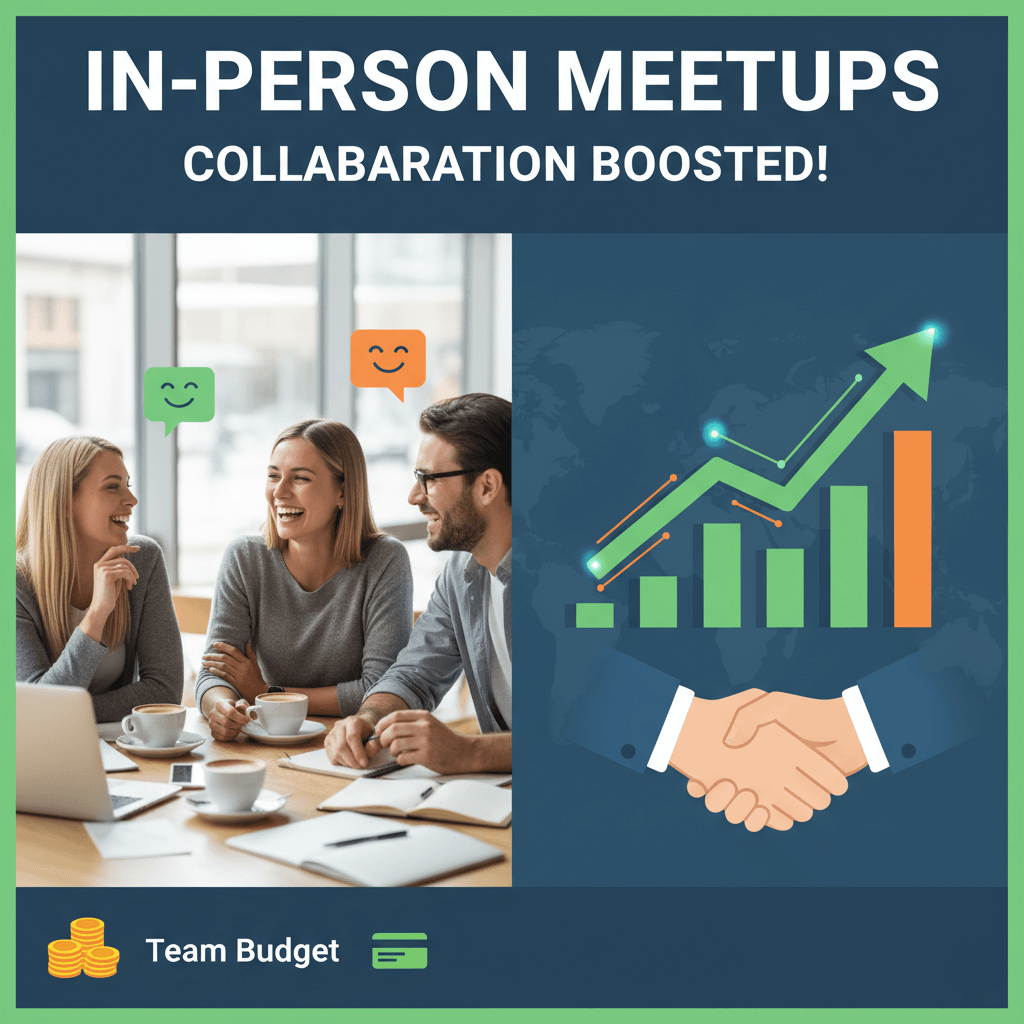
Discover actionable insights: that was the promise, and it started with a simple line item in our operating plan. After years of building a remote-first culture, we thought we had collaboration figured out—async updates, thoughtful documentation, and video calls that ran like clockwork. But something was still missing. Progress was punctual, but it wasn’t compounding. We were shipping, but not surprising ourselves. We were aligned, yet not accelerating.
The turning point came when we gave team members a modest budget to meet each other in person. Not for conferences or company offsites, but for small, purpose-driven meetups: a designer and developer sharing a whiteboard in a coffee shop; a customer success lead and product manager walking through use cases side by side; two engineers comparing notes across teams without a screen between them. The results were undeniable. Roadblocks melted. Shared language crystallized. Appetite for risk-taking grew—responsibly. And the quality of our work took a noticeable step up, not just in output but in outcomes.
What follows is the real story of how it unfolded, the key takeaways from the discussions that happened in those rooms, and a practical playbook you can use to do the same. If you want collaboration that compounds, this is how you turn a budget line into a collaboration engine.
The moment we put real dollars behind human connection
It started as a pilot. We carved out a small pool—enough to give every team member a per-quarter stipend to meet colleagues in their geographic cluster or along travel routes they already had planned. No extravagant hotels. No lavish dinners. Just clear guardrails and a simple objective: meet for a purposeful session, document the learnings, and translate them into better work.
Our first experiment was a set of micro-meetups. A back-end engineer in Austin met a data analyst flying through town; they spent four hours modeling edge cases that had haunted a feature for months. Two customer support reps in Manchester mapped out patterns from tickets that no dashboard had fully captured. A designer and QA engineer in Berlin reviewed flows on a whiteboard and found three ways to cut test time by half. These were not grand events. They were ordinary meetups with extraordinary outcomes because they helped people connect context to craft.
One scene sticks with me. We had a persistent friction point: feature handoffs between design and engineering were documented, but UX intent was not always obvious. In a two-hour session at a coworking space, a senior engineer sketched the data constraints while a designer layered in user journeys. They created a shared rubric: how to decide when a pixel-perfect behavior matters and when latency realities should dominate. That framework is still in use. It has saved us countless cycles of review and rework.
We could feel the difference in our conversations the next week. Pull requests had more context and fewer surprises. Asynchronous updates read cleaner. Slack threads took on an assumption of good intent, not because we mandated it, but because people had looked one another in the eye while solving something hard. Suddenly, conflict was about the work, not the people.
The unexpected part? These meetups did not undermine our remote-first ethos. They fortified it. People returned to their distributed routines with stronger shared mental models and a renewed discipline for async work. In-person conversations weren’t a crutch; they were a catalyst.
What really happened in the room: key takeaways from real discussions
We asked people to share what they talked about, what changed, and what they carried back into their daily workflows. Here are the most consistent patterns—insights we could not have derived from dashboards alone.
Trust recalibrated quickly—and in specific, actionable ways
Trust is not a warm glow. It’s a set of expectations you can predict. In person, those expectations became clearer. People saw how others reasoned about trade-offs and what good looked like to them. That specificity made a measurable difference.
- Shared standards emerged. Design tokens, code review criteria, and release checklists were tuned together on a whiteboard, shrinking the gap between “done” and “done right.”
- Intent was clarified. Disagreements that read as resistance in chat were revealed to be risk management or customer advocacy.
- Accountability felt mutual. People volunteered to own hard problems after aligning on constraints in real time.
One engineer put it simply: “I finally understood why product keeps pushing for a tighter scope. It’s not to cut corners—it’s to protect the experience that users actually feel.”
A shared language formed around tangible artifacts
In remote settings, language drifts. The same word means different things to different teams. In person, we anchored terms to artifacts: wireframes, data tables, error logs, prototypes. It accelerated sense-making.
- Glossaries got real. We defined “latency,” “reliability,” and “delight” with concrete thresholds and examples everyone signed off on.
- Diagrams replaced debates. Flows on sticky notes turned abstract disagreements into solvable sequencing problems.
- Memory stuck. People recalled conversations better when they co-created artifacts rather than passively reading docs.
When folks returned to Slack, the shared references held. Threads could say “follow the Berlin flow” and everyone knew what that meant.
Decision speed improved because constraints were co-authored
We often think speed comes from eliminating meetings. In our case, speed came from one focused meeting that made many others shorter or unnecessary. Co-authoring constraints helped everyone move with confidence.
- We pre-agreed on “no-go” lines. With clear boundaries, teams made bolder choices inside them.
- We set two-way SLAs. Product would not change scope within 72 hours of a code freeze; engineering would not merge breaking changes without a paired review.
- We prioritized as a team. Rather than debating everything, we ranked the top three levers that would move our metrics now.
Result: fewer reversals, fewer reworks, and faster time from idea to testable reality.
Conflict became productive because it was framed as a joint experiment
Disagreement never disappeared; it matured. The key shift was framing: we set up experiments in the room, then ran them remotely. It took the sting out of being wrong and reduced defensiveness.
- We named assumptions openly. “If support tickets spike, we will revert.” That sentence saved weeks of hedging.
- We bound experiments. Timeboxed tests with clear success criteria prevented endless pilots.
- We normalized dissent. We wrote down the strongest opposing case and agreed to monitor it.
By the time the experiment ended, people felt heard whether their view “won” or not. And the work got better either way.
Hidden dependencies surfaced—then shrank
Some of our slowdowns had nothing to do with engineering or design. They were process and people issues hiding in plain sight. In person, those became obvious.
- We found handshake failures. Handoffs between customer success and product lacked a clear owner; a 20-minute conversation and a shared template fixed it.
- We reduced queue time. A quick tweak to our triage path shaved days off waiting for decisions.
- We aligned calendars. A change in release cadence reduced cross-timezone pain with no loss of tempo.
These were small changes with outsized impact, unlocked because people could map the system together at a whiteboard.
Informal moments created durable confidence
Not everything was structured. The walks between sessions, the coffee breaks, the quiet minutes reviewing a PR side by side—these mattered. They built a sense that “we’ve got this” and “we’ve got each other.”
- People asked the awkward questions. “What do you actually worry about?” led to better risk planning.
- Strengths and quirks became assets. Knowing who loves writing docs or who thrives under a deadline lets teams self-organize more intelligently.
- Onboarding accelerated. Newer teammates absorbed norms faster through osmosis in a single afternoon than a week of reading.
When those same teammates returned to remote routines, they were quicker to raise a hand and to trust the process.
The playbook: how to design an in-person budget that actually works
If you want better collaboration, fund it on purpose. But put structure around the spend so it scales outcomes, not just expenses. Here is the playbook we refined.
Define outcomes before flights
- Pick two outcomes. Examples: reduce cycle time for cross-team features; align on quality thresholds; close a customer feedback loop.
- Write a one-page session brief. Objectives, participants, agenda, artifacts to produce, success metrics, and a follow-up plan.
- Timebox by purpose. Most sessions are 2–4 hours. Longer only if building something that literally requires a day together.
Set clear guardrails for budget use
- Per-person quarterly stipend. Enough for local travel and workspace; top-ups for longer distances only with a business case.
- Expense categories. Transport, coworking, light meals. No alcohol on the company card. Lodging only when absolutely required.
- Approval flow. Manager approves the brief, finance approves the budget, ops books shared spaces.
Map hubs and clusters to reduce cost
- Cluster by geography. Encourage micro-meetups within 90 minutes’ travel when possible.
- Leverage existing travel. Add a half-day meetup onto a trip someone is already taking.
- Rotate hubs. Avoid always meeting where one team is dominant; share the travel load over time.
Keep groups small and purpose-led
- 3–6 people beats 20. Large gatherings drift toward updates; small ones solve problems.
- Invite by problem ownership. If someone’s success depends on the outcome, they belong. Everyone else gets a summary.
- Design the mix. Pair doers with deciders and customers’ voices via support or research.
Provide facilitation kits so sessions ship outcomes
- Templates. Decision records, architecture diagrams, journey maps, experiment charters.
- Timeboxes. 15-minute cycles: diverge, converge, decide, document.
- Roles. Facilitator keeps time; scribe captures artifacts; owner translates outcomes into work items.
Ritualize capture and follow-up
- Artifacts or it didn’t happen. Every session produces a decision record and a link to assets.
- Async recap in 24 hours. Share highlights, decisions, open questions, and next steps.
- Translate to backlog. Create tasks with owners and deadlines before the glow fades.
Measure what matters
- Before-and-after metrics. Cycle time, PR review latency, bug reopen rate, meeting hours per person, and customer ticket volume on the feature.
- Qualitative pulse checks. Two questions post-session: Did this reduce confusion? Did this make you faster?
- Attribution with humility. Look for directional shifts, not perfect causal proof. Triangulate with narratives.
Make it equitable and inclusive
- Accessibility first. Choose spaces with step-free access, quiet rooms, and high-contrast presentation options.
- Timing fairness. Rotate meeting windows across time zones if virtual components exist; avoid after-hours pressure.
- Care and safety. Offer childcare stipends, clear safety guidance, and opt-out without penalty.
Mind the carbon and cost footprint
- Local over long-haul. Default to local meetups; require a stronger case for flights.
- Bundle objectives. If flying, accomplish multiple outcomes per trip.
- Offset wisely. Support credible carbon reduction projects where policy allows.
Legal and finance checklist
- Expense policy clarity. What is reimbursable, daily caps, receipts required, and booking flows.
- Tax considerations. Understand permanent establishment and per diem regulations across jurisdictions.
- Insurance coverage. Verify coworking and travel coverage for employees and contractors.
The results we measured—and how you can replicate them
We did not want this to be a feel-good story. We wanted measurable improvement. So we set baselines, ran the pilot, and compared windows before and after. We normalized by team size and looked for durable shifts over eight weeks.
- Cross-team feature cycle time decreased by 18%. The work moved from kickoff to release faster, with fewer stalls at handoffs.
- PR lead time dropped by 25%. Reviews sped up because shared standards made comments crisper and more relevant.
- Bug reopen rate fell by 22%. Misunderstood requirements and edge cases were caught earlier in in-person scenario mapping.
- Meeting hours per person reduced by 12%. We cut recurring debates because prior sessions had decided the frameworks.
- Employee Net Promoter Score (eNPS) rose by 9 points. People felt more effective and more connected.
- Knowledge base contributions increased by 30%. Returning from meetups, teams documented decisions with renewed clarity.
We also tracked narrative indicators. Slack threads had fewer escalations. Cross-team @mentions were more constructive. Managers reported spending less time arbitrating and more time enabling. Customers noticed smoother releases and fewer surprises.
Want to replicate this? Start with a clear measurement plan:
- Pick three metrics you believe will move. Set baselines from the previous quarter.
- Tag work items connected to in-person sessions so you can filter and compare.
- Run a four-week pilot with two cycles of micro-meetups. Follow with a four-week observation window.
- Compare trend lines and annotate inflection points with session dates.
- Share a one-page results summary with data, quotes, and decision recommendations: expand, adjust, or sunset.
Perfect attribution is a myth in complex systems, but actionably better is not. Triangulate data with stories, decide, and keep moving.
Pitfalls to avoid and smarter tradeoffs
Adding budget without design can create bloat or inequity. Here are common failure modes and how to dodge them.
Turning meetups into mini-offsites
When a two-hour session becomes a day of slides and speeches, outcomes evaporate.
- Fix: Keep the purpose narrow, the group small, and the agenda short. No status updates in person—save those for async.
Over-planning or under-planning
Too much structure kills creativity; too little yields drift.
- Fix: Use timeboxed facilitation. Plan 60% of the time, leave 40% for exploration anchored to the objective.
Inequity across time zones or roles
If one region always travels or one function gets all the budget, resentment grows.
- Fix: Rotate hubs and set allocation rules. Publish a transparent ledger of spend and sessions by org and region.
Extracting value without capturing it
Great conversations die if no one writes things down.
- Fix: Make the scribe role explicit. Artifacts must ship the same day: decision records, diagrams, and next steps.
Assuming in-person is the solution to everything
Some problems need quiet focus or better tooling, not a meetup.
- Fix: Use a decision tree. If the blocker is ambiguity or misalignment across functions, consider a session. If it is a skill gap or missing data, solve that first.
Burnout from stacked sessions
People are excited; they overbook. Energy dips and quality drops.
- Fix: Cap meetups per person per month. Encourage recovery time and preserve maker schedules.
Actionable checklist: your first 14 days
If this resonates, do not wait for the perfect plan. Run a small, well-designed test. Use this checklist to launch in two weeks.
Days 1–3: Frame the pilot
- Define objectives. Choose two measurable outcomes you want in the next quarter.
- Choose two to three clusters. Identify small groups with clear, shared problems to solve.
- Set budget and guardrails. Publish a simple policy: per-person limit, approved categories, and approval flow.
Days 4–7: Design the sessions
- Write session briefs. One page each: objective, participants, agenda, artifacts, metrics.
- Book spaces. Reserve a coworking room or quiet cafe tables; confirm accessibility.
- Prepare templates. Decision record, experiment charter, architecture diagram, and journey map.
Days 8–10: Run the meetups
- Facilitate tightly. Timebox discussions, capture decisions visually, and leave with owners for each next step.
- Document immediately. Publish artifacts and a 10-bullet recap in your knowledge base within 24 hours.
- Translate to work. Create backlog items with owners, deadlines, and cross-links to artifacts.
Days 11–14: Measure and iterate
- Pulse survey. Ask participants if clarity increased and speed improved; capture quotes.
- Track quick wins. Log time saved, bugs avoided, decisions made, and debates eliminated.
- Decide next step. Expand to two more clusters, adjust guardrails, or refine templates.
Templates you can copy
- Decision Record: Context, options considered, chosen option, rationale, risks, owner, date, review trigger.
- Experiment Charter: Hypothesis, metric, baseline, target, timebox, kill criteria, decision owner.
- Architecture Diagram: Components, data flow, failure modes, latency targets, monitoring plan.
- Journey Map: User goal, steps, emotions, friction points, moments that matter, success metrics.
Call to action: give your team the budget and the blueprint
Every team talks about collaboration. Few fund it with intention. Fewer still design the spend to compound into better work. You do not need lavish offsites or sprawling retreats. You need small, purposeful sessions where people co-author constraints, align on standards, and walk back into their remote routines with stronger mental models.
Here is your next move:
- Set a modest per-person stipend for the next quarter and publish simple guardrails.
- Pick two outcome-focused meetups to run in the next two weeks and use the templates above.
- Measure the before and after on cycle time, PR latency, bug reopens, and meeting hours.
- Share the story and the data with your team—and then iterate.
If you want collaboration that compounds, invest in the moments where people make meaning together. Give them a budget, give them a blueprint, and watch your remote-first culture accelerate, not despite in-person time, but because you designed it to serve the work. Discover actionable insights by putting them to the test—starting now.
Where This Insight Came From
This analysis was inspired by real discussions from working professionals who shared their experiences and strategies.
- Source Discussion: Join the original conversation on Reddit
- Share Your Experience: Have similar insights? Tell us your story
At ModernWorkHacks, we turn real conversations into actionable insights.
![[Workflow Included] A simple 5-node Instagram posting workflow for beginners](https://modernworkhacks.com/wp-content/uploads/2026/04/workflow-included-a-simple-5-node-instagram-posting-workflow-for-beginners-1024x675.png)



0 Comments