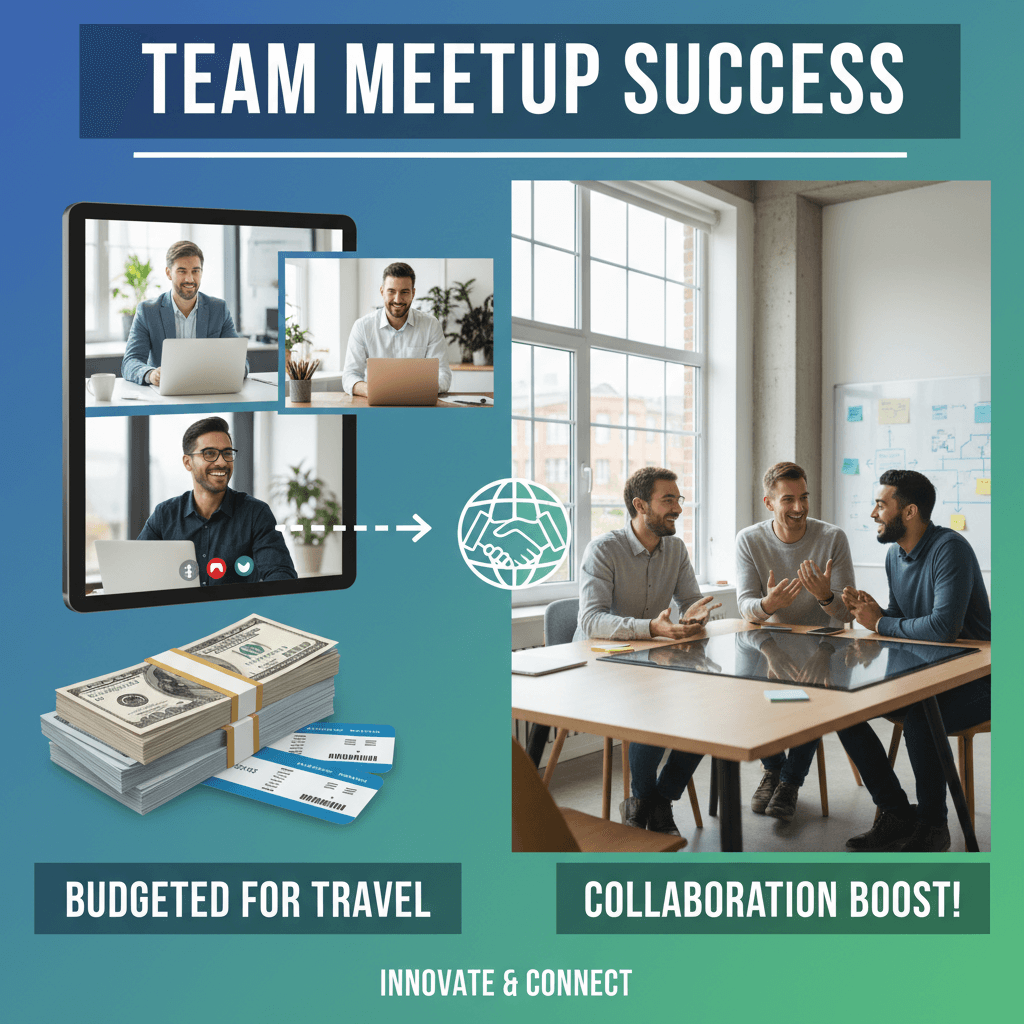
Discover actionable insights. This is a story about one small policy change—giving team members a budget to meet each other in person—that produced outsized gains in speed, trust, and quality. We didn’t run a massive offsite. We didn’t redesign org charts. We simply funded real conversations where they mattered most: between the people doing the work.
A Story About Budget, Trust, and a Team Reborn
When our product organization hit a plateau, we had every signal but no clear diagnosis. Slack threads stretched into miniature novels. Pull requests lingered. Meetings multiplied like rabbits. We were working hard, but few cycles ended with satisfying outcomes. Teams were remote and distributed across six time zones, with decent tooling and generous async norms—but momentum kept evaporating between handoffs.
We tried the standard fixes: clarified OKRs, tightened our meeting hygiene, consolidated docs. Things improved at the margins. Still, the gaps were obvious when we shipped a feature that looked good on paper but left customer-facing teams confused and the data pipeline laboring under edge cases we hadn’t anticipated. We did a retro. We documented lessons learned. Yet the uneasy truth remained: our people didn’t have shared context, and our misunderstandings were compounding.
The turning point was decidedly unglamorous. In a leadership meeting, someone said, “What if we just gave people money to meet each other in person?” Not for a conference. Not for a mandatory offsite. Just a budget for people to use as they saw fit—to gather, anywhere that made sense, with whoever they needed to talk to. It sounded simple enough to try without a committee.
We set aside a per-person microbudget—enough for a train ride or a short flight, a day pass at a coworking space, meals, and a coffee or two. We set a few guardrails: use it to meet colleagues face-to-face; prioritize cross-functional interactions; give us a brief summary of what you discussed. We promised quick reimbursements and zero micromanagement. Within a week, calendars filled with meetups in coffee shops, parks, coworking spaces, and a borrowed conference room in a customer’s building.
What happened next surprised us. Designers and engineers who clashed in threads discovered they shared the same mental model—it just never made it through in text. An analyst sketched a few metrics on a napkin that changed the framing of a core KPI. A product manager and a senior engineer re-scoped an entire quarter’s roadmap in an afternoon because a hallway conversation surfaced two critical dependencies that hadn’t been obvious on a spreadsheet. “I finally understand why you’ve been worried about performance,” one person said. “I thought you were blocking progress. You were trying to protect users.”
By the second month, message volume fell without a drop in transparency. The PR backlog shrank. The operations folks stopped firefighting on Fridays, and the Wednesday roadmap check-in got shorter. None of it came from heroics; it came from compressed cycles of context-building and decision-making.
What changed in one quarter
- Decision velocity increased: Questions that previously spawned long threads now ended in a message like, “We met for an hour; here’s the decision and the constraints we considered.”
- Review times dropped: Pull request review turnaround improved because reviewers and authors aligned on “what good looks like” during in-person pairing sessions.
- Less friction, more ownership: Teams began volunteering to own cross-functional problems once they’d put faces and stories to pain points.
- Higher clarity in plans: Quarterly goals were sharper. People sifted signal from noise faster after live discussions anchored shared priorities.
- Morale ticked up: Informal social capital made hard conversations easier. Feedback stung less because trust rose.
We didn’t “fix” remote work. We gave it the missing ingredient: occasional, intentional proximity. Our hypothesis was straightforward: real discussions, in person, would surface tacit knowledge and build the trust required for faster, cleaner collaboration. Reality agreed.
Why this worked (beneath the surface)
- Tacit knowledge transfer: Whiteboard sketches, hand gestures, and quick clarifying questions communicate high-bandwidth context that rarely survives in written summaries.
- Conflict reinterpreted: What looks like obstruction in text often reads as prudence in person. Tone and nuance reduce attribution errors.
- Shared frames emerge: Proximity accelerates the emergence of “how we do things here,” which reduces rework.
- Micro-rituals form: Teams develop shorthand (naming conventions, review rules of thumb) that compound over time.
Actionable takeaways
- Create a small, flexible budget for one-on-one or small-group meetups across functions.
- Set a simple purpose: meet to clarify decisions, unblock work, or review systems together.
- Ask for a lightweight recap: 3-5 bullet points capturing decisions and open questions.
- Favor pairs and trios over big gatherings to maximize depth of discussion.
- Anchor meetups around the work: backlogs, Figma files, logs, dashboards, and code—not just social catch-ups.
Designing the Budget Experiment
We intentionally called it an experiment to emphasize learning and iteration. The goal wasn’t to fund travel; it was to fund progress. Framed that way, the policy practically wrote itself: minimal friction, clear purpose, and a bias toward action.
We started with principles. Autonomy: People closest to the problem choose who to meet and where. Inclusivity: Make the program accessible regardless of geography, caregiving obligations, or mobility constraints. Transparency: Aggregate what we learned and share it with the organization. Safety: Clear guidelines on appropriate venues, expense types, and boundaries.
Then we translated principles into lightweight rules. Each team member got a specific amount per quarter. If two or three people wanted to pool budgets for a half-day working session, great. If someone preferred a local coworking pass and lunch to avoid travel, also great. We avoided a top-down approval process; instead, we trusted teams to use judgment and asked them to share what they learned so others could benefit.
We designed for low administrative overhead. Approval worked like this: propose the meetup in a shared channel with a one-sentence intent—“Pairing on auth migration risks”—and tag participants. After the meetup, post 3-5 bullets capturing outcomes. For expenses, we used our existing reimbursement tool with a dedicated category. That was it.
We anticipated edge cases. Some teammates live in regions with limited transit or visa constraints; we encouraged hybrid meetups with one person in a coworking space and others joining from the same location if possible, supplemented by a follow-up video call. For parents and caregivers, we allowed childcare expenses within the budget. For safety and equity, we discouraged late-night meetups and offered templates for safe, accessible venues.
We focused on cross-functional collisions. Engineers meeting engineers had value, but the step-change gains came when design, product, data, support, sales engineering, and security met around concrete artifacts. The policy nudged people toward conversations across the seams where misunderstandings accumulated.
How we kept costs low and outcomes high
- Micro-budgets, macro results: Small amounts used by many beat large amounts used by a few. We capped per-person spend but funded broadly.
- Timing windows: Monthly “meetup weeks” reduced scheduling friction and normalized the practice.
- Templates, not mandates: We offered agendas and note-taking prompts rather than prescribing formats.
- Public summaries: A shared channel collected recaps. Over time, it became a searchable knowledge base of decisions and lessons.
- Optionality: No one was pressured to travel. Local meetups, short walks, and coworking days were equally valued.
Actionable takeaways
- Set a per-person quarterly budget sized for local/regional meetups, not airfare extravagance.
- Publish a one-page guide with purpose, eligible expenses, safety guidelines, and recap format.
- Use a shared channel for proposals and summaries to model transparency and curb duplication.
- Encourage cross-functional participation by recommending specific pairings (e.g., PM + Support, Eng + Data).
- Include an equity lens: childcare, accessibility, and visa considerations belong in the policy.
Key Takeaways from Real Discussions
The richest outcomes didn’t surface in meetings for meetings’ sake. They came from real discussions anchored in real work. We noticed patterns across dozens of meetup recaps that directly improved collaboration throughout the quarter.
- Decision rights got clarified: A recurring pain point—“Who decides what?”—faded once teams explicitly mapped RACI-like roles for common decisions during their meetups. The fog lifted.
- Definition of Done stabilized: Engineers and PMs aligned on acceptance criteria and post-release validation. Less churn, fewer surprises.
- Metrics got simpler and sharper: Data and product co-authored a handful of core metrics and retired overly clever proxies. Teams made faster calls with less debate.
- Roadmaps became dependency-aware: People spotted hidden couplings and created small interfaces to decouple. Scope shrank intelligently.
- Runbooks matured: Ops and engineering wrote first-draft runbooks together, reducing incident guesswork and exhaustively clarifying on-call expectations.
- Feedback got easier: In-person rapport transformed “hard feedback” into “useful coaching.” Afterward, written feedback grew clearer and less defensive.
- Design handoffs tightened: Paired design-engineering sessions produced interactive prototypes aligned with performance and accessibility constraints, cutting rework.
- Security shifted left: Security partners joined early whiteboarding to annotate threat models in real time, preventing post-hoc vetoes.
- Customer empathy deepened: Support and product walked through actual tickets together; stories replaced abstractions, and priorities shifted accordingly.
- Ownership sharpened: Teams voluntarily claimed neglected but critical components once they understood downstream impacts.
Across these themes, a common thread emerged: when people talk in person about specific work, they converge on simpler, more durable decisions. The details matter, but the meta-pattern is what scaled: surface assumptions, define decision rights, reduce ambiguity, and memorialize in lightweight artifacts.
How we captured and spread the learning
- Recap discipline: Every meetup yielded bullet-point notes on what changed, what was decided, and open questions.
- Digest cycles: Once a month, a rotating editor compiled highlights into an internal digest with links to recaps and artifacts.
- Reusable templates: When we saw a strong format (e.g., metric definition template, rollout checklist), we templatized it.
- Playlists of pairings: We curated suggested pairings based on recurring friction points: PM + Support; Eng + Sec; Data + Design.
- Evergreen resources: A single “Meetups Hub” page linked to policy, agendas, and an index of past summaries.
Actionable takeaways
- Ask every meetup host to answer three questions: What did we decide? What will we try next? What remains unclear?
- Rotate curatorship of a monthly “collab wins” digest so the practice isn’t reliant on one person.
- Turn great one-off documents into shareable templates and pin them where work happens.
- Systematize successful pairings; make them visible so others can copy the pattern.
The Playbook: How to Run This in Your Org
If you want the same gains, you don’t need a new headquarters or a culture committee. You need a simple plan, constraints that foster creativity, and the will to start small. Here’s a playbook you can run in a month.
Step 1: Define the policy in one page
- Purpose: Fund real discussions that unblock work, align decisions, and strengthen cross-functional collaboration.
- Eligibility: Anyone in product, engineering, design, data, support, and adjacent functions.
- Budget: A modest per-person amount per quarter, sized for local/regional meetups.
- Guardrails: Use for coworking space, coffee, meals, local transit; include childcare if needed; no alcohol reimbursement; safety-first locations.
- Process: Propose in a shared channel; after, post 3-5 bullets and artifacts.
Step 2: Seed the first wave
- Target friction seams: Invite pairs from areas with recurring misunderstandings (e.g., release engineering and product marketing).
- Provide agendas: Offer lightweight agendas: “Decisions to make,” “Risks to test,” “Artifacts to review.”
- Time-box: Encourage 60-120 minute sessions; avoid all-day marathons that drain energy.
- Anchor in artifacts: Bring dashboards, logs, designs, docs, and code. Make decisions visible.
Step 3: Normalize and celebrate
- Visibility: Share recaps in a public channel; react, comment, and encourage replication.
- Highlight wins: In all-hands, spotlight one decision that sped up due to a meetup, and name the people who made it happen.
- Reduce friction: Pre-approve common expenses and create a reimbursement code so people don’t hesitate.
Step 4: Institutionalize learning
- Digest and templates: Publish a monthly summary and extract templates from high-quality artifacts.
- Lightweight governance: Review anonymized usage data quarterly to balance equity and impact; adjust budget accordingly.
- Scale cross-function: Rotate participation to include security, compliance, legal, and finance for decisions that involve them.
Step 5: Measure what matters
- Throughput and lead time: Track cycle time from idea to decision, PR review delays, and story completion variance.
- Quality signals: Monitor escaped defects, incident counts, and rollback rates before and after meetups.
- Engagement signals: Survey perceived alignment, clarity of priorities, and psychological safety.
- Communication load: Watch Slack volume and meeting counts; look for fewer, clearer threads and shorter, more focused meetings.
Agendas you can copy
- Decision Jam (90 min): 1) Clarify the decision; 2) List constraints; 3) Explore options; 4) Choose; 5) Define a time-boxed test; 6) Capture owner and next review date.
- Dependency Triage (60 min): 1) Visualize work; 2) Mark blockers; 3) Identify interfaces; 4) Create decoupling tasks; 5) Update roadmap.
- Metric Alignment (75 min): 1) Audit existing metrics; 2) Define success; 3) Pick 3-5 core metrics; 4) Draft definitions; 5) Agree on dashboards.
- Design-to-Dev Handoff (90 min): 1) Walk the prototype; 2) List constraints; 3) Capture acceptance criteria; 4) Define test strategy; 5) Align on accessibility.
- Runbook Sprint (60 min): 1) Choose top incident class; 2) Document signals; 3) Define diagnosis steps; 4) List remediation actions; 5) Set on-call expectations.
Budget templates
- Starter: $200-$300 per person per quarter for local transit, coworking, and meals.
- Regional: $500-$700 per person for occasional short flights or train journeys.
- Equity add-ons: Up to $100 per meetup for childcare or accessibility accommodations.
Recap prompt (copy/paste)
- Context: Who met, where, and why (1 sentence).
- Decisions: 1-3 crisp bullets.
- Experiments: What we will try and how we’ll know if it worked.
- Open questions: What remains unclear and who owns closing it.
- Artifacts: Links to docs, PRs, designs, dashboards.
Risk management without overcomplicating
- Safety checklist: Public venues; daytime hours; clear travel boundaries; no one-on-one in private residences.
- Consent and comfort: Opt-out culture; no pressure to travel; alternatives for remote-only participants.
- Budget hygiene: Treat the policy as a trust dividend; audit for patterns, not individual mistrust.
Actionable takeaways
- Publish a one-page policy and go live within two weeks—opt for momentum over perfection.
- Seed the first ten meetups with suggested pairings and sample agendas to model the behavior.
- Measure a small set of signals monthly and adjust the budget where you see clear returns.
- Codify great outputs into templates and update your “Meetups Hub” so learning compounds.
Take the Next Step
Don’t wait for a perfect offsite or a new collaboration platform. You can start with a few hundred dollars and a bias for real conversations. The leverage is remarkable: small budgets fund proximity; proximity unlocks trust; trust accelerates decisions; faster, better decisions multiply outcomes.
Here’s your nudge: choose a pilot group this week. Write the one-page policy. Announce a two-week window for your first wave of meetups. Offer three agenda templates and a recap prompt. Then watch what happens when teams move arguments from threads to tables and from assumptions to shared artifacts.
Your call to action:
- Set a per-person meetup budget for the next quarter.
- Publish the policy and templates in a shared space.
- Invite cross-functional pairs to schedule one meetup in the next 14 days.
- Share recaps and celebrate the first visible wins at your next all-hands.
If the past is any guide, you won’t just see happier people. You’ll see crisper plans, fewer delays, and better outcomes. All from giving your team permission—and a small budget—to meet each other in person and have the real discussions that matter.
Where This Insight Came From
This analysis was inspired by real discussions from working professionals who shared their experiences and strategies.
- Source Discussion: Join the original conversation on Reddit
- Share Your Experience: Have similar insights? Tell us your story
At ModernWorkHacks, we turn real conversations into actionable insights.
![[Workflow Included] A simple 5-node Instagram posting workflow for beginners](https://modernworkhacks.com/wp-content/uploads/2026/04/workflow-included-a-simple-5-node-instagram-posting-workflow-for-beginners-1024x675.png)



0 Comments