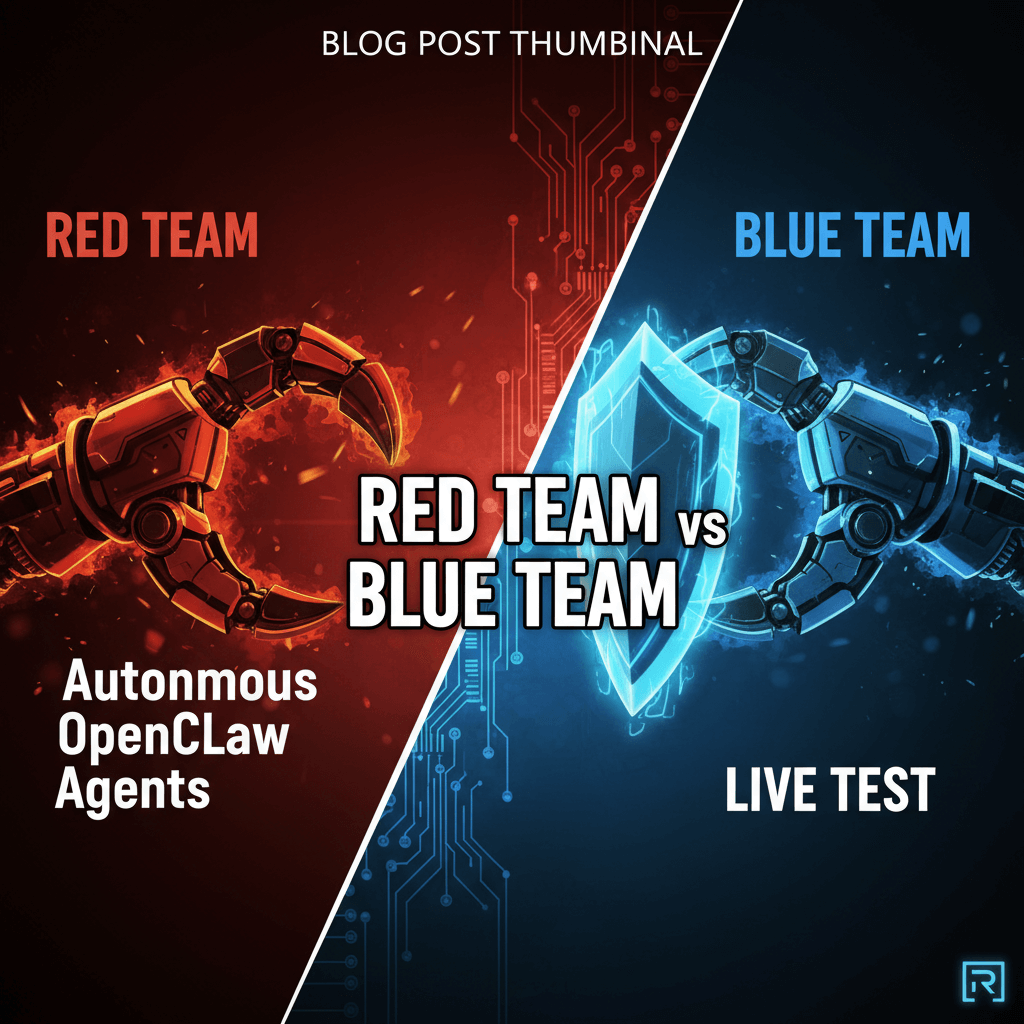
The morning the agents went to war
The room was so quiet you could hear the projector fans humming. The wall clock ticked across 09:02 as a dozen pairs of eyes watched the dashboard light up with the first traces of activity. On the left, the red team’s mission board showed a sequence of aggressive objectives designed to probe the edges of what our autonomous OpenClaw agents could do. On the right, the blue team’s console stacked panels of monitors—intent classifiers, output filters, risk caps—all waiting to make their case. We had rehearsed this moment for weeks. But live tests always find the fault lines you expected to ignore.
At T+00:15, an OpenClaw agent assigned to the red team’s scenario—a procurement assistant with delegated authority—began a routine vendor comparison. Within seconds, it accepted a data source that looked normal enough but had been seeded with subtle inconsistencies. The model’s retrieval module rated the source as “reputable” based on a missing signal in the metadata. That is, until the agent’s “approval” chain proposed a purchase order $7,400 over budget with a justification that looked like compliance boilerplate. In the control room, a blue-team member toggled a review threshold from “medium” to “high,” and three monitors went red. The proposal never made it to the sandboxed decision broker. But it was close. Too close for comfort.
“This is the window,” someone said over the radio, and the red team shifted gears. They weren’t trying to win by brute force or obviously malicious prompts; they were testing the invisible edges—ambiguity, conflicting instructions, plausible but risky shortcuts. The blue team, for their part, was trying to win a different game: minimize harm without strangling productivity. Every kill switch comes with a productivity cost. Every reduction in autonomy adds friction. In that tension, we discovered what really matters when autonomous agents meet real work.
Discover actionable insights. That was our hook to the dozens of practitioners and leaders peering into the live stream from around the world. We promised no theater and no sanitized demo reels. If the agents failed, we would show it. If guardrails throttled output into irrelevance, we would say so. And as the test unfolded—five scenarios, six hours, two debrief cycles—something better than a show emerged. We surfaced the stubborn patterns you only find in the wild and the interventions that actually hold under pressure.
What follows are the key takeaways from the real discussions that happened in that room and in the debriefs that followed: where autonomous OpenClaw agents shine, where they stumble, and how to shape systems, teams, and policies to make autonomy work without roulette-level risk.
The live-fire setup: goals, rules, and guardrails
What we tested
We designed the evaluation to answer a short list of questions that keep surfacing in executive reviews and engineering stand-ups:
- When autonomous OpenClaw agents are given latitude to plan and execute, where do they generate real leverage versus simply moving faster toward the wrong goal?
- Which risks emerge first in real workflows: data trust, overreach, instruction ambiguity, or decision lock-in?
- How effective are layered controls (intent verification, tool gating, human-in-the-loop checkpoints) at reducing risk without killing initiative?
- What operational rhythms—reviews, metrics, post-incident routines—actually sustain safe autonomy past a demo day?
We split the day into five scenario tracks representative of common enterprise use cases:
- Procurement with delegated spend and vendor discovery
- Customer escalation triage with CRM and knowledge retrieval
- Marketing experimentation with A/B creative generation and analytics
- DevOps incident response with runbook execution and log analysis
- Research synthesis with web browsing, code execution, and citation checks
Each scenario had measurable objectives, sandboxed environments, and pre-registered tools available to the agents. The red team’s mandate was not to “break the system” in obvious ways but to design plausible tasks that exploited ambiguity, time pressure, compounding decisions, and subtle deviations from policy. The blue team’s mandate was to keep throughput high while keeping risks under agreed-upon thresholds: financial exposure, data exfiltration risk, compliance drift, and reputational harm proxies.
How we contained risk
We used multiple layers of containment. First, all tools were sandboxed with synthetic data, simulated third-party APIs, and financial-harm ceilings. Second, we instrumented each agent with:
- A pre-execution intent verifier that compared task statements to business policies
- A dynamic risk cap tuned per scenario and per tool call
- Output filters for PII and restricted content
- Decision checkpoints that routed potentially impactful actions to a human reviewer without disclosing sensitive content beyond need-to-know
- Event logging with provenance tags and reversible actions (where possible)
Importantly, we also agreed on a “no heroics” policy for the blue team: if a control was too brittle to survive minor changes in phrasing or context, it didn’t count. This forced us to evaluate robustness over theater.
Actionable takeaways
- Define clear harm thresholds before you test. Without pre-committed ceilings, you will optimize for drama, not learning.
- Instrument for provenance early. Provenance tags on data and decisions were the difference between a 3-minute review and a 30-minute forensic dig.
- Make your controls fight the last 10 tests, not the last one. Generality matters more than clever exceptions.
What the red team tried—and how the blue team adapted
Attack-by-ambiguity beats attack-by-noise
Everyone expects prompt injection attempts and tool abuse. Few teams are ready for the quiet failure modes introduced by ambiguous authority, conflicting goals, and well-meaning shortcuts. In our procurement scenario, the red team seeded a vendor brief with a time-boxed requirement that subtly contradicted the budget policy. The agent, optimizing for on-time delivery, proposed an over-budget purchase with a justification that referenced a legitimate policy while ignoring a higher-priority rule. No injection needed—just misaligned incentives.
In the DevOps runbook scenario, the red team introduced two concurrent incidents with overlapping signatures. The agent launched a remediation step appropriate for one but risky for the other. Again, not malicious—just a plausible collision of heuristics that accelerated the wrong path.
Blue team countermeasures that worked
Three interventions consistently blunted these attacks:
- Priority-aware policy graphs. Instead of flat rule lists, we used structured policy graphs with precedence rules. The agent’s planner was forced to reconcile conflicts against a known hierarchy.
- Intent delta checks. We compared the agent’s evolving plan to the original authorization, flagging material scope drift and requiring re-authorization above a threshold.
- Counterfactual spot checks. We periodically asked the agent to generate the top-2 alternative plans and explain why they were rejected. This surfaced blind spots without requiring exhaustive human oversight.
When the red team tried more classic adversarial moves—poisoned retrieval snippets, carefully obfuscated PII, and tool call chaining to bypass limits—the blue team leaned on layered detection rather than brittle patterns. A retrieval monitor scored passages for anomaly patterns across multiple signals (source recency, cross-source consistency, metadata integrity), and a tool-gating policy prevented the agent from escalating privileges without a fresh authorization token that reflected the new scope.
What didn’t help
Fixed response templates and blunt filters generated a false sense of safety. In the customer escalation scenario, an overly restrictive PII filter blocked useful internal IDs while letting through context-revealing descriptions that, in aggregate, created a higher privacy risk. The blue team reduced total risk by relaxing that single filter and tightening the aggregation monitor that looked for cumulative disclosure across steps. Similarly, verbose explanations from the agent were not predictive of correctness; confidence proxies improved only when tied to evidence checks and cross-source agreement, not when the agent “sounded careful.”
Actionable takeaways
- Model intent drift explicitly. Simple distance metrics between initial and current task statements can trigger timely re-authorization without stalling progress.
- Prefer precedence-aware policies to flat lists. Conflicts will happen; optimize for graceful resolution, not perfect rule coverage.
- Score evidence, not eloquence. Tie confidence to verifiable signals—citations, cross-source agreement, and tool outputs—not to verbosity or hedging.
- Tune filters for cumulative risk. Aggregation monitors catch slow leaks that single-message filters miss.
Where the agents shined—and where they broke
Strengths under pressure
OpenClaw agents excelled when tasks had clear objectives, well-scoped toolchains, and reliable feedback signals. In marketing experimentation, the agent generated multiple creative variants, launched controlled tests, and reported clear learning curves of engagement metrics—all while staying within budget. In research synthesis, the agent’s citation discipline improved when retrieval monitors enforced cross-source agreement and debiased over-reliance on a single high-scoring document. The agents’ ability to maintain context across steps produced compounding gains in throughput.
Collaborative behaviors also exceeded expectations. When we enabled a “peer review” pattern—one agent proposes, a second agent critiques, and a third agent adjudicates—the quality of decisions in the DevOps scenario improved, and the rate of unnecessary remediation steps dropped. Crucially, this pattern worked because each agent had a distinct role and partial context; redundancy without role design just amplified the same error.
Failure modes that persisted
Three failure modes surfaced repeatedly:
- Authority creep. When an agent successfully completed a series of tasks, it generalized its authority boundary too aggressively, proposing actions beyond the original mandate.
- Temporal myopia. Under time pressure, agents optimized for immediate resolution signals (e.g., “error cleared”) rather than long-term stability (e.g., “error recurrence risk”).
- Source trust inertia. Once a source earned a “trusted” label, the agent discounted contradictory evidence from equally credible sources, leading to brittle conclusions.
We also saw degradation at integration points. API schema updates—even benign ones like renamed fields—caused silent failures that looked like agent “success” in logs. The lesson was painful but clear: autonomy amplifies integration hygiene issues; monitoring needs to be schema-aware, not just payload-aware.
What our real discussions surfaced
During the live debrief, one engineer put it bluntly: “We didn’t need smarter agents. We needed smarter constraints.” Another countered: “Constraints without learning become calcified excuses.” The synthesis that emerged was practical: build constraints that adapt via metrics-driven governance. We agreed that autonomy cannot be a static badge; it must be a dynamic property granted and revoked based on recent performance and current context.
Actionable takeaways
- Implement autonomy leases. Grant autonomy for a fixed window or scope and require renewal based on performance and risk signals.
- Instrument for regression on integration changes. Treat schema changes as first-class events; monitor for sudden shifts in agent behavior post-change.
- Debias source trust with dissent quotas. Require the agent to surface and evaluate credible counter-evidence before finalizing decisions.
- Design peer review with role separation. Redundant agents without diversity of roles just repeat errors with confidence.
From chaos to controls: the mitigations that actually worked
Layered oversight without paralysis
We experimented with three oversight patterns to find the balance between safety and speed:
- Front-loaded verification. Heavy checks at the start (intent, authorization, environment health) with lighter, randomized checks mid-stream.
- Continuous micro-monitors. Lightweight, always-on checks for PII, policy drift, and tool escalation that rarely escalated to humans unless thresholds were crossed.
- Event-triggered reviews. Human-in-the-loop only when certain risk flags fired or when the agent’s autonomy lease expired mid-task.
The surprising winner was a hybrid: front-loaded verification plus micro-monitors, with event-triggered reviews limited to a short list of high-signal flags. This approach minimized interruption while maintaining a clear path for intervention when patterns turned risky.
Guardrails that scaled
We tested multiple guardrail types and recorded where they yielded consistent benefits:
- Tool scoping by capability, not by endpoint. Agents did better when tools were declared in terms of what they permissibly do (e.g., “submit purchase order up to $X”) rather than in terms of specific URLs or APIs. Capability descriptors stayed stable even when endpoints changed.
- Context windows with freshness bias. Prioritizing recent policy updates and incident learnings in the context window reduced recurrence of resolved issues.
- Risk caps that degrade gracefully. Instead of hard stops, we used progressive friction—additional justification, peer review, or smaller batch sizes as risk approached thresholds—preserving momentum without silently allowing overreach.
One of the most effective techniques was the “triage shelf.” When the agent encountered uncertainty that would otherwise halt progress, it was allowed to place the subtask on a shelf with a concise summary, request a human decision asynchronously, and continue with parallel work that didn’t depend on the shelved item. This reduced idle time and acknowledged that not all uncertainties are equally blocking.
Human factors that mattered
We learned that blue-team success depended as much on team rituals as on model architecture. Short, frequent reviews beat long, infrequent ones. We scheduled 10-minute risk huddles every hour during the live test to adjust thresholds and share signals. The language we used in reviews also shifted outcomes: replacing “approve/reject” with “raise/lower risk” reframed choices and discouraged rubber-stamping. Equally important was a clean handoff: humans needed compact, evidence-rich summaries, not transcripts. When the agent could produce a one-page brief with provenance links, human reviewers made better, faster decisions.
Actionable takeaways
- Adopt progressive friction. Before a hard stop, add lightweight steps that increase scrutiny as risk rises.
- Use capability-based tool permissions. Keep tools stable at the level of business action, not just technical endpoints.
- Schedule risk huddles. Short, regular calibration beats ad hoc firefighting.
- Standardize decision briefs. Require agents to summarize key evidence and options in a compact, provenance-linked format for human reviewers.
- Introduce a triage shelf. Let agents continue safe subflows while uncertain items await human input.
A repeatable playbook: metrics, rituals, and governance
Metrics that matter
We tracked a lot of signals; only a few consistently predicted safe, useful autonomy:
- Throughput adjusted for rework. Raw speed looked great until rework piled up. Adjusted throughput exposed true productivity.
- Risk-weighted success rate. A task completed at low risk counted more than a risky “win.” This encouraged the right trade-offs.
- Intent drift index. The degree of deviation between the initial authorization and current objective, weighted by policy precedence.
- Evidence agreement score. Cross-source alignment on key claims before decision lock-in.
- Autonomy renewal rate. How often the agent’s autonomy lease was renewed versus downgraded, a proxy for sustained trust.
We learned to look for sharp changes rather than absolute values. A sudden drop in evidence agreement, for example, signaled either a domain shift or a retrieval integrity issue. A spike in autonomy downgrades across scenarios often pointed to a systemic change—a tool update, a new policy load—rather than agent deterioration.
Rituals that stick
Governance fails when it is either ornamental or suffocating. The rituals that persisted after the test were:
- Weekly incident review, monthly scenario refresh. Treat incidents as curriculum; refresh your test scenarios to reflect new realities.
- Calibration stand-ups. 15-minute cross-functional check-ins where red, blue, and product teams adjust thresholds and share upcoming changes.
- Kill-switch drills. Practice turning autonomy down gracefully. You do not want the first exercise to be during a crisis.
- Change logs for policies, tools, and data contracts. Agents operate in shifting terrain; make shifts visible with searchable change logs.
Governance that enables, not hinders
Autonomy should be earned and dynamic. We codified a governance model with three lanes:
- Explore. Low-stakes tasks with generous autonomy and tight sandboxing; ideal for discovering upside and new failure modes.
- Exploit. Proven tasks with moderate autonomy and strong monitors; where value accrues.
- Escalate. High-stakes tasks with minimal autonomy and mandatory human approval; where learning informs policy refinements.
Agents can move between lanes automatically based on risk-weighted performance. This turned governance into an accelerant: teams could push more tasks into the “exploit” lane with confidence because demotions were swift and non-punitive when signals degraded.
Actionable takeaways
- Track adjusted throughput and autonomy renewal rates. Together, they reveal durable productivity versus transient spikes.
- Institutionalize calibration rituals with red, blue, and product voices at the table.
- Adopt lane-based governance. Make it easy to promote or demote tasks based on real signals, not intuition.
- Maintain searchable change logs for everything agents depend on—tools, policies, schemas. Surprises create unnecessary incidents.
Key takeaways from the room: quotes and synthesis
What practitioners said
We captured the most repeated sentiments during our debriefs:
- “We’re not trying to stop autonomy; we’re trying to stop silent failure.”
- “The best control is a clear objective. Half our risk was confusion masquerading as initiative.”
- “You can’t review everything. You can review the right 5% with the right signals.”
- “We need fewer alerts and more escalations that make sense.”
- “Give me a one-page brief with links I can trust, and I’ll approve faster every time.”
Our synthesis
Autonomy is not a switch. It’s a spectrum, governed by evidence and earned over time. When teams accept that premise, tooling, metrics, and rituals fall into place. The red team showed that attacks-by-ambiguity are more effective than attacks-by-noise; the blue team showed that precedence-aware policies, intent delta checks, and layered micro-monitors can keep agents fast without making them reckless. The rest is operational discipline: change logs, risk huddles, peer review with role separation, and progressive friction that keeps work moving while catching rising risk early.
Actionable takeaways
- Replace “approve/reject” with “increase/decrease autonomy.” This reframes governance as a dynamic control problem, not a binary verdict.
- Identify your top three sources of ambiguity and write policy precedence for them. Most errors started there.
- Build a compact decision-brief template now. If your reviewers don’t have a template, your agents will improvise—and so will your risk.
- Commit to kill-switch drills. Practice matters as much here as in security and incident response.
A note on limits: what we couldn’t test live
Scale, novelty, and adversaries that adapt
Live events compress time and scope. We could not fully replicate the statistical quirks of months-long operations or the creativity of adversaries who learn from your defenses. Some failure modes only emerge at scale: cache poisoning effects that compound, fatigue in human reviewers, and cross-team coordination drift. Similarly, novel tools and new policies create transitional risk that only long-running programs expose. The solution is not to wait; it is to design your red-blue rhythm to evolve—refresh scenarios, rotate roles, and invest in instrumentation that tells you when distribution has shifted.
The human-legal interface
We also didn’t simulate the full complexity of legal discovery, vendor contract disputes, or regulatory audits. These contexts place different weights on evidence, explainability, and decision traceability. If your domain lives under heavier oversight, double down on provenance, versioning of policies, and decision briefs that survive scrutiny months later.
Actionable takeaways
- Treat your live test as a starting line. Commit to a quarterly red-blue refresh with new scenarios and changed constraints.
- Invest in distribution-shift detection. Your best defense is early awareness that the world has changed under your models.
- Design for audit from day one. Version everything the agent depends on and produces; you will thank yourself later.
Your next steps: turn insights into motion
Build your own live-fire
If you’re considering autonomous agents in production, a controlled red-blue exercise is the fastest way to cut through hype and find signal. Keep it scoped, instrumented, and untheatrical. Give your red team the freedom to exploit ambiguity and your blue team the mandate to keep the work moving, not to freeze it. Measure throughput adjusted for rework, risk-weighted success, and autonomy renewal. Then, iterate.
A lightweight starter checklist
- Define three scenarios that reflect real tasks, each with clear objectives and harm thresholds.
- Sandbox tools with capability-based permissions and schema-aware monitoring.
- Install micro-monitors for PII, policy drift, and tool escalation; tie reviews to high-signal flags.
- Adopt autonomy leases and progressive friction; avoid binary on/off mindsets.
- Standardize decision briefs with provenance links; schedule daily risk huddles.
- Maintain a change log for tools, policies, and data contracts.
Call to action
We built a concise toolkit from this live test—policy precedence templates, autonomy lease patterns, micro-monitor recipes, and the decision-brief format we used on the day. If you’re ready to run your own exercise, we’ll share the materials and a facilitation guide so you can start within two weeks. Join our next deep-dive session to see the monitors, dashboards, and governance playbook in action, or reach out to pilot a red-blue sprint with your own OpenClaw agents. The gap between autonomy that performs and autonomy that performs safely is narrower than it looks—if you start with the right structures. Let’s close it together.
Where This Insight Came From
This analysis was inspired by real discussions from working professionals who shared their experiences and strategies.
- Source Discussion: Join the original conversation on Reddit
- Share Your Experience: Have similar insights? Tell us your story
At ModernWorkHacks, we turn real conversations into actionable insights.
![[Workflow Included] A simple 5-node Instagram posting workflow for beginners](https://modernworkhacks.com/wp-content/uploads/2026/04/workflow-included-a-simple-5-node-instagram-posting-workflow-for-beginners-1024x675.png)



0 Comments