Discover actionable insights.
The day I learned that starting is worth one third of any outcome, it wasn’t in a classroom or a book. It was a Tuesday I had been dreading for weeks. I had a blank page, an overdue commitment, a cluttered desk, and a brain trapping itself in loops of “what if this isn’t good enough?” The task wasn’t impossible; it was just unstarted. My to-do list had expanded into a monster with tiny, jagged edges—endless subtasks and dependencies, all as intimidating as the work itself. The tension crescendoed until I did one tiny thing: I wrote the first sentence, then the second. Ten minutes later, I had momentum. Two hours later, I had a draft. The project didn’t suddenly become easy, but it became inevitable.
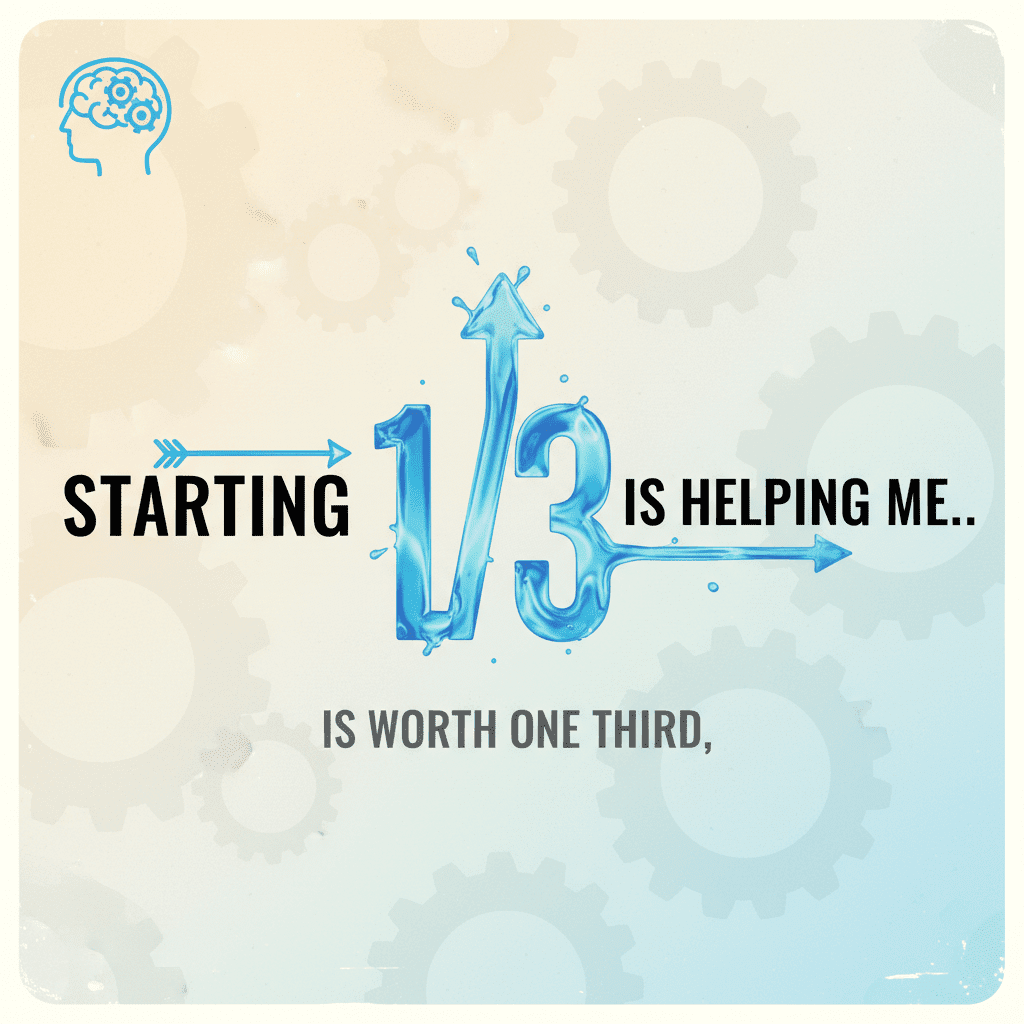
That day, I realized the important truth behind the messy phrase: starting is worth one third, is helping me. The very act of starting does not merely move you forward in time; it reshapes the task. It changes the physics of your effort. Huge becomes smaller. Ambiguous becomes tangible. Frightening becomes familiar.
In dozens of conversations since—founders wrestling with product launches, managers recovering from decision paralysis, creators staring down the blank page, and students switching careers—the same pattern shows up. People are not failing because they lack talent or tools. They’re stalling at the threshold. They’re waiting for certainty, clarity, or courage that only arrives after they start.
Starting, then, is not a formality. It is a strategic move that converts unknowns into knowns and intention into evidence. If you can design your environment and habits to make starting the default, you will discover that momentum does more work than motivation ever could. And when you collect the right conversations and reflection points, you’ll find that the first inch is often the longest mile—once you cross it, the rest of the path gets shorter.
This article distills those lessons into a compact playbook. It begins with a simple story and unfolds into practical systems, plus the key takeaways surfaced from real discussions with people across roles and industries. The goal is straightforward: help you start faster, more often, with less friction—and to keep going once you do.
Why “Starting Is Worth One Third” Works
Consider the three biggest phases of almost any project: initiation, elaboration, and optimization. Initiation is messy, emotional, and uncertain. Elaboration is disciplined. Optimization is technical. The mistake many of us make is trying to perform optimization-precision while we’re still in the headwinds of initiation. We want to start perfectly instead of starting at all. But if you treat the first step as a distinct, high-leverage phase—worthy of its own processes—you gain an unfair advantage: momentum.
The math of momentum
Starting does more than create progress; it compounds clarity. Before you begin, the project is a cloud of assumptions. After the first inputs—a sketch, a query, an email—you have artifacts. Artifacts anchor the next action. You won’t know exactly what you need until you try something and inspect the result. That attempt reduces uncertainty, reveals constraints, and exposes opportunities. In other words, the first 10% of effort can deliver 50% of the insight you need. Those numbers aren’t precise; the point is that the earliest action is disproportionately informative.
The psychology of activation energy
Every task has a hidden activation cost: context switching, environment setup, fear of scrutiny, the temptation to “just quickly” check something else. When the cost is high, you delay. Lower the cost, you start. The first step need not be sophisticated; it must be frictionless. A “minimum viable start” (MVS) is anything so small it’s easier to do than avoid—opening the document, naming the repository, making the first list of questions. Once you’re moving, the mind favors completion—our brains are wired for consistency and closure. Starting hijacks this wiring for good.
Why the one-third heuristic is useful
When you embrace the idea that starting is worth one third, you shift expectations from perfect beginnings to effective beginnings. You budget time, energy, and attention to the initiation phase. You value rough drafts and prototypes as crucial deliverables, not sloppy placeholders. You measure action, not only outcomes. This heuristic is not literal math—it’s a design principle. It says: allocate meaningful attention to how you begin because the beginning determines the shape of everything that follows.
Actionable takeaways:
- Define a “minimum viable start” for each project: one action that takes 5 minutes or less.
- Write a “why this matters” sentence at the top of every task to anchor motivation.
- Start where clarity is highest, not where impact is highest—clarity creates the momentum that later unlocks impact.
- Time-box the first session to 20 minutes; you’re building a runway, not finishing the flight.
Key Takeaways From Real Discussions
Across coaching sessions, team workshops, and community roundtables, people repeatedly surfaced a set of patterns that helped them break inertia. These are not theories; they’re field notes condensed into principles.
Founders: Start with a “sandcastle,” not a skyscraper
In conversations with early-stage founders, the biggest unlock was building a flimsy first version on purpose. A “sandcastle prototype” is built quickly to be knocked down and rebuilt. Its purpose is to test the shape of a solution and the size of the problem. Because it’s designed to be temporary, it removes the ego trap of polish. Founders reported faster learning loops, reduced fear of wasted effort, and clearer investor narratives because they had something concrete to show and critique.
Managers: Start with a one-page brief
Managers wrestling with scattered priorities found that a one-page brief became the universal start ritual. It includes the problem, constraints, success criteria, stakeholders, and the first two actions. By limiting the scope to one page, they forced clarity. The brief traveled well between meetings, mediated debates, and lowered the cost of onboarding collaborators. Once the brief existed, tasks flowed naturally—and fewer meetings were needed because the brief answered 80% of baseline questions.
Designers and creators: Constraint-first moodboards
Designers and creators often stalled at “vibes.” The breakthrough? Build a constraint-first moodboard: curate reference pieces that specifically reflect the project’s limitations (colors you must use, formats you must deliver, timelines you must meet) alongside the desired inspiration. The juxtaposition transforms taste into decisions. With constraints visible, creators reported faster direction-setting, fewer detours, and more confident early drafts.
Engineers and analysts: Open the failing test
Technical work stalls when the problem space is too large. The practical start: write or run a failing test that captures the smallest slice of the desired behavior. Now the target is explicit and binary. Engineers noted that “green test moments” created micro-wins that propelled them into deeper work. Analysts mirrored this by drafting the “ugliest chart” that validates a core metric before investing in perfect dashboards.
Students and career-changers: Public micro-commitments
For students and career-changers, the fear of visibility was paralyzing. The solution wasn’t grand public declarations but micro-commitments: publicly scheduled, small sessions with clear outputs—a 30-minute study livestream, a weekly progress post, a two-sentence update to a peer group. The presence of others provided gentle pressure; the small scope made the sessions repeatable. Over time, confidence built not from bravado but from visible evidence of consistency.
Actionable takeaways:
- Adopt a “sandcastle first” rule on new projects: make something in one hour you expect to remake.
- Create a one-page brief template for your team; fill it before any kickoff meeting.
- Design moodboards with constraints alongside inspiration; make trade-offs visible early.
- For technical tasks, write a failing test or produce the quickest “ugly chart” that proves the core assumption.
- Schedule public micro-commitments with peers to normalize imperfect starts.
Design Your “Start System”
Your system for starting is the set of defaults that make the first step cheaper than avoidance. You don’t rise to the level of your goals; you sink to the level of your start system. The good news: a few small levers can produce outsized changes in behavior.
Environment priming
Make your workspace beg for a start. Put the relevant document, repo, or board one click away. Pre-open tabs. Name the file before you need it. Place your notes where your hands fall. Reduce visual noise. If you work physically, lay out tools in the order you’ll use them. The goal is subconscious friction removal: you should be able to fall into the first action without thinking.
Time-boxed ignition
Decide in advance that your first session will be short and bounded. Fifteen to twenty-five minutes is enough to breach inertia while too short to trigger perfectionism. Set a visible timer. End the session with a quick “next action” note, so you can re-enter quickly later. Predictability is powerful; your brain trusts what it can measure.
The two-level task breakdown
Break the work into two lists: outcomes and motions. Outcomes are the deliverables; motions are the smallest actions to begin moving toward them. “Draft summary” is an outcome. “Open notes doc and paste three quotes” is a motion. Motions are how you start; outcomes are how you decide what to do next. When you get stuck, you likely need a motion, not a reminder of the outcome.
The zero-draft policy
Call the first pass a “zero draft”—a draft that doesn’t count. This framing removes the identity threat tied to early work. A zero draft is allowed to be disorganized, repetitive, and incomplete. You are gathering clay, not sculpting marble. People who adopt the zero-draft policy report faster throughput and less emotional load; the work improves because there is more of it to refine.
Friction logs and energy mapping
Keep a simple friction log: a running list of moments where you resisted starting and why. Was it unclear requirements? Tool confusion? Fear of feedback? The log tells you which part of your system to fix. Pair this with energy mapping—notice when your energy peaks and schedule starts then. Starting when your energy is naturally aligned is like catching a wave; it makes everything else easier.
Actionable takeaways:
- Pre-stage your workspace the night before: one click to start, no decisions required.
- Use a 20-minute ignition timer for the first session of any task.
- Write two lists: outcomes (what) and motions (how to begin). Do the motion immediately.
- Adopt the zero-draft policy for any creative or strategic task.
- Track friction for a week and fix the top two systemic blockers.
Overcoming Common Blockers
Even with a good system, three universal blockers often derail starts: perfectionism, ambiguity, and divided attention. Each has a practical countermeasure.
Perfectionism: lower the bar, shorten the loop
Perfectionism tries to protect you from criticism by preventing you from generating anything to criticize. The antidote is to lower the bar for first outputs and shorten feedback loops. Set constraints that force progress, not polish: “Write 200 ugly words,” “Ship a draft to one trusted reviewer,” “Record a 90-second voice memo summarizing the argument.” The smaller the unit, the faster the loop, the weaker perfectionism’s grip.
Ambiguity: ask the smallest clarifying question
Ambiguity masquerades as complexity. It often dissolves if you ask one precise question. Before starting, write down the single question that, if answered, would enable a first action. If you can’t ask someone, make a testable assumption and proceed. Starting with assumptions is not reckless if you mark them clearly and revisit them early.
Decision overload: pre-decide defaults
Multiple options create paralysis. Pre-decide a set of defaults: default tool, default format, default time slot, default checklist. If a better option appears, you can switch—but you don’t let the lack of an ideal choice prevent you from beginning. Defaults are bridges across indecision.
Social friction: shrink the audience
If visibility makes you freeze, reduce the audience for your first attempts. Share with one person who understands the goal and will give kind, specific feedback. A smaller, safer audience invites starts. Over time, you can scale exposure with confidence built on evidence rather than hope.
Competing priorities: protect the first 30 minutes
When everything feels urgent, nothing starts. Reserve the first 30 minutes of your day for the most important unstarted item. No email, no messaging, no meetings. Even three days per week of protected starts will change your throughput. Priority is not what you say; it’s what you schedule.
Actionable takeaways:
- Set “ugly first” constraints: 200 ugly words, the ugliest chart, the flimsiest prototype—delivered to one person.
- Write the single clarifying question; if unanswered, proceed with a marked assumption.
- Create defaults for tool, format, and time slot to bypass indecision.
- Pick a “safe first reviewer” for early feedback to reduce social risk.
- Block 30 minutes at the start of the day for your most important unstarted task.
Launch Your 7-Day Start Sprint
Beginnings become habits when they are repeated on purpose. Use this one-week sprint to institutionalize your starts. It’s simple, flexible, and designed to produce visible momentum fast.
Day 1: Choose and frame
List three significant projects you’ve been postponing. For each, write a one-sentence “why this matters,” a one-page brief (if relevant), and identify the minimum viable start (5 minutes or less). Pick one project as your sprint focus. Pre-stage your workspace for tomorrow.
Day 2: Start small, on time
At a pre-scheduled time, begin with your minimum viable start. Use a 20-minute ignition timer. End the session by writing one motion for tomorrow. Share a one-sentence update with a peer or group to create a gentle accountability loop.
Day 3: Build the sandcastle
Create the flimsiest working version of your deliverable: a zero draft, a rough prototype, a bare-bones script, a failing test. Do not polish. Your only job is to make the future tangible and testable.
Day 4: Feedback and fix
Share the sandcastle with one safe reviewer. Ask two questions: “What’s clear?” and “What’s missing?” Apply the smallest fixes that unlock your next action. Update your brief with any new constraints or insights.
Day 5: Expand and organize
Turn the zero draft into a first draft. Expand points, organize sections, or add tests and basic instrumentation. Keep sessions time-boxed. Capture any friction you feel; note what made starting today easier than on Day 2.
Day 6: Decide and reduce
Make necessary decisions you’ve postponed. Use defaults where possible. Reduce scope if needed to preserve momentum. The aim is progress, not maximalism. Starting is still your core metric, not finishing; finishing will come from accumulated starts.
Day 7: Review and ritualize
Review the week. What helped you start quickly? What repeatedly blocked you? Update your start system: refine your brief template, adjust your workspace, schedule recurring start blocks. Decide on a “weekly start day” where you initiate something new every week—no matter how small—to keep the muscle active.
Actionable takeaways:
- Commit to a 7-day start sprint with one focal project and two minor starts.
- Use daily 20-minute ignition sessions to build a streak.
- Collect one piece of external feedback by midweek to guide iteration.
- End the sprint by codifying your start system into templates and calendar blocks.
Call to action: Pick one project you’ve been delaying. Right now, set a 20-minute timer, write a one-sentence brief, and take the minimum viable start. Then, tell one person what you did. Do not wait for perfect conditions. Starting is worth one third, is helping me—and it can help you. Begin today, and let your future self inherit the momentum you create in the next twenty minutes.
Where This Insight Came From
This analysis was inspired by real discussions from working professionals who shared their experiences and strategies.
- Source Discussion: Join the original conversation on Reddit
- Share Your Experience: Have similar insights? Tell us your story
At ModernWorkHacks, we turn real conversations into actionable insights.
![[Workflow Included] A simple 5-node Instagram posting workflow for beginners](https://modernworkhacks.com/wp-content/uploads/2026/04/workflow-included-a-simple-5-node-instagram-posting-workflow-for-beginners-1024x675.png)




0 Comments