
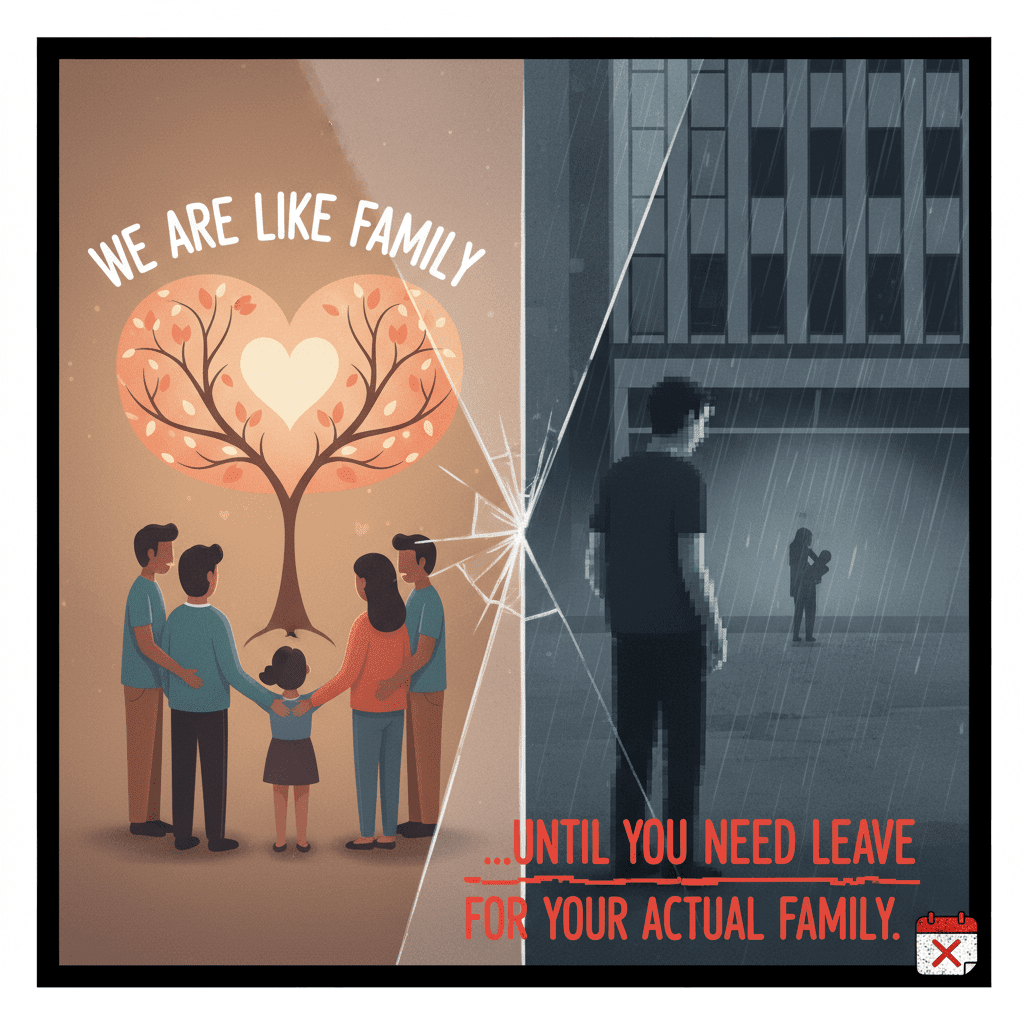
Discover actionable insights. This isn’t just another workplace think piece—it’s a field guide drawn from real conversations with employees, managers, and HR leaders about the friction between warm words and hard realities. When life happens—births, losses, illnesses, caregiving—policies and people collide. What you do in those moments isn’t a perk; it’s a culture test you either pass or fail.
The story that exposes the gap
On a Thursday afternoon, two Slack messages arrived within 90 seconds of each other. The first was company-wide: “We’re a family. We’ve got each other’s backs.” A minute later, Maya—an operations manager known for impossible deadlines and immaculate results—messaged her director privately: “My mom’s surgery was moved up. I need to take two weeks of emergency leave starting Monday. I’ve documented my projects. I’ll be available for handoff calls tomorrow.”
Her director typed, hesitated, deleted, and then finally sent: “Understood. Let me check with HR. We’re in a critical period and need your leadership—can you do partial days?”
Maya re-read the message. The Slack announcement echoed in her head. “We’re a family.” Families don’t ask for timecards at the ICU. But Maya knew this wasn’t a family; this was a company with quarterly goals and a revolving door of priorities. Over the next six hours, a familiar pattern unfolded:
- HR was supportive, but unclear on how “emergency caregiving” mapped to the leave policy. There was a policy for parental leave, a policy for short-term disability, and a vague line about “manager discretion.”
- Her director, under pressure, pushed for “a hybrid approach,” suggesting Maya stay on Slack for critical escalations.
- Her team wanted to help but didn’t know who had authority to make decisions in her absence. Everything funneled back to Maya’s inbox.
- When she asked to log off for two weeks, one senior peer said, “We just need you for the first three days to get over the hump.”
Maya went on leave. She answered messages in recovery rooms. She missed medication alarms because her phone pinged constantly. The handoff she had prepared got overwritten in a scramble. Two months later, during performance review season, the feedback summary landed in her inbox: “Impact slightly reduced in Q2; concerns about responsiveness during critical period.”
The sting wasn’t the reduced rating. It was the dissonance. Families don’t hand out micro-penalties for being human.
Here’s the hard truth: the “we’re a family” narrative collapses under pressure because it hides the systems problem inside a sentiment. The problem isn’t that people don’t care; it’s that organizations don’t plan. And when there’s no plan, the cost of unplanned coverage falls on the person who most needs support—or on the teammates least able to absorb it.
This article offers a practical reset: move from family fiction to team mechanics. From warm vibes to operational clarity. From “we’ll figure it out” to “here’s our playbook.”
The myth of “we’re family” and what real discussions reveal
Why companies say it—and how it backfires
Leaders say “we’re family” to signal care and commitment. It’s meant to soothe uncertainty, build belonging, and create a sense of shared sacrifice. The problem is that families are unconditional; companies aren’t. Families don’t restructure you out when the quarter misses. Families don’t ask your toddler to wait until after earnings call.
When the metaphor collides with reality, trust erodes. Employees start to translate “we’re a family” as “you owe us loyalty without guarantees,” and managers feel trapped between empathy and deliverables. The emotional vocabulary turns into an IOU nobody can pay without resentment.
What people actually say in the room: key takeaways from real discussions
Across listening sessions, roundtables, exit interviews, and public forums, a consistent set of themes emerges. These aren’t opinions from the sidelines; they’re patterns from people who’ve tried to take leave, approve leave, or cover for someone on leave.
- Clarity beats charisma. Employees prefer a plain, predictable process over inspirational slogans. If people can’t tell how to request leave, what it covers, and how performance will be evaluated after, they’ll delay asking—or they’ll “work through it.”
- Coverage is the choke point. Most friction isn’t about whether leave is allowed; it’s about who does the work. Without a coverage plan, every request feels like a betrayal of the team, and managers default to guilt or heroic asks.
- The fear isn’t abuse—it’s ambiguity. Leaders worry less about people gaming the system and more about getting stuck in gray zones: partial availability, “just this one thing,” and unclear boundaries. Ambiguity breeds resentment on all sides.
- Micro-penalties are common and corrosive. After leave, people report slower promotions, “needs to rebuild momentum” comments, and being left off strategic projects. These are rarely explicit; they are systemic side effects of poor planning and memory bias.
- Equity gaps widen in crisis. Frontline and shift-based workers face more rigid constraints than desk workers. Caregiving requests from men are treated as optional; from women, as expected but career-limiting. Cultural stigma is uneven and intersectional.
- Compliance is not care. Meeting the legal minimum keeps you out of court; it doesn’t keep you out of churn. The gap between policy on paper and support in practice is where disengagement lives.
- Managers are scared to say the wrong thing. Many want to help but lack scripts and guardrails. They inadvertently ask illegal or intrusive questions, or they compensate by being vague and avoidant.
Red flags that your “family” narrative is masking a systems problem
- Leave timelines vary wildly by manager, even within the same department.
- People return to find their work either vanished (no role clarity) or doubled (backlog with no triage).
- Emergency leave triggers a flurry of ad hoc meetings and last-minute delegation.
- Performance reviews reference responsiveness during leave-adjacent periods.
- Leaders praise “heroes who didn’t take a day off” during crises.
Actionable takeaways from these discussions
- Replace metaphor with mechanism. Stop saying “we’re family.” Say, “We’re a professional team with the depth and systems to support time away.” Then show the system.
- Publish the path. Create a one-page, plain-language leave map: eligibility, steps, who approves, coverage expectations, timelines, and what happens to goals and reviews.
- Standardize manager levers. Give managers the same toolkit: scripts, checklists, and a coverage playbook. Reduce variance at the team level.
- Instrument fairness. Track promotion rate, comp changes, and project access 12 months post-leave; investigate gaps.
- Normalize coverage practice runs. Do quarterly “out-of-office fire drills” so coverage isn’t invented in crisis.
Make leave work: policies, coverage, equity
Principles that translate care into operations
- Simplicity. One intake door for all leave types, even if back-end processes differ.
- Predictability. Clear timelines for approvals, handoffs, and return-to-work plans.
- Coverage by design. Role documentation and cross-training baked into normal operations, not just pre-leave scrambles.
- Equity. Consistent standards across teams and job types, with tailored mechanisms (e.g., shift coverage pools) where needed.
- Boundary integrity. Defined expectations for availability: full stop-off unless explicitly and voluntarily negotiated—no half-measures by default.
- Continuity without penalty. Objective calibration to prevent post-leave bias in performance and pay decisions.
- Measurement. Regular audits of utilization, satisfaction, time-to-approve, and post-leave outcomes.
Your policy checklist (short, plain, and actionable)
- Eligibility and types of leave: Parental, medical, caregiving, bereavement, military, civic, mental health days, and flexible PTO—all defined in one guide.
- How to request: Single form or portal, with three fields: timing, anticipated length, confidentiality preference.
- Approval SLA: A two-step SLA: acknowledgment within 24 hours; preliminary plan within 5 business days.
- Coverage plan template: A required one-pager: top responsibilities, current projects, decision rights, critical dates, substitutes.
- Availability standard: Default is 0% availability. Any exception must be employee-initiated, time-bound, and approved by HR.
- Return-to-work plan: Staged options (e.g., 60% week 1, 80% week 2, 100% week 3) as needed, without pay or rating penalty.
- Performance guardrails: Formal note in the performance system to pause or prorate goals; reviewers must exclude leave-adjacent responsiveness from ratings.
- Financial clarity: Plain-language explanation of pay, benefits continuation, and any state or insurer coordination.
- Privacy and dignity: Employee controls what is shared with the team; managers receive only operationally necessary info.
- Appeals and escalation: Neutral channel for disputes; HR partner assigned for coaching.
The coverage playbook: before, during, and after leave
Before leave (2–6 weeks out, when possible)
- Document the role. Maintain a living “runbook” for key responsibilities: vendors, logins, workflows, dashboards, cadences. Update quarterly so it’s ready when needed.
- Define decision rights. Publish a RACI: who acts, who advises, who must be informed. Name a single point of contact (SPOC).
- Slice work into tiers. Tier 1 (must continue), Tier 2 (can pause), Tier 3 (drop or delegate to development opportunities). Communicate the tiers.
- Recalibrate goals. Adjust OKRs or KPIs to reflect the absence. Shift ownership or defer—not everything rolls up to a heroic crunch.
- Run the fire drill. Have the SPOC shadow for two cycles (e.g., two weekly meetings, two reporting cadences) pre-leave. Practice decisions without the primary owner.
- Set boundaries in writing. Confirm the default “no contact” stance. If exceptions exist, list time windows and escalation criteria.
During leave
- Respect the boundary. No casual pings. If an allowed exception arises, the SPOC handles it, not a swarm.
- Protect the runway. Leadership monitors workload redistribution to avoid burnout in the cover team; if needed, scale back scope rather than extract overtime.
- Track decisions. Keep a single log of material decisions made and rationale; this is for continuity, not surveillance.
After leave (first 30–90 days)
- Staged re-entry. Offer a ramp schedule based on the person’s needs and role demands; pair it with a reboarding checklist (systems access, project briefings, stakeholder updates).
- Debrief, don’t devalue. The SPOC shares outcomes neutrally. Avoid “We were drowning” narratives; frame challenges as system learning, not personal deficit.
- Performance calibration. The review cycle must explicitly prorate goals and exclude coverage-period responsiveness. Require a second reviewer to check for bias.
- Career continuity. Ensure the returning employee is invited to critical meetings, added back to strategy threads, and considered for projects with clear growth trajectory.
Designing for different leave types
- Parental leave: Offer a full-stop period plus an optional ramp. Encourage all parents to take the full benefit to reduce stigma. Pair each leave with a designated SPOC and a leadership sponsor who ensures visibility on return.
- Caregiving leave: Allow flexible sequencing (e.g., intermittent days). Provide resource referrals (EAP, community services) without requiring disclosure of sensitive details.
- Medical leave: Prioritize confidentiality. Any work contact must go through HR and respect medical guidance. Mandate a fit-to-return check that centers capability, not presenteeism.
- Bereavement: Set a minimum standard (more than a token few days), with manager discretion to extend. Train leaders on grief literacy: productivity is variable; offer options, not pressure.
- Frontline/shift workers: Build a coverage pool and cross-train regularly; publish shift-swap norms and guardrails to prevent retaliation or favoritism.
What to stop doing immediately
- No partial default. Stop asking for “just a quick check-in” unless it’s explicitly employee-initiated and approved.
- No halo for heroics that punish care. Don’t publicly celebrate people who skipped legally protected time—this sets a toxic norm.
- No performance dings tied to leave. If a note mentions “momentum” or “responsiveness,” scrub it and retrain reviewers.
Human-centered management in action
Scripts that reduce fear and avoid illegal or intrusive questions
- When notified: “Thank you for letting me know. I’m here to support you. You don’t need to share personal details. Let’s partner with HR to map the process and timeline that works for you.”
- On availability: “Our default is full time off to focus on your situation. If you prefer to define limited availability, we can discuss, but there’s no expectation.”
- With the team: “Here’s our coverage plan and decision rights while Alex is out. If something feels blocked, escalate to me or the SPOC. Our priority is sustainable work, not heroics.”
- On performance: “We’ll adjust goals and exclude leave-adjacent availability from review. Your trajectory matters more than a short-term gap.”
- On return: “Welcome back. We’ll ramp at your pace. Here’s what changed, what stayed, and what we’ll re-evaluate together.”
Say this, not that
- Say: “What do you need from me right now?” Not: “When can you be back online?”
- Say: “We’ll reassign decisions to the SPOC.” Not: “We might ping you if something urgent comes up.”
- Say: “We’ve updated the plan; let’s review it together.” Not: “We’ll figure it out as we go.”
- Say: “We’ve adjusted goals to reflect the leave.” Not: “We’ll keep your goals and see how it shakes out.”
Cadences that prevent drift and resentment
- Pre-leave cadence: Two shadow cycles, one full handoff meeting with stakeholders, and a final boundary confirmation.
- During-leave cadence: Zero contact by default. Manager holds a weekly 15-minute internal sync to keep the coverage plan updated.
- Post-leave cadence: Week 1 reboarding checklist, weeks 2–4 re-entry check-ins, week 8 career checkpoint.
Guardrails to eliminate micro-penalties
- Review hygiene: Any draft review mentioning availability or momentum during leave is auto-flagged; second-level calibration required.
- Project boards: People returning from leave must have at least one strategic assignment within 60 days.
- Comp cycles: Pay progression is benchmarked vs. peers with similar performance pre-leave; leaders must justify any deviation in writing.
Metrics that matter (and how to read them)
- Approval time (median): Target under 5 business days. Over 10 indicates bottlenecks or manager hesitation.
- Coverage quality score: Quick pulse to the coverage team on workload and clarity; low scores predict burnout.
- Return friction index: Number of access issues, meeting invites missed, or “who owns this?” pings in first two weeks; high counts mean poor documentation.
- 12-month equity outcomes: Compare promotion, rating, and comp deltas for those who took leave vs. those who didn’t. Any negative delta signals systemic micro-penalties.
Manager self-check
- Can someone open your team’s playbook and run it without you for two weeks? If not, your team depends on heroics, not systems.
- Do you know your SPOC bench? If two people left tomorrow, who steps in? Build it before you need it.
- Could you, personally, take two weeks fully off without dread? If not, fix the conditions you manage.
Actionable next steps and call to action
For executives: run a 30-day leave-readiness sprint
- Week 1: Audit. Inventory policies, approval times, and recent leave experiences. Interview a sample of employees who took leave and those who covered. Name the top five friction points.
- Week 2: Standardize. Publish a one-page leave map and the coverage plan template. Train managers on scripts and guardrails.
- Week 3: Drill. Do a company-wide “coverage day” where leaders step out for 24 hours. Capture what breaks and fix it.
- Week 4: Instrument. Add leave-related fairness metrics to your people dashboard. Commit to quarterly reviews and publish anonymized outcomes.
For HR and People Ops: build the single front door
- Centralize intake. One request flow for all leave categories. Route internally; don’t make employees figure out the back end.
- Template the hard parts. Provide runbook, RACI, and handoff templates pre-filled with examples from different functions.
- Train for legality and empathy. Short, scenario-based modules that show what to say, what not to ask, and how to handle gray areas.
- Create a leave concierge option. A named HR partner who can coordinate benefits and be a confidential sounding board.
- Close the loop. Post-leave surveys to the employee and coverage team. Share insights and fixes visibly.
For managers: operationalize support today
- Write your team’s playbook. Document critical processes, decision trees, and contacts. Review it in your next team meeting.
- Establish a SPOC rotation. Rotate point-of-contact duty monthly so the muscle is built before it’s needed.
- Calibrate work tiers. Label current initiatives by must-continue, can-pause, can-drop. Revisit monthly.
- Normalize time off. Take your own planned time away and refuse check-ins. Model the boundary you will need to uphold for others.
- Practice the script. Write and rehearse your leave conversation opener and boundary statement now, not in crisis.
For employees: protect your time and trajectory
- Know the map. Ask HR for the one-page guide. If it doesn’t exist, ask for one and document what you learn in writing.
- Document your role now. Keep a simple runbook and decision log. It’s career insurance and an act of leadership.
- Set the boundary early. When requesting leave, state your default unavailability and any exceptions you’re willing to make. Put it in writing.
- Choose your SPOC. Recommend someone who knows your workflows and can make calls. Empower them with your decision rights.
- Protect your review. Remind your manager to prorate goals and exclude responsiveness during leave. Ask for a written acknowledgment.
- On return, reboard intentionally. Schedule stakeholder updates and ask for one strategic assignment within 60 days.
A cultural reset worth making
Move from “we’re a family” to “we’re a professional team.” Families are about love; teams are about reliability. The highest form of care at work is not language—it’s infrastructure. When your systems make it safe for people to step away, you unlock loyalty, reduce churn, and build a bench that wins the long season, not just a single quarter.
Imagine Maya in a different company. The same Thursday afternoon, the same surgery moved up. She messages her director: “I need to be out starting Monday. I’ve drafted the coverage plan.” Her director replies within minutes: “I’m sorry you’re going through this. Our default is full time off. I’ll loop in HR and your SPOC now. Let’s do the handoff tomorrow at 10, and then we’ve got you.” Nothing heroic follows—because nothing heroic is needed. Two weeks later, Maya returns to a clean inbox, a calm team, and a career that didn’t take a hit for doing what life demanded. That is not sentiment. That is design.
Call to action: In the next 48 hours, pick one concrete move from each list—executive, HR, manager, employee—and do it. Share the changes. Name the shift out loud: “We are a professional team with systems strong enough to support real life.” Then prove it, the next time someone needs leave for their actual family.
Where This Insight Came From
This analysis was inspired by real discussions from working professionals who shared their experiences and strategies.
- Referenced Article: Explore the source material on the source
- Community Discussion: Join the conversation on Reddit
- Share Your Experience: Have similar insights? Tell us your story
At ModernWorkHacks, we turn real conversations into actionable insights.
![[Workflow Included] A simple 5-node Instagram posting workflow for beginners](https://modernworkhacks.com/wp-content/uploads/2026/04/workflow-included-a-simple-5-node-instagram-posting-workflow-for-beginners-1024x675.png)



0 Comments