Lara’s 4 a.m. Refresh: A Remote Dream Meets Reality
Discover actionable insights from a story that might feel uncomfortably familiar. The clock read 4:03 a.m. when Lara finally shut her laptop. She had applied to 37 remote jobs that week—entry-level customer support, junior marketing coordinator, operations assistant, you name it. She tweaked her resume, wrote custom cover letters, and checked her inbox like it was a slot machine paying out life changes. The jackpot never came.
She had good reasons to want remote work—a long commute she couldn’t afford, aging parents who needed her around, and the kind of quiet focus she only found at home. She also had something else: zero formal experience.
“If it’s entry-level,” she reasoned, “isn’t that what training is for?” She wasn’t naïve. She knew she’d need to work hard. She just assumed companies hiring remotely would be open to training someone who was smart and hungry. After all, isn’t remote hiring supposed to democratize opportunity?
Then she got an interview. The hiring manager, a warm and direct woman named Priya, asked a few questions about Lara’s projects and tools, then paused. “You’re clearly motivated,” Priya said, “but remote work requires signals. We need to trust that you can operate without constant supervision, deliver asynchronously, and communicate clearly. You don’t need years of experience. But you do need proof.”
Lara stared at her notebook after the call. Signals. Proof. The words rattled around like coins in an empty jar. It wasn’t that she lacked potential; it was that potential didn’t translate into trust fast enough for a team stretched across five time zones. She could keep applying and hope for luck—or she could make the signals obvious.
She changed course. In three weeks, Lara did a micro-internship for a nonprofit, handling their inbox and documenting workflows in Notion. She shadowed two community moderators, learned Help Scout, and wrote a template library for FAQs. She recorded a 3-minute Loom explaining her improvements and posted the link on her portfolio page. She slapped a modest line on her resume: “Volunteer Operations Assistant, 30-day sprint: reduced average response time from 24 hours to 6.” She gathered a testimonial. By day 45 she had two freelance clients. By day 90, she got the remote job she wanted—not as a favor to a beginner, but as a low-risk hire with proof.
The difference wasn’t magic. It was strategy. Remote teams don’t hire potential; they hire signals of reliability, clarity, and output. If you’re starting with zero experience, you can still create those signals quickly. But you’ll need to stop hoping and start shipping.
What “Remote-Ready” Actually Means to Employers
Remote-ready is not a personality trait; it’s a stack of verifiable behaviors. In real conversations with hiring managers, team leads, and founders, five expectations come up again and again:
- Clear, asynchronous communication: You can document decisions, summarize progress, and ask sharp questions without needing a meeting. Your messages reduce ambiguity and move work forward.
- Self-management: You define your day, break down tasks, and hit deadlines without a manager hovering. You leave an audit trail of progress that others can follow.
- Output over hours: You measure your contribution in deliverables and outcomes, not time spent online.
- Tool fluency: You’re comfortable with the basics—Docs, Sheets, project boards (Asana/Trello/Notion), messaging (Slack), and lightweight automation (Zapier), plus role-specific tools.
- Trust signals: You show up consistently, respond thoughtfully, and handle friction calmly—especially when things go wrong.
The communication layer
Remote teams rely on written updates and short video walkthroughs. If you can write an update that a colleague in another time zone can act on immediately, you’re already valuable. If you can record a concise Loom showing a process you improved, you’re demonstrating both empathy and initiative.
The execution layer
Planning your week, chunking tasks into shippable units, and showing progress in a shared space—these are the muscles managers look for in juniors. When you attach your work to simple metrics (tickets closed, response times reduced, conversion bumps), you make yourself legible to decision-makers.
The reliability layer
Reliability isn’t perfection; it’s how you handle imperfection. Miss a deadline? Flag it early, propose a new plan, and note what you learned. Spotted a process gap? Write it down, propose a fix, and try a small experiment. These behaviors tell a remote team you won’t create silent chaos.
The environment layer
A quiet space, a good mic, and basic time zone overlap with your team. That’s not fancy—it’s foundational. An employer wants to picture you joining the Monday kickoff without audio echoes or scrambling to find a charger. Small logistics, big trust.
From Zero to Credible: How to Build Experience Fast
You don’t need to wait a year for “experience.” You can build it in public in 30–90 days. The playbook is simple: target a narrow problem, deliver value for real humans, capture proof, and package it well.
Quick wins you can create in two weeks
- Volunteer a micro-project: Offer to clean a messy inbox, document a simple SOP, or set up a project board for a small nonprofit or community.
- Shadow a role for a weekend: Ask a freelancer if you can assist or observe on a low-risk part of their workflow. Take notes. Turn it into a checklist.
- Build a mini-case study: Pick a hypothetical company. Redesign their FAQ, create a bug triage flow, or rewrite a landing page. Show before/after and your process in a short walkthrough video.
- Contribute to open-source or a community project: Triage issues, improve docs, or respond to user questions. Focus on clarity and consistency.
30–60 day credibility sprints
- Apprenticeship-style engagements: Offer 20 hours over 4 weeks to a small business—unpaid or low-paid—with a clear scope and outcomes. In return, request a testimonial, a LinkedIn recommendation, and permission to publish a case study.
- Freelance beachheads: Start with micro-gigs: data cleanup, research summaries, customer support coverage, scheduling, content repurposing. Price modestly, deliver beyond scope, and ask for referrals.
- Nonprofit operations upgrade: Identify a small nonprofit with volunteers. Propose a basic stack: Notion for SOPs, Google Drive structure, a form for intake, and Slack channels. Ship a template and train a volunteer to use it.
- Role-specific simulations: For marketing, run a 30-day content calendar for a niche. For support, create a ticket taxonomy and macros. For product, manage a backlog for a sample app. For sales, build a lead list and outreach tracker.
Outreach scripts that get “yes” responses
Generic “Can I pick your brain?” emails don’t work. Specific offers do. Try these tailored scripts:
- Micro-internship offer: “Hi [Name], I noticed [org] is [doing X]. I can set up a simple [process/tool] to reduce [pain] over the next 10 days. I’ll scope it in writing, share a 2-minute Loom plan, and measure [metric]. No cost—just asking for feedback and permission to publish a mini case study. If helpful, I can start Monday.”
- Shadow-and-document: “Hi [Freelancer], I admire your [work]. May I quietly observe your [workflow] via recorded sessions and translate it into a reusable checklist and SOP for you? I’ll sign an NDA and return a clean doc with Loom walkthrough. If you love it, a short testimonial would mean a lot.”
- Nonprofit pitch: “Hi [Director], I volunteer locally and noticed your team might benefit from a centralized hub for tasks and FAQs. I can implement a basic Notion workspace and process guide in two weeks. It’s turn-key, free, and leaves you with an easy way to onboard new volunteers.”
Where to find your first wins
- Community groups and local associations: Small orgs often lack process help and will welcome a defined, time-bound upgrade.
- Indie founders and solo operators: They value speed and clear outcomes. Keep your scope microscopic and useful.
- Open-source projects: Look for “good first issue” labels and documentation improvements. Consistency and follow-through matter.
- Online marketplaces: Tiny gigs on Fiverr or Upwork (with scoped outcomes) can become testimonials and referrals if you overdeliver.
Quality bar: what to deliver every time
- Written scope: One paragraph stating the problem, your plan, and the single metric you’ll move.
- Progress log: A simple doc with dates, actions, and decisions so stakeholders can follow async.
- SOP or artifact: A tangible deliverable—template, checklist, macro library, content calendar, or workflow diagram.
- Before/after metrics: Even basic metrics (response time, error rate, turnaround, click-through) build credibility.
- Loom recap: A 2–4 minute video summarizing what you changed, why, and how to maintain it.
- Testimonial request: Make it easy: “Would you be open to two sentences about [result]? Here’s a draft you can edit.”
Make Your Profile Impossible to Ignore
Once you’ve created proof, package it like a pro. Your online presence should scream, “I ship. I communicate. I make teams’ lives easier.”
Portfolio: show, don’t tell
- One-page hub: A clean landing page with your name, a one-sentence value statement, and three case studies.
- Each case study: Start with the problem, show your approach, link artifacts (docs, templates, screenshots), include a short Loom, and end with a measurable outcome.
- Role fluency: Use role-literate language: “ticket taxonomy,” “CRM hygiene,” “macro library,” “SOP index,” “handoff checklist,” “content repurposing matrix.”
Resume: whisper ROI, not buzzwords
- Lead with outcomes: “Reduced backlog by 38% in 3 weeks by implementing triage tags and daily summaries.”
- Quantify small wins: Even an 8% improvement signals you can move the needle.
- Compress fluff: No generic “team player” or “detail-oriented.” Prove it with actions and artifacts.
- Tool list with context: “Zendesk (macros, triggers), Notion (SOPs, knowledge base), Zapier (Gmail-to-Asana automations).”
LinkedIn: attract inbound
- Headline that states your value: “Remote-ready Ops Generalist | I document chaos and shorten response times.”
- Featured section: Link your best Loom and portfolio. Pin your strongest case study.
- Activity: Comment thoughtfully on role-relevant posts. Share weekly bite-sized learnings from your sprints.
- Recommendations: Request specific feedback tied to outcomes: “clarity,” “async updates,” “initiative.”
References and social proof
- Testimonials: Two lines from a real person beat a page of adjectives. Include name, title, and company if possible.
- Micro-endorsements: Screenshots of “This was so helpful!” messages (with permission), GitHub PR approvals, or Slack kudos.
- Certs and badges: Only add those that map directly to job tasks. Support tools, PM basics, or AI-assisted workflows can help.
Tooling and setup signals
- Environment: Decent mic or headset, neutral background, reliable internet. List your time zone and availability window.
- Workflow: Show your personal kanban, weekly plan template, or daily check-in format. This proves self-management.
- Accessibility: Short, captioned Looms; readable docs; thoughtful formatting. You’re showing you think about teammates’ time and context.
Apply Like a Pro: Strategy, Interviews, and a 30-Day Plan
Spraying resumes is a tax on your morale. Precision beats volume. Combine targeted applications with visible proof, and you’ll move from ignored to interviewed.
Targeting that actually works
- Narrow your lane: Choose a role family (Support, Ops, Marketing Assistant, RevOps, Community) and a niche (SaaS, e-commerce, non-profit tech).
- Time-zone fit: Pick companies within 3–4 hours of your time zone for maximum overlap—especially for entry-level roles.
- Company size sweet spot: 10–150 employees often equals less red tape and more appetite for juniors who can ship.
- Signal-based fit: Favor teams that value documentation, async work, and lightweight experiments. Their job posts use words like “autonomy,” “Loom,” “docs,” and “SOPs.”
Craft 10x applications
- Mini-portfolio link front and center: Put it in your resume header and your cover letter opening line.
- Cover letter formula: Problem they have → two relevant artifacts you’ve shipped → how you’d start in week one → link to a 60–90 second Loom addressed to them by name.
- Role-language mirroring: Use terms from their job post; tie them to your case studies. Make it easy to imagine you doing the work.
- Cold outreach: Message the hiring manager with a 3–4 sentence note and a Loom. Don’t ask for a job; offer a quick win related to their stack.
Crush remote interviews and take-home tasks
- Environment dry run: Test your mic, camera, and screen share. Frame your shot. Close bandwidth-hungry apps.
- Story library: Prepare 6–8 short examples demonstrating communication, initiative, learning, handling mistakes, and making processes clearer.
- Async excellence: For take-homes, over-index on clarity. Include assumptions, a changelog, and a short Loom walkthrough. Ship early if possible.
- Follow-up: Send a recap email with bullet points, clarifications, and one small improvement you’d propose after the interview.
30-day action plan to go from zero to interviews
- Week 1: Choose and set up
- Pick a role family and niche. Create a one-page portfolio skeleton.
- Draft two micro-project scopes relevant to your role. Identify 10 target orgs (nonprofits, indie products, local communities).
- Record a 45-second intro Loom: who you help, how you work, what you’re improving in the next 30 days.
- Week 2: Ship two proofs
- Deliver your first micro-project. Capture before/after metrics, a Loom recap, and request a testimonial.
- Start a second project. Document everything in a shared doc. Publish your first case study by Friday.
- Week 3: Package and apply
- Refine your resume with outcome bullets. Update your LinkedIn and feature your case study.
- Apply to 8–12 roles max. For each, send a tailored Loom and a two-paragraph cover letter referencing your artifacts.
- Do one cold outreach daily to a hiring manager with a specific quick-win suggestion.
- Week 4: Iterate and escalate
- Analyze responses. Improve your case studies based on feedback and gaps.
- Ship a third micro-project or contribute to an open-source doc. Add it to your portfolio.
- Conduct two mock interviews: one behavioral, one take-home simulation with a friend or mentor.
Key takeaways from real discussions
- “Entry-level” isn’t “experience-free”: Teams still need proof you can handle basics without hand-holding.
- Signals beat credentials: Concrete artifacts—SOPs, templates, Looms, metrics—carry more weight than generic certificates.
- Asynchronous communication is the currency: Clean writing and short video explainers win trust faster than “I’m a fast learner.”
- Scope small, ship fast: The quickest route from zero is delivering two or three tiny but real outcomes.
- Volume without relevance kills momentum: Ten great, tailored applications outperform a hundred generic ones.
- Trust compounds: Testimonials, references, and visible process logs create a flywheel that outlasts a single job application.
Actionable checklists to implement now
- Proof pack (create this week):
- 1 x Loom (60–90 seconds): your intro and how you work async.
- 2 x micro-case studies: problem, approach, artifact, metric, testimonial.
- 1 x SOP or template: something plug-and-play (macro library, inbox rules, content calendar).
- Application assets (polish in 48 hours):
- Resume with 3 outcome bullets and tool context.
- LinkedIn headline and Featured links updated.
- Cover letter template with placeholders for company name, relevant artifact, and your week-one plan.
- Signal rituals (adopt immediately):
- Daily progress log with a timestamp and next step.
- Weekly summary post (what you shipped, what you learned, what’s next).
- “Assumptions” section on every deliverable.
You don’t need permission to build experience. You need a plan, a small stage, and the habit of showing your work.
Common myths to drop today
- Myth: “Remote companies will train me from scratch if I’m hungry.” Reality: They’ll train you faster if you’ve already shown self-direction and basic tool fluency.
- Myth: “If I apply to enough places, something will hit.” Reality: A few targeted applications with proof outperform a hundred blind submissions.
- Myth: “I need a brand-new certification.” Reality: A living portfolio and testimonials outrank most certificates for juniors.
- Myth: “I must choose between unpaid work and no experience.” Reality: Time-bound micro-projects with explicit outcomes create exchange value—and can be paid soon after.
- Myth: “Remote is easier than on-site.” Reality: Remote is different. It rewards clarity, consistency, and the ability to make progress without meetings.
Lara didn’t become the “exception.” She simply aligned with how remote teams actually hire. She built real proof quickly, packaged it well, and made it obvious how she’d operate. You can do the same—starting this week, not “someday.”
Your next move: stop waiting, start shipping
- Pick a narrow role and define one metric you’ll improve (response time, backlog, conversion, accuracy).
- Offer a micro-project to a real org with a clear scope and a two-week timeline.
- Document obsessively: assumptions, decisions, artifacts, Looms.
- Publish a mini case study and request a testimonial.
- Apply to 8–12 targeted roles with proof front and center.
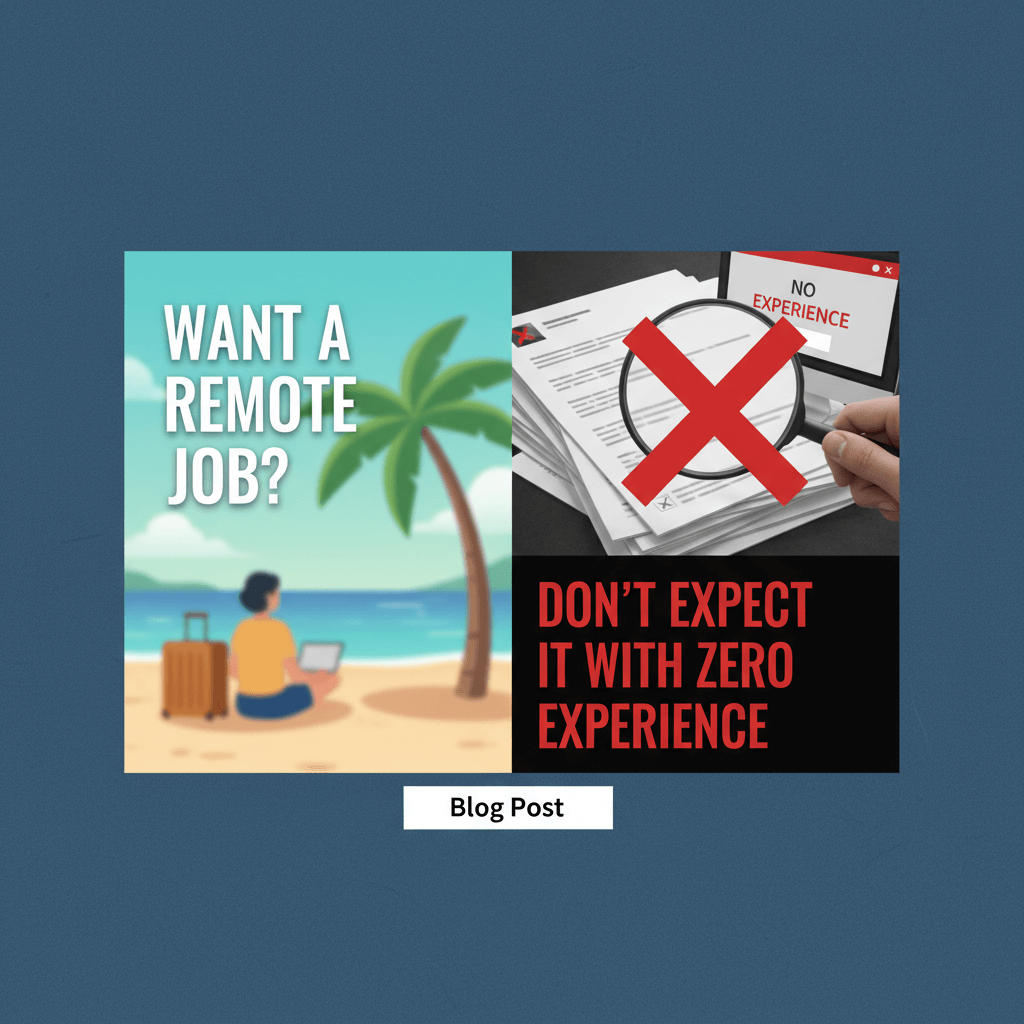
Want a remote job? Don’t expect it with zero experience. But do expect it when you build trust signals faster than anyone else in the applicant pool. That’s not luck—it’s a method.
Call to action
In the next 24 hours, choose your first micro-project and send three outreach messages using the scripts above. In the next seven days, ship your first case study. When you do, send me the link. I’ll cheer you on—and more importantly, so will the hiring managers who finally see the signals they’ve been looking for.
Where This Insight Came From
This analysis was inspired by real discussions from working professionals who shared their experiences and strategies.
- Source Discussion: Join the original conversation on Reddit
- Share Your Experience: Have similar insights? Tell us your story
At ModernWorkHacks, we turn real conversations into actionable insights.
![[Workflow Included] A simple 5-node Instagram posting workflow for beginners](https://modernworkhacks.com/wp-content/uploads/2026/04/workflow-included-a-simple-5-node-instagram-posting-workflow-for-beginners-1024x675.png)



0 Comments