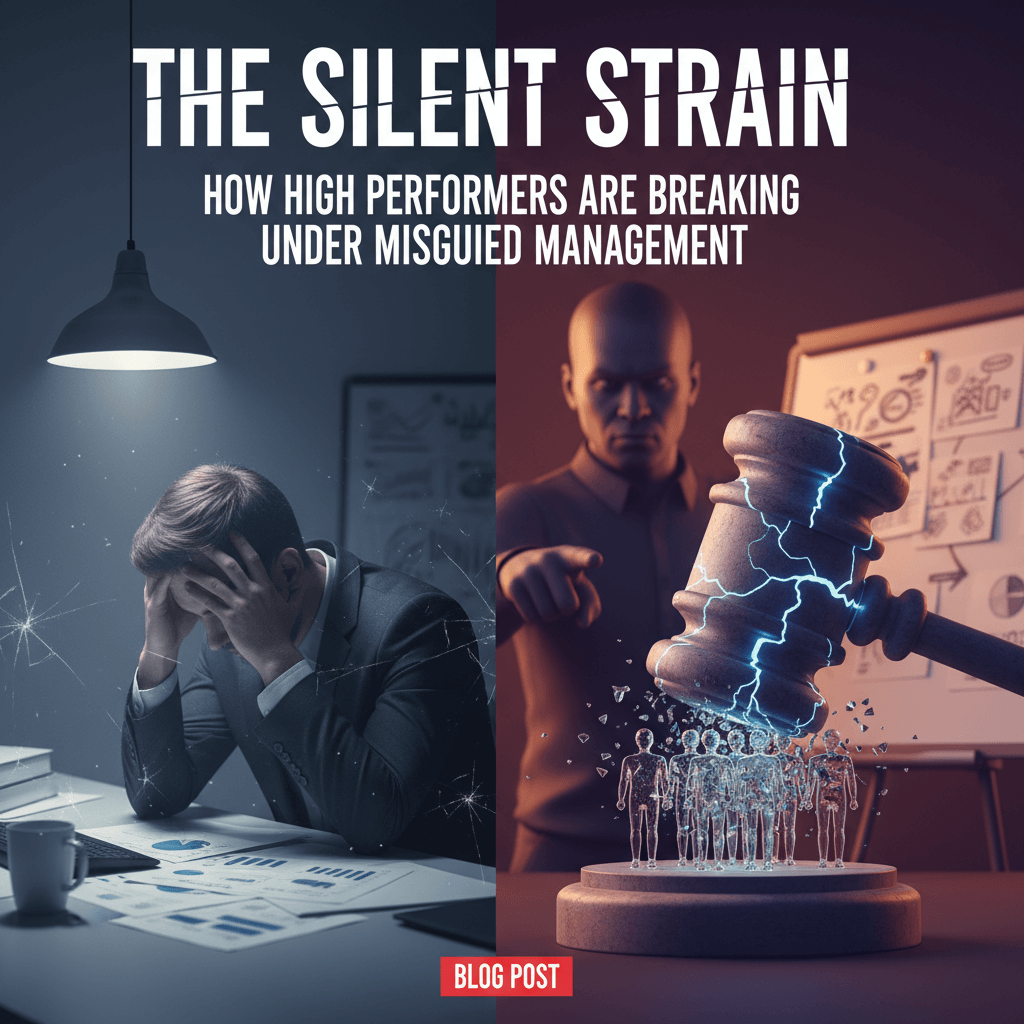
Alex was the kind of employee every company claims to want. Consistently exceeding targets, innovating solutions to problems others hadn’t even identified yet, and always willing to put in extra hours when needed. Three years into his role at a Fortune 500 tech company, he was the go-to person for critical projects and the unofficial mentor for new team members.
Then one day, he simply didn’t show up. His resignation email arrived at 3 AM, containing just two sentences: “I can no longer work in an environment that takes my contribution for granted while failing to address systematic issues I’ve repeatedly flagged. I wish the team well.”
His manager was stunned. The executive team was baffled. But his colleagues? They were already updating their resumes.
This scenario is playing out across industries with alarming frequency. When high performers—the backbone of organizational success—begin breaking under strain, it signals a fundamental failure of management. The consequences extend far beyond the loss of talent. When the achievers are burning out, who’s left to keep the engine running?
The Invisible Burden of Excellence
High performers share a common experience: their competence becomes a curse. Their reliability, efficiency, and willingness to take initiative makes them targets for increasingly unreasonable expectations, while simultaneously receiving less support than their struggling counterparts.
The Competency Tax
Jessica, a senior project manager at a marketing agency, described her experience: “I delivered consistently, so they gave me more work. I handled that well, so they added more. When I finally said I was at capacity, my director seemed genuinely surprised—as if my ability to juggle impossible deadlines meant I should always be willing to take on more.”
This “competency tax” creates a perverse incentive structure where excellence is punished rather than rewarded. Research from the Harvard Business Review found that top performers are typically assigned 50% more work than average performers, yet only receive about 5% more in compensation.
Three critical consequences emerge:
- Diminishing returns: Even exceptional talent has limits. When pushed beyond those limits, quality inevitably suffers.
- Resentment buildup: High performers begin to notice the imbalance between their contributions and their recognition.
- Motivation erosion: The intrinsic satisfaction of doing excellent work gets buried under avalanches of unreasonable demands.
The Feedback Desert
Paradoxically, while high performers shoulder heavier workloads, they often receive less guidance and feedback. Managers assume these employees “have it handled” and direct their attention to underperforming team members.
“My annual review was literally three minutes long,” recalls Marcus, a software engineer. “My manager said, ‘You’re doing great, keep it up,’ and moved on. Meanwhile, my colleague who barely meets expectations got weekly check-ins and a personalized development plan.”
This feedback desert leaves even the most capable employees navigating complex challenges without a compass, creating isolation precisely when collaboration and guidance are most needed.
The Management Disconnect
At the heart of this phenomenon lies a fundamental disconnect between management perception and workplace reality. According to a Gallup study, 89% of managers believe employees leave for money, while only 12% of employees cite compensation as their primary reason for departure.
The Visibility Problem
Many managers fail to recognize the true workload of high performers. When tasks are completed efficiently and without complaint, the effort behind them becomes invisible. This creates a dangerous blind spot where management cannot see the mounting pressure until it’s too late.
Dr. Amelia Rivera, an organizational psychologist, explains: “There’s a cognitive bias at play—managers often confuse outcomes with capacity. If someone produces excellent results, the assumption is they have excess capacity rather than exceptional focus or skill. This leads to the continuous loading of more work until the system breaks.”
To combat this visibility problem:
- Implement workload tracking systems that quantify effort, not just outcomes
- Schedule regular capacity check-ins that aren’t tied to performance reviews
- Create safe channels for employees to signal when they’re approaching their limits
The Accountability Gap
Perhaps most frustrating for high performers is watching management fail to address obvious organizational problems. When leadership ignores or minimizes legitimate concerns raised by their most valuable employees, it signals that excellence and honesty are not truly valued.
A 2022 McKinsey study found that 67% of high performers who left their positions cited “leadership’s failure to act on identified problems” as a primary factor in their decision—far outranking compensation or advancement opportunities.
“I documented process inefficiencies that were costing us hundreds of hours monthly,” shares Priya, a former operations director. “After presenting solutions for the third time and seeing no action, I realized my expertise wasn’t valued beyond my ability to compensate for broken systems.”
The Breaking Point: Recognizing the Warning Signs
High performers rarely collapse without warning. Their deterioration follows a predictable pattern that attentive management can identify and address before reaching the point of no return.
The Withdrawal Sequence
The journey from engagement to resignation typically follows four stages:
- Decreased initiative: The employee stops volunteering for new projects or proposing innovations
- Reduced communication: Participation in meetings declines, emails become shorter and more functional
- Boundary enforcement: Strict adherence to working hours replaces previous flexibility
- Disengagement: Emotional investment in outcomes visibly diminishes
James, a former high performer who now coaches executives, reflects: “Looking back, I spent six months trying to signal my distress before quitting. I went from solving problems proactively to just handling what landed on my desk. No one noticed until I was already interviewing elsewhere.”
The Organizational Ripple Effect
When high performers break, the damage extends far beyond their individual roles. Their departure creates multiple organizational wounds:
- Knowledge gaps that can take months or years to fill
- Decreased morale among remaining team members
- Loss of informal leadership that often held teams together
- Exponential increase in management challenges as secondary employees also depart
A study by the Society for Human Resource Management estimates that replacing a high performer costs an organization between 90-200% of their annual salary when accounting for recruitment, training, and productivity losses.
Rebuilding the Management Approach
Creating environments where high performers can thrive requires fundamental shifts in management philosophy and practice. The goal isn’t merely retention—it’s enabling sustainable excellence.
From Extraction to Investment
The extractive approach to management—squeezing maximum output from top talent until they burn out—must be replaced with an investment mindset that prioritizes long-term capacity building.
Practical strategies include:
- Workload calibration: Regular assessment of task distribution to prevent overloading
- Recovery periods: Scheduled downtime after intense project cycles
- Skill development: Creating space for high performers to expand their capabilities in directions they value
Companies implementing these approaches report 35% higher retention rates among top performers, according to research from the Work Institute’s 2023 Retention Report.
Accountability as Cultural Cornerstone
When high performers raise concerns about systemic issues, their observations should trigger action, not defensiveness. This requires creating frameworks for organizational accountability.
“We implemented what we call ‘concern tracking,'” explains Rajiv Patel, CEO of a mid-sized software company. “When anyone identifies a problem, it gets logged, assigned, and tracked to resolution. The employee who raised it gets updates throughout the process. Our turnover among top performers dropped 40% in the first year.”
Three key elements make accountability systems effective:
- Transparent tracking of identified issues
- Clear ownership for resolution
- Regular communication about progress
The Path Forward: Creating Sustainable Excellence
The relationship between high performers and management doesn’t have to be adversarial. Organizations that get this right create environments where excellence is sustainable and mutually beneficial.
Recognition Beyond Rewards
While compensation matters, high performers consistently rank other forms of recognition as equally or more important. These include:
- Autonomy: Freedom to determine how work gets done
- Influence: Having their expertise shape organizational decisions
- Purpose: Connecting their efforts to meaningful outcomes
“The best recognition I ever received wasn’t a bonus,” shares Elaine, a high-performing marketing director. “It was being invited to help redesign our department’s workflow based on pain points I’d identified. That showed my input was truly valued.”
The Manager as Enabler
The most effective managers for high performers function less as directors and more as enablers—removing obstacles, providing resources, and creating conditions for success.
This requires:
- Regular check-ins focused on barriers rather than progress
- Willingness to advocate upward on behalf of the team
- Flexibility to adapt systems to people, not just people to systems
As management expert Marcus Buckingham notes, “People leave managers, not companies.” For high performers, the quality of management often represents the difference between engagement and exodus.
Conclusion: The Choice Before Us
Organizations face a clear choice: continue practices that burn out their best people, or evolve toward management approaches that sustain excellence. The cost of the status quo isn’t just the loss of top talent—it’s the creation of cultures where mediocrity becomes the safer option.
For leaders, the first step is simple but profound: listen to your high performers before they’re gone. Their frustrations contain the blueprint for organizational improvement. Their breaking points reveal the structural weaknesses you need to address.
For high performers themselves, recognize that your capabilities deserve environments where they can flourish. Setting boundaries isn’t failure—it’s necessary for sustainable excellence.
The organizations that will thrive in the coming decade won’t be those that extract maximum short-term value from their top talent. They’ll be the ones that build systems where high performance doesn’t come at the cost of wellbeing, where accountability flows in all directions, and where excellence is cultivated rather than exploited.
Because when the achievers are burning out, nobody wins. And when they’re thriving, there’s no limit to what can be accomplished.
Where This Insight Came From
This analysis was inspired by real discussions from working professionals who shared their experiences and strategies.
- Share Your Experience: Have similar insights? Tell us your story
At ModernWorkHacks, we turn real conversations into actionable insights.
![[Workflow Included] A simple 5-node Instagram posting workflow for beginners](https://modernworkhacks.com/wp-content/uploads/2026/04/workflow-included-a-simple-5-node-instagram-posting-workflow-for-beginners-1024x675.png)



0 Comments