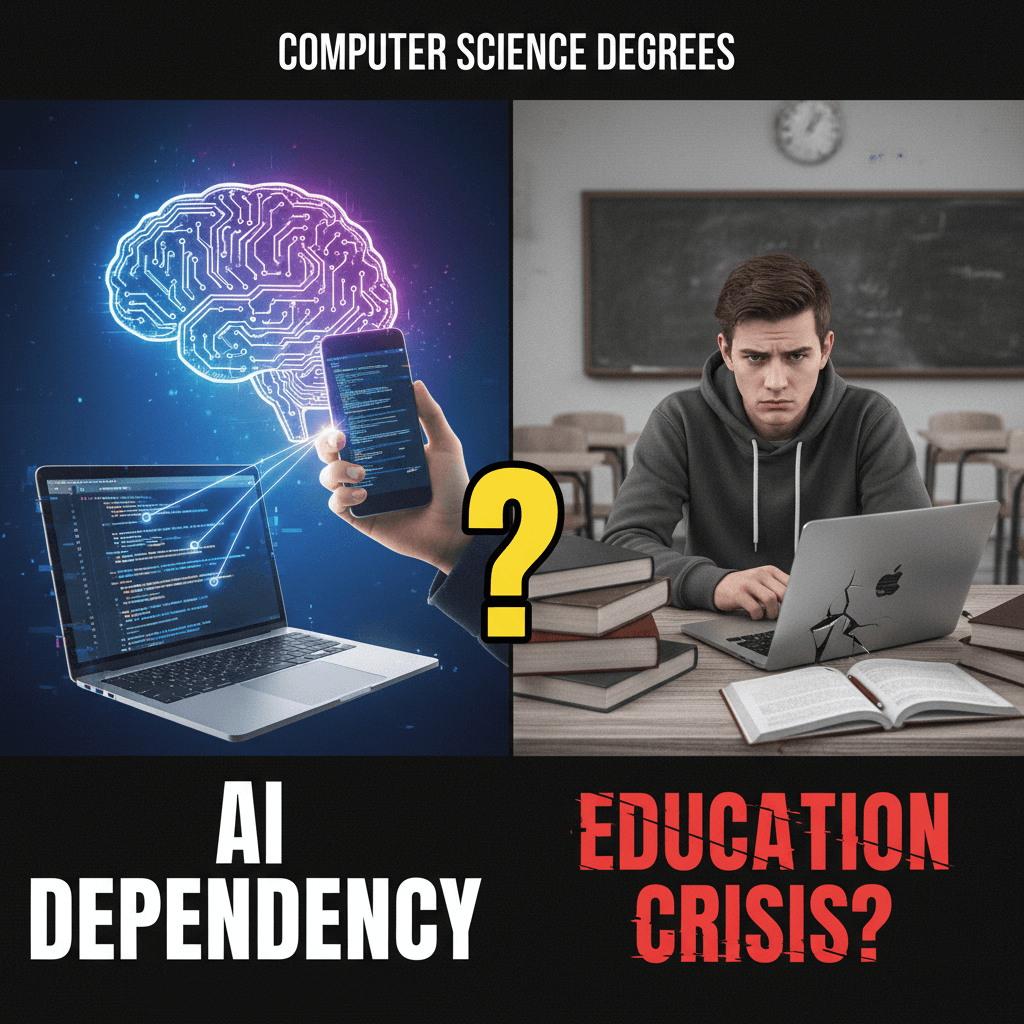
When Sarah, a recent computer science graduate from a prestigious university, landed her first job at a tech startup, she felt confident in her abilities. She had maintained a 3.8 GPA throughout her degree and had become adept at using AI tools like ChatGPT to help her complete complex coding assignments. But within her first week on the job, reality hit hard. Asked to debug a critical application without AI assistance, she froze. “I realized I’d become so dependent on AI tools that I’d never truly developed the problem-solving muscles needed for real-world coding challenges,” she confessed to her mentor.
Sarah isn’t alone. Across university campuses and tech companies, a troubling question is emerging: Has artificial intelligence robbed computer science graduates of real-world readiness? As AI tools become increasingly sophisticated and accessible, educators and employers are raising alarms about a generation of tech professionals who may have delegated too much of their learning to algorithms.
The Rise of AI-Assisted Learning in Computer Science
The integration of AI tools in computer science education has exploded since late 2022, when ChatGPT and similar large language models became widely available. According to a 2023 survey by the Computing Research Association, over 78% of computer science students now regularly use AI tools to help with programming assignments, debugging, and even theoretical concept exploration.
From Learning Aid to Learning Crutch
Initially welcomed as innovative learning supplements, AI coding assistants have gradually shifted from helpful tools to potential crutches. Dr. Elena Rodriguez, Department Chair of Computer Science at MIT, explains: “We’re seeing a fundamental shift in how students approach problem-solving. Rather than working through the logic and debugging process—which builds critical thinking—many immediately turn to AI for solutions.”
This shift is quantifiable. A longitudinal study from Stanford’s Computer Science Education Group found that students who heavily relied on AI tools scored 22% lower on closed-book exams testing fundamental programming concepts compared to cohorts from pre-AI availability years.
The Allure of Efficiency
The appeal is understandable. In a competitive academic environment where students juggle multiple courses and deadlines, AI offers tempting efficiency:
- Instant debugging of code without the time-intensive trial and error process
- Ready-made solutions to common programming problems
- Automated explanation of complex concepts in simplified language
“I can complete assignments in half the time using GitHub Copilot,” admits Jason, a junior at Georgia Tech. “But sometimes I submit code I don’t fully understand, and that’s starting to worry me as internship interviews approach.”
The Widening Skills Gap
The consequences of AI dependency are becoming apparent as graduates transition to professional environments. A 2023 report by the Information Technology and Innovation Foundation revealed that 64% of tech employers have observed a decline in problem-solving abilities among recent computer science graduates compared to their predecessors.
What Employers Are Seeing
Tech industry leaders are increasingly vocal about the skills gap they’re witnessing. Sundar Pichai, CEO of Google, noted in a recent interview: “We’re seeing candidates with impressive transcripts who struggle with fundamental debugging and algorithm optimization when AI assistance isn’t available. There’s a growing disconnect between academic performance and practical capability.”
This disconnect manifests in specific skill deficiencies:
- Inability to trace code execution mentally
- Reduced persistence when facing challenging bugs
- Weaker understanding of memory management and optimization
- Difficulty translating theoretical knowledge to practical applications
The Real-World Readiness Crisis
Maria Chen, CTO at a mid-sized software company in Austin, describes the practical impact: “We’ve had to extend our onboarding process by nearly six weeks for recent graduates. Many have impressive portfolios built with AI assistance but struggle when asked to whiteboard solutions or debug unfamiliar codebases independently.”
This observation is supported by data from HackerRank, which reported that while submission rates for their programming challenges have increased, the average time to solution has increased by 35% among recent graduates when their platform disabled AI assistance tools.
The Educational Dilemma: Adapt or Restrict?
Universities find themselves at a crossroads: should they restrict AI use to ensure fundamental skills development, or embrace and adapt to these tools as part of the evolving landscape?
The Restriction Approach
Some institutions have implemented strict policies. Carnegie Mellon University’s School of Computer Science recently introduced “AI-free zones” for certain foundational courses and assessments. Professor James Harrison explains their rationale: “We’re not anti-AI. We’re pro-fundamentals. Students need to develop core competencies before leveraging AI as an accelerator rather than a substitute.”
Their approach includes:
- Proctored, network-isolated exams that test raw coding ability
- Handwritten algorithm design exercises before computer implementation
- Pair programming sessions where processes must be verbally explained
Early results show promise—students initially struggled but showed stronger independent problem-solving skills by semester’s end.
The Integration Approach
Conversely, Stanford and UC Berkeley have embraced AI as an inevitable part of the programming landscape. They’ve redesigned curricula to teach with AI rather than despite it.
“Fighting against AI use is futile,” argues Dr. Wei Zhang from Berkeley’s Computer Science Division. “Instead, we’re teaching students to use AI responsibly while ensuring they understand the underlying principles. It’s like allowing calculators but still requiring students to understand mathematical concepts.”
Their approach includes:
- Courses specifically on “AI-Augmented Programming” ethics and best practices
- Assignments requiring students to critique and improve AI-generated code
- Exams with both AI-allowed and AI-restricted portions
Finding Balance: The Hybrid Approach
The most promising educational models appear to be hybrid approaches that recognize AI’s permanence while safeguarding fundamental skill development.
Case Study: University of Washington’s Framework
The University of Washington’s Paul G. Allen School of Computer Science has pioneered a three-tiered approach to AI integration that has gained attention for its balanced results:
- Foundation Phase (Years 1-2): Limited AI use, focusing on manual coding and fundamentals
- Integration Phase (Year 3): Guided AI use with reflection requirements
- Augmentation Phase (Year 4): Full AI integration with emphasis on oversight and optimization
Dr. Lisa Montgomery, who helped design this curriculum, reports: “Our early data shows students develop stronger fundamentals while still graduating with practical AI collaboration skills. They can work both with and without AI assistance effectively.”
Their first cohort through this program showed 27% stronger performance on independent coding assessments while maintaining high proficiency with AI-augmented tasks.
Industry-Academia Partnerships
Companies like Microsoft, Amazon, and IBM are increasingly partnering with universities to bridge the readiness gap. These partnerships include:
- Guest lectures on how AI tools are actually used in professional settings
- Internship programs specifically designed to build independent problem-solving
- Capstone projects that require both AI-assisted and independent components
“We need graduates who can leverage AI while maintaining critical thinking skills,” explains Rajesh Patel, Engineering Director at Microsoft. “The most valuable developers understand what’s happening under the hood, even when using AI to accelerate their work.”
Developing AI-Resilient Skills
For current students concerned about becoming too dependent on AI, experts recommend specific approaches to build what some are calling “AI-resilient” skills.
Deliberate Practice Techniques
Dr. Anders Ericsson’s research on expertise development suggests specific techniques for computer science students:
- Time-boxed independence: Attempt problems without AI assistance for at least 30 minutes before seeking help
- Reverse engineering: When using AI-generated code, manually trace through it line by line to understand its logic
- Explanation practice: Regularly explain your code to peers without referencing documentation
“The students who thrive are those who use AI as a teacher rather than a substitute,” notes Dr. Ericsson. “They ask ‘why’ questions about the solutions AI provides rather than simply implementing them.”
Building Mental Models
Strong programmers develop robust mental models of how code executes. To build this skill:
- Practice whiteboarding solutions before coding them
- Manually trace variable states through algorithms
- Implement the same solution in multiple programming languages to understand universal concepts
“I’ve started challenging myself to explain my AI-assisted solutions to non-technical friends,” shares Miguel, a senior at University of Texas. “If I can’t make them understand the logic, I probably don’t truly understand it myself.”
The Path Forward: Responsible AI Integration
As we navigate this educational transformation, a balanced approach is emerging as the most promising path forward. The goal isn’t to eliminate AI tools but to ensure they enhance rather than replace fundamental skill development.
For educators, this means designing assessments that test both AI-augmented and independent capabilities. For students, it requires honest self-assessment about which skills they’re developing versus outsourcing. And for employers, it means evolving interview processes to accurately gauge both technical fundamentals and AI collaboration skills.
The question isn’t whether AI belongs in computer science education—it’s already here and will only become more prevalent. The real question is how we ensure students graduate with both AI fluency and the fundamental problem-solving abilities that have always been at the heart of computer science.
As Dr. Rodriguez from MIT concludes: “Our goal must be producing graduates who see AI as one tool in their toolkit, not the entire toolkit itself. The future belongs to those who can work with AI while maintaining the human creativity, critical thinking, and first-principles understanding that AI still cannot replicate.”
For current computer science students, the message is clear: embrace AI as a powerful assistant, but ensure you can still think, code, and problem-solve when it’s just you and a blank text editor. Your future career may depend on it.
Where This Insight Came From
This analysis was inspired by real discussions from working professionals who shared their experiences and strategies.
- Share Your Experience: Have similar insights? Tell us your story
At ModernWorkHacks, we turn real conversations into actionable insights.
![[Workflow Included] A simple 5-node Instagram posting workflow for beginners](https://modernworkhacks.com/wp-content/uploads/2026/04/workflow-included-a-simple-5-node-instagram-posting-workflow-for-beginners-1024x675.png)


0 Comments