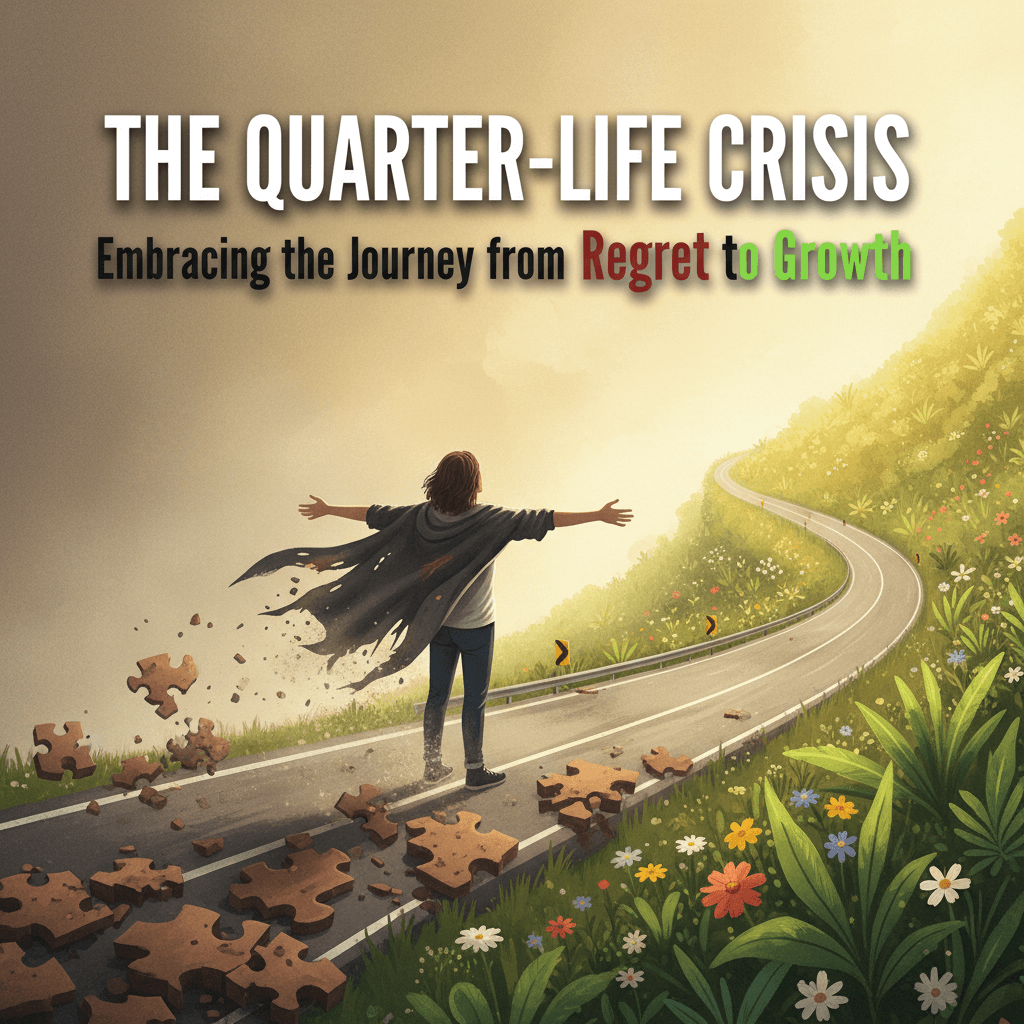
I was 26 when I found myself sitting on my apartment floor, surrounded by job rejection emails, a half-eaten pizza, and the distinct feeling that everyone else had figured out life except me. My college friends were posting engagement photos, promotion announcements, and exotic vacation stories while I was questioning every decision I’d made since graduation. Was I behind? Had I wasted precious years? The anxiety was paralyzing.
If this resonates with you, you’re experiencing what psychologists now recognize as the “quarter-life crisis” – a period of intense questioning and uncertainty that typically strikes between ages 25-35. But here’s what I discovered after interviewing dozens who’ve navigated this turbulent phase: feeling lost in your twenties might actually be the best thing that ever happens to you.
Understanding the Quarter-Life Crisis: More Common Than You Think
According to research published in the International Journal of Behavioral Development, approximately 75% of 25-33 year olds experience some form of quarter-life crisis. This phenomenon isn’t just anecdotal – it’s a documented developmental stage that’s becoming increasingly recognized.
The Anatomy of a Quarter-Life Crisis
The typical quarter-life crisis involves questioning fundamental aspects of one’s life, including:
- Career path: “Am I in the right field? Should I have studied something different?”
- Relationships: “Everyone is settling down while I’m still figuring things out.”
- Identity: “Who am I outside of my achievements? What do I actually want?”
Maya, a 29-year-old marketing executive, described her experience: “I had the ‘perfect’ job on paper – great salary, prestigious company – but I would cry in my car before work. I felt like I was living someone else’s life, but was terrified of making a change because I’d invested so much time getting there.”
Why It Happens Now More Than Ever
The quarter-life crisis is intensified by several modern factors:
- Social media creating unrealistic comparisons
- Longer lifespans making our 20s seem less definitive
- Economic uncertainty and changing career landscapes
Dr. Oliver Robinson, a leading researcher on quarter-life crises, found that this period typically follows a predictable pattern: feeling trapped, desire for change, creating space for change, rebuilding, and finally, developing new commitments aligned with updated values.
The Hidden Gift: Why Crisis Leads to Growth
What if your quarter-life crisis isn’t a catastrophe but rather a catalyst? Psychologists increasingly view these periods as essential developmental phases rather than problems to be solved.
Neuroplasticity: Your Brain’s Secret Weapon
Your twenties are a neurological goldmine. Research from Jay Giedd at the National Institute of Mental Health shows that the prefrontal cortex – responsible for decision-making and personality – continues developing well into our twenties. This neuroplasticity means your brain is literally primed for transformation during this period.
Actionable takeaway: Leverage this neuroplasticity by intentionally exposing yourself to new experiences. Take a class in something completely unfamiliar, travel somewhere culturally different, or volunteer in an unfamiliar environment.
Identity Consolidation Through Challenge
Erik Erikson’s developmental stages suggest that early adulthood is precisely when we should be exploring and experimenting before consolidating our identity. The discomfort you feel is often the friction of growth.
James, a 31-year-old teacher, shared: “I spent three years after college working in finance because it seemed impressive. My quarter-life crisis hit when I realized I was living for external validation. Quitting and pursuing education was terrifying, but it forced me to define success on my own terms.”
Actionable takeaway: Create a personal definition of success that isn’t borrowed from parents, peers, or social media. Write it down and revisit it monthly.
Reframing Regret: From Paralysis to Possibility
Perhaps the most painful aspect of the quarter-life crisis is regret – that gnawing feeling that you’ve made irreversible mistakes or wasted precious time.
The Science of Productive Regret
Researcher Daniel Pink, author of “The Power of Regret,” discovered through a survey of over 16,000 people that regret, when properly channeled, becomes a powerful catalyst for growth. His research identified four core regrets people experience: foundation regrets (responsible choices not made), boldness regrets (risks not taken), moral regrets (wrong turns), and connection regrets (relationships neglected).
Actionable takeaway: Identify which type of regret is most affecting you, then use Pink’s “if-then” technique: “If I feel this regret, then what specific action can I take now to address its underlying cause?”
The Opportunity Cost Fallacy
We often torture ourselves with thoughts of alternate timelines – what if I had chosen a different major? Dated different people? Taken that job abroad?
Psychologists call this the opportunity cost fallacy – the mistaken belief that the path not taken would have been perfect, while ignoring the inevitable challenges that would have emerged on that route as well.
Alex, a 28-year-old consultant, explained: “I spent years regretting not pursuing medicine. I finally shadowed a doctor friend for a week and realized the daily reality wouldn’t have suited me at all. My regret was based on a fantasy version of that life.”
Actionable takeaway: For your biggest “road not taken” regret, research the actual day-to-day reality of that choice. Interview someone living that life or try a short-term experience that approximates it.
Strategic Experimentation: Turning Uncertainty into Discovery
The quarter-life crisis provides a perfect opportunity for strategic experimentation – intentionally testing different paths without committing fully.
The Power of Low-Cost Probes
Bill Burnett and Dave Evans, authors of “Designing Your Life,” advocate for “low-cost probes” – small experiments that help you gather data about potential paths without making drastic changes.
Examples include:
- Taking a night class in a field you’re curious about
- Shadowing someone in a role you’re considering
- Volunteering in an organization aligned with your interests
- Starting a side project to test entrepreneurial ideas
Sarah, a 27-year-old accountant questioning her career, shared: “Instead of quitting outright, I negotiated a four-day workweek and used Fridays to intern at a local design studio. Six months later, I had enough information and portfolio pieces to make an informed career transition.”
Actionable takeaway: Identify three potential directions you’re curious about, then design one low-cost probe for each that requires less than 5 hours weekly.
The Prototyping Mindset
Silicon Valley’s “fail fast, learn fast” approach applies perfectly to quarter-life crises. Adopt a prototyping mindset where “failures” become valuable data points rather than personal indictments.
Research from Stanford’s “Designing Your Life” course shows that people who run multiple small experiments report higher life satisfaction than those who make one big change or remain paralyzed by indecision.
Actionable takeaway: Keep an experiment journal documenting what you’re learning about yourself through each probe. What energizes you? What drains you? What environments bring out your best?
Building Your Personal Board of Directors
Navigating a quarter-life crisis alone intensifies its difficulty. Research from the Harvard Study of Adult Development – the longest study on happiness – consistently shows that quality relationships are the strongest predictor of wellbeing.
Beyond the Echo Chamber
While venting to friends feels good momentarily, it rarely leads to breakthroughs. Instead, intentionally build a diverse personal board of directors:
- The Mentor: Someone 10+ years ahead who’s navigated similar challenges
- The Peer Coach: Someone at your stage but with complementary strengths
- The Industry Insider: Someone with specialized knowledge in areas you’re exploring
- The Outsider: Someone from a completely different field who offers fresh perspective
Miguel, a 30-year-old software developer, credited his transition to UX design to his board: “My mentor helped me see transferable skills I was overlooking. My peer coach kept me accountable to weekly action steps. My industry insider connected me with informational interviews. And my outsider – my artist cousin – helped me build a portfolio that stood out.”
Actionable takeaway: Identify one person for each role above and schedule specific conversations about your quarter-life questions. Come prepared with targeted questions rather than general complaints.
From Crisis to Clarity: Embracing the Journey
The quarter-life crisis isn’t something to merely survive – it’s an invitation to thrive through intentional growth. By reframing this period as a necessary developmental stage rather than a personal failing, you transform what feels like floundering into a foundation for a more authentic life.
Remember that this discomfort is not evidence that you’ve failed at adulting – it’s evidence that you’re doing the hard, important work of becoming. The friends posting seemingly perfect lives on Instagram? Many are avoiding the very questions that will eventually lead to genuine fulfillment.
As researcher Brené Brown notes, “You cannot selectively numb emotion.” Those avoiding the discomfort of questioning also miss the joy of discovery. Your willingness to face uncertainty now is creating the capacity for deeper satisfaction later.
So tonight, instead of scrolling through others’ highlight reels, take one small action from this article. Design a low-cost probe. Reach out to a potential board member. Write your personal definition of success.
Your quarter-life crisis isn’t a detour from your proper path – it is the path. And the person you’re becoming through this process is exactly who you need to be for the journey ahead.
Where This Insight Came From
This analysis was inspired by real discussions from working professionals who shared their experiences and strategies.
- Share Your Experience: Have similar insights? Tell us your story
At ModernWorkHacks, we turn real conversations into actionable insights.
![[Workflow Included] A simple 5-node Instagram posting workflow for beginners](https://modernworkhacks.com/wp-content/uploads/2026/04/workflow-included-a-simple-5-node-instagram-posting-workflow-for-beginners-1024x675.png)




0 Comments