
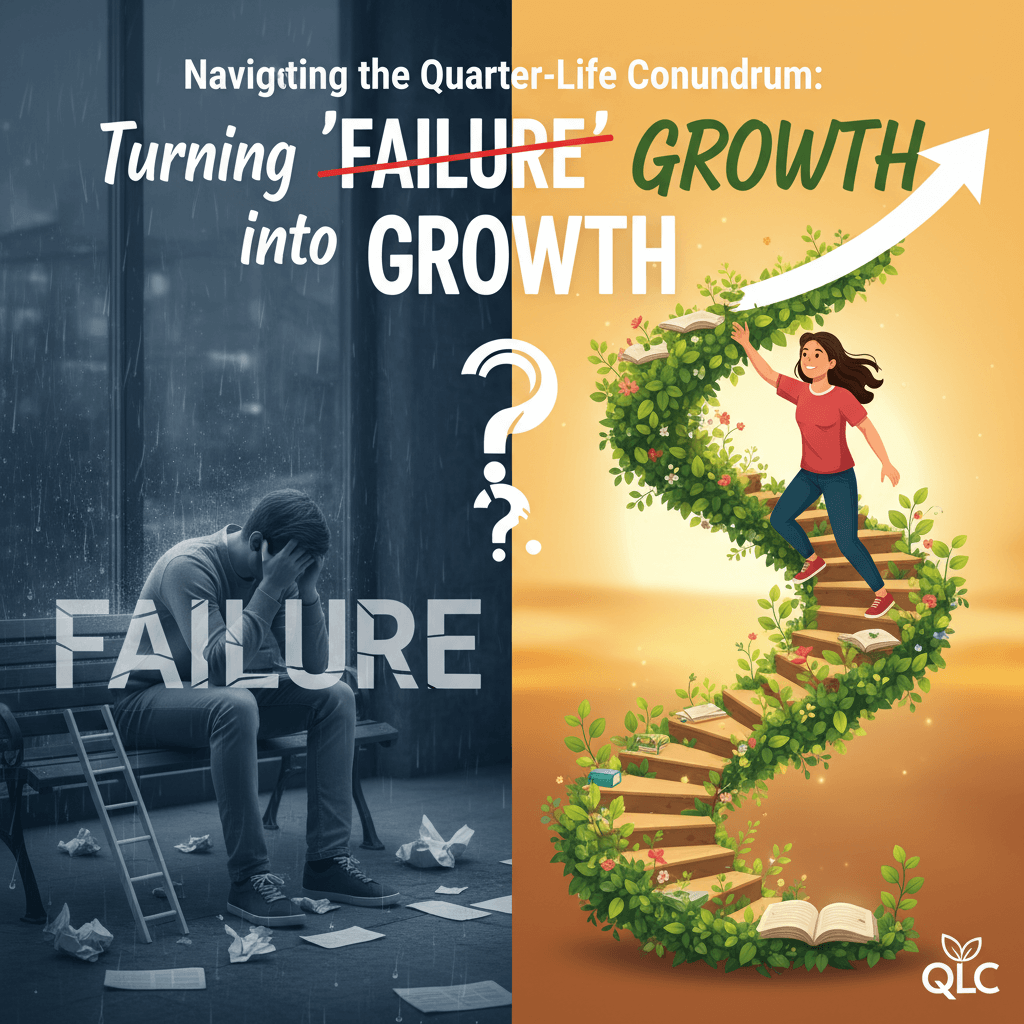
I remember the night vividly. Sitting on my apartment floor at 26, surrounded by job rejection emails, watching friends celebrate promotions on Instagram, and questioning every life decision I’d made. The apartment I could barely afford suddenly felt like a monument to my inadequacy. “By this age, my parents had a house, stable careers, and were starting a family,” I thought. Meanwhile, I was eating ramen for the third night in a row, wondering where I’d gone wrong.
If this scenario resonates with you, you’re far from alone. The “quarter-life crisis” has become a defining experience for millions of young adults navigating their 20s. A period marked not by the carefree exploration we were promised but by profound anxiety, comparison, and the persistent feeling of falling behind invisible timelines.
But here’s what I’ve learned since that night on the floor: what feels like failure in your 20s is often the foundation for your most significant growth. The question isn’t whether you’re failing—it’s whether you’re allowing those perceived failures to define you or develop you.
The Anatomy of a Quarter-Life Crisis
According to research from LinkedIn, 75% of 25-33 year-olds have experienced a quarter-life crisis, with the average age of onset being 27. But what exactly constitutes this increasingly common phenomenon?
The Perfect Storm of Expectations
The quarter-life crisis emerges from a collision of factors unique to this life stage:
- Identity formation – Transitioning from the structured environment of education to the ambiguous landscape of adulthood
- Decision paralysis – Facing seemingly permanent choices about career, relationships, and location with limited life experience
- Social comparison – Constant exposure to curated success stories through social media
Emma, a 28-year-old marketing associate I interviewed, described it perfectly: “I graduated with honors, then spent three years in entry-level positions watching high school classmates become doctors and get married. I felt like I was running a race where everyone else had a map, and I was just guessing which way to go.”
This sentiment echoes across Reddit threads with thousands of comments, where young adults confess feeling “behind,” “lost,” or “like an imposter” in their own lives.
The Reality Gap
The crisis intensifies when we confront the gap between expectation and reality. A 2021 study from the American Psychological Association found that millennials and Gen Z report higher levels of disappointment with their life progress than previous generations at the same age.
Why? Because we’re comparing our beginnings to others’ middles, measuring ourselves against highlight reels, and holding onto outdated timelines in a fundamentally changed economic and social landscape.
Redefining Failure: The Growth Perspective
What if the problem isn’t our circumstances but our interpretation of them? What if what we perceive as “falling behind” is actually the necessary foundation for moving forward?
The Myth of the Linear Path
When I interviewed Dr. Meg Jay, clinical psychologist and author of “The Defining Decade,” she emphasized that “the most successful careers and lives rarely follow a straight line.” This perspective is backed by data – a LinkedIn study found that professionals who changed roles or industries in their 20s were more likely to reach senior positions by their 40s than those who remained in a single track.
Consider these reframing strategies:
- View detours as data collection – Each “wrong turn” provides valuable information about your preferences, strengths, and values
- Recognize that timing differs by field – Some careers peak early (like professional athletes), while others build slowly (like writers, therapists, or business owners)
- Embrace the concept of “productive struggle” – Neurological research confirms that our brains form stronger neural pathways when we overcome obstacles
Case Study: The Power of the Pivot
Alex, now 34, spent his early 20s pursuing a finance career he hated because it seemed prestigious and secure. After being laid off during a recession at 27, he felt like a complete failure. “I moved back with my parents and delivered pizzas while figuring out my next steps. It was humiliating.”
But that period of “failure” allowed Alex to reassess. He took coding classes while delivering pizzas, built a portfolio, and eventually landed a junior developer role at 29. Six years later, he’s a senior software engineer earning twice his finance salary and genuinely enjoying his work.
“If I hadn’t ‘failed’ at 27, I’d still be miserable in finance. That layoff was the best thing that happened to me, though it certainly didn’t feel that way at the time.”
The Comparison Trap and How to Escape It
Social comparison isn’t new, but its intensity has reached unprecedented levels. A 2020 study in the Journal of Social and Clinical Psychology directly linked social media usage with increased depression symptoms, with comparison being the primary mechanism.
Creating Healthier Benchmarks
To break free from the comparison cycle:
- Implement a “comparison audit” – Track when comparison thoughts arise and what triggers them
- Practice “temporal comparison” – Compare yourself to your past self rather than to others
- Develop “realistic idealism” – Maintain aspirational goals while acknowledging the messy reality of achieving them
When Priya, a 29-year-old teacher, found herself spiraling after seeing a former classmate featured in Forbes 30 Under 30, she implemented a simple but effective strategy: “I started keeping a ‘personal wins’ document where I recorded growth moments, no matter how small. Over time, I realized I was building something meaningful at my own pace.”
The Hidden Reality of Success Stories
Remember that success narratives are typically compressed and sanitized. The entrepreneur’s “overnight success” usually omits years of failed attempts. The “perfect relationship” on Instagram doesn’t show the arguments and therapy sessions that maintain it.
Research from the Harvard Business Review found that professional setbacks were present in 93% of career success stories, though these setbacks were mentioned in only 21% of public narratives about those same careers.
Building Resilience Through Intentional Failure
What if, instead of avoiding failure, we deliberately sought small, strategic failures as immunization against the fear that paralyzes us?
The Practice of Rejection Therapy
Jia Jiang, author of “Rejection Proof,” deliberately sought 100 rejections over 100 days. His goal wasn’t masochism but desensitization—reducing the power rejection held over his choices and actions.
You can adapt this approach by:
- Setting “rejection goals” – Apply for positions slightly beyond your qualifications
- Practicing “low-stakes failure” – Try activities where you expect to perform poorly initially (a new language, sport, or skill)
- Celebrating the attempt – Reward yourself for taking action, regardless of outcome
When Michael, a 25-year-old aspiring writer, committed to submitting work to publications far outside his league, something unexpected happened. “After collecting 27 rejections, I got a conditional acceptance from a magazine I admired. The editor said they appreciated my persistence in revising and resubmitting. My ‘failures’ were actually building my reputation.”
Community as Antidote to Isolation
Perhaps the most damaging aspect of the quarter-life crisis is the isolation it creates. We struggle silently, believing we’re uniquely flawed.
Finding Your Fellow Travelers
Research from Harvard’s Grant Study, the longest-running study on human happiness, consistently finds that relationship quality is the strongest predictor of well-being—stronger than wealth, fame, or professional success.
To build supportive community during this phase:
- Practice vulnerability reciprocity – Be the first to share authentic struggles, creating space for others to do the same
- Seek “growth friends” – Cultivate relationships with people who view challenges as opportunities
- Join structured communities – Consider mastermind groups, cohort-based courses, or volunteer organizations where connection happens alongside shared activities
When I started a simple monthly dinner with five friends where we discussed our “beautiful failures,” the relief was palpable. Discovering that the friend with the seemingly perfect career was questioning everything, or that the couple in the enviable relationship had considered breaking up three times, didn’t produce schadenfreude—it produced solidarity.
From Crisis to Chrysalis: Your Path Forward
The quarter-life crisis, reframed, isn’t a crisis at all. It’s a chrysalis—an essential, if uncomfortable, transformation phase.
As you navigate this period, remember:
- Documentation beats rumination – Journal about your journey, capturing lessons from each perceived setback
- Small actions cure existential dread – When overwhelmed by big questions, focus on immediate, manageable steps
- Your timeline is valid – The standardized life script is obsolete; you’re writing a custom one
Your 20s aren’t a race to accumulate achievements. They’re a laboratory for discovering who you are, what matters to you, and how you want to contribute. The “failures” you’re experiencing now are providing exactly the data you need for that discovery.
So ask yourself: Is your 20s journey defined by self-doubt or self-discovery? The answer lies not in how many times you’ve fallen, but in how you rise, what you learn, and who you become in the process.
The quarter-life conundrum isn’t a detour from your proper path—it is the path. And the person emerging from this chrysalis will be stronger, clearer, and more authentically you than you could have imagined on that apartment floor, wondering where you went wrong.
Where This Insight Came From
This analysis was inspired by real discussions from working professionals who shared their experiences and strategies.
- Share Your Experience: Have similar insights? Tell us your story
At ModernWorkHacks, we turn real conversations into actionable insights.
![[Workflow Included] A simple 5-node Instagram posting workflow for beginners](https://modernworkhacks.com/wp-content/uploads/2026/04/workflow-included-a-simple-5-node-instagram-posting-workflow-for-beginners-1024x675.png)




0 Comments