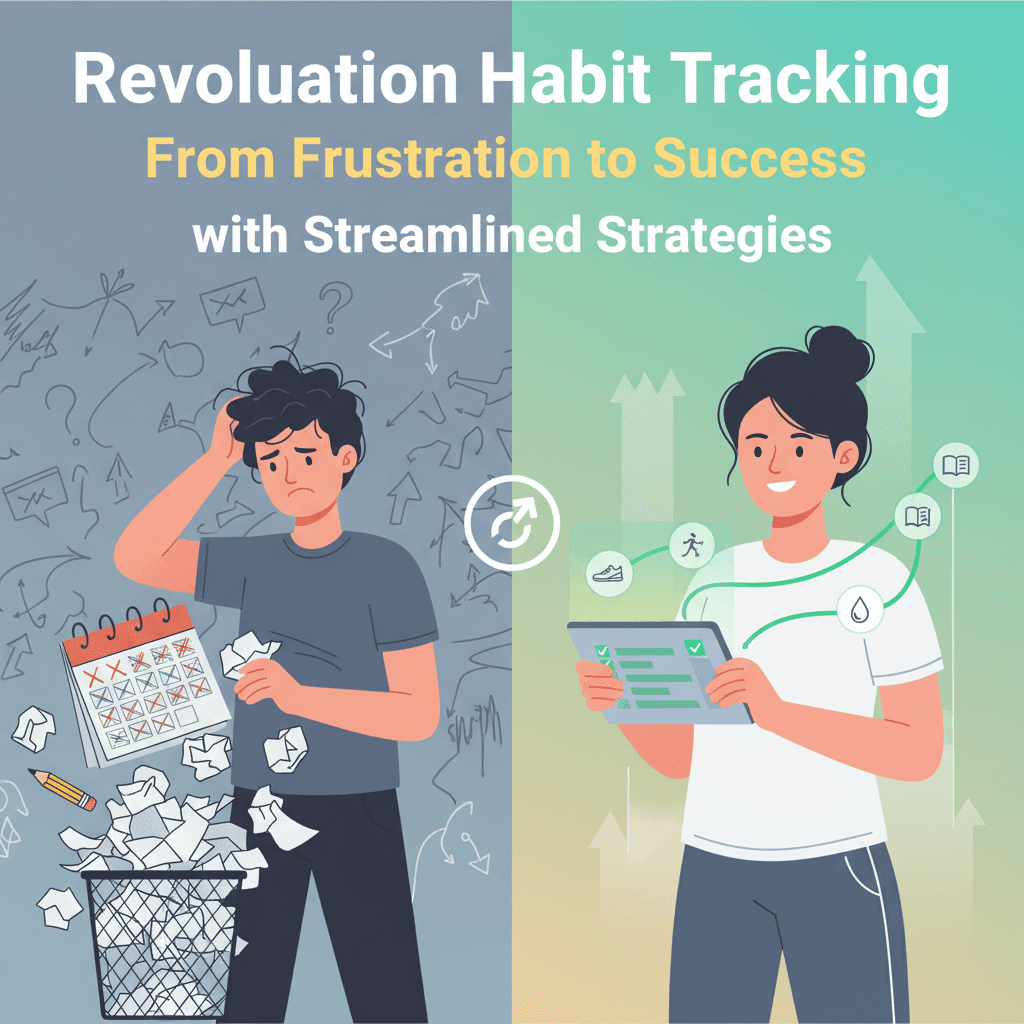
The notification lit up my phone for the fifth time that day: “Don’t forget to meditate!” I swiped it away with a familiar mix of guilt and frustration. My habit tracking app—the one I’d spent hours customizing with goals, reminders, and progress metrics—had become another source of stress rather than the productivity solution I’d hoped for. As I later discovered in a viral Reddit thread with over 2,000 comments, I wasn’t alone in this digital habit-tracking fatigue.
The irony wasn’t lost on me: the very tools designed to build better habits were creating new problems—notification overload, data entry burnout, and the discouragement of broken streaks. Yet buried in that same online discussion was a surprising revelation: many successful habit-formers were abandoning complex digital systems for remarkably simple alternatives. Their success stories pointed to a counterintuitive truth: when it comes to habit tracking, less is often more.
The Digital Overwhelm: Why Traditional Habit Tracking Fails
The habit tracking landscape has exploded in the past decade. With over 500 habit-focused apps available across major app stores and the global productivity app market valued at $4.2 billion in 2022, we’re not lacking options. Yet research from the University of Scranton suggests that 92% of people fail to maintain their habits long-term. The disconnect is striking.
The Psychology of Digital Burnout
Dr. Alex Pang, author of “Rest: Why You Get More Done When You Work Less,” explains the phenomenon: “Many habit apps trigger what psychologists call ‘goal-performance anxiety’—the more metrics we track, the more opportunities we create for perceived failure.” This anxiety creates a counterproductive cycle where the tracking itself becomes more stressful than the habit we’re trying to form.
Take James, a software developer from Portland who shared his experience in the Reddit thread: “I was using three different apps to track my meditation, fitness, and reading habits. I spent so much time logging data and customizing dashboards that I had less time for the actual habits. The irony hit me when I realized I was procrastinating meditation by tweaking my meditation tracking app.”
The research backs up James’s experience. A 2021 study in the Journal of Consumer Research found that quantification of activities (turning them into trackable metrics) often reduced enjoyment and increased dropout rates—particularly for intrinsically motivating activities like reading or exercise.
The Perfectionism Trap
Digital tracking systems often emphasize unbroken streaks and perfect consistency—metrics that don’t align with how habit formation actually works. When a missed day feels like a catastrophic failure rather than a normal part of the process, the psychological impact can derail progress entirely.
Key takeaways:
- Recognize when your tracking system causes more stress than the habits themselves
- Be wary of streak-based motivation that creates all-or-nothing thinking
- Consider the time cost of maintaining complex tracking systems
The Minimalist Revolution in Habit Formation
The most compelling pattern in the Reddit discussion wasn’t just complaints about digital tracking—it was the surprising alternatives people had discovered. A clear theme emerged: simplicity drives sustainability.
The Return to Analog
Maria, a marketing executive and mother of two, described her transformation: “After trying six different apps over two years, I switched to a pocket notebook with a simple grid. Each evening, I mark an ‘X’ for completed habits. No notifications, no battery drain, no distractions—just me and a pen. I’ve maintained my habits longer than ever before.”
This analog approach isn’t just anecdotal. The “Bullet Journal” method, created by Ryder Carroll, has amassed millions of followers specifically because it offers a customizable but low-tech alternative to digital productivity systems. The physical act of writing appears to create stronger mental connections to our goals—a phenomenon supported by a 2021 study in Frontiers in Psychology that found handwriting activates regions of the brain associated with learning and memory in ways typing does not.
Key takeaways:
- Consider a simple paper tracker for your most important habits
- Embrace the “X-effect” method: a grid of days where you mark completed habits
- Use physical tracking to create a tactile connection to your habit practice
Environmental Design Over Willpower
Another powerful theme was the shift from tracking-dependent habits to environment-dependent habits. This approach aligns perfectly with James Clear’s concept from “Atomic Habits” that environment often matters more than motivation.
Alex, a teacher from Chicago, shared: “Instead of tracking my flossing habit on an app, I simply put floss picks next to my toothbrush. My water intake improved when I bought a marked water bottle rather than logging ounces in an app. By designing my environment, tracking became unnecessary—the habit just happens.”
Stanford behavior scientist BJ Fogg calls this “designing for automaticity”—creating environmental triggers so consistent that they eventually eliminate the need for conscious tracking altogether.
Key takeaways:
- Identify which habits could be triggered by environmental cues rather than reminders
- Create physical “habit stations” where all necessary tools are visible and accessible
- Focus on designing your environment first, tracking second
Integration Over Isolation: The Habit Stacking Approach
Perhaps the most revolutionary insight from the community discussion was the power of integrating new habits with existing behaviors rather than treating each habit as a separate entity to track.
The Science of Habit Stacking
The concept of “habit stacking,” popularized by S.J. Scott, involves attaching new habits to existing automatic behaviors. This approach leverages what neuroscientists call “neural chunking”—the brain’s ability to package complex behaviors into a single unit.
Dr. Wendy Wood, author of “Good Habits, Bad Habits,” explains: “About 43% of what we do every day is repeated in the same context, usually while we’re thinking about something else.” By connecting new habits to these existing automatic behaviors, we bypass the need for reminders or tracking systems.
Sarah, a nurse practitioner, described her success: “Instead of using reminder apps for my supplements, I now take them while my coffee brews—something I do without fail every morning. My gratitude practice happens during tooth brushing. By linking to behaviors that are already automatic, I’ve eliminated the need to track at all.”
Key takeaways:
- Identify your most consistent daily behaviors to use as “anchor habits”
- Attach new habits directly to these existing routines
- Use the formula: “After I [current habit], I will [new habit]”
Meaningful Metrics: Tracking What Actually Matters
For habits that still benefit from some form of tracking, the Reddit discussion revealed a crucial distinction: successful habit-formers track outcomes rather than actions.
Results Over Activity
Traditional habit tracking focuses on consistency—did you perform the habit today? Yes or no? But this binary approach misses the deeper purpose behind habits. By shifting focus to outcomes, tracking becomes more meaningful and often less frequent.
Michael, a software engineer, shared his revelation: “I stopped tracking daily meditation sessions and instead do a weekly reflection on my overall stress levels. I stopped logging every workout and instead take monthly progress photos and quarterly fitness tests. This outcomes-based approach keeps me focused on why I’m building these habits in the first place.”
This approach aligns with research on goal-setting theory, which suggests that outcome-focused goals often produce better results than process-focused goals, particularly when they connect to intrinsic motivation.
The Power of Reflection
Many successful habit-formers in the discussion had replaced daily tracking with periodic reflection—a practice that research shows can be equally effective for habit formation while requiring less constant attention.
Emma, a therapist, described her method: “Sunday evenings, I spend 15 minutes reviewing how my key habits are serving me. This reflection is more valuable than daily tracking because it helps me adjust and improve rather than just maintain.”
Key takeaways:
- Consider tracking outcomes monthly rather than activities daily
- Schedule regular reflection sessions to evaluate habit quality and impact
- Ask “Is this habit serving its purpose?” rather than just “Did I do it?”
Finding Your Minimum Effective Dose
The most successful habit-formers weren’t those tracking the most data points—they were those who had identified their “minimum effective dose” of tracking: just enough structure to support habit formation without creating additional burden.
This personalized approach recognizes that different personalities and different habits require different levels of accountability. Some habits thrive with daily tracking, while others perform better with minimal oversight.
Dr. Gretchen Rubin’s framework of the “Four Tendencies” provides useful context here. She classifies people as Upholders, Questioners, Obligers, or Rebels based on how they respond to expectations. An Obliger might need external accountability through tracking, while a Rebel might be demotivated by the very same system.
The key is honest self-assessment. As one Reddit user succinctly put it: “The best tracking system is the one you’ll actually use consistently.”
Key takeaways:
- Experiment to find your personal threshold for productive tracking
- Consider different tracking approaches for different types of habits
- Be willing to adjust your system as habits become more automatic
From Tracking to Transformation
As I reflect on my own journey and the collective wisdom of the Reddit community, the path forward becomes clear: habit tracking should be a means to an end, not an end in itself. The goal isn’t perfect tracking—it’s life transformation through consistent behavior change.
I’ve since simplified my own approach dramatically. My meditation habit now connects to my morning coffee ritual rather than a notification. My exercise is tracked through monthly fitness assessments rather than daily logs. My reading habit is supported by a simple paper bookmark that moves through my current book rather than an app tracking minutes and pages.
The result? More consistent habits, less digital noise, and a stronger connection to why these habits matter in the first place.
The productivity paradox turns out to be true: sometimes the most effective way to do more is to track less. By embracing simplicity, integration, and meaningful metrics, we can transform habit tracking from a source of frustration to a catalyst for lasting change.
I challenge you to examine your current habit tracking methods this week. Where could simplification lead to greater consistency? Which habits might thrive with less oversight rather than more? The most powerful tracking system might be the one you barely notice at all.
Where This Insight Came From
This analysis was inspired by real discussions from working professionals who shared their experiences and strategies.
- Share Your Experience: Have similar insights? Tell us your story
At ModernWorkHacks, we turn real conversations into actionable insights.
![[Workflow Included] A simple 5-node Instagram posting workflow for beginners](https://modernworkhacks.com/wp-content/uploads/2026/04/workflow-included-a-simple-5-node-instagram-posting-workflow-for-beginners-1024x675.png)





0 Comments