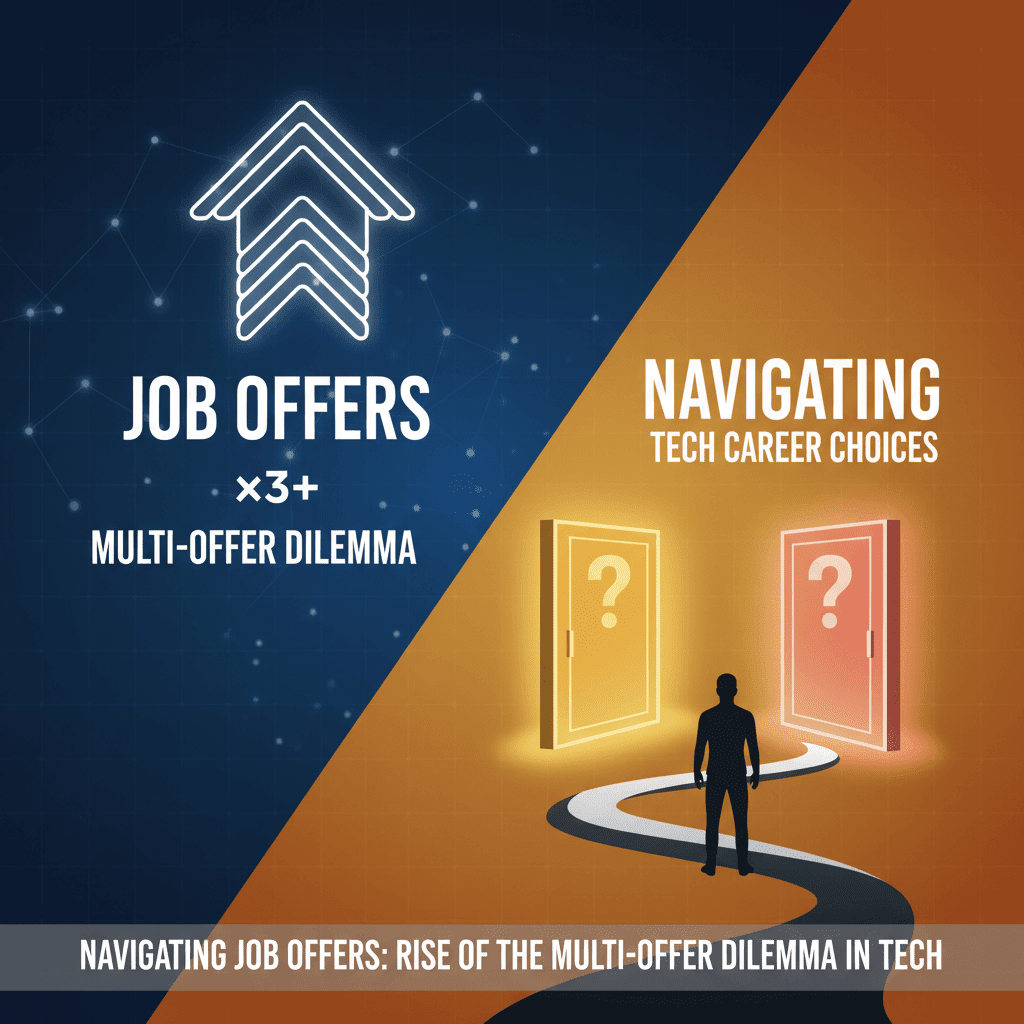
Last month, Sara, a senior software engineer with eight years of experience, found herself in what should have been a dream scenario. After an exhaustive job search, she had three offers in hand: one from a FAANG company offering exceptional compensation, another from a promising startup with equity potential, and a third from an established mid-size firm with work-life balance guarantees. Instead of celebration, Sara felt paralyzed with anxiety.
“I should be thrilled, but I’m losing sleep,” she confided in a popular Reddit thread that garnered over 2,000 comments. “The tech landscape feels so volatile right now. What if I choose wrong and end up in a layoff three months later? What if I decline the wrong offer and burn bridges I’ll need later?”
Sara’s dilemma represents a growing phenomenon in tech recruitment: the multi-offer anxiety syndrome. As the industry experiences unprecedented volatility with simultaneous hiring freezes and aggressive talent acquisition, candidates increasingly find themselves navigating complex offer scenarios with imperfect information and mounting pressure.
The Changing Landscape of Tech Recruitment
The tech job market has transformed dramatically in the past three years. Following the pandemic-fueled tech boom and subsequent correction, we’ve entered what industry analysts call a “selective growth phase” – where certain companies aggressively expand while others contract, often simultaneously.
The Dual-Reality Job Market
Recent data from CompTIA shows tech employment grew by 12,700 positions in June 2023, yet this occurred against a backdrop of 75,000 tech layoffs in Q2 2023. This paradoxical environment creates a scenario where candidates might receive multiple competitive offers while simultaneously hearing about mass layoffs – sometimes from the same companies.
Meta serves as a prime example of this contradiction. After laying off 11,000 employees in November 2022, they began selectively rehiring in certain divisions by March 2023. This whiplash approach has left candidates questioning the stability of even the most established tech employers.
Actionable insights:
- Research not just current hiring trends but also recent layoff history at prospective employers
- Look beyond headcount changes to understand which specific departments are growing versus contracting
- Connect with recent hires (within 6-12 months) via LinkedIn to gauge post-offer reality
The Compressed Timeline Phenomenon
Another factor contributing to candidate stress is the compression of hiring timelines. According to a survey by Hired, the average time-to-hire for tech positions decreased from 45 days in 2019 to just 30 days in 2023 for mid to senior-level positions.
“Companies are putting enormous pressure on candidates to decide quickly,” explains Rajesh Ahuja, VP of Talent Acquisition at a Fortune 500 tech firm. “We’re seeing exploding offers with 48-hour deadlines become normalized, which hardly gives candidates time to complete other interview processes or properly evaluate options.”
The Ethical Considerations of Multiple Offers
The multi-offer dilemma has spawned intense debates about candidate ethics in online forums and industry discussions. The central question: what obligations do candidates have when holding multiple offers?
The Acceptance Dilemma
One of the most contentious practices is accepting an offer while continuing to interview elsewhere. A poll on Blind, the anonymous professional network, found that 62% of tech professionals admitted to accepting an offer while still pursuing other opportunities.
Michael, a product manager who requested anonymity, shared: “I accepted an offer from a mid-size SaaS company while still in final rounds with two FAANG companies. Two weeks later, I received an offer with a 40% higher compensation package. I reneged on my first acceptance. It felt terrible, but in this economy, I had to prioritize my financial security.”
Navigating ethical considerations:
- Be transparent about your timeline when possible, without revealing specific details about other offers
- Request reasonable time extensions rather than accepting offers you’re likely to decline
- If you must renege, do so professionally and as early as possible
The Transparency Question
How much should candidates disclose about competing offers? Industry experts are divided.
“Strategic transparency can work in your favor,” advises Alison Green, workplace consultant and author. “Mentioning you have other opportunities in the pipeline is acceptable, but using offers as leverage requires careful handling to avoid appearing mercenary.”
A recent LinkedIn poll of 1,500 tech recruiters revealed that 78% appreciate knowing a candidate has other offers, but 65% felt negatively about candidates who shared specific compensation details from competitors to negotiate.
Psychological Impact and Decision Paralysis
The psychological toll of navigating multiple offers in an uncertain market shouldn’t be underestimated. What appears to be a privileged position can quickly become a significant source of stress.
The Paradox of Choice
Psychologist Barry Schwartz’s concept of “the paradox of choice” applies perfectly to the multi-offer scenario. More options often lead to increased anxiety and decreased satisfaction with the final decision. A study published in the Journal of Occupational Health Psychology found that job seekers with multiple offers reported 37% higher stress levels during the decision period than those with single offers.
“I had three solid offers, and I was miserable,” recounts Devon, a UX designer. “I made spreadsheets, pro-con lists, talked to mentors, but kept second-guessing myself. The fear of making the wrong choice was overwhelming, especially seeing friends go through layoffs.”
Mental health strategies:
- Set a decision framework before receiving offers to reduce emotional decision-making
- Limit information gathering to prevent analysis paralysis
- Consider working with a career coach to provide objective perspective
The Post-Decision Anxiety
Even after making a decision, many candidates experience persistent anxiety. According to Dr. Lisa Cohen, organizational psychologist, this stems from “counterfactual thinking” – the human tendency to imagine alternative outcomes.
“Tech professionals are particularly susceptible to ‘optimization thinking’ – the belief that there must be one perfect choice,” explains Dr. Cohen. “This mindset makes it difficult to feel confident in any decision when multiple options exist.”
Strategic Approaches to Multiple Offers
How can candidates effectively navigate this complex landscape? Industry experts and successful job-seekers suggest several strategic approaches.
The Timeline Management Strategy
Proactive timeline management has become essential for candidates juggling multiple interview processes. This approach involves transparency about your situation without revealing specific details that could weaken your position.
Priya, an engineering manager who successfully navigated five simultaneous late-stage interviews, shares her approach: “I created a master timeline and was upfront with recruiters about having multiple processes moving forward. When I received my first offer, I immediately contacted other companies I was genuinely interested in and asked if they could accelerate their process.”
Timeline management tactics:
- When receiving an offer, request a specific decision timeframe (1-2 weeks is reasonable)
- Contact other companies in your pipeline immediately to inform them you have an offer with a deadline
- Be prepared with a decision framework for scenarios where timelines cannot align
The Decision Matrix Approach
To combat decision paralysis, many successful candidates develop structured decision frameworks before receiving offers.
Carlos, a data scientist who chose between offers from Google, a health-tech startup, and a financial services firm, created a weighted decision matrix. “I assigned percentage weights to factors that mattered to me – compensation (30%), growth potential (25%), work-life balance (20%), job security (15%), and company mission (10%). This allowed me to score each offer objectively rather than getting overwhelmed by different strengths.”
Research from organizational psychologists suggests this approach reduces both decision stress and post-decision regret. A structured framework helps candidates make choices aligned with their true priorities rather than being swayed by the most recent conversation or most impressive brand name.
The Future of Multi-Offer Navigation
As the tech industry continues to evolve, how might the multi-offer dilemma change? Several trends suggest both challenges and opportunities ahead.
The Rise of Offer Transparency Platforms
Platforms like Levels.fyi, Blind, and Glassdoor have transformed compensation transparency. Now, new tools are emerging to help candidates navigate offer decisions more holistically.
OfferZen’s “Offer Comparison Tool” and Candor’s “Offer Calculator” represent the first wave of technologies designed specifically for multi-offer scenarios. These platforms incorporate factors beyond compensation, including growth trajectory, company stability metrics, and work culture assessments.
Emerging resources:
- Community-driven offer databases that track not just initial offers but retention rates and promotion timelines
- AI-powered decision assistants that help quantify qualitative factors
- Peer mentorship platforms connecting candidates with professionals who faced similar decisions
Evolving Employer Practices
Some forward-thinking employers are adapting their practices to address candidate anxiety in multi-offer scenarios. Stripe, for example, has implemented a “candidate comfort” policy that guarantees candidates at least one week to decide on offers and provides direct access to potential team members during the decision period.
Other companies are exploring innovative approaches like paid trial periods or project-based assessments that allow both parties to evaluate fit before full-time commitment.
Conclusion: Embracing the New Normal
The multi-offer dilemma in tech recruitment reflects the industry’s fundamental volatility and competitiveness. While stressful, this situation also represents opportunity – the chance to thoughtfully design your career trajectory rather than simply accepting the first available path.
As Sara, our software engineer from the introduction, ultimately discovered: “The stress of choosing between offers forced me to clarify what I actually wanted from my career. I realized I was chasing prestige when what I truly valued was impact and autonomy. This clarity led me to choose the mid-size company – not the highest offer, but the right one for me.”
For those currently navigating multiple offers, remember that perfect certainty is impossible in today’s tech landscape. Instead, focus on developing a decision framework aligned with your values, managing timelines proactively, and maintaining professional relationships regardless of your ultimate choice.
The multi-offer dilemma may be unavoidable, but with strategic preparation and perspective, it can transform from a source of anxiety into an opportunity for career intention and growth.
Where This Insight Came From
This analysis was inspired by real discussions from working professionals who shared their experiences and strategies.
- Share Your Experience: Have similar insights? Tell us your story
At ModernWorkHacks, we turn real conversations into actionable insights.
![[Workflow Included] A simple 5-node Instagram posting workflow for beginners](https://modernworkhacks.com/wp-content/uploads/2026/04/workflow-included-a-simple-5-node-instagram-posting-workflow-for-beginners-1024x675.png)



0 Comments