Discover actionable insights.
The story, the coffee, and the annoying answer
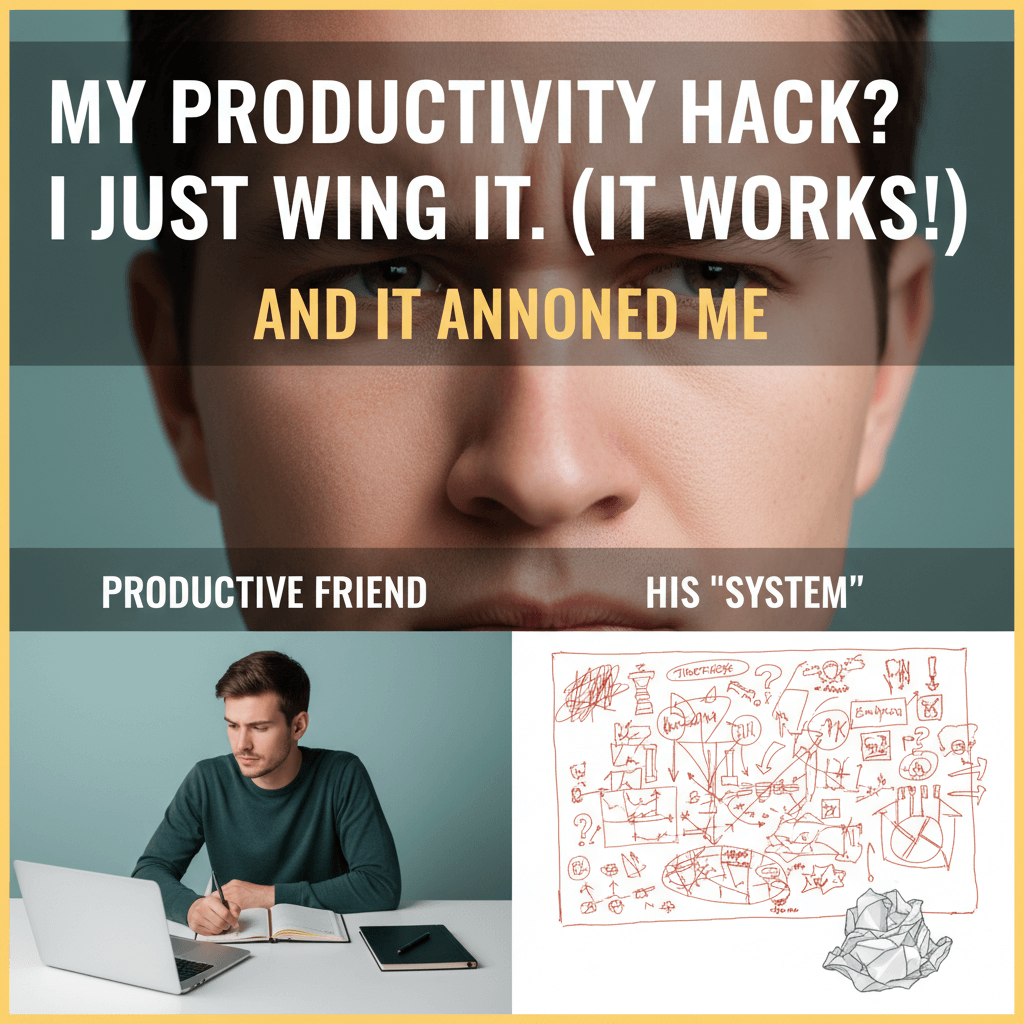
It started over a small table wedged between a potted fern and the espresso machine. I had hunted this conversation for months. My friend—let’s call him Evan—was the person in our group who always seemed ahead. The kind of ahead that looks accidental until you count the receipts: promotions that stuck, projects that shipped, weekends that weren’t swallowed by emergencies. I had questions. Secretly, I wanted a magic lever.
I ordered a black coffee and said, “Okay, what’s your system?” I expected an exotic stew of apps, automations, and acronyms, maybe some sleep hack that involved a freezer and a yoga mat. Evan stirred his tea and said, “It’s boring.”
“Boring how?”
“I do the same week, every week.” He shrugged like this was self-evident. “Same loop. If the week gets weird, I reset the loop and start again.”
I remember feeling a flash of disappointment that surprised me—like opening a gift to find socks. I was ready for a revelation, not a routine. Boring? Predictable? Repetition? Where was the sizzle, the secret sauce? I wanted fireworks. He gave me a metronome.
But the more he explained, the more the metronome became the point. Not a lack of ambition—an architecture for it. Not a lack of ambition—an antidote to chaos. And, annoyingly, it was the opposite of complicated. It was unromantic, unoriginal, and ruthlessly effective. It was also, as I learned, reproducible.
What follows are the key takeaways from real discussions: with Evan over that tea, with colleagues who quietly ship more than they brag, and with managers who navigate calendar traffic like air-traffic controllers. None of them share the same job, but they share the same spine. And if you let it, this spine can hold your week up too.
The system, line by line: what he actually does
Let’s dismantle the mystique. Evan’s “system” isn’t a guru’s labyrinth; it’s a loop with few moving parts. He repeats it until it becomes gravity. Here’s how it works.
The one-page plan
Every week starts with one page (paper or digital). At the top, three lines called Must-Win Results. These are not tasks; they are outcomes. “Draft client proposal version 1,” not “work on proposal.” “Publish Q2 hiring plan,” not “think about hiring.” Outcomes force clarity.
Below that, a short list called Supporting Projects—the containers that feed those outcomes. The final section: Maintenance—recurring essentials that keep life from catching fire (finance check, 30-minute 1:1s, workout, inbox to zero twice this week). The whole page fits on a single screen or index card. Constraint is not cute here; it’s a feature. If it doesn’t fit, it can’t be a priority.
The weekly reset (30–45 minutes)
Sunday night or Monday morning, same time every week, non-negotiable. Evan calls it the reset: no meetings, no email, just decisions. It looks like this:
- Empty the head: a quick brain-dump of everything tugging on attention—work, home, errands, ideas. No filtering yet.
- Group and triage: collapse duplicates, delegate what clearly belongs to someone else, and delete what’s wishful thinking.
- Choose three Must-Win Results: If everything is important, nothing is. He picks three outcomes that, if achieved, would make the week proud even if nothing else happens.
- Block the calendar: timebox deep work for those outcomes. He treats these blocks like meetings—with himself—but will move them when reality demands instead of deleting them.
- Pre-decide maintenance: 1–2 workouts? Done. Groceries? Scheduled. Call with parents? On the calendar. Oxygen first.
What’s annoying here is its simplicity: no sacred knots of color-coded complexity. The “system” is a weekly conversation with reality in which decisions are made once, on purpose.
The daily cadence
Each day is a mini-loop inside the weekly loop. Evan keeps it in four beats:
- Morning plan (10–20 minutes): Review the one-page plan, the calendar, and the inbox. Choose the day’s 1–2 outcome moves—specific steps that push a Must-Win forward. Not everything fits; that’s fine.
- The big block: a 60–90 minute deep work session focused on the hardest outcome. Morning is preferred; resistance is loudest then. Phone away, notifications off, single window, clear start and stop times.
- Admin window: a 30–60 minute slot for email, approvals, pings, and micro-decisions. This contains the swarm and protects the big block.
- Shutdown ritual (10 minutes): Note what moved, what stalled, and what the first task is tomorrow. Then stop. Tomorrow’s friction decreases when today ends cleanly.
Capture and triage, not obsess
Productive people don’t remember more; they remember less by capturing more. Evan keeps two inboxes he trusts: one for work (email + a simple task list) and one for life (notes app). Everything goes there immediately. Twice a day, he triages and files or schedules. There is no third inbox. The rule is blunt: what isn’t captured doesn’t count.
The interrupt protocol
Interruptions attack everyone’s plans. Evan’s move is not willpower; it’s policy.
- If it takes less than two minutes, he does it now—once. If it repeats, it gets a template or an automation.
- If it takes more than two minutes and isn’t tied to a Must-Win, it goes to the admin window; he tells the requester when to expect it.
- If the interruption comes from above, he asks, “What should move down the list to make room?” He doesn’t say yes to everything; he negotiates priorities.
Friday review and reset trigger
On Friday afternoon, he writes three short bullets: Win, Learn, Stuck. The stuck item becomes the first question at next week’s reset. If the week fell apart, he doesn’t autopsy it to death—he just starts the loop again. The reset is the safety net.
Actionable takeaways you can deploy this week
- Create a one-page plan with three Must-Win Results. Force outcomes, not activities.
- Schedule a non-negotiable weekly reset (30–45 minutes). Same day, same time.
- Protect one deep work block daily. Even 45 minutes, truly focused, beats three hours interrupted.
- Contain email and pings to an admin window. Twice a day is usually enough.
- End each day with a two-sentence shutdown note: “Moved X. Next step tomorrow is Y.”
Why the boring system works when flashier systems fail
Let’s address the annoyance: why does something so un-clever outperform cleverness?
It reduces friction, not adds motivation
Motivation is a weather pattern; friction is engineering. The weekly loop minimizes the number of decisions you face while you’re tired or tempted. By deciding once, ahead of time, you make the path easy to follow and hard to leave. Habits latch on to low friction, not hype.
It trades memory for visibility
Our brains are lousy storage devices. The one-page plan, calendared blocks, and captured tasks create an external workspace where you see your commitments instead of juggling them. Visibility is honest; memory is a magician that makes things disappear and reappear at the worst time.
It constrains options so effort concentrates
Focus isn’t a feeling; it’s the absence of a hundred alternatives. By limiting Must-Win Results to three, the system builds a forcing function. Constraints make choices expensive, which makes progress cheap.
It operates in small, repeatable loops
The loop size matters. Weekly is short enough to detect drift and long enough to produce something meaningful. A month is too vague; a day is too cramped. The weekly cadence lets you be strategic and tactical without whiplash.
It bakes in recovery and review
Work without review becomes noise; review without recovery becomes guilt. The Friday bullets and the end-of-day shutdown create micro-reflection. The weekly reset re-anchors. Busy people don’t have time to reflect; productive people can’t afford not to.
Take these reasons and convert them into rules
- Rule 1: Decide difficult things when you’re not in the heat of doing them.
- Rule 2: Make the path obvious—if you need to think hard just to start, you’ll stall.
- Rule 3: Lower the bar for starting; raise the bar for breaking the loop.
- Rule 4: If it isn’t on the page or calendar, it isn’t real.
- Rule 5: Review is sacred. Even five minutes beats none.
Make it yours: a practical seven-day rollout and real-world variations
You don’t need a month to adopt this. Give it one week—seven days to set up, test, and adjust. Here’s a map, plus variations pulled from real conversations with people who live in messy calendars and still ship.
Day 0 (today): choose tools and create the page
- Pick a capture tool you already use (notes app or a pocket notebook). Resist buying anything new.
- Pick a task list that’s easy (a simple to-do app, spreadsheet, or paper). One list only.
- Pick a calendar you’ll actually check (Google Calendar or paper). Color-coding optional, honesty required.
- Create the one-page template with three sections: Must-Win Results, Supporting Projects, Maintenance.
Day 1: schedule your weekly reset and run a “mini” version
- Book a 45-minute slot the same time every week. Protect it like a doctor’s appointment.
- Do a mini-reset now: brain-dump, pick one Must-Win Result for the next three days, and block a deep work session for tomorrow.
Days 2–4: run the daily cadence
- Morning: pick the one move that advances your Must-Win. Name it like an outcome step (“Draft two pages,” not “Work on report”).
- Deep block: phone out of reach, tabs closed, a visible timer. Aim for 45–90 minutes.
- Admin window: twice daily, batch email and pings. If it repeats, template it.
- Shutdown: write tomorrow’s first step. This reduces the ignition energy tomorrow morning.
Day 5: Friday bullets and a tiny retrospective
- Write Win, Learn, Stuck. One sentence each.
- If your deep block fell apart, ask why. Time? Place? People? Adjust that, not your ambition.
Day 6–7: full reset and minor upgrades
- Run a full reset: brain-dump, pick three Must-Win Results, block deep work, book maintenance.
- Add one friction reducer: an out-of-office block for your deep work, a sign on the door, noise-cancelling headphones, or a shared calendar note, “Heads-down: will reply after 2 p.m.”
Real-world variations: lessons from actual teams and roles
What follows isn’t theory; it’s what surfaced in conversations with people whose weeks don’t fit neat boxes.
- Managers drowning in meetings: They use “manager mornings, maker afternoons.” Before noon: 1:1s, approvals, decisions. After lunch: a single 60–90 minute maker block protected by an assistant or an autoresponder.
- Parents of young kids: Their deep block often happens early (5:30–7 a.m.) or late (8–9:30 p.m.). The rule is “same time, same place,” not “perfect time.” Maintenance includes childcare logistics and meal prep as first-class items.
- Sales and client-facing roles: They treat follow-ups as a Must-Win Result. Deep work is prospecting or proposal drafting, not just calls. Admin windows handle CRM updates in batches to avoid death by a thousand clicks.
- Engineers/designers: They fight context switching by clustering similar problems across days. Tuesday is bug triage; Wednesday is feature design. Their Must-Win Results describe artifacts: pull request merged, prototype tested.
- Students: Must-Win Results are tied to deliverables (outline complete, problem set submitted). Admin windows become campus email and scheduling with tutors or professors.
- Freelancers: They anchor the week around revenue-generating work first, then marketing. Friday reviews include pipeline health. Maintenance: invoicing and receipts.
- Distributed teams: They post their Must-Win Results in a shared channel on Monday and reply to themselves on Friday with Win/Learn/Stuck. Visibility replaces micromanagement.
Actionable takeaways to customize without breaking the backbone
- Keep the loop; modify the tempo. If five days is chaos, run a three-day “sprint” and a midweek reset.
- Protect one sacred block. If you can’t find 90 minutes, take 2×45 or 3×30. Volume matters less than integrity.
- Make maintenance explicit. Underestimating upkeep is how systems drown. Book it.
- Publicize priorities wisely. Share your Must-Win Results with your manager or team to preempt misalignment.
Common pitfalls and the simple fixes that rescue momentum
Every system breaks. The question isn’t if; it’s when and how you recover. Here are the traps I’ve fallen into—and the fixes Evan and others use to climb out.
Pitfall: overloading the one-page plan
When you stuff five Must-Win Results onto the page, you didn’t get more ambitious; you got less credible. The fix is social: tell someone your three. Saying them aloud makes adding a fourth feel like breaking a promise.
Pitfall: confusing activity with outcomes
“Work on” is the productivity version of empty calories. The fix: rewrite tasks as outcomes or verifiable steps. Swap “work on deck” for “draft 10 slides with story arc.” Ambiguity invites procrastination; clarity invites motion.
Pitfall: deep work blocks that dissolve
Common culprits: phone proximity, open chat, or a leaky calendar. The fix: environmental constraints. Put the phone in another room. Use a full-screen, single-document mode. Physically block your calendar with “Busy—focus session” and share that setting.
Pitfall: a reset that becomes a research project
Overplanning is just a pretty form of stalling. The fix: cap the reset at 45 minutes and set a timer. If you’re still “optimizing” when it rings, ship the imperfect plan and start. You can’t steer a parked car.
Pitfall: letting other people’s priorities set your Must-Wins
Helping is noble; being a human inbox isn’t. The fix: align Must-Win Results with your actual responsibilities and OKRs, and ask, “What outcome do you expect by Friday?” If they can’t name one, it’s not a Must-Win.
Pitfall: break the loop once, stall for weeks
Miss a day, not the pattern. The fix is the floor: the minimum viable loop you run even on bad days. For some, it’s a 20-minute deep block and a 5-minute shutdown. Momentum loves continuity more than intensity.
Actionable takeaways to keep you out of the ditch
- Use a timer for resets and deep work. End on a win, not a whimper.
- Write the next step before you stop. Tomorrow’s you is less heroic than you think.
- Pick a “floor” routine for chaotic days. Name it now: “20-minute focus + 5-minute note.”
- Put your Must-Win Results where you can’t avoid them—desktop wallpaper, sticky note on your monitor, the first page of your notebook.
Keep score without gaming yourself
What gets measured gets managed—until the measurement becomes the goal. You want numbers that reinforce the loop without distorting it.
Measure inputs you control, outcomes you own, and loops you keep
- Loop integrity: Did you run your reset this week? That’s a yes/no you can celebrate. Consistency compounds.
- Deep work hours: How many minutes did you protect and use? Track in half-hour increments; aim for a weekly total, not a daily perfection.
- Must-Win Results shipped: Out of three, how many outcomes landed? If the answer is often one, your selection may be too ambitious; if it’s always three, consider raising the bar.
Use tiny dashboards, not giant spreadsheets
On Friday, write three numbers and three bullets: Reset? Y/N. Deep hours: X. Must-Wins shipped: Y/Z. Bullets: Win, Learn, Stuck. This is enough data to learn without turning your life into a lab.
Adapt deliberately, not reactively
Every four weeks, review your Friday notes. What’s the recurring stuck? Time of day? Type of task? People? Fix one constraint at a time: change the hour of your block, move it off meeting-heavy days, or renegotiate a recurring ask that derails you. Improvement thrives on single-variable experiments.
When life explodes, shrink the loop, expand the grace
There will be weeks when the loop feels like a luxury. New baby, quarter-end, illness, layoffs—you name it. Then you run the floor routine and keep the symbol alive: one Must-Win Result becomes “keep the team informed daily,” deep work becomes “30 minutes on the critical path,” and maintenance becomes “sleep and food.” Systems don’t judge; they flex.
Actionable takeaways for sustainable scoring
- Pick three metrics: loop integrity, deep hours, outcomes shipped. Track weekly, not daily.
- Review every four weeks. Choose one change. Test it for two weeks before swapping again.
- Define your floor. Write it on your one-page plan so you don’t negotiate with yourself when you’re tired.
Here’s the quiet truth I resisted at that coffee table: I wanted a lever that made work effortless. What I needed was a spine that made effort inevitable. The lever would have lifted for a week or two; the spine holds you up all year. Boredom wasn’t a flaw in Evan’s system—it was the path to repeatability. Repeatability was the path to results.
So if your week currently feels like a patchwork of intentions and apologies, this is your invitation to try the most annoyingly effective move there is: decide once, do on repeat, and let the loop be your lever.
Call to action: Take 30 minutes today to create your one-page plan, choose three Must-Win Results, and block a single deep work session for tomorrow. Tell one person your three, and then start. No new app, no perfect timing, no ceremony—just the loop, starting now.
Where This Insight Came From
This analysis was inspired by real discussions from working professionals who shared their experiences and strategies.
- Source Discussion: Join the original conversation on Reddit
- Share Your Experience: Have similar insights? Tell us your story
At ModernWorkHacks, we turn real conversations into actionable insights.







0 Comments