Discover actionable insights.
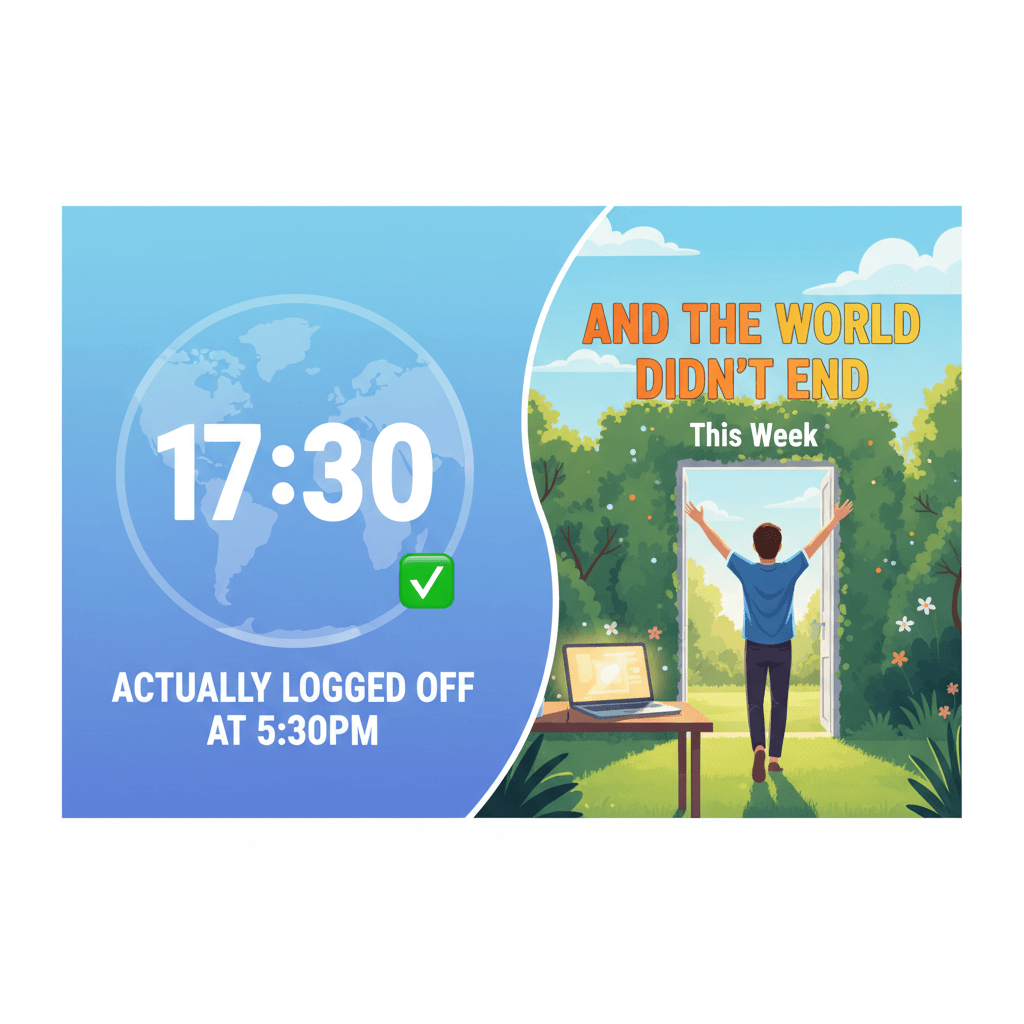
It started with a dare—one I made to myself on a Sunday night while rewriting the same sentence for the third time because my brain refused to cooperate. I said it out loud just to see how it sounded: “This week, I’m going to log off at 5:30. Every day.”
I didn’t say “try.” I didn’t say “aim.” I said “log off.” Full stop. No half-measures. No “just one more email” at 8:47 p.m. My stomach somersaulted at the thought because, like a lot of people, I had quietly inherited the belief that professionalism equals availability. That the best people linger. That important work always drifts past the boundaries of our calendars and into every other corner of our lives if we care enough.
But I was also tired of feeling always on and never fully present. So I created a small, slightly terrifying constraint and told exactly three people: a teammate, a manager, and a friend who’s a spectacular human calendar. I asked them to hold me to it. Then I did something I hadn’t done in ages—I closed my laptop at 5:30 p.m. on Monday and walked away.
Here’s what did not happen: no catastrophic client meltdown, no avalanche of Slack messages with siren emojis, no dramatic drop in productivity. Here’s what did happen: I wrestled with guilt, I noticed the invisible frictions that stretched my days, I redesigned a few small systems, and, by Friday, the entire week had a different texture. The edges of my workday were solid again. And the work? Still good. Maybe better.
Over coffee breaks, team chats, and one delightfully candid 1:1, I asked everyone I could: What actually happens when someone sets a hard stop? What gets better? What breaks? People didn’t hold back. The stories, the eye-rolls, the quiet confessions—those real discussions shaped what follows: practical strategies that don’t require changing jobs, firing your calendar, or transforming your personality.
If you’ve ever whispered to yourself, “I’ll log off at a decent hour… starting next week,” this is for you. It’s not about being rigid; it’s about getting deliberate. And it’s not just a personal productivity trick; it’s a cultural nudge that others will notice—in a good way.
The myth that late equals loyal (and why it sticks)
We don’t regularly work late because we love dim office lighting and reheated leftovers. We do it because we’ve absorbed a set of myths that feel true in the moment. When I asked colleagues and peers why quitting on time felt risky, the answers circled the same drain:
Myth 1: “If I log off at 5:30, people will think I care less.”
Underneath this myth sits a fragile equation: hours visible = value. But work that matters is usually measured in outcomes, not timestamps. In real conversations, managers consistently said the same thing: what frustrates them isn’t shorter days—it’s surprises, silence, and missed expectations. When someone leaves at a predictable time, sets clear checkpoints, and communicates blockers before the last minute, their shorter day becomes a sign of maturity, not apathy.
Reframe: Care is visible through clarity. If your priorities, progress, and constraints are transparent, your departure time stops being a mystery and starts being a signal: “I run a tight ship.”
Myth 2: “Urgent work arrives late, so I have to be available.”
Crises do happen. But they’re rarer than our adrenaline would have us believe. What’s frequent is new information arriving late—not work that is genuinely critical and cannot wait. The fix isn’t eternal availability; it’s an escalation protocol: a shared understanding of what qualifies as urgent, who decides, and how to reach you if the need is real.
Reframe: Replace ambient availability with explicit escalation. Ninety percent of “urgent” items melt when exposed to a simple question: “What’s the consequence if this waits until morning?”
Myth 3: “If I finish earlier, people will just give me more.”
Sometimes this one is true—if you don’t set scope boundaries or if “more” always lands without negotiation. But completing focused work faster doesn’t have to mean becoming the catch-all. Teams that talk openly about capacity and priorities tend to protect each other’s focus time. The counter-move is to define “done,” make trade-offs visible, and normalize asking, “What should move off my plate if this moves on?”
Reframe: Throughput invites choice, not automatic overload, when you make capacity and trade-offs explicit instead of implicit.
These myths persist because they’re socially reinforced. The good news: so are better norms. When one person shapes their day with intention—and narrates how they do it—others feel permitted to experiment too.
- Actionable takeaway: Ask your manager, “If I leave at 5:30 daily, what would you need from me to feel confident?” Capture the list. Make that your working agreement.
- Actionable takeaway: Define “urgent” with your team this week. Write it down. Include examples. Share the contact method that bypasses everything else only for those edge cases.
- Actionable takeaway: Add this sentence to your status updates: “If you need something reprioritized, here’s the trade-off I recommend.” Normalize negotiated scope.
What actually happened during the 5:30 experiment (day by day)
I thought the hard part would be saying no. It wasn’t. The hard part was learning where time slipped away unnoticed. Here’s the daily play-by-play—and what I changed in response.
Day 1: The Exit Alarm and the Guilt Spiral
I set a 5:20 p.m. “wind-down” alarm and a 5:29 p.m. “close it now” alarm. When 5:20 hit, my first reaction was panic. I had two half-finished messages and a tab forest that looked like a cartographer’s nightmare. I wanted to rush, cram, and promise follow-ups I couldn’t guarantee. Instead, I wrote three quick notes: “Here’s where I got to; here’s what’s next; I’ll pick this up at 9 a.m.” Then I shut down.
The surprise: no one replied with disappointment. Two people thanked me for the clarity. The bigger surprise: the guilt lasted about 20 minutes, then turned into a low hum I could ignore.
- Takeaway: Time-box your shutdown. A 10-minute ritual beats a 45-minute slow fade.
- Takeaway: Replace vague “I’ll get this soon” with specific handoffs: state progress, next step, and when you’ll resume.
Day 2: Calendar Reality vs. Calendar Fantasy
On Tuesday, I tried to brute-force my way through a day that had meetings stacked like dominoes. By 3 p.m., I had completed exactly zero deep-work tasks. So I paused and did something radical: I moved a non-urgent sync to later in the week, declined a “nice to have” invite with a short agenda question, and carved one 90-minute focus block. I finished the most cognitively heavy task of the day inside that block—and logged off at 5:30 without the churn.
Calendar visibility made all the difference. Fantasy schedules ignore context switching; real schedules defend one or two blocks like sacred ground.
- Takeaway: Protect at least one 60- to 90-minute focus block before noon. If your calendar rebels, move something. Don’t wait for empty space to appear.
- Takeaway: Decline invites without agendas. Offer a written update or a question instead. Most meetings will either shrink or vanish.
Day 3: The Boundary Script That Worked
Wednesday brought the dreaded late-afternoon “quick ask.” It wasn’t trivial, but it also wasn’t time-bomb urgent. I used a script I’d drafted the night before: “I’m logging off at 5:30. I can start this first thing tomorrow and have X done by Y. If this truly can’t wait, here are two faster options.” I suggested a lightweight workaround and offered a short morning check-in. They chose the morning. We shipped it by 10:45 a.m. the next day.
The magic wasn’t the phrasing so much as the structure: acknowledge, offer a clear alternative, provide a path for escalation if truly urgent. Boundaries feel like a wall when they lack doors. This one had two.
- Takeaway: Draft two or three boundary scripts in advance. When the moment comes, you won’t improvise yourself into a corner.
- Takeaway: Always include a next-best-step and an explicit escalation path. Don’t just say no—design a useful no.
Day 4: The Debugging of Invisible Work
Thursday was the turning point. I noticed patterns: I was answering the same three questions repeatedly in DMs, double-entering updates across tools, and spending 20 minutes formatting things no one needed formatted. I created a simple doc with FAQs, posted it in a channel, and linked it in my status. I also started using one canonical source of truth for progress, then pasted the link everywhere instead of copying content.
Nothing glamorous. Just friction removal. The compound effect was real: less rework, fewer micro-interruptions, and less mental residue at 5:30.
- Takeaway: Eliminate duplicate updates. Pick one source of truth. Link to it relentlessly.
- Takeaway: Externalize FAQs. If you answer something twice in a week, it deserves a home you can point to.
Day 5: The Friday Debrief and the Culture Nudge
On Friday morning, I told my team what I was trying and asked what they noticed. The comments were candid: “Your handoffs made it easier to help.” “The morning priorities in your status saved me a check-in.” “It felt easier to wrap my own day when you did.” We also agreed on two small changes: a shared “what’s hot” list visible to everyone and a five-minute “finish line” post in our channel at 5 p.m. on Fridays to name what we shipped.
And when 5:30 came, logging off felt… normal. Not defiant. Not indulgent. Just part of how we work.
- Takeaway: Narrate the experiment. People support what they understand—and copy what works.
- Takeaway: Add a collective end-of-week ritual. It gives closure and quiets the “did I do enough?” voice.
Systems that make 5:30 possible (without being a unicorn)
“Be more disciplined” is not a system. Neither is “just say no.” The routines that actually shortened my days were boring on purpose. They replaced ambient hope with repeatable steps.
1. The shutdown checklist
A tiny ritual prevents late-afternoon chaos from leaking into the evening. Mine fits on a sticky note:
- Review tomorrow’s top three priorities. Are they still the top three?
- Write a two-sentence status: what moved, what’s next.
- Scan inbox and DMs for true blockers. Respond or escalate with a time-bound plan.
- Close all tabs that aren’t tied to tomorrow’s top three.
- Set the first 30 minutes tomorrow as warm-up time. Fill it now.
Why it works: You trade a twitchy last 30 minutes for a calm first 30 tomorrow. Momentum pays interest overnight.
2. The calendar guardrails
“What gets scheduled gets done” is half true. What gets protected gets done, too. Three simple rules help:
- Two 60- to 90-minute focus blocks per day, ideally one before noon.
- Meeting cap: no more than 4 hours of meetings in any one day when possible.
- Buffer zones: 10 minutes between back-to-back meetings to write decisions and next steps while they’re fresh.
Why it works: Protecting time is cheaper than context switching every 12 minutes.
3. The escalation agreement
Write, share, and pin a simple note titled “When to escalate and how.” Include:
- Definition of urgent (with examples and non-examples).
- Primary channel for standard asks (email, project board, or channel).
- Escalation channel for rare, time-sensitive cases (call/text).
- What to include in an escalation (impact, deadline, minimal viable solution).
Why it works: Urgency becomes a specific pathway, not a vibe.
4. The async-first update
Instead of status meetings that sprawl, adopt a lightweight written update: three bullets, once per day.
- What I did today
- What I’m doing tomorrow
- Where I’m blocked (and what I need)
Why it works: People coordinate without adding another half hour to the calendar. Meetings shrink to decisions.
5. The scope swap script
When something new arrives, reply with: “To take this on by [time], I recommend we pause [thing] or push [deadline]. Which do you prefer?”
Why it works: You surface trade-offs in the moment, instead of quietly stretching yourself and your day.
6. The “one home” rule for information
Pick one canonical home for each artifact: decisions, documents, timelines. Link to it everywhere else. Don’t multiply versions. Don’t parallel-post updates unless the second channel is a pointer.
Why it works: You reduce scavenger hunts and late-afternoon “where is that?” scrambles.
7. The “pre-commit” to stop time
Tell people your stop time early in the day—especially if you expect last-minute asks. For example: “Heads up: I’m offline after 5:30 today. If you need input from me, please ping by 4.”
Why it works: People route requests earlier. You don’t become the emergency lane by default.
8. The Friday closure ritual
End the week with a five-minute wrap: share two wins, one learning, and your top priority for Monday. Archive or postpone everything that didn’t make the cut. Be explicit about what’s carrying over.
Why it works: Clarity replaces the creeping sense that you left 17 loose ends on the table.
- Actionable takeaway: Pick two of the systems above and implement them tomorrow. Don’t try to overhaul everything. Small, visible changes compound fastest.
What changed—and what didn’t—when I shut the laptop at 5:30
The first and most immediate change was psychic: evenings felt wider. But there were practical shifts too. Some were unexpected, and some were stubbornly the same—which was instructive.
Fewer after-hours pings, more morning momentum
Because I pre-announced my stop time and clarified how to escalate, questions shifted earlier. Morning time turned into a consistent runway: I started with intent instead of reaction. My first 90 minutes produced more than the previous week’s scattered afternoons.
Better meeting hygiene
Saying no to late-afternoon meetings pushed me to ask for agendas, outcomes, and time caps. It also made me suggest recording short loom-style updates instead of live sessions. The result was fewer meetings and tighter ones. People noticed—and reciprocated.
No disaster in responsiveness
I worried clients or cross-functional partners would feel I’d vanished. They didn’t. They saw faster replies during the day and more thorough updates. When something truly couldn’t wait, the escalation path worked. The silent lesson: fear of being unreachable is often a story we tell ourselves, not feedback we’ve received.
The stubborn stuff: unexpected work and shifting scope
Surprise tasks still arrived. Priorities still moved. The difference was not the absence of change; it was the presence of guardrails. Instead of absorbing everything, I invited decisions. My days didn’t become perfectly predictable; they became negotiable in the open.
- Actionable takeaway: Track one metric for a week: number of after-hours messages you respond to. Then share your plan to reduce it by half, with the escalation backup. Measure again.
- Actionable takeaway: Convert one recurring meeting into a written update for two weeks. Compare outcomes and time reclaimed. Decide whether to keep the change.
Key takeaways from real discussions
The best insights came from honest chats across roles—managers, individual contributors, and partners. Here’s what surfaced repeatedly:
- From managers: “I don’t need you online late; I need no surprises.” They want visibility into progress, early warnings on risks, and clarity on trade-offs. Proactive communication beats reactive availability every time.
- From teammates: “When you log off on time, it gives me permission to do the same.” Boundaries are contagious. People mirror the behavior they see, especially if it comes with clear handoffs.
- From cross-functional partners: “Tell me your stop time up front.” Most partners appreciate time constraints when they’re explicit early, paired with alternatives and clear next steps.
- From clients/stakeholders: “I care that we hit outcomes, not that you answered at 7 p.m.” Responsiveness within reasonable hours, plus a path for true emergencies, preserves trust without burnout.
- From the skeptics (and we need them): “What about peak cycles?” Even in crunch periods, a lighter version of the system helps: tighter priorities, shorter days where possible, and explicit sunset times on exceptions prevent “temporary” from becoming the norm.
- From myself (after one week): Ending on time sharpened my daytime choices. With a real deadline, I wrote shorter emails, asked better questions, and invested in one source of truth instead of formatting updates for three tools.
If you’re leading a team, the meta-takeaway is this: when you model and reward clarity over constant presence, you don’t just protect people—you improve the work. If you’re an individual contributor, the move is smaller and just as powerful: define your stop time, share your plan, and deliver outcomes that make the boundary boring.
Your 5:30 playbook: scripts, checklists, and experiments
Here’s a compact toolkit you can copy, paste, and adapt this week. You don’t need perfect conditions; you need one or two moves that tilt the day in your favor.
Boundary scripts you can use today
- Pre-commit: “Heads up: I’m offline after 5:30 today. If you need input from me, please ping by 4. Otherwise I’ll pick things up at 9 a.m. tomorrow.”
- Late ask (non-urgent): “I’m closing at 5:30. I can start this first thing tomorrow and have X by Y. If something changed and it’s urgent, call me at [number]; otherwise, I’ll update you in the morning.”
- Scope swap: “To fit this in today, should we pause [A] or move [B]’s deadline? I can’t do all three by end of day and keep quality.”
- Meeting redirect: “Could we handle this async? If you share the top two questions, I’ll reply in writing by noon.”
10-minute shutdown checklist
- Write your two-sentence status (done/next).
- Capture one blocker and what you need.
- Set your top three for tomorrow and reserve a focus block.
- Close or save tabs. Bookmark anything you’ll actually use tomorrow.
- Clear the inbox triage: respond, snooze, or schedule.
Micro-experiments for the next two weeks
- The 4 p.m. sweep: For five workdays, spend 10 minutes at 4 p.m. scanning for asks that will blow up your exit. Nudge them forward or renegotiate scope before they become last-minute emergencies.
- One source of truth: Choose a single spot for project updates for two weeks. Link to it everywhere. Measure how often you repeat yourself; aim to cut it in half.
- Meeting compression: Turn one 30-minute meeting into a 15-minute decision huddle with a pre-read. Keep score: Did you decide faster? Did anything suffer?
- Public finish line: Post a short “what shipped today” note at 5 p.m. in your team channel for a week. See if others join in. Closure is a social cue.
- Trade-off transparency: Each time new work lands, respond with explicit options. Track how often scope or deadlines shift in response. You’ll notice people start preempting the question.
If you manage a team
- State explicitly that availability ≠ performance. Tie recognition to outcomes, clarity, and collaboration.
- Codify your escalation policy. Share examples. Praise people who used it well, even when they decided not to escalate.
- Audit recurring meetings quarterly. Require agendas and outcomes—or archive them.
- Model the boundary. Log off visibly. Share your shutdown ritual. Celebrate end-of-day posts.
- Create a “what’s hot” list visible to everyone. When priorities shift, update it in public. This single move calms a lot of after-hours churn.
Reality check: Some weeks won’t allow a pristine 5:30 exit every day. That’s not failure. The point is not perfection—it’s agency. When exceptions happen, mark them as exceptions, set a sunset date, and do a mini-retro on what made them necessary.
Call to action: start your own 5:30 week
You don’t need to overhaul your life to reclaim your evenings. You need seven days, a few scripts, and the courage to narrate your plan. Here’s your starter kit:
- Pick a week. Put “5:30 hard stop” on your calendar every day. Add a 5:20 wind-down reminder.
- Tell the three people who matter most to your workflow: a manager, a close teammate, and one key partner. Share your plan, your escalation path, and your top three priorities for the week.
- Adopt two systems from this article. My picks for quick wins: the shutdown checklist and the 4 p.m. sweep.
- Replace one meeting with a written update. Guard one morning focus block like your ability to think depends on it—because it does.
- On Friday, do a five-minute retro. What helped? What got in the way? What will you keep?
Then report back—to your team, your manager, or even just a note to yourself—on what changed and what didn’t. Share what you learned so others can borrow it. The culture you want to work in is built one small, repeatable practice at a time. When we make our boundaries boring and our progress visible, 5:30 becomes not a defiant act but a shared norm.
Try it this week. Close the laptop, step away at 5:30, and see for yourself: the world won’t end—and your work might just get better.
Where This Insight Came From
This analysis was inspired by real discussions from working professionals who shared their experiences and strategies.
- Source Discussion: Join the original conversation on Reddit
- Share Your Experience: Have similar insights? Tell us your story
At ModernWorkHacks, we turn real conversations into actionable insights.
![[Workflow Included] A simple 5-node Instagram posting workflow for beginners](https://modernworkhacks.com/wp-content/uploads/2026/04/workflow-included-a-simple-5-node-instagram-posting-workflow-for-beginners-1024x675.png)




0 Comments