Discover actionable insights.
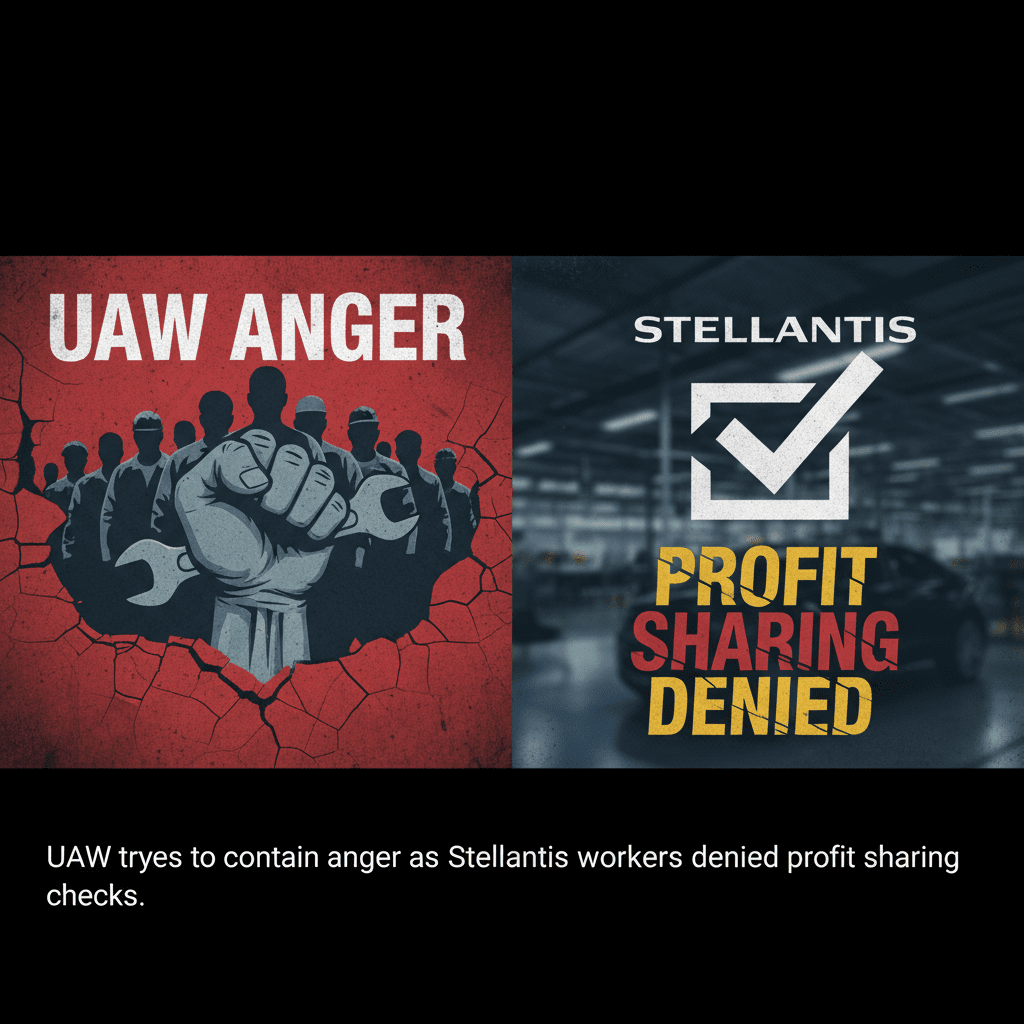
On a chilly morning in the Midwest, the line outside a Stellantis plant moved slowly. Workers shuffled through the gate in heavy boots, eyes down, conversations hushed. Word had spread through overnight texts and Facebook groups: profit sharing checks were being posted, but a significant group of workers weren’t on the list. Some were told they didn’t qualify. Others were simply left in the dark. As the shift horn sounded, a veteran assembler brushed past a younger co-worker who had just transferred from another plant. “Did you hear anything yet?” the newcomer asked. The older worker shook his head and said, “No check. No explanation.” Then he added, almost reflexively: “They’re telling us to be patient.”
By lunchtime, the rumor mill was in overdrive. A union steward fielded a dozen versions of the same question—who was in, who was out, and why? Management said the formula was applied as always. Some local leaders said they were working “behind the scenes.” UAW’s national office pushed out talking points emphasizing the broader wins of the recent contract and urging members not to let the company “divide the ranks.” Yet the anger kept growing, fueled by screenshots of pay stubs, fragments of policy, and a palpable sense that the ground rules had shifted just enough to leave many behind.
This is the moment where trust is either rebuilt with clarity and action—or eroded by spin and silence. In the days that followed, the phrase “profit sharing” turned into a contested terrain. Whose profits? Which formula? What counts as hours worked? Who is an eligible worker? And what, if anything, could be done now—before resentment calcifies into apathy?
What follows distills real worker discussions across union halls, plant-floor conversations, and local social channels into clear takeaways and practical steps. You will find not just analysis, but a blueprint for action that any Stellantis worker, steward, or local officer can use to push for answers and outcomes—quickly.
What just happened: the shock, the silence, and the spin
The shock was immediate because profit sharing has long been stitched into the rhythm of work in the auto industry. Even when the checks vary year to year, the expectation is a kind of social contract: when the company thrives, the people who build the product share in the upside. That is the promise that makes grueling schedules, rotating shifts, and weekend overtime feel worth it to many.
But this cycle broke that rhythm for a sizable number of Stellantis workers. The reasons cited were multiple and often murky: classification issues, hours thresholds, plant or unit eligibility, transfer dates, and the use of uncompensated time that pushed workers below a line they didn’t even know existed. Meanwhile, official messages—both from management and some union channels—tried to keep the temperature down. “Be patient.” “We’re looking into anomalies.” “There’s a process.”
The immediate result was a credibility crisis. Workers who had celebrated wage gains and job security language asked why profit sharing—a core part of the total package—felt out of reach. The frustration wasn’t only about money; it was about fairness, voice, and whether the union would publicly challenge a company that appears to benefit from intricate eligibility rules that many members only learn about at the worst possible time.
Signals you can’t ignore
- Information asymmetry: Workers learned about denials from pay portals and rumor, not from direct, timely, transparent communication.
- Fragmentation risk: Different plants, job classifications, and transfer groups experienced different outcomes, making it harder to unite around a single story.
- Containment instincts: Messages from leadership emphasized patience and process, not mobilization—at least initially.
Actionable takeaways
- Document everything now: Screenshots of pay statements, HR emails, job codes, and any denials. Time-stamp your records.
- Map the impact: Identify who didn’t receive checks (classification, plant, transfer status). Patterns are power.
- Create one trusted communication channel per local or department to stop rumors and spread verified information.
The fine print that denied checks: how the profit-sharing formula can zero you out
Profit sharing in auto is simple in theory and complicated in practice. A company announces a performance metric—usually profits in North America or a related division—and then applies a formula. The formula gets multiplied by “eligible hours” per worker to produce a payout, often prorated. Somewhere between the press release and the pay stub, however, definitions become destiny. That’s where many Stellantis workers found themselves this year: on the wrong side of definitions they didn’t set and couldn’t easily decode.
What’s typically in the formula
- Profit basis: Most plans key off North American operating profit or EBIT, not global results. If Europe or other regions outperform while North America lags, it can depress payouts.
- Proration based on hours: Workers receive more or less depending on “eligible compensated hours”—a term with exclusions and caveats.
- Eligibility rules: Some classifications, probationary periods, transfers, or affiliates may be treated differently or excluded.
- Cutoff dates: Hire dates and transfer effective dates can affect whether hours “count” for a given plan year.
Common traps workers reported encountering
- Uncompensated time: Strike days, certain types of unpaid leave, or disciplinary time off can reduce “eligible hours,” lowering or eliminating payouts for workers near minimum thresholds.
- Classification gray zones: Supplemental employees, temporary status, or special assignments (including certain parts distribution and logistics roles) can be coded differently, affecting eligibility.
- Transfers and conversions: Moving between plants or converting from temporary to permanent can reset eligibility or split hours, creating gaps that systems sometimes interpret harshly.
- Data lags: HR and payroll systems that haven’t reconciled year-end changes can label hours incorrectly, delaying or denying checks until errors are contested.
Behind each of these traps is a structural reality: the company writes and operates the systems that calculate profit sharing. Unless the union wins clear language that bans exclusions, mandates counting certain hours, or forces clean data reconciliation before issuance, “the system” tends to err in the company’s favor.
What to verify immediately (and how)
- Eligible hours ledger: Request an itemized ledger of your compensated hours used for the profit-sharing calculation. Compare it against your own timekeeping and any approved leaves.
- Classification history: Confirm your status for every pay period of the plan year. Note dates of any conversion, transfer, or departmental change.
- Plan document access: Ask your local for the most current profit-sharing plan and any side letters or MOUs that define “eligible” time and populations. Do not rely on summaries alone.
- Error-correction procedure: Get the documented process and timeline for contesting profit-sharing calculations. Push for written responses, not verbal assurances.
Actionable takeaways
- Don’t accept “not eligible” without a plan citation: Demand references to the specific section of the plan that explains your denial.
- Push for counting protected time: If certain unpaid time was negotiated to be protected, insist that it not be used to zero out your check.
- Use the grievance and information rights strategically: File targeted grievances and information requests to force data transparency.
Containing anger vs. channeling it: UAW’s response and what workers are really saying
In the hours after news of denials broke, local and national union messages emphasized unity and patience. That tone is understandable: no union wants an internal meltdown to become a company’s leverage. But workers don’t experience patience and unity as abstract values; they experience them as paychecks, rent due dates, and whether the union defends their material interests in public, not just in private.
Across real discussions—union halls, shift-change conversations, and local chat groups—the same themes surfaced repeatedly. These aren’t one-off gripes; they’re patterns.
Key takeaways from real discussions
- Confusion breeds suspicion: Without clear, written explanations, many assume the worst. Workers swap contradictory screenshots and hearsay because official channels lag.
- Uneven local response: Some locals rapidly published FAQs, hosted pop-up office hours, and filed mass information requests; others defaulted to “we’re looking into it.”
- Formula shock: Many learned for the first time how aggressively the formula can exclude time or people—especially those who transferred or spent time as temporary workers.
- Comparisons sting: When other automakers’ workers circulate their payouts, Stellantis denials feel even more punitive, whether or not cross-company formulas are truly comparable.
- Desire for leverage: Members aren’t just asking for sympathy; they want a strategy—joint audits, deadlines, public pressure, escalation points, and a credible plan to fix this mid-contract if needed.
To be fair, some union leaders did move quickly to gather data and challenge calculations. But in a moment like this, speed and transparency matter as much as intent. Every day without a clear plan drains trust. The task is not simply to “contain anger”—it’s to convert it into a disciplined campaign that produces corrections now and changes the rules for next time.
What leaders can do that builds trust fast
- Hold a member briefing with documents in hand: Plan language, company memo, and a simple explainer of who is affected and why.
- Publish a timeline: When data will be received, when corrections will be processed, and when escalations will occur if deadlines slip.
- Create a grievance and inquiry “war room”: A small team that tracks every case, status, and outcome. Report numbers weekly.
- Speak plainly about risk: If strike time or certain statuses aren’t counted, say so. Don’t sugarcoat. Then outline how you will contest or negotiate remedies.
Actionable takeaways
- Demand a joint audit: Member reps and management in the same room, reconciling hours and eligibility line by line for affected groups.
- Standardize the ask: Provide members a template request for their hours and eligibility file so data arrives in a comparable format.
- Close the rumor gap: Daily updates—even brief—outperform long silences that fuel speculation.
Your 30-day playbook: concrete steps workers and locals can take right now
Anger without a plan burns hot and fades fast. Anger with a plan builds power—and fixes problems. Whether you’re a rank-and-file worker, a steward, or a local officer, here’s a disciplined, time-bound approach to turn confusion into clarity and results within the next month.
Days 1–3: Stabilize information and collect evidence
- Launch a secure intake form: Collect names, employee IDs (securely), classification history, transfer dates, and a brief description of the denial. Make fields standardized.
- Build a case folder per worker: Include pay stubs, HR messages, and your notes. Date-stamp everything.
- Publish an initial FAQ: What is known, what is under review, and how members can request their hours/eligibility file from HR.
- Notify management in writing: Inform them that the local will be reviewing all denials and requests prompt document production under your information rights.
Days 4–10: Verify data, file targeted grievances, and identify patterns
- Cross-check hours: Compare member-submitted time records with the company’s calculation. Flag unpaid time and disputed classifications.
- Batch grievances by issue: One for classification denials, one for transfer-related miscounts, one for uncompensated time ambiguities. Batching builds scale and clarity.
- Create a pattern dashboard: Tally denials by plant, classification, and status changes to reveal systemic errors or policies.
- Engage the regional: Share the pattern data and request coordinated action to prevent plant-by-plant whack-a-mole.
Days 11–20: Negotiate fixes and escalate strategically
- Seek an interim remedy: Ask for a provisional payout or expedited corrections for clearly misclassified cases.
- Press for a joint reconciliation session: Put reps who know the floor’s realities into the room with HR/payroll to correct errors live.
- Leverage public accountability with care: Use member-approved stories (with identities protected if needed) to highlight systemic issues—after giving management a fair deadline to fix.
- Prepare midterm bargaining asks: If the plan language clearly enables these denials, craft proposals that redefine eligible hours, protect transfers, and include strike-related provisions.
Days 21–30: Secure outcomes and lock in long-term improvements
- Confirm corrections are paid: Track each resolved case to ensure the money actually lands in members’ pockets.
- Publish a post-mortem: What went wrong, what was fixed, and what’s next. Transparency here builds lasting trust.
- Institutionalize safeguards: Adopt local bylaws or standing committees that annually audit profit-sharing calculations before checks go out.
- Scale what worked: Share templates, dashboards, and strategies with other locals. Solidarity multiplies impact.
Tools and templates to put in motion today
- Member data request template: A one-page letter to HR requesting the profit-sharing calculation, eligible hours ledger, and classification record used.
- Grievance short forms by category: Pre-filled descriptions for common scenarios (transfer miscount, classification denial, unpaid time exclusion errors).
- Weekly update script: A 5-bullet message for stewards to share on the floor to keep everyone aligned on progress and next steps.
- Privacy and security protocol: Guidance for collecting member data safely, using secure storage and limited access controls.
Actionable takeaways
- Move from individual confusion to collective clarity: Standardize data collection and analysis.
- Set deadlines you control: Don’t wait passively—publish your own timetable and hold management to it.
- Win now, fix forever: Seek immediate corrections while negotiating structural protections for next year.
The bigger picture: profit sharing, power, and how to change the rules
Profit sharing is often framed as a bonus—a little something extra when times are good. In reality, it’s part of total compensation and a tool that can either align incentives or drive wedges between classes of workers. When the formula is narrow (focused on one region’s profits), when “eligible hours” carve out big chunks of real life, and when classification games can exclude the very people who bore the brunt of lean staffing or strike risks, profit sharing becomes less a reward and more a sorting mechanism.
There’s a broader context too. Stellantis operates in multiple markets and can legally and financially segment performance in ways that make it hard for workers in one region to benefit from wins elsewhere. The company has powerful levers—capital allocation, product placement, and internal transfer pricing—that shape where profits show up on paper. When workers feel that those levers reduce their share of success, frustration isn’t just emotional; it’s rational. That’s why a strong union strategy centers on changing the rules, not just reacting to outcomes.
Strategic goals for the next bargaining cycle (and what can start now)
- Broaden the profit basis: Tie payouts to a blended performance metric or include global or multi-regional factors to reduce gamesmanship and geographic arbitrage.
- Codify eligibility fairness: Guarantee that key categories of time—like certain protected leaves, negotiated downtime, or strike-related periods—count toward eligibility or don’t trigger zeroing out.
- End classification loopholes: Mandate that temporary/supplemental workers accrue profit-sharing eligibility on a clear timetable, with transparent prorating that doesn’t quietly exclude them.
- Protect transfers: Ensure that moving to meet company needs never penalizes profit-sharing eligibility. Transfers should carry hours, status, and eligibility seamlessly.
- Annual pre-issuance audits: Lock in a joint audit requirement 30 days before checks are paid, with dispute resolution protocols and automatic provisional payouts where data is contested.
Power-building beyond the table
- Member education as leverage: When every worker understands the formula and its traps, management loses the advantage of obscurity. Make plan literacy a routine part of new-hire orientation and steward training.
- Data transparency campaigns: Push for dashboards that show profit-sharing forecasts and eligibility projections quarterly, not as a year-end surprise.
- Coalition pressure: Coordinate with other unions and community allies to spotlight how value created on the factory floor translates (or fails to translate) into worker gains.
What success looks like
- No surprises: Every worker knows 90 days in advance where they stand, why, and how to correct errors.
- Less volatility, more fairness: Eligibility rules that track real work and real life—not narrow definitions that create “gotchas.”
- Trust restored: Members see their union not only win contracts but actively police and improve how those contracts are implemented in day-to-day pay.
Actionable takeaways
- Start now: Don’t wait for the next big bargaining window to draft proposals. Build your evidence base and member support early.
- Measure what matters: Track how many denials were reversed, how fast corrections were paid, and which language gaps caused harm. Turn metrics into mandates.
- Institutionalize wins: Bake audits, definitions, and transfer protections into enforceable language—not handshakes or memos.
From anger to action: your next step matters
Moments like this define a union’s culture. Will members remember a fog of mixed messages—or a movement that used their anger to win real outcomes? The people who didn’t receive profit-sharing checks this cycle aren’t outliers; they are the stress test of whether negotiated gains reach everyone who builds the product. If the test reveals cracks, fix them visibly and fast.
As that Midwest shift ended, workers streamed out the gate with the same questions they brought in. But some carried something else as well: a plan. A steward had handed them a one-page template to request their hours and eligibility file. The local had posted office hours for joint reconciliation. A simple dashboard went live, tallying how many denials had already been reversed. Small moves, quickly executed, can turn a bad news cycle into a credibility win.
Profit sharing should tell a simple story: when you make the company stronger, you share in the success. If that story has become tangled in exclusions and ambiguity, it’s time to edit the script—and lock it into the contract.
Actionable takeaways
- File your data request today: Secure your hours and eligibility record in writing.
- Join or form the profit-sharing audit team at your plant: Five focused members can change the outcome for hundreds.
- Set a 30-day goal: X denials resolved, Y corrections paid. Publish progress weekly.
- Document language gaps: Capture where the plan failed you so it can’t fail you next time.
Call to action: If you were denied a profit-sharing check—or know someone who was—don’t wait. Bring one co-worker to your local’s next meeting. Submit a written request for your profit-sharing calculation and eligible-hours ledger. Volunteer for the audit team. Share your story (with documentation) with your steward or local officers. The fastest way to turn anger into leverage is to move together, with evidence and deadlines. When workers act in concert—on the shop floor, in the union hall, and at the bargaining table—the formula changes.
Where This Insight Came From
This analysis was inspired by real discussions from working professionals who shared their experiences and strategies.
- Referenced Article: Explore the source material on the source
- Community Discussion: Join the conversation on Reddit
- Share Your Experience: Have similar insights? Tell us your story
At ModernWorkHacks, we turn real conversations into actionable insights.
![[Workflow Included] A simple 5-node Instagram posting workflow for beginners](https://modernworkhacks.com/wp-content/uploads/2026/04/workflow-included-a-simple-5-node-instagram-posting-workflow-for-beginners-1024x675.png)




0 Comments