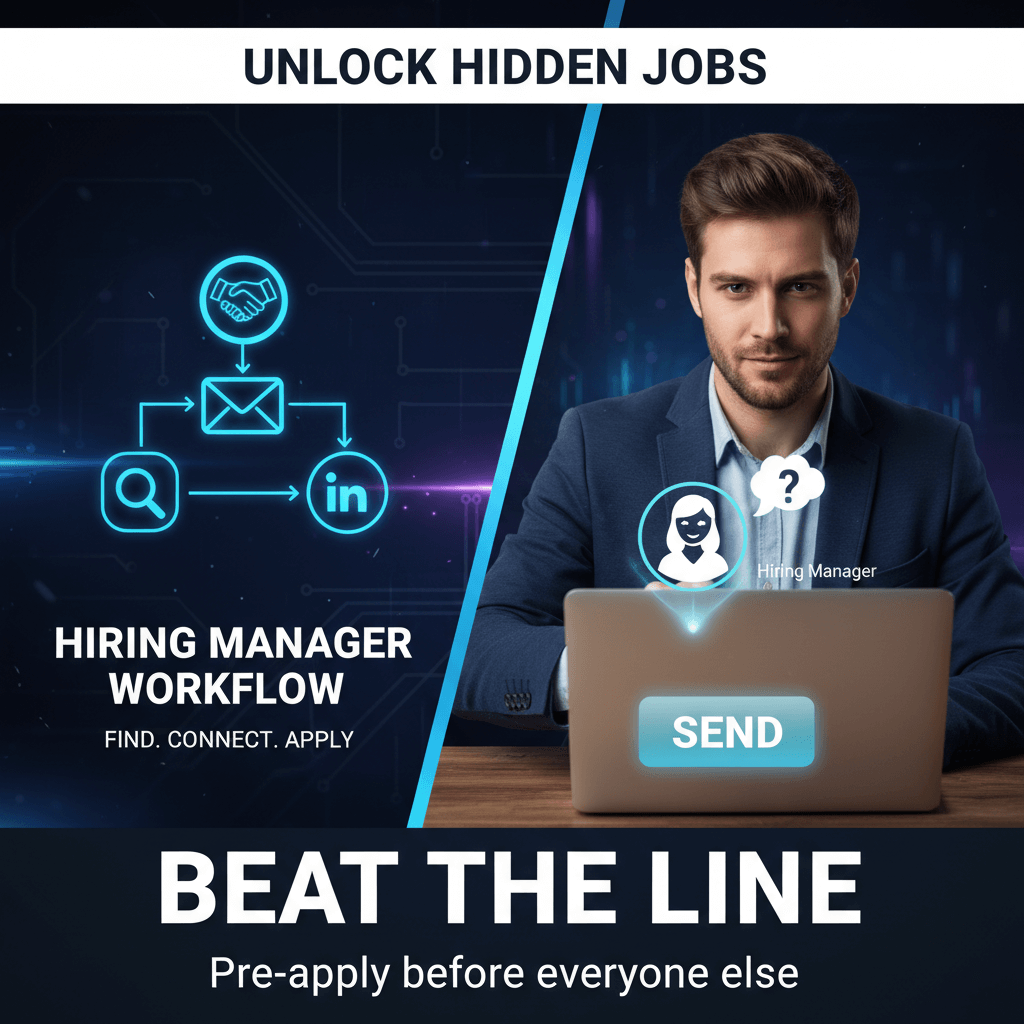
I still remember the timestamp: 9:12 AM. A new role popped up that fit like a glove. It was the kind of posting that would attract hundreds of clicks and dozens of “Easy Apply” submissions within the hour. I’d been here before—spraying resumes into the void, then waiting. But that day I tried something different. I didn’t submit the application. I went looking for the hiring manager.
By 9:34 AM, I had a name. By 9:38, I had proof points that mapped directly to the team’s priorities. At 9:41, a lean, respectful connection request went out that spoke to their outcomes—not my biography. By 10:07, I had a reply. By lunch, I had a brief introductory call on the calendar. When the formal interviews began days later, I wasn’t another resume in a stack—I was a known quantity who had already demonstrated initiative and fit.
That day, I realized a simple truth: every job posting has a human behind it—a hiring manager or decision influencer with real constraints and goals. Reaching them with context, clarity, and value—fast—changes your odds dramatically. And it’s repeatable.
Discover actionable insights. In this article, I’ll show you the exact workflow I built to identify the hiring manager quickly and send personalized connection requests before most applicants even find their resume file. It’s built on repeatable research moves, a short list of data sources, and a messaging framework that proves relevance in under seven lines.
These aren’t theories. They’re key takeaways from real discussions with hiring managers across product, operations, sales, design, and engineering—conversations that revealed what they notice, what they ignore, and how to signal “high-signal candidate” without sounding formulaic or pushy.
Why finding the hiring manager first changes everything
The timing advantage: Beat the curve
Most applicants submit within the first 24 hours. The bulk of those submissions look alike and land in an ATS queue that screens for keywords before a human ever sees them. Meanwhile, decision-makers are aligning stakeholders, clarifying scope, and sketching the first 90 days in their head. If you reach them early—before the narrative hardens—you can anchor that narrative with your value.
Hiring managers are flooded with generic interest. They rarely get an outreach that names their problems with specificity and proposes a next step that makes their life easier. Showing up early and relevant builds a mental shortcut: you become the candidate who “gets it.”
What the ATS can’t capture
Applicant tracking systems optimize for compliance and efficiency, not nuance. They can filter for must-have skills and years of experience; they can’t evaluate situational understanding. A one-paragraph message that connects your past outcomes to their likely constraints can do more than a polished resume that floats in a queue for a week.
What hiring managers actually want
- Clarity: Can you name the problem they’re hiring to solve in plain language?
- Evidence: Have you solved something meaningfully similar, with numbers?
- Efficiency: Do you respect their time with brief notes and a simple ask?
- Initiative: Did you do even 15 minutes of research before reaching out?
- Professionalism: Are you persistent without being intrusive?
When you lead with these, you reduce their uncertainty. That’s the currency that converts interest into interviews.
The workflow: From job post to personal connection in 30 minutes
This workflow prioritizes speed, signal, and respect. It’s designed to reach the right person quickly with a message that earns a response without demanding it. Here’s the path I use repeatedly.
Step 1: Capture the essentials in a one-page brief (5 minutes)
Copy the job posting into a one-page template and extract the following:
- Core outcomes: What will success look like 3–6 months in?
- Constraints: Headcount stage, product phase, geo, tech stack, ICP, revenue band.
- Signals of urgency: “Immediate,” “first hire,” “build from scratch,” “working cross-functionally.”
- Adjacent teams: Which teams depend on this role?
- Keywords to mirror sparingly: Industry terms, internal naming conventions.
Write a two-sentence hypothesis: “It looks like you’re hiring to achieve X under constraint Y. My most relevant example is Z, which improved [metric] by [percentage/timeframe].” This becomes the spine of your message.
Step 2: Identify the likely hiring manager (8–10 minutes)
Use a triangulation process to find the person most likely to own the outcome:
- LinkedIn search: Title + function + company (e.g., “Director of Product Marketing” at Company). Sort by current company, then filter by location if relevant.
- Org clues: Look for team pages, press releases, medium posts by team leaders, or leadership directories. Identify who speaks publicly about the domain.
- Peer validation: Search for people in the role you’re applying for at the company, then check who they report to or engage with frequently.
- Recent hires: If the team recently hired a similar role, who welcomed them or commented? That person is often the hiring manager or a heavy influencer.
- Size heuristic: In small orgs, the hiring manager is often the functional head; in larger orgs, it’s a manager or group lead under a director/VP.
If there’s ambiguity, shortlist two people: the direct manager and the cross-functional stakeholder most impacted by the role. You can send a tailored message to each, acknowledging you’re reaching out to confirm fit.
Step 3: Build a mini “relevance packet” (5 minutes)
Gather two to three assets that support your hypothesis with minimal friction:
- One 3–5 bullet case study with metrics aligned to the posting’s outcomes.
- A link to a portfolio, GitHub, or artifact that showcases the method you’d use.
- A concise 30–60 second loom or written teardown only if it’s genuinely useful and respects confidentiality.
The key is restraint. You’re not pitching; you’re offering proof. One artifact done well beats a link dump.
Step 4: Draft a 7-line connection request and a follow-up note (7 minutes)
Use this structure to avoid sounding like a template while staying concise:
- Line 1: Context anchor (their role, team initiative, or product milestone).
- Line 2–3: Problem hypothesis framed as a question or observation.
- Line 4–5: Your closest relevant outcome with proof (metric/timeframe).
- Line 6: Offer a helpful artifact or brief perspective.
- Line 7: Soft, easy next step (no pressure; respect their process).
Example for a product role:
“Saw you’re hiring for a Senior PM to scale activation on [Product]. If the goal is to raise week-4 retention for [ICP] while keeping support tickets flat, I’ve done similar at [Prior Company]. We lifted activation-to-retention by 19% in one quarter by narrowing onboarding to 3 jobs-to-be-done and gating advanced features. Happy to share a short breakdown if useful. If I’m off, thanks for the read and best of luck with the search.”
Example for sales/enablement:
“Noticed your posting for Sales Enablement Lead and your recent push into the mid-market. If ramp time and consistency across AEs are priorities, I built a program that cut ramp from 120 to 72 days and improved P1 win rate by 8 pts. I’ve got a one-pager you can skim; can send if it helps. If I should route through a recruiter, happy to do that, too.”
Step 5: Send within 30 minutes and log the outreach (2 minutes)
Speed signals initiative; accuracy signals judgment. Get your note out early while the role is still fresh and before volume spikes. Track basic details:
- Job link, manager name(s), outreach time/date.
- Message variant used and artifact offered.
- Response status and follow-up date.
This creates a historical view you can iterate on, not a blur of one-off tries.
Step 6: Follow-up cadence that respects attention (3 minutes to schedule)
- Day 0: Connection request with compact value.
- Day 3–4: One follow-up with a fresh, lighter angle (e.g., quick insight, relevant article, or refined metric) if no response.
- Day 10–12: A polite close-the-loop note. Thank them; wish them success; leave the door open.
Always be explicit that you respect their process and time. The absence of pressure is a differentiator.
Personalization at scale without sounding like a template
Personalization doesn’t mean inserting a first name and a company. It means connecting your experience to their near-term outcomes in a way that reduces their uncertainty. The trick is to build reusable scaffolding with flexible content blocks, so you move fast without sounding robotic.
The P-I-P-A message framework
- Problem: One sentence naming the likely outcome they’re driving.
- Insight: One sentence showing you understand a relevant constraint or trade-off.
- Proof: One sentence with a metric, timeframe, and brief method.
- Ask: One sentence proposing a frictionless next step.
Example for a design role:
“Looks like you’re hiring to unify the IA across web and mobile to lift conversion. Keeping dev velocity while reducing cognitive load is tough at your scale. At [Prior Co], we cut checkout drop-off by 14% in 8 weeks by consolidating patterns and aligning content hierarchy to search intent. If a 10-slide teardown of your current flow would help, I’m happy to share.”
Three data points that make messages feel specific
- Recent signals: Product launches, pricing changes, new markets, or public roadmaps they’ve shared.
- Team patterns: Job descriptions across similar roles reveal internal language and priorities.
- Customer lens: Reviews, community threads, or changelogs highlight friction you can reference tactfully.
Use one or two of these—not all three—in a single message. Overloading detail reads as performative. Precision beats volume.
Do’s and don’ts that hiring managers repeatedly emphasized
- Do mirror their language sparingly to signal you read the posting.
- Do tie a metric to a timeframe for every claim.
- Do keep the ask small and optional (e.g., “happy to share,” “if helpful”).
- Don’t apologize for reaching out. Confidence with humility outperforms deference.
- Don’t attach files unprompted; offer links or a short note first.
- Don’t ask, “Can I pick your brain?” Replace with a clear value-forward sentence.
Templates you can adapt quickly
For operations:
“Your Ops Manager role reads like you’re streamlining quote-to-cash while preparing for SOC 2. I led a similar cross-functional effort at [Co], cutting DSO by 11 days and reducing handoffs by 40%. I have a 1-page swimlane I can share if helpful. If I should route via your recruiter, I’m happy to.”
For engineering:
“Saw the posting for a Backend Engineer focused on latency under burst traffic. We brought P95 down from 420ms to 160ms at [Co] by introducing request coalescing and targeted caching. If you’re exploring similar approaches, I’d be glad to compare notes briefly.”
For customer success:
“Looks like you’re scaling CS for your new enterprise tier. We cut churn 3.2 pts at [Co] by implementing quarterly value reviews tied to roadmap themes. I drafted a light agenda template I can send if useful.”
Key takeaways from real discussions with hiring managers
Across dozens of conversations with hiring managers and senior ICs, a few patterns emerged consistently. These aren’t platitudes; they’re repeated observations from people who review candidates weekly.
Signals that earn a response
- Specificity about outcomes: “Raising activation from X to Y without increasing support volume” beats “improve onboarding.”
- Modesty paired with proof: “Happy to share a one-pager” beats “I’m the perfect fit.”
- Respect for process: A note that you’ll still apply formally reduces friction and puts them at ease.
- Clear time-boxing: Propose a 10–15 minute sync, not an open-ended meeting.
Common missteps that kill momentum
- Mass messages: Anything that smells like a blast is ignored.
- Overpromising: Claims without metrics feel like bluster—even if they’re true.
- Negging the company: Pointing out obvious flaws without empathy reads poorly.
- Pushiness: Multiple messages in 48 hours feels like pressure, not enthusiasm.
What they wish candidates knew
- They’re under time pressure and uncertainty. Help them de-risk the hire.
- They notice thoughtful brevity. Tight writing feels like tight thinking.
- They value relevant process, not just results. Show how you think.
- They often don’t control every step. Acknowledge recruiters and HR partners.
Response-rate insights
- Early outreach (within 24 hours of posting) tends to outperform late outreach by a wide margin, especially when the message includes a recent public signal.
- Offering a small, concrete artifact (“1-page breakdown,” “10-slide teardown”) produces more replies than a generic “happy to chat.”
- Second-degree warmth (reference a mutual connection or shared community) lifts response rates, but only if it’s genuine and relevant.
One recurring theme: credibility compounds. Candidates who showed up with clear, respectful notes often got looped in for broader opportunities—even when the specific role wasn’t the match.
Your 7-day action plan: Build, run, and optimize the workflow
Here’s a compact plan to implement the workflow and tune it with real data in a week.
Day 1: Build your research brief and message scaffolding
- Create a one-page job analysis template with fields for outcomes, constraints, team, and a two-sentence hypothesis.
- Draft three P-I-P-A message variants aligned to your core functions or industries.
- Assemble two case study bullets with metrics and a single artifact you can share.
Day 2: Calibrate targets and search heuristics
- Identify 10–15 target companies and map titles that likely own your outcomes.
- Define search queries you’ll reuse (Title + Function + Company + Location).
- Set up alerts or saved searches to catch new postings early.
Day 3: Run the workflow on two roles
- Complete the job brief for each role in under 10 minutes.
- Identify 1–2 likely hiring managers for each.
- Send a personalized connection request within 30 minutes of seeing each post.
Day 4: Follow up once and refine
- Send one concise follow-up to any non-responders from Day 3 with a fresh angle (new metric, refined hypothesis).
- Review your messages for clarity and remove any filler or jargon.
Day 5: Expand to three more roles and test a variant
- Run the workflow on three new roles in adjacent companies or functions.
- A/B test a small variation: different opening line, different proof structure, or rotating the artifact offered.
Day 6: Analyze the data
- Track response rate, time-to-first-reply, intro call rate, and conversion to formal interview.
- Identify which opening lines and proof points correlate with replies.
- Prune underperforming phrases; standardize the winners.
Day 7: Systematize and scale responsibly
- Codify your process into a checklist you can run in 30 minutes per role.
- Prepare a light CRM or spreadsheet to track roles, contacts, messages, and outcomes.
- Set weekly goals (e.g., 5 targeted outreaches per week) and protect the time block on your calendar.
Metrics that matter
- Connection acceptance rate: Indicates whether your profile and opener align.
- Reply rate: Measures message clarity and relevance.
- Intro call conversion: Reflects perceived value and professionalism.
- Interview conversion: Validates alignment between brief, proof, and role needs.
- Time-to-first-reply: Early responses often correlate with better fit and urgency.
Ethics and professionalism
- Respect boundaries: If someone directs you to a recruiter or application portal, acknowledge and comply.
- Protect confidentiality: Never share sensitive data from past employers.
- Be patient: Two thoughtful messages are better than five nudges.
- Be accurate: Round numbers are fine; invented numbers are not.
Call to action
You don’t need a new resume to shift your odds. You need a new sequence: clarify the problem, find the owner, and offer context with proof. This week, pick two roles and run the workflow within 30 minutes of seeing each posting. Use the message scaffolding above, keep your notes to seven lines, and offer one artifact that actually helps. Track the responses, iterate on what lands, and keep going.
If you’re serious about standing out, make this your edge: arrive early, be specific, and reduce uncertainty. Hiring managers remember the candidate who makes their decision easier. Be that candidate—starting today.
Discover actionable insights isn’t a slogan; it’s a practice. Start with one posting. Build the brief. Send the note. Then do it again tomorrow. Your future manager is out there, and they’re a lot more reachable than the ATS wants you to believe.
Where This Insight Came From
This analysis was inspired by real discussions from working professionals who shared their experiences and strategies.
- Referenced Article: Explore the source material on the source
- Community Discussion: Join the conversation on Reddit
- Share Your Experience: Have similar insights? Tell us your story
At ModernWorkHacks, we turn real conversations into actionable insights.





0 Comments