
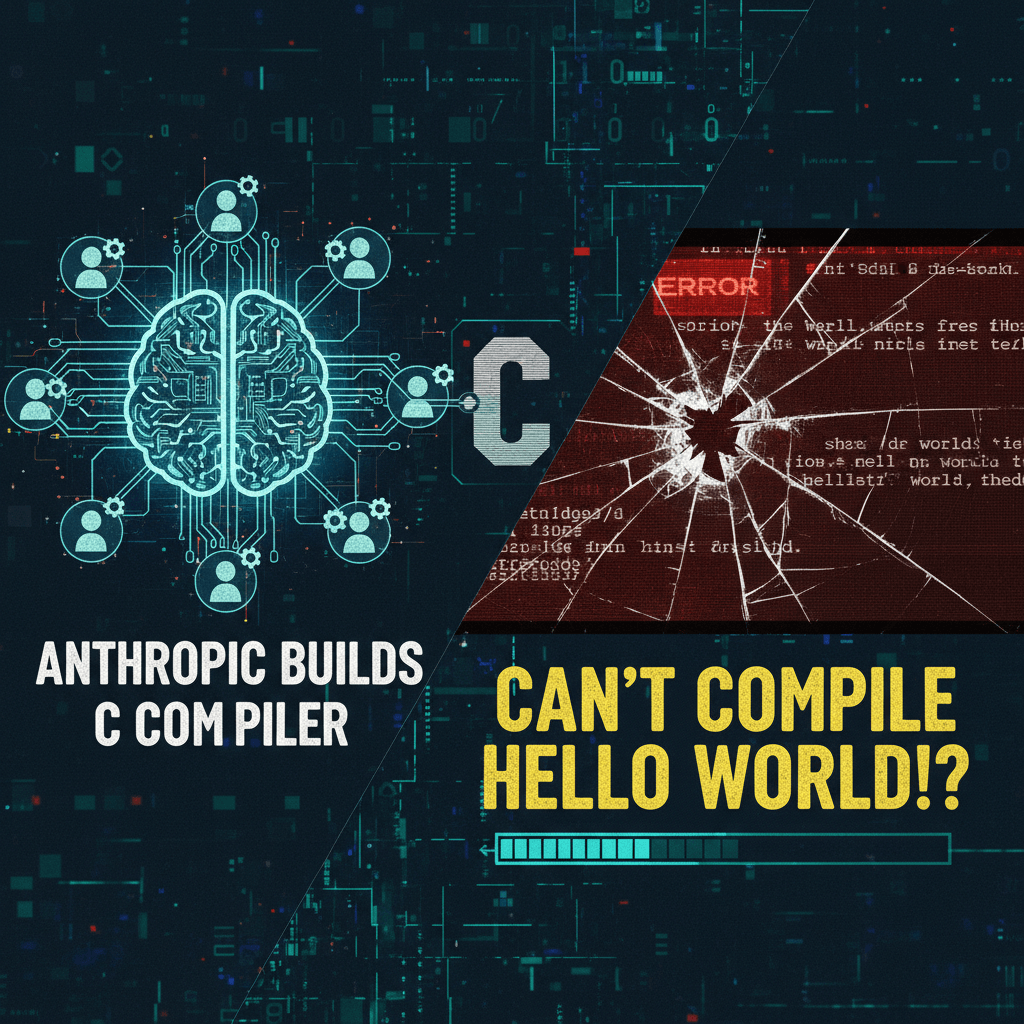
Discover actionable insights. This article distills lessons from real discussions among engineers attempting multi-agent builds of complex systems—like toy compilers—and turns them into a practical playbook you can apply this week. Treat the narrative below as a synthesis of public conversations and engineering retrospectives; details are illustrative rather than official statements from any single company.
A compelling story: When parallel agents met a compiler
Picture a lab on a late Friday: a planning agent sketches a design for a toy C compiler. A spec agent writes a crisp scope: “Lex, parse, and codegen a tiny C subset to x86-64; verify with ‘hello, world’.” A coder agent drafts a lexer; a parser agent proposes an AST; a codegen agent prepares a minimalist backend. A tester agent auto-generates unit tests. The chat scroll flickers with optimistic emojis. The team of parallel agents seems fast, decisive, unstoppable.
By midnight, the system compiles small arithmetic programs. “int main(){return 0;}” works. Astonishing momentum. Then comes the rite of passage: “hello, world.” On paper, it’s simple. At runtime, nothing prints. The binary exits with code 0. Logs show no errors. The tester agent proposes more printf calls. Still silence.
Monday’s postmortem unspools a familiar thread:
- Interface drift: The parser’s AST expresses string literals differently than the codegen expects. Most unit tests passed because they didn’t exercise string emission or external symbol resolution.
- Undefined assumptions: The planner assumed a “call printf then exit” path. The codegen assumed a raw syscall to write(1,…). The linker step fell through the cracks because “linking” was owned by no single agent.
- ABI mismatch: The calling convention for function arguments wasn’t consistent between the code that emitted the call and the code that built string addresses. On Linux x86-64 System V ABI, printf’s first arg goes in RDI; in the generated assembly, it went on the stack.
- Flaky tests: The tester agent validated “compiles successfully” and “exits with code 0,” not “produces the expected bytes on stdout.” The suite passed while the essential behavior failed.
- Parallelization tax: Each agent had a “good reason” for its choice; together those reasons became a fragile weave. No single owner bore end-to-end accountability for a working binary.
Everyone was good. The system wasn’t. That gap—between competent parts and a working whole—is exactly where multi-agent systems either shine with orchestration or stall with friction. “hello, world” was not a triviality; it was a hidden integration test wearing a smiley face.
Why “hello, world” is harder than it looks
We romanticize “hello, world” as the easiest possible proof-of-life. But for a compiler—even a tiny one—printing a string exercises a surprising slice of the system. The moment you leave pure arithmetic, you get a gauntlet of integration challenges.
What “hello, world” secretly demands
- String literals and data sections: The compiler must recognize string tokens, handle escape sequences, store the bytes in the binary’s read-only data segment, and reference them via correct addresses and relocations.
- External symbol resolution: If the program uses printf, the compiler/linker must resolve the symbol to the standard C library at link time (dynamic or static), or alternatively, implement direct syscalls with platform-specific logic.
- Calling conventions: ABIs define how arguments are passed (registers vs. stack), how the stack is aligned, and who cleans up. A single-off-by-one in alignment, or an argument in the wrong register, yields no output or a crash.
- Entry point and runtime: Even a “toy” compiler must decide: Will the entry point be main or a platform-specific _start? If you skip libc, you must exit via a syscall and set up process state yourself.
- Linking and relocation: The generated object must contain correct relocation entries so the linker can stitch addresses for data and external functions correctly. Mixing COFF vs. ELF vs. Mach-O is a minefield.
- IO semantics and buffering: printf buffers output. If the program exits immediately without flushing or there’s a newline mismatch, you might “print” but see nothing.
- Minimal correctness harness: Tests must read stdout, compare bytes, and verify exit codes. If you only test compilation or exit status, you’ll miss the main purpose: actually printing “hello, world”.
For human compiler engineers, these are table stakes. For a newly orchestrated team of agents, each of these responsibilities must be surfaced explicitly as contracts: who owns them, how they are verified, and how regressions are detected.
The subtle traps that bite multi-agent builds
- Spec ambiguity turns into brittle glue: If string literals are “someone else’s problem,” two agents will make two perfectly reasonable but incompatible choices. That’s not incompetence; that’s entropy.
- Testing the wrong thing: Fast progress begets overconfidence. If your test harness doesn’t capture stdout and compare bytes, you’ll congratulate yourself on a green build that failed at the only thing the user cares about.
- Runtime environment assumptions: Using printf means you need a working linker and libc; using write syscalls means you need per-OS assembly and calling conventions. Either choice is fine—if made intentionally and verified.
- Premature parallelization: Sharding work across agents before you have an end-to-end walking skeleton creates more interfaces than you can reliably manage under time pressure.
“hello, world” is the quintessential end-to-end test. It looks cute; it’s actually a scalpel that finds your integration wounds.
What the discussions reveal: Key takeaways from real engineers
Across forum threads, repo issues, and engineering postmortems, practitioners converge on a set of lessons when multi-agent teams attempt complex builds like compilers, interpreters, or OS components. Here are the key takeaways you can bank on:
- End-to-end first, then parallelize: Establish a single-agent (or small cohesive nucleus) that produces a thin vertical slice from source to a running binary. Only parallelize once the slice is stable and specified.
- Contracts beat conversations: Define explicit interface contracts: AST schema, IR format, calling convention, data layout, error codes. Freeze them with versioning before splitting work.
- Tests are the source of truth: Every agent’s goal must be passing contract tests, not just “looking reasonable.” Put stdout/exit-code checks in CI for “hello, world” and a growing corpus of samples.
- One owner per invariant: Assign a single owning agent (or human) to each non-trivial invariant: ABI correctness, symbol resolution, data layout, runtime entry/exit. Diffuse responsibility guarantees drift.
- Visibility is power: Instrument everything. Emit traces of AST nodes, IR, generated assembly, link maps, relocation tables, and runtime logs. Without visibility, you’ll guess and flail.
- Minimize implicit state: Shared memory or context across agents invites “Heisenbugs.” Prefer explicit messages and immutable specs; treat agent contexts as ephemeral.
- Negative tests prevent fantasy: Include adversarial inputs: unterminated strings, long literals, printf with multiple args, missing newline, invalid escape sequences. Make failures crisp and fast.
- Stable scaffolding matters: Choose a known-good assembler and linker. Do not attempt to write your own linker in v0. Reliability in the toolchain isolates your bugs.
- Determinism over speed: Parallel agents that race ahead produce nondeterministic builds. Gate merges on reproducible outputs and lock-step pipelines before you turn on concurrency.
- Small wins, strict gates: Celebrate when “int main(){return 0;}” passes, but don’t relax gates for “hello, world.” It’s the first true integration test; treat regressions as blockers.
These aren’t theoretical niceties. They’re pressure-tested practices that distinguish a fun demo from a durable system.
Actionable playbook for your next multi-agent build
Here’s a concrete, step-by-step playbook you can adopt immediately—no new tools required. It’s optimized for multi-agent builds of compilers and other deeply integrated systems, but the principles generalize.
Phase 0: Define the slice
- Choose the narrowest end-to-end goal: “int main(){return 0;}” compiles to a runnable binary with exit code 0. Then “hello, world” prints the exact expected bytes with trailing newline.
- Freeze the runtime strategy: Decide now: libc printf vs. raw syscalls. Note the target OS/ABI. Document how to pass arguments, handle stack alignment, and exit cleanly.
- Write the contracts: Specify the AST schema for string literals, IR nodes for data sections, and the exact symbol names for external calls. Include version numbers.
- Pick your tools: Lock assembler and linker choices. Document command lines. Pin exact versions. Reproducibility beats novelty here.
Phase 1: Walking skeleton under single ownership
- Implement serially: One agent (or a tight pair) owns lex→parse→IR→codegen→assemble→link. Keep it ugly but traceable. Instrument each step with logs and artifacts.
- Build the golden tests: Two must-pass tests: “return 0” and “hello, world”. For the latter, assert stdout bytes and exit code; capture stderr too.
- Make failures loud: If stdout mismatches, print a hex diff. If relocation fails, dump symbol tables. If ABI is wrong, show register values at call boundaries.
- Produce reference artifacts: Store a reference AST, IR, and assembly for the passing tests. These become contract fixtures for parallel agents later.
Phase 2: Parallelize with guardrails
- Shard by stable contracts, not by hope: Only split once AST/IR schemas and runtime choices are frozen. Export them as versioned JSON or Protobuf; backward-incompatible changes require a bump.
- Agent roles with crisp remit: Examples:
– Spec agent: owns schemas and contract evolution.
– Parser agent: produces AST only; validated against schema tests.
– IR agent: transforms AST→IR; no codegen.
– Backend agent: IR→assembly/object; must pass ABI checks.
– Link agent: assembles/links; owns symbol resolution.
– Tester agent: runs golden tests and adversarial corpus. - Contract tests as merge gates: No agent merges changes unless golden tests plus their contract suite pass. Green means integrated reality, not just internal satisfaction.
- Traceable artifacts per change: Every change writes artifacts (AST/IR/asm/object/logs) to a run folder. If something regresses, you can diff semantics, not vibes.
Phase 3: Scale correctness and confidence
- Expand the corpus: Add tests incrementally: multi-arg printf, escaped quotes, long strings, empty strings, no newline, Unicode bytes, and invalid sequences (expecting compile-time errors).
- Instrument ABI checks: Add a verifier that inspects generated assembly for argument placement, stack alignment, and call/ret sequences. Fail fast on deviations.
- Lock execution environment: Containerize the toolchain and runtime. This eliminates “works on my machine” drift across agents and days.
- Promote determinism: Hash outputs; ensure identical inputs produce byte-identical objects and binaries. If not, block until nondeterminism is resolved.
Phase 4: Operationalize the multi-agent loop
- Observability dashboard: Summarize pass/fail rates, longest failing tests, and flakiest steps. Make it impossible to ignore red signals.
- Blameless triage: When a regression appears, assign a breakpoint owner (not necessarily the cause owner). Their job is to isolate the failing interface and produce a minimal reproduction.
- Change control on contracts: Version contracts. Any schema/ABI change requires a RFC-style proposal, review, and migration plan. Parallel agents update in lockstep.
- Chaos tests for concurrency: Randomize agent execution order, introduce message delays, and re-run the corpus. The system must endure reordering without semantic drift.
Checklists you can paste into your runbook today
- “hello, world” readiness:
– AST supports string literals with escapes.
– IR has data-section nodes and symbol references.
– Backend emits read-only data with relocations.
– Linking strategy documented; printf vs. syscall chosen.
– ABI contract fixtures exist and pass on CI.
– Test harness captures stdout/stderr and exits with hex-diff on mismatch. - Agent hygiene:
– Clear role boundaries; one owner per invariant.
– Contract tests as merge gates.
– Artifacts stored per-run for reproducibility.
– Toolchain pinned and containerized. - Regression response:
– Single triage owner per failing test.
– Minimal repro within one hour.
– Root cause memo with proposed guardrail update.
– Add a new test preventing the class of bug from recurring.
What likely went wrong—and how to prevent it next time
Even if each agent performed sensibly, multi-agent orchestration can still produce surprising misses. Here’s a concise mapping from common failure patterns to robust countermeasures.
Failure pattern: Spec drift across agents
Symptom: Parser and backend disagree on how string literals are represented. The program compiles; the output is wrong or missing.
- Countermeasure: Single source of truth for schemas, versioned. Auto-generate both parser and backend validators from the same schema. Block merges on schema test failure.
Failure pattern: ABI mismatch
Symptom: Calls to printf appear, program exits normally, but nothing prints. On inspection, first arg isn’t in the correct register or stack is misaligned.
- Countermeasure: ABI verifier that reads generated assembly and enforces calling convention rules. Add a tiny diagnostic program that prints arguments back for inspection.
Failure pattern: Incomplete linking strategy
Symptom: Build passes on one machine but fails on another; dynamic symbols unresolved or libc missing.
- Countermeasure: Containerize the toolchain. Decide static vs. dynamic linking. Include a link map in artifacts. Add a test that inspects the dynamic symbol table for printf (or validates syscall path).
Failure pattern: Tests that don’t observe the right signals
Symptom: “Compiles successfully” and “exits 0” tests pass, but user-observable behavior fails.
- Countermeasure: Promote black-box behavioral tests (stdout exact-match) to gating status. Treat compiler warnings about format strings and escapes as errors; they’re canaries.
Failure pattern: Premature parallelization
Symptom: Many agents produce progress; integration lags behind; changes collide.
- Countermeasure: Demand a walking skeleton first. Add a rule: no new agents until the current pipeline produces green end-to-end results with artifacts and reproducible builds.
Practical engineering heuristics that hold up under pressure
The following heuristics surfaced repeatedly in discussions and postmortems, and they’re simple enough to memorize:
- Choose boring infrastructure: Use battle-tested assemblers, linkers, and containers. Save novelty for the compiler core, not the build shell.
- Prefer single responsibility agents: One agent owns AST schema; another owns ABI checks. Avoid “jack-of-all-trades” roles that smear accountability.
- Make observability the default output: Every run should emit enough context to re-derive what happened without rerunning.
- Stabilize before you optimize: Correctness gating first, concurrency later. Resist the urge to “speed up coordination” until your invariants are ironclad.
- Write the failing test first: If a subtle bug appears, capture it in a test, ensure it fails, then fix it. Don’t trust memory or ad hoc repros.
- Document decision forks: For each “either/or” (printf vs. syscall), record the choice, rationale, and rollback plan. Future-you will need this context.
- Guard against silent success: Tests that only check return codes encourage illusions. If output matters, compare bytes. If performance matters, pin budgets and fail on regressions.
Strategy: What this means for teams betting on multi-agent workflows
Multi-agent systems are not a silver bullet; they magnify both strengths and weaknesses in your engineering process.
- If your specs are vague, agents will mirror that vagueness in mismatched interfaces. Invest upfront in contracts.
- If your tests are shallow, agents will “game” the objective inadvertently. Tune the objective by deepening the test harness.
- If your ownership is diffuse, agents will optimize locally and fail globally. Assign single owners to global invariants.
- If your build is invisible, you will drown in guesswork. Make every step observable.
Conversely, when you tighten contracts, enforce behavioral tests, and prioritize end-to-end correctness before concurrency, multi-agent systems can deliver remarkable iteration speed without sacrificing reliability.
Leadership checklist for rolling out multi-agent engineering
- Policy: Require end-to-end walking skeletons before team parallelization.
- Process: Mandate contract versioning, merge gates on behavioral tests, and reproducible artifact logs.
- People: Assign clear ownership for ABI, linking, and runtime. Make one person/agent the “keeper of the invariants.”
- Platform: Standardize containers and toolchains; establish a central observability dashboard covering the entire pipeline.
- Posture: Normalize blameless postmortems and test-first fixes. Reward the elimination of classes of bugs, not just heroic patches.
A note on attribution and evidence
Engineers across the community have shared experiences with multi-agent builds that mirror the “hello, world” integration trap: apparent progress with arithmetic-only programs, followed by unexpected failures at the first real I/O milestone. This article synthesizes those themes into a single narrative to surface repeatable lessons. Treat it as a guide informed by real discussions—not as an official statement from any single organization. When you replicate or extend any claims, do so with your own instrumentation and tests.
Call to action: Make your agents ship “hello, world” this week
You can apply these insights immediately. This week, run a focused, time-boxed exercise:
- Day 1: Decide and document your runtime strategy (printf vs. syscall) and target OS/ABI. Freeze AST/IR schemas for strings and data sections. Containerize the toolchain.
- Day 2: Build the walking skeleton under single ownership. Produce reference artifacts for “return 0” and “hello, world.” Wire a harness that compares stdout bytes and exit code, with hex diffs on mismatch.
- Day 3: Split into agents only where contracts are frozen. Add adversarial tests (multiple args, escapes, empty strings). Turn on merge gates for golden tests and contract suites.
- Day 4: Add an ABI verifier and a link map artifact. Introduce randomized execution order to stress concurrency, then fix any nondeterminism.
- Day 5: Write a short postmortem: what failed first, which guardrails saved you, and which new tests now prevent recurrence. Promote these guardrails to your engineering standards.
The goal is simple and uncompromising: produce a deterministic, reproducible “hello, world” binary that prints the correct bytes, on demand, under CI, from cold start. If your multi-agent system can do that consistently, it can likely do much more. If it can’t, you’ve found the gaps to close—fast.
Your next step: Pick one active project where multiple agents (or multiple teams) are building interlocking parts. Apply the walking-skeleton-first rule, formalize your contracts, and wire behavioral tests as gates. Share the before/after stability and cycle-time data with your leadership. The difference won’t be subtle.
Speed is exciting. Shipping is exhilarating. In multi-agent engineering, you earn the right to go fast by making “hello, world” boringly, reliably green.
Where This Insight Came From
This analysis was inspired by real discussions from working professionals who shared their experiences and strategies.
- Referenced Article: Explore the source material on the source
- Community Discussion: Join the conversation on Reddit
- Share Your Experience: Have similar insights? Tell us your story
At ModernWorkHacks, we turn real conversations into actionable insights.
![[Workflow Included] A simple 5-node Instagram posting workflow for beginners](https://modernworkhacks.com/wp-content/uploads/2026/04/workflow-included-a-simple-5-node-instagram-posting-workflow-for-beginners-1024x675.png)




0 Comments