
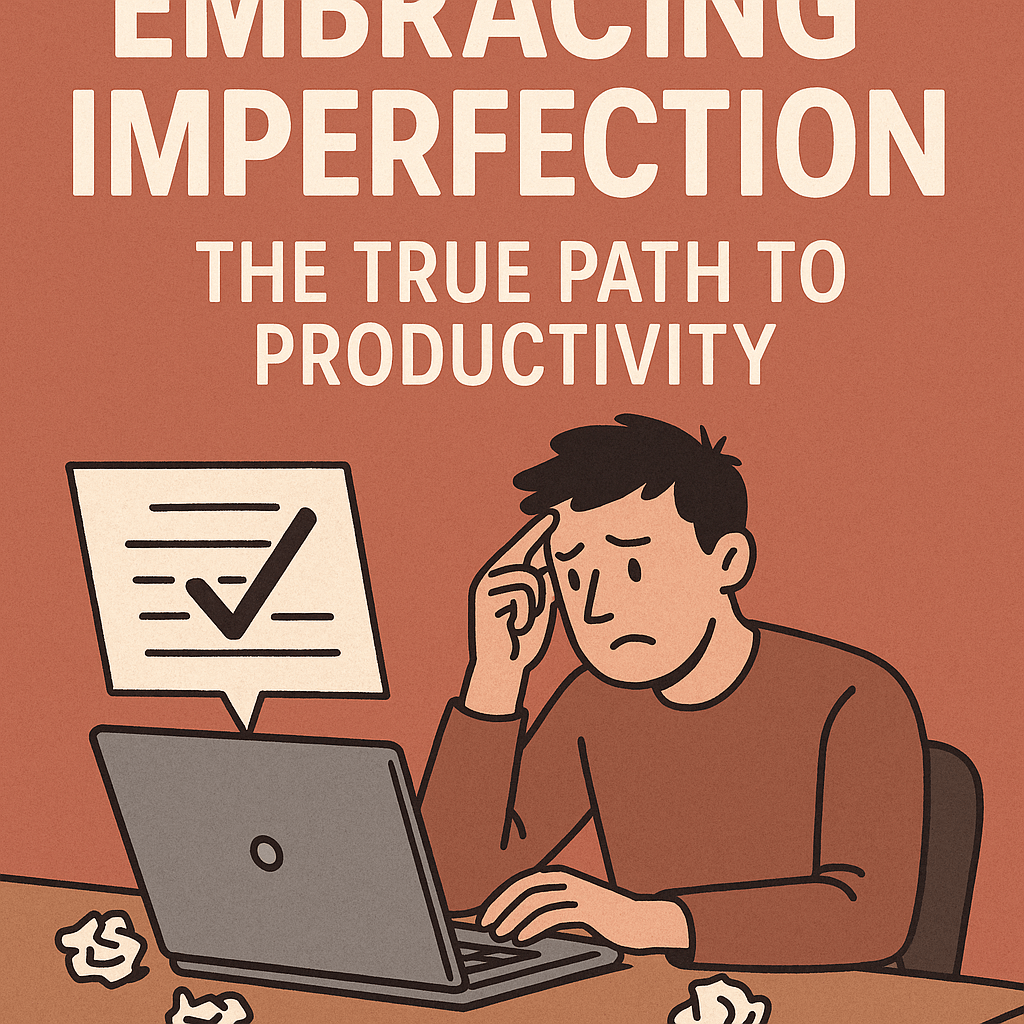
I stared at the blinking cursor, frozen by indecision. The presentation was due in three hours, and I was still tweaking the same slide I’d been working on for the past 45 minutes. Was the font right? Should I change that transition? Maybe the data visualization needed more context? Meanwhile, the remaining ten slides sat untouched. Sound familiar?
For years, I believed that excellence demanded perfection. Every email needed perfect phrasing, every project required flawless execution, and anything less felt like failure. Then came my breaking point: a missed deadline that cost my team an important client because I couldn’t stop polishing what was already good enough.
That painful lesson taught me something transformative: done is better than perfect. This isn’t just a catchy phrase—it’s a revolution in how we approach productivity, creativity, and ultimately, success itself.
The Perfection Trap: Why We Get Stuck
Perfectionism isn’t about high standards—it’s about fear. According to research published in the Journal of Personality and Social Psychology, perfectionists aren’t driven by a passion for excellence but by a deep fear of failure and judgment. This fear creates a psychological paralysis that prevents progress.
Take Maya, a graphic designer I interviewed for this article. “I’d spend hours tweaking tiny details no client would ever notice,” she told me. “One day I realized I was billing 60-hour weeks but producing less work than my colleagues. My perfectionism wasn’t making me better—it was making me inefficient.”
The Hidden Costs of Perfectionism
- Decision paralysis: When perfect is the only acceptable outcome, even small decisions become agonizing.
- Reduced output: Studies show perfectionists complete fewer projects despite working longer hours.
- Innovation suffers: Perfect conditions for creativity rarely exist—waiting for them means missing opportunities.
Dr. Brené Brown’s research reveals another surprising cost: perfectionism actually increases the likelihood of failure. “Perfectionism is not the path to success,” she writes. “It’s a defense mechanism against vulnerability and shame.”
From Perfect to Done: Real Stories of Transformation
James Dyson famously created 5,126 failed prototypes before inventing his revolutionary vacuum cleaner. Had he waited for perfection, the world would never have benefited from his innovation. This principle applies beyond famous inventors—it transforms ordinary lives too.
The Software Developer Who Let Go
Alex, a software engineer at a tech startup, struggled with shipping code. “I’d obsess over every function being perfectly optimized,” he explained. “My manager finally sat me down and said something that changed everything: ‘Your perfect code that never ships is infinitely worse than imperfect code that users can actually benefit from today.'”
After embracing this mindset, Alex adopted a “minimum viable product” approach to his work. The result? His productivity tripled, and user feedback on actual products allowed for more meaningful improvements than his theoretical optimizations ever could.
The Writer Who Found Her Voice
Sarah, a content creator, spent three years working on her first novel—not because it was epic in scope, but because she rewrote the first three chapters 17 times. “I was so afraid it wouldn’t be good enough that I never moved forward,” she shared.
Her breakthrough came from a 30-day writing challenge where participants had to post daily, unedited work. “Publishing imperfect writing daily was terrifying at first, but it broke the spell. I finished more in that month than in the previous year, and the feedback showed me that readers connected with authenticity more than polish.”
The Science of Good Enough: Why Imperfection Works
Research from the University of California found that embracing “good enough” decisions leads to greater happiness and productivity than striving for the absolute best outcome in every situation. This concept, called “satisficing” (a blend of satisfy and suffice), proves remarkably effective in complex environments.
The 80/20 Principle in Action
The Pareto Principle suggests that 80% of results come from 20% of efforts. This mathematical reality means that pursuing the final 20% of perfection requires 80% of your time—a terrible investment in most scenarios.
- Identify the vital 20%: Focus your perfectionist energy only on the elements that truly impact outcomes.
- Set clear “good enough” thresholds: Decide in advance what level of quality is sufficient for each task.
- Time-box your work: Allocate specific time limits for tasks and stick to them regardless of perceived completion.
Dr. Simon Sherry, who studies perfectionism at Dalhousie University, notes: “Perfectionism isn’t about achieving—it’s about avoiding. When we shift from avoidance to approach goals, productivity naturally improves.”
Building Your Imperfection Muscle: Practical Steps
Like any significant change, embracing imperfection requires practice. These evidence-based strategies can help you build this crucial skill:
Start With Low-Stakes Experiments
Michael, a project manager who described himself as “pathologically perfectionist,” began his journey with email. “I set a two-minute timer for non-critical emails. When the timer went off, I had to send whatever I’d written, even if it wasn’t perfect.”
This small exercise created a safe space to practice imperfection where consequences were minimal. Over time, Michael expanded this approach to larger projects, setting appropriate “good enough” standards for each.
Create Accountability Through Community
A Reddit thread on productivity revealed something fascinating: people who shared their imperfect work with supportive communities reported 67% higher completion rates on projects. This external accountability creates powerful momentum.
- Find your “done” champions: Connect with people who celebrate progress over perfection.
- Schedule regular sharing sessions: Commit to showing work-in-progress to trusted colleagues.
- Celebrate the shipped, not just the shiny: Create rituals that honor completed work, regardless of its flaws.
Reframe Mistakes as Data
Elena, a marketing director, transformed her team’s productivity by introducing “failure reports” where team members shared what didn’t work and what they learned. “We turned mistakes from something shameful into valuable intelligence,” she explained. “Once people saw imperfection as information rather than inadequacy, innovation exploded.”
The Imperfectionist’s Paradox: Better Results Through Lower Standards
Perhaps the most counterintuitive finding in productivity research is what I call the Imperfectionist’s Paradox: lowering your standards often leads to superior outcomes. This happens for several fascinating reasons:
Volume Creates Mastery Faster Than Precision
A famous study with ceramics students divided the class into two groups. One group was graded solely on quantity—how many pots they produced. The other was graded exclusively on quality—they needed to create just one perfect pot. Surprisingly, the quantity group ended up producing the highest quality work because they gained experience through iteration rather than overthinking.
This principle applies universally. Writers who produce pages daily become better than those who polish single paragraphs. Programmers who ship code regularly outperform those who architect perfect systems that never launch.
Feedback Loops Accelerate Growth
When you release imperfect work, something magical happens: you get real feedback instead of imagined criticism. This creates a virtuous cycle where each iteration improves based on actual data rather than anxious speculation.
Tina, a UX designer, discovered this when she began sharing early prototypes instead of refined designs. “The insights I gained from watching users interact with rough designs completely changed my approach. Problems I never anticipated became obvious, while issues I’d spent hours fixing turned out to be irrelevant to users.”
From Burnout to Balance: The Wellbeing Connection
Perhaps the most important benefit of embracing imperfection is its impact on mental health. A 2020 study in the Journal of Clinical Psychology found perfectionism strongly correlates with burnout, anxiety, and depression. Conversely, those who practiced “good enough” approaches reported higher satisfaction and sustainable productivity.
Carlos, a former management consultant, shared how perfectionism nearly ended his career: “I was hospitalized for exhaustion after my third 100-hour week. My recovery forced me to accept limits and prioritize completion over perfection. Not only did my health improve, but clients actually preferred my more focused, timely deliverables.”
The Sustainable Productivity Framework
- Define “done” before you begin: Clear completion criteria prevent endless refinement.
- Schedule recovery time: Build breaks into your workflow to maintain perspective.
- Practice self-compassion: Speak to yourself as you would to a respected colleague when reviewing your work.
Conclusion: The Courage to Be Imperfect
Embracing imperfection isn’t about lowering standards—it’s about raising your impact. It takes genuine courage to share work that isn’t flawless, to ship the product that still has minor bugs, or to publish the article that could use one more edit.
Yet this courage is what separates those who create real change from those who merely aspire to it. As Reid Hoffman, LinkedIn co-founder, famously said: “If you’re not embarrassed by the first version of your product, you’ve launched too late.”
I challenge you to identify one project you’ve been perfecting endlessly and set a deadline to release it—flaws and all. The world needs your contributions more than it needs your perfection. What will you finish today?
Where This Insight Came From
This analysis was inspired by real discussions from working professionals who shared their experiences and strategies.
- Share Your Experience: Have similar insights? Tell us your story
At ModernWorkHacks, we turn real conversations into actionable insights.
![[Workflow Included] A simple 5-node Instagram posting workflow for beginners](https://modernworkhacks.com/wp-content/uploads/2026/04/workflow-included-a-simple-5-node-instagram-posting-workflow-for-beginners-1024x675.png)





0 Comments