
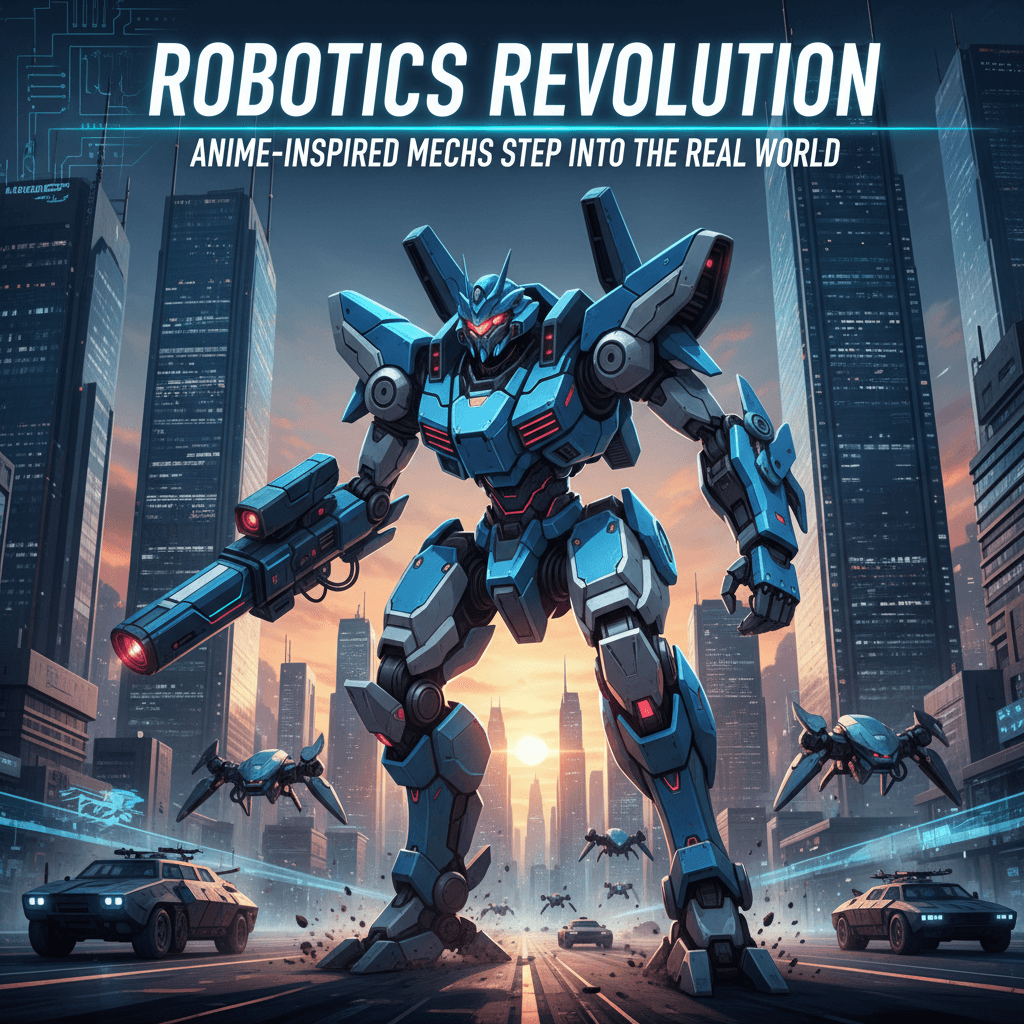
I remember the first time I watched Mobile Suit Gundam as a teenager. The idea of piloting a massive humanoid machine seemed like pure fantasy—something that would forever remain in the realm of animation and science fiction. Yet standing in a warehouse in Tokyo last month, watching engineers make final adjustments to a 4.5-meter tall bipedal robot with a human pilot nestled inside its torso, I realized that the line between anime fantasy and industrial reality has begun to blur in remarkable ways.
Japan’s Tsubame Industries has unveiled ARCHAX, a piloted humanoid robot that represents a watershed moment in the evolution of mechatronics. This isn’t just another industrial robot or remote-controlled machine—it’s a direct manifestation of the “mecha” concept that has captivated audiences in Japanese animation for decades. But beyond its striking visual appeal lies a serious question: are human-piloted mechs transitioning from sci-fi dreams to industrial powerhouses?
The Birth of ARCHAX: Where Anime Meets Engineering
Tsubame Industries’ ARCHAX stands 4.5 meters (nearly 15 feet) tall and weighs 3.5 tons—dimensions that would feel at home in a mecha anime series. What makes this creation truly remarkable isn’t just its imposing stature, but the philosophy behind its design.
From Concept to Reality
“We’ve always believed that the line between imagination and engineering is thinner than most people think,” explains Ryo Yoshida, the 25-year-old CEO of Tsubame Industries. “ARCHAX began as a question: what if we built robots not just for efficiency, but for the human experience of operating them?”
This approach stands in stark contrast to most industrial robotics, which prioritize automation and removing humans from the equation. ARCHAX instead places the human operator at the literal center of its operation. The pilot sits in an immersive cockpit equipped with motion-tracking systems that translate human movements into the robot’s actions.
The development timeline reveals the ambition behind the project:
- 2019: Initial concept development and feasibility studies
- 2020-2021: Prototype development and control system engineering
- 2022: First working model with limited mobility
- 2023: Full ARCHAX unveiling with bipedal movement and manipulator arms
Technical Specifications That Blur Fiction and Reality
What truly sets ARCHAX apart is its technical execution. The robot features:
- A hybrid electric-hydraulic power system providing up to two hours of continuous operation
- Dual-mode operation: a “vehicle mode” where it moves on wheels and a “robot mode” where it walks on two legs
- Articulated hands capable of manipulating objects with surprising dexterity
- A panoramic cockpit display providing 360-degree visibility through external cameras
According to robotics expert Dr. Hiroshi Yamamoto from Tokyo Institute of Technology, “The most impressive achievement isn’t just that ARCHAX works—it’s that it manages to solve several complex engineering challenges simultaneously while maintaining the aesthetic and functional vision of its anime inspiration.”
The Economics of Mech Development: Luxury Toy or Industrial Revolution?
With a price tag of $3 million per unit, ARCHAX sits in an unusual market position. Is it an industrial tool, a luxury item, or something entirely new?
The Market Reality
Tsubame Industries initially plans to produce just five units of the ARCHAX, positioning it as much as a statement piece as a functional robot. This limited production run reflects both the experimental nature of the technology and its current economic realities.
“We’re essentially creating a new category,” says Yoshida. “The first smartphones and personal computers were also expensive and limited in production. What matters is proving the concept works and finding the right applications that justify further development.”
Market analysis suggests three potential trajectories for this technology:
- Entertainment and tourism: Theme parks, events, and experiences centered around piloting mechs
- Specialized industrial applications: Hazardous environments where human judgment is needed but physical presence is dangerous
- Defense and emergency response: Scenarios requiring heavy lifting capabilities combined with human decision-making
Cost Reduction Pathways
For piloted mechs to move beyond novelty status, significant cost reductions will be necessary. Industry experts point to several factors that could drive down prices:
First, standardization of components specifically designed for humanoid robotics could create economies of scale. Currently, many parts in ARCHAX are custom-manufactured at great expense.
Second, advancements in materials science offer promising alternatives to the expensive alloys currently required for structural integrity. Research from MIT’s Material Science Department suggests that carbon-fiber composites combined with new manufacturing techniques could reduce structural costs by up to 60%.
Finally, simplified control systems that require less specialized training could expand the potential user base. “The current learning curve for piloting ARCHAX is steep,” admits Yoshida. “We’re working on more intuitive interfaces that would make operation accessible to more people.”
Practical Applications: Beyond the Spectacle
While the visual impact of ARCHAX garners immediate attention, the more compelling question concerns its practical utility. What can a human-piloted mech do that existing solutions cannot?
Disaster Response and Recovery
Japan’s history with natural disasters has driven significant innovation in robotics. The Fukushima nuclear disaster in 2011 highlighted the limitations of both remote-operated robots and human responders in hazardous environments.
Masashi Takahashi, former disaster response coordinator for Japan’s Self-Defense Forces, sees potential in the ARCHAX approach: “In disaster zones, you need both the physical capability to move debris and the human judgment to make split-second decisions about structural stability or rescue operations. Remote operation introduces delays and reduces situational awareness.”
In a 2022 simulation conducted by Tsubame Industries, an ARCHAX prototype demonstrated the ability to:
- Clear a path through simulated building debris that would be impossible for human workers
- Lift and transport injured victims (mannequins) while maintaining the gentle handling that automated systems struggle with
- Navigate complex terrain with human-like judgment but machine-like strength
Construction and Infrastructure
Another promising application lies in construction and infrastructure maintenance. Traditional heavy equipment excels at specific tasks but lacks versatility. Human workers provide adaptability but face physical limitations.
“The most interesting applications might be in scenarios where you need both precision and power,” explains civil engineering professor Kenji Watanabe from Osaka University. “Think about bridge inspection and repair, where you need to navigate complex structures, make judgment calls about structural integrity, and then perform heavy-duty repairs.”
Several construction firms in Japan and South Korea have expressed interest in leasing ARCHAX units for experimental projects, particularly in urban renewal projects where space constraints limit the use of conventional heavy equipment.
The Human Element: Why Put People Inside Machines?
The most fundamental question surrounding ARCHAX is philosophical as much as practical: in an era of increasing automation, why build machines that require human pilots?
The Limits of Automation
Despite remarkable advances in artificial intelligence and robotics, fully autonomous systems continue to struggle with unstructured environments and novel situations. A 2023 study from Carnegie Mellon University’s Robotics Institute found that human operators still outperformed autonomous systems in 87% of complex manipulation tasks in unpredictable environments.
“There’s a reason the anime vision of piloted mechs has endured,” observes Dr. Sachiko Hirose, cognitive robotics researcher. “It acknowledges that human perception, judgment, and adaptability remain superior to machines in many contexts, while recognizing that our physical capabilities have limitations that machines can overcome.”
This hybrid approach—enhancing human capabilities rather than replacing humans—represents a distinctly Japanese philosophy toward robotics that contrasts with Western approaches that often prioritize full automation.
The Psychological Factor
There’s also a psychological dimension to the piloted mech concept. Test pilots for ARCHAX report a unique sense of embodiment that differs from remote operation.
“When you’re inside ARCHAX, you don’t feel like you’re controlling a separate machine—you feel like you are the machine,” explains Takeshi Mori, one of the test pilots. “Your sense of body extends to include the robot’s limbs. This creates an intuitive control experience that’s difficult to replicate through remote operation.”
This phenomenon, known as “proprioceptive extension,” has been documented in research from the University of Tokyo’s Embodied Media Project. The studies suggest that direct physical feedback creates neural adaptations that improve control precision and reduce mental workload compared to remote operation.
The Future of Human-Machine Integration
As I watched ARCHAX move through its paces—transforming from vehicle mode to standing bipedal form, then carefully picking up and manipulating objects—I couldn’t help but consider the broader implications for our relationship with machines.
ARCHAX represents more than just an engineering achievement; it suggests a future where the boundaries between humans and machines become increasingly fluid. Rather than replacing human workers or remaining separate tools, machines like ARCHAX hint at new forms of human-machine integration.
The path forward involves several key developments:
- Control interface refinement: Moving beyond physical controls to more intuitive brain-computer interfaces
- Modular designs: Creating platforms that can be rapidly reconfigured for different tasks
- Regulatory frameworks: Establishing safety standards and operational guidelines for this entirely new category of machinery
“We’re just at the beginning,” Yoshida tells me as we watch ARCHAX return to its maintenance bay. “The first automobiles were also expensive, impractical curiosities before they transformed society. What matters isn’t what ARCHAX can do today, but what it suggests is possible tomorrow.”
Whether piloted mechs become industrial workhorses or remain specialized tools for niche applications, ARCHAX has already achieved something significant: it has transformed a persistent science fiction dream into physical reality, challenging our assumptions about the relationship between humans and machines in the process.
The question is no longer whether anime-inspired mechs can step into the real world—they already have. The question now is how far they’ll go, and how they’ll reshape our industrial landscape in the process.
Where This Insight Came From
This analysis was inspired by real discussions from working professionals who shared their experiences and strategies.
- Share Your Experience: Have similar insights? Tell us your story
At ModernWorkHacks, we turn real conversations into actionable insights.
![[Workflow Included] A simple 5-node Instagram posting workflow for beginners](https://modernworkhacks.com/wp-content/uploads/2026/04/workflow-included-a-simple-5-node-instagram-posting-workflow-for-beginners-1024x675.png)



0 Comments