Last month, I watched as my colleague—a talented developer with fifteen years of experience—stared at his screen in disbelief. An AI coding assistant had just generated in seconds what would have taken him hours to write. “Is this it?” he asked quietly. “Is this how my career ends?”
His concern echoes across developer forums, tech conferences, and university computer science departments worldwide. With AI systems like GitHub Copilot, ChatGPT, and Claude generating increasingly sophisticated code, many developers are questioning their future relevance. The narrative that “AI will replace programmers” has never been louder.
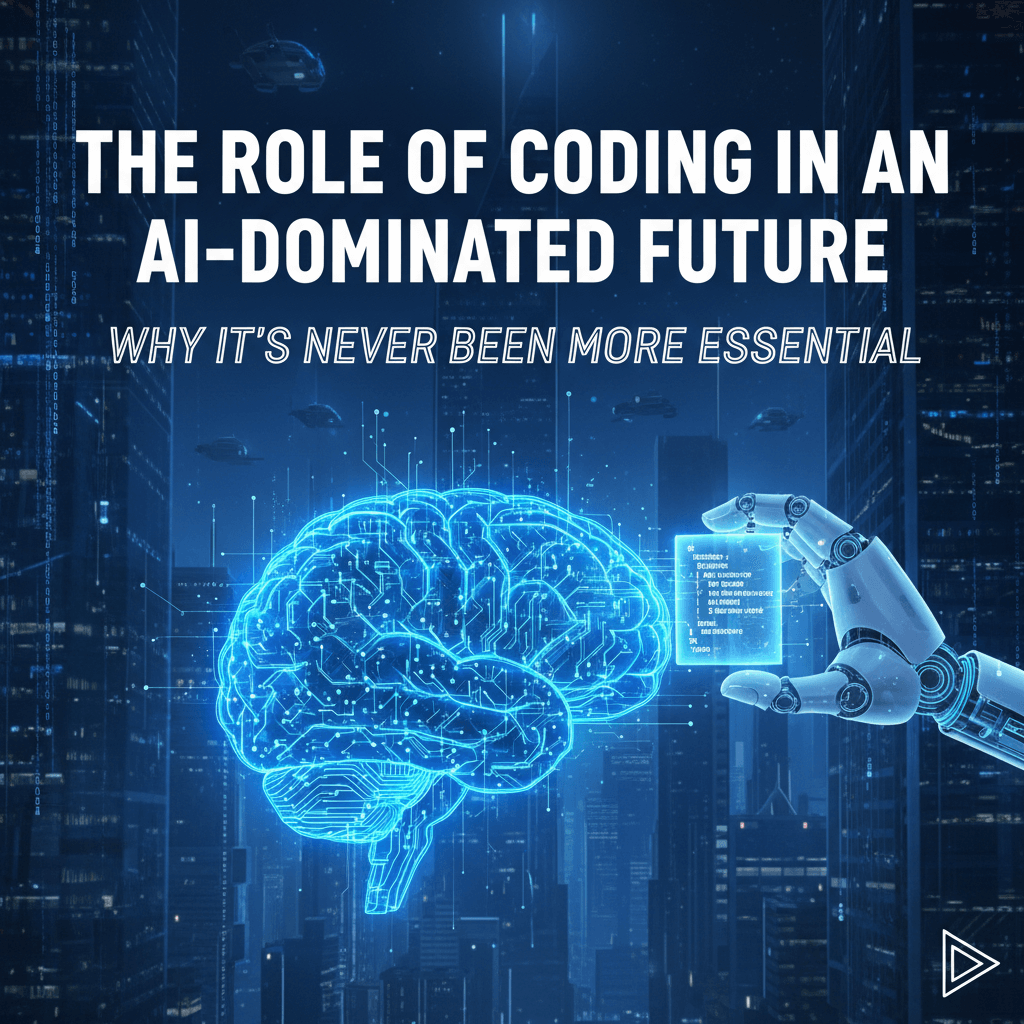
Yet this narrative fundamentally misunderstands both the nature of coding and the role of artificial intelligence. In the age of AI, coding isn’t obsolete—it’s indispensable. The relationship between human programmers and AI isn’t zero-sum; it’s symbiotic, with each enhancing the capabilities of the other.
The Evolution of Programming in the AI Era
Programming has always evolved alongside technological advancements. From punch cards to assembly language to high-level languages, each transition sparked fears of obsolescence that never materialized. Instead, each evolution expanded what programmers could accomplish.
How AI Is Transforming Coding Practices
Today’s AI coding assistants represent the next step in this evolution. They excel at pattern recognition and code generation based on existing patterns, but they don’t understand the why behind programming decisions. A 2023 study from Stanford University found that while AI can generate syntactically correct code 87% of the time, it only produces functionally correct solutions for complex problems about 48% of the time.
What we’re witnessing isn’t the replacement of programmers but the automation of routine coding tasks. This shift allows developers to focus on higher-level problem-solving, architecture, and innovation—the aspects of programming that require human creativity and contextual understanding.
The New Programmer’s Toolkit
Today’s developers are integrating AI tools into their workflows in fascinating ways:
- Pair programming with AI – Using tools like GitHub Copilot to suggest code completions while maintaining control over implementation
- Rapid prototyping – Generating initial versions of components to iterate upon
- Learning acceleration – Using AI to explain unfamiliar code patterns or suggest optimizations
As Maria Rodriguez, lead developer at Fintech startup PayStream, told me: “I don’t see AI as my replacement but as my amplifier. It handles the boilerplate while I focus on the architecture and business logic that actually solves our customers’ problems.”
Why Coding Literacy Remains Critical
Despite AI’s growing capabilities, understanding how to code remains essential for several compelling reasons.
The Computational Thinking Advantage
Coding teaches computational thinking—breaking down complex problems into solvable components, recognizing patterns, and creating systematic solutions. This mental framework has value far beyond writing code.
Research from the Massachusetts Institute of Technology found that students who learn to code show improved problem-solving abilities across disciplines, from mathematics to natural sciences and even humanities. These cognitive benefits remain valuable regardless of AI advancement.
Actionable takeaways include:
- Focus on learning programming concepts rather than just syntax
- Practice decomposing complex problems into smaller, manageable parts
- Develop pattern recognition skills by solving varied programming challenges
The Human-AI Collaboration Model
The most powerful computing systems of the future will combine human and artificial intelligence. Understanding code allows you to effectively direct, evaluate, and improve AI-generated solutions.
Consider the case of Orbital Insight, a geospatial analytics company. Their team uses AI to generate initial analysis code, but human programmers review, refine, and integrate these components into larger systems. This collaboration produced a 63% increase in development speed while maintaining higher quality standards than either humans or AI could achieve independently.
The Widening Opportunity Landscape
Rather than shrinking the job market, AI is transforming and expanding it in unexpected ways.
Emerging Roles at the Human-AI Intersection
New career paths are emerging that combine coding knowledge with AI expertise:
- Prompt engineers – Specialists who craft precise instructions to get optimal results from AI systems
- AI trainers – Programmers who develop training regimens and fine-tune AI models for specific applications
- AI ethics implementers – Technical professionals who ensure AI systems operate within ethical guidelines
According to the World Economic Forum’s Future of Jobs Report 2023, these hybrid roles are growing at three times the rate of traditional software development positions. They also command salary premiums of 15-30% above standard programming roles.
The Democratization of Software Development
AI is also making coding more accessible to people without traditional computer science backgrounds. Tools that assist with code generation allow domain experts in fields like finance, healthcare, and education to create specialized applications without mastering every programming detail.
Dr. Elena Patel, an epidemiologist who incorporated coding into her public health research, shared: “With AI assistance, I can write data analysis code that previously would have required a specialized programmer. This democratization means more diverse perspectives are shaping the software we use.”
Developing Future-Proof Coding Skills
The question isn’t whether to learn coding but how to develop coding skills that remain valuable in an AI-enhanced landscape.
Focus on Higher-Order Skills
The most AI-resistant coding skills involve higher-order thinking:
- Systems architecture – Designing the overall structure of complex software systems
- Algorithm design – Creating efficient approaches to solving computational problems
- Critical evaluation – Assessing code quality, security, and performance implications
These skills require a deep understanding of both technical constraints and human needs—something AI still struggles with.
Learning to Direct AI Tools Effectively
Knowing how to effectively prompt, evaluate, and refine AI-generated code is becoming a meta-skill in itself. The developers who thrive will be those who can articulate problems clearly, recognize the limitations in AI solutions, and iteratively improve them.
James Chen, CTO of healthcare startup Medsync, implemented a training program teaching his development team to effectively collaborate with AI coding tools. The result was a 40% reduction in development time for new features while maintaining their quality standards.
His advice? “Learn to be specific with your prompts. Understand enough about the underlying technologies to know what’s possible. And always verify the output—AI can confidently generate completely incorrect code.”
Preparing the Next Generation
As AI reshapes programming, how we teach coding must evolve as well.
Shifting Educational Focus
Educational institutions are already adapting their computer science curricula to emphasize:
- Fundamental concepts over specific languages
- Critical analysis of code rather than just writing it
- Ethical considerations in algorithm design
- Effective collaboration with AI tools
Stanford University recently revamped its introductory programming courses to include modules on AI collaboration, recognizing that this skill will be essential for future programmers.
Continuous Learning as Professional Practice
The half-life of technical skills continues to shrink. Developers who thrive will embrace continuous learning as a core professional practice.
Practical approaches include:
- Dedicating 10-15% of work time to learning new technologies
- Building small projects to experiment with emerging tools
- Participating in communities that share knowledge about AI-human collaboration
The Enduring Value of Human Creativity in Code
At its heart, programming has always been a creative discipline. Developers don’t just write code; they craft solutions that balance technical constraints with human needs. This creative aspect remains uniquely human.
Consider the development of SpaceX’s flight software. While routine components could be generated by AI, the critical systems required human programmers who understood both the physics of spaceflight and the psychology of astronauts using the interfaces. This fusion of technical knowledge with human empathy remains beyond AI’s capabilities.
As Sundar Pichai, CEO of Google, noted in a recent interview: “AI will automate coding, but it won’t automate creativity, judgment, or the understanding of human needs that makes software truly valuable.”
Conclusion: Coding as the Language of Innovation
The rise of AI doesn’t signal the end of programming—it heralds a new era where coding skills become even more valuable, but in different ways. By understanding code, you gain the ability to shape AI rather than merely be shaped by it.
For those concerned about the future, the path forward is clear: embrace AI as a powerful tool while continuing to develop the higher-order thinking skills that remain uniquely human. Learn to code not despite AI but because of it—to become fluent in the language that will increasingly define our technological future.
The programmers who thrive won’t be those who can write the most lines of code the fastest; they’ll be those who can envision solutions to complex problems and effectively collaborate with AI to bring those solutions to life. In this symbiotic relationship between human creativity and artificial intelligence lies the future of programming—and it’s never looked more promising.
Your challenge: Rather than asking if you should learn to code in an AI world, ask yourself how coding knowledge could amplify your unique human capabilities. Then take the first step—whether that’s enrolling in a course, starting a project, or exploring how AI coding tools might complement your existing skills. The future belongs to those who can speak both the language of humans and the language of machines.
Where This Insight Came From
This analysis was inspired by real discussions from working professionals who shared their experiences and strategies.
- Share Your Experience: Have similar insights? Tell us your story
At ModernWorkHacks, we turn real conversations into actionable insights.
![[Workflow Included] A simple 5-node Instagram posting workflow for beginners](https://modernworkhacks.com/wp-content/uploads/2026/04/workflow-included-a-simple-5-node-instagram-posting-workflow-for-beginners-1024x675.png)


0 Comments