
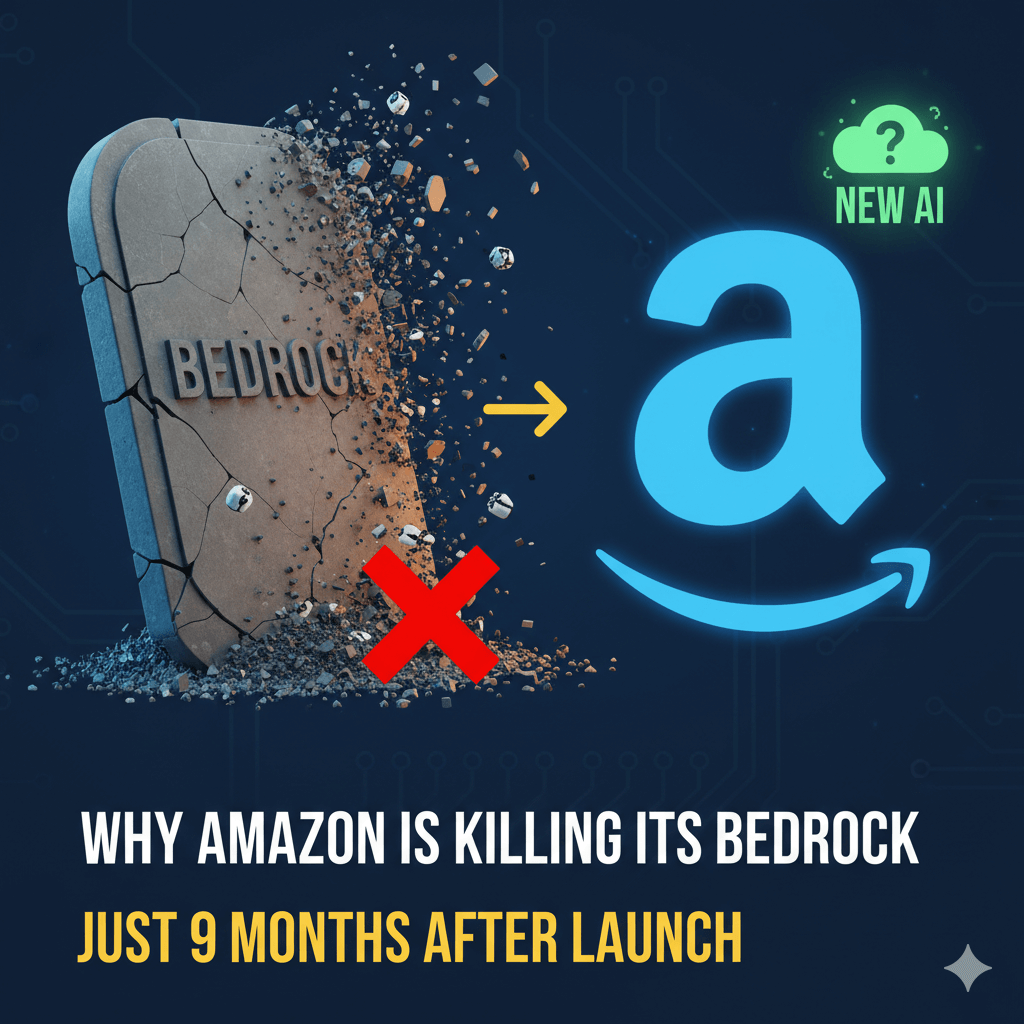
Amazon’s decision to shutter its AI Bedrock Agents service less than a year after launch offers a rare glimpse into the tech giant’s internal struggles with artificial intelligence development. The company that revolutionized e-commerce and cloud computing appears to be recalibrating its AI strategy in real-time—with significant implications for businesses and developers who had already begun building on the platform.
The announcement, which came quietly through user notifications rather than a formal press release, marks a significant shift in Amazon’s AI roadmap. For those tracking the breakneck pace of AI development, this retreat raises important questions about the technology’s readiness for enterprise applications and Amazon’s position in the increasingly competitive AI race.
What Exactly Is Being Discontinued
Amazon is specifically shutting down Bedrock Agents, a service introduced in November 2023 that allowed developers to build AI applications capable of performing tasks across various AWS services. This tool was designed to compete with similar offerings from Google and Microsoft, positioning Amazon as a serious contender in the generative AI space.
According to notifications sent to users, Amazon will completely discontinue the service by December 31, 2024, giving current users approximately six months to migrate their applications to alternative solutions. Importantly, this shutdown doesn’t affect Amazon’s broader Bedrock service, which will continue to provide access to various foundation models from Anthropic, Cohere, Meta, Mistral AI, and Amazon’s own Titan models.
The Timing Raises Eyebrows
The short lifespan of Bedrock Agents—just nine months from announcement to deprecation notice—is unusually brief for a major Amazon service. Typically, AWS products undergo extensive testing before public release and receive years of support once launched. This rapid reversal suggests internal recognition of fundamental issues with the service that couldn’t be resolved through incremental improvements.
The timing is particularly noteworthy considering Amazon’s recent aggressive push into AI. At its 2023 re:Invent conference, CEO Andy Jassy highlighted AI as a central focus, with Bedrock Agents featured prominently in the company’s strategic vision. This quick about-face indicates that Amazon is willing to make tough decisions rather than continuing to invest in underperforming products—even at the cost of short-term embarrassment.
Why Amazon Is Making This Move
While Amazon hasn’t publicly detailed its reasoning, several factors likely contributed to this decision:
Technical Limitations
Sources familiar with the service suggest that Bedrock Agents struggled with reliability and performance issues. The complex task of integrating AI agents with AWS’s vast ecosystem of services proved more challenging than anticipated. As one developer who tested the service noted, “The agents were inconsistent in how they executed tasks across different AWS services, sometimes failing to complete operations or requiring extensive prompt engineering to function properly.”
These technical hurdles created a frustrating user experience that fell short of Amazon’s typically high standards for enterprise-ready services.
Strategic Refocusing
Amazon appears to be consolidating its AI efforts around services with clearer market traction. Rather than spreading resources across multiple overlapping AI products, the company is likely prioritizing its core Bedrock offering, which provides direct access to foundation models without the additional complexity of the Agents layer.
This strategic shift aligns with recent comments from AWS executives emphasizing a more focused approach to AI development. As competition intensifies with Microsoft’s Azure OpenAI Service and Google Cloud’s Vertex AI, Amazon needs to ensure its resources are directed toward the most promising opportunities.
Market Feedback
Customer adoption rates and feedback undoubtedly played a role in this decision. If Bedrock Agents wasn’t gaining the expected traction among AWS customers, continuing to invest in the service would be difficult to justify. Amazon’s customer-obsessed culture often leads it to quickly pivot when products don’t resonate with users.
Implications for Businesses and Developers
For organizations that invested in building applications on Bedrock Agents, this announcement creates immediate challenges:
- Migration costs: Companies will need to allocate resources to redesign and redeploy their applications on alternative platforms
- Trust concerns: The short lifespan of this service may make some businesses hesitant to adopt future AWS AI offerings early in their lifecycle
- Technical rework: Developers must find new solutions for the functionality previously handled by Bedrock Agents
Amazon is offering migration assistance to affected customers, but the transition will inevitably require significant effort for organizations that made substantial investments in the platform.
Alternative Paths Forward
For those currently using Bedrock Agents, several migration options exist:
Remain Within the AWS Ecosystem
The most straightforward path for many will be to use Amazon’s core Bedrock service directly, implementing the agent functionality through custom code. While this requires more development work, it provides greater control over the application’s behavior. Additionally, Amazon Lambda functions can replicate many of the workflow capabilities previously handled by Bedrock Agents.
Amazon’s documentation suggests that “many use cases can be addressed by using Amazon Bedrock directly with APIs and knowledge bases.” This indicates that the company believes most agent applications can be reconstructed using its remaining AI services.
Explore Competitor Offerings
Some organizations may consider this an opportunity to evaluate competing services like Azure OpenAI Service, Google’s Vertex AI Agents, or Anthropic’s Claude. These platforms offer similar capabilities and may provide a more stable long-term solution for agent-based AI applications.
However, switching cloud providers introduces additional complexity, especially for organizations deeply integrated with other AWS services.
Build Custom Solutions
For companies with sufficient AI expertise, developing proprietary agent frameworks using foundation models available through Bedrock or other providers might offer the most control. This approach requires greater initial investment but reduces dependency on any single vendor’s agent implementation.
What This Tells Us About the State of AI
Amazon’s retreat from Bedrock Agents reveals several important realities about the current state of artificial intelligence:
Enterprise-Grade AI Remains Challenging
Creating reliable, production-ready AI systems that can consistently perform complex tasks across different services is still extraordinarily difficult. The gap between impressive demos and dependable enterprise solutions remains substantial.
As one AI researcher put it, “We’re still in the early days of truly autonomous AI agents. The technology shows promise in controlled environments but struggles with the variability and complexity of real-world enterprise systems.”
The AI Landscape Is Still Taking Shape
Major players like Amazon are still determining which AI approaches and products will deliver sustainable value. This period of experimentation and rapid iteration will likely continue as companies refine their understanding of what works in practical applications.
For businesses adopting AI, this environment demands flexibility and a willingness to adapt as the technology and market evolve.
“We’re in a phase where even the largest tech companies are figuring out AI strategy in real-time. This creates both risk and opportunity for organizations building on these platforms.” — Sarah Johnson, Enterprise AI Consultant
Amazon’s AI Strategy Moving Forward
Despite this setback, Amazon remains heavily invested in artificial intelligence. The company continues to develop its Titan family of models and maintain partnerships with leading AI providers like Anthropic (in which Amazon invested $4 billion).
The discontinuation of Bedrock Agents appears to be a tactical retreat rather than a strategic withdrawal from AI competition. By focusing resources on more promising areas, Amazon is likely positioning itself for longer-term success in the AI space.
Recent job postings and internal reorganizations suggest that Amazon is doubling down on foundation model development and AI infrastructure—areas where the company’s cloud expertise provides natural advantages.
Lessons for Business Leaders
This situation offers several valuable takeaways for executives navigating the AI landscape:
Approach Early-Stage AI Products Cautiously
When building critical business infrastructure, consider the maturity of AI services. Early adoption brings competitive advantages but also carries increased risk of disruption if services are discontinued or significantly altered.
Maintain Flexibility in AI Architecture
Design systems with the expectation that underlying AI services may change. Where possible, create abstraction layers that allow for substitution of different AI providers or services without requiring complete application rewrites.
Watch the Leaders’ Moves
Amazon’s decision to pull back from agent technology may signal broader industry challenges in this specific approach to AI. Business leaders should pay attention to where major players are investing and divesting as indicators of technology readiness.
The Future of AI Agents
Despite Amazon’s retreat, the concept of AI agents remains compelling. The vision of AI systems that can independently execute complex workflows across multiple services continues to drive innovation across the industry.
Other companies, including OpenAI with its forthcoming GPT Agent framework and Anthropic with Claude Opus, are actively developing similar capabilities. The question isn’t whether AI agents will become viable, but rather when the technology will mature enough for mainstream enterprise adoption.
For now, Amazon’s decision suggests that dependable, enterprise-ready AI agents may still be further away than the initial hype suggested. Organizations planning their AI strategy should balance enthusiasm for these promising capabilities with realistic assessments of their current limitations.
Final Thoughts
Amazon’s decision to discontinue Bedrock Agents represents a notable moment in the evolution of enterprise AI—a rare acknowledgment from a major player that certain approaches aren’t yet ready for prime time. Rather than viewing this as a failure, it’s more accurately interpreted as a necessary recalibration in a rapidly evolving field.
For businesses navigating the AI landscape, Amazon’s move reinforces the importance of thoughtful technology adoption and maintaining flexibility as the market matures. The companies that will thrive in this environment are those that can balance innovation with pragmatism, remaining agile enough to adjust as the technology evolves.
As the December 31 shutdown date approaches, affected organizations should begin planning their migration strategies while keeping an eye on Amazon’s next moves in the AI space. This retreat may well be setting the stage for a stronger, more focused advance in the near future.
Real Stories Behind This Advice
We’ve gathered honest experiences from working professionals to bring you strategies that work in practice, not just theory.
- Read more: Get the full details in the original article
- Join in: See what others are saying and share your thoughts in the Reddit discussion (1,044 upvotes, 395 comments)
- Tell your story: Have experience with this? Help others by sharing what worked for you at our Contact Us page
At ModernWorkHacks, it’s practical ideas from real people.






0 Comments