Discover actionable insights.
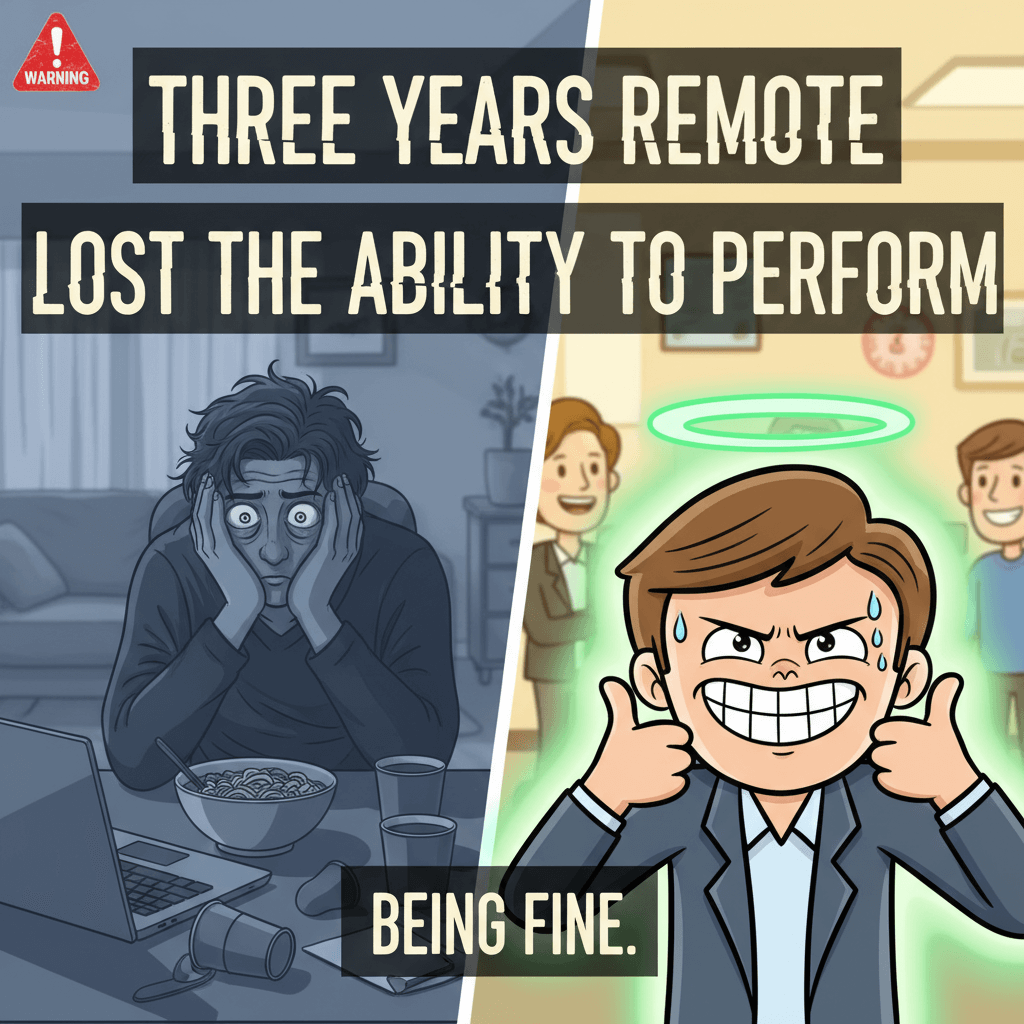
Two minutes before the daily standup, I was practicing the face I used to save for Mondays. The neutral half-smile, the comforting lift in the eyebrows, the “doing great, thanks,” all prepped for a 15-second check-in over a video square the size of a sticky note. At 9:00 a.m., the camera winked on, and I became a confident, unruffled version of myself. Or so I thought. When it was my turn, my script broke on contact. “I’m fine,” I started, but my voice had that unmistakable brittle edge. Someone asked a quick follow-up—“You okay?”—and the awkward pause that followed was longer than any hallway silence I’d ever endured. It turns out that three years into remote work, I’ve lost the ability to perform being fine.
In an office, “fine” used to be a ritual flourish. You could glide past a colleague with a coffee cup and an easy grin and call it a conversation. Eye contact, jokes about the commute, a shared sigh at the elevator—these were small, physical gestures that smoothed over bigger, messier undercurrents. Remote work didn’t just relocate us; it stripped out those micro-rituals that used to make “fine” feel believable. Now, the same performance happens under the blue light of a camera, where each second is recorded, gallery-viewed, and instantly judged—with none of the warmth that helps a half-truth land softly.
Over the last few years, I’ve listened to teammates, managers, and friends. I’ve scrolled discussion threads and sat in virtual roundtables where people talk about “the exhaustion of pretending,” the Slack messages that say “no worries at all” while their pulse rate says otherwise, the pressure to be present everywhere with no doors to close. From those real conversations come a set of hard-won insights—and more importantly, practical ways forward. This is not an argument against remote work. It is a blueprint to stop performing “fine” and start practicing something more sustainable: aligned, honest, resilient work.
The Disappearing Act: Why “performing fine” stopped working online
Before the world went remote, “fine” had scaffolding. Commuting rhythms signaled that you were a responsible adult. Desk neighbors witnessed enough of your day to fill in the blanks. A rushed greeting in the kitchen communicated more than words: “I’m busy, but I’m here.” In that shared physical context, the social mask of “fine” was lubricated by proximity. It wasn’t always honest, but it was understood.
Remote work replaced a hundred subtle cues with a handful of explicit ones: your camera frame, your Slack status, your punctuality in the meeting list. We tried to port over the old performance—smiles, upbeat tones, tidy status updates—but the bandwidth for nuance collapsed. An “I’m fine” without shared context can sound suspicious, robotic, or worse, dismissive. When your entire presence is reduced to a thumbnail, your words carry more weight, but your intent is harder to read.
Another reason the act fails is scale and permanence. “Fine” used to evaporate after a conversation. Now our performance lingers: calendar histories, chat logs, recorded meetings, and employer dashboards that track availability. The fear of being misunderstood is amplified by the knowledge that misunderstandings can be replayed. The side effect is self-surveillance, a round-the-clock audition where the stakes feel both invisible and immense.
Finally, remote work changed the cost structure of pretending. What used to be a brief, energy-saving fiction in the hallway has become a sustained, energy-expensive fiction across the day. Every context switch—to a call, a doc, a channel—invites another micro-performance. The cumulative load converts from “white lie” to “chronic stress.” The mask doesn’t come off at 5:00 p.m. because the office is everywhere and nowhere.
Actionable takeaways
- Name the shift: Acknowledge in your team’s norms that remote work erodes context and makes “performing fine” less effective and more draining. A shared vocabulary reduces stigma.
- Replace rituals, don’t delete them: Intentionally add two-minute “human warm-ups” before agenda items—music, check-in polls, or a single open prompt—so the room has a temperature before work begins.
- Constrain the performance window: Agree on meeting-free blocks and explicit “camera-optional” guidance for specific meeting types to lower the baseline pressure to perform visually.
What people are actually saying: Key takeaways from real discussions
Across team retros, industry communities, and manager 1:1s, the same refrains surface. They are not theoretical—they are lived experiences shared by people trying to do great work without burning out. Here are distilled takeaways that echo in those rooms and threads:
- The smile tax is real: People spend surprising energy calibrating facial expressions on camera. The burden is heavier for those navigating bias: women, people of color, neurodivergent colleagues, and caregivers often feel they must overcompensate to be read as “engaged” or “reliable.”
- Status emojis aren’t status updates: A green dot or a “heads down” note doesn’t communicate capacity or context. Teams mistake availability signals for wellness signals, then wonder why deliverables slip.
- Meetings eat margins: Back-to-back calls remove recovery time, turning minor frustrations into major frictions. Without hallway decompression, small misalignments escalate.
- Public praise, private panic: Asynchronous recognition posts sometimes backfire, creating pressure to keep outperforming a narrative. People crave specific, actionable feedback more than fanfare.
- Silence isn’t consent: In large calls, non-response is often caution, not agreement. Psychological safety doesn’t improve because the “raise hand” button exists.
- Boundaries blur downward, not upward: Teams that say “flexible” often mean “work whenever,” not “work less.” Without explicit guardrails, availability expands to fill the toolset.
- Leaders set the honesty ceiling: Managers who model saying “I’m at 70% today” unlock permission for healthier transparency. Leaders who never show limits teach everyone else to hide theirs.
Actionable takeaways
- Shift recognition from performative to practical: Praise behaviors that are repeatable—clarity in specs, thoughtful handoffs, proactive risk flags—rather than personality traits.
- Ask capacity, not just status: Add “What’s your realistic bandwidth this week?” to planning rituals. Treat the answer like a constraint, not a confession.
- Design for dissent: Use structured formats—anonymous pre-reads, written objections, or a designated “red team” respondent—to reduce the social cost of disagreement in large calls.
The mechanics behind the feeling: cognitive load, context loss, and performative pressure
Understanding why the mask slips helps us design smarter habits. Several forces combine to make remote “fine” uniquely fragile.
Cognitive load multiplies online. In the office, your senses distribute the work of understanding a situation: who looks rushed, who’s in conversation, where the urgency lives. Online, you process all of that through a narrow channel—tiny faces, text scrolls, and calendar tiles. That compression forces your brain to make more inferences with less data. Add lag, background noise, or multitasking tabs, and your working memory burns hot. When cognitive load spikes, self-regulation drops. The polished “I’m fine” you meant to present leaks frustration or goes flat.
Context collapse erases nuance. Remote tools flatten audiences: the same Slack channel hosts interns and executives; a recorded all-hands sits next to a casual team chat. We used to tailor performance to context; now, any sentence might be read by anyone, anytime. The safer move becomes the bland move, and bland often reads as brittle or insincere. People default to short, positive signals to avoid misinterpretation—ironically inviting more misinterpretation.
Asymmetry of visibility fuels self-editing. Your “green dot” is public, but your life is private. Others see your response time; they don’t see your toddler’s nap schedule or your chronic back pain. We overcorrect for what’s visible (presence) and underinvest in what’s invisible (recovery). The delta widens until an offhand “I’m fine” has to do the labor of an entire wellbeing plan.
Surveillance-tinged tools change behavior. Even when organizations don’t intend to monitor, features like read receipts, join/leave notifications, and meeting recordings can nudge employees to display “engagement theater.” That performance becomes contagious: if one person never turns their camera off, everyone wonders if they should follow. Social proof turns into social pressure.
Loneliness edits the script. Without casual mirroring from teammates—laughter after a joke, a nod during a tough update—you doubt your read of the room. Doubt makes honesty feel dangerous, so you default to “fine” even when connection would help.
Actionable takeaways
- Reduce cognitive tax: Turn off self-view by default to free attention. Encourage one-screen meetings (no multitasking) and schedule shorter calls with explicit pauses.
- Protect context: Separate channels by audience and risk. Use “decision logs” to record outcomes and reserve casual channels for true casual chat, reducing the need to overperform in mixed spaces.
- Normalize capacity statements: Add a lightweight template to weekly updates: “At X% this week. Best slots: 10–2. Risks: Y.” Make it routine, not revealing.
- Audit tool nudges: Disable or de-emphasize engagement metrics that don’t correlate with outcomes. Replace attendance tallies with deliverable check-ins.
A practical playbook for individuals: how to show up without the mask
If pretending “fine” is costly, what replaces it? Not radical vulnerability at every turn. The goal is calibrated honesty—specific, bounded, and aligned to outcomes—so your team gets what it needs and you keep your energy.
Micro-scripts that reduce friction
- Capacity without confession: “I can reliably deliver A and B by Thursday; C needs a separate window early next week.”
- Energy check without drama: “I’m at 70% today. If we keep this to decisions and not ideation, I’ll be most useful.”
- Boundary with alternatives: “I log off at 5:30. If something is urgent after that, text me before 6 or let’s plan for early morning.”
- Reset after misread: “My last message was terse; the intent was speed, not tone. Here’s the detail you need.”
Rituals that rebuild signal
- Two-state status: Pair your green dot with a short “mode” note: “Focus: drafting spec, responses by top of hour,” or “Collaborative: quick pings welcome.” This clarifies availability without performative cheer.
- Timeboxing instead of availability: Block “Focus” and “Collab” windows on your calendar, then steer requests into the right box. This makes “no” unnecessary; the calendar says it for you.
- Closing rituals: End your day with a two-line note to yourself: “Moved: X. Stuck: Y (because Z). Next: W.” It becomes your morning brief and reduces anxious over-performance the next day.
- Camera choice by task: Use video for alignment and trust-building, audio for brainstorming, and async for updates. Don’t conflate visibility with value.
Communication defaults that travel well
- Write for the absent person: Assume someone will read your note tomorrow with no context. Include one sentence of “why now” and one sentence of “what success looks like.”
- Adopt the “polite blunt” rule: Be generous in tone and crisp in content. “Great work pulling this together. I propose we cut section two for time and add one example to section three.”
- Use tiered escalation: Start async. If stuck after two messages, propose a quick call with a clear goal. If still stuck, schedule a longer sync with the right people. This reduces backchanneling and performance anxiety.
Energy management that respects reality
- Match work to rhythm: Identify your peak 90 minutes. Schedule most cognitively demanding tasks there, guard them, and let “performative” slots take the off-peak times.
- Micro-recovery over marathon days: Between calls, do 60 seconds of physical reset—stand, roll shoulders, look at something far away. It interrupts the build-up that makes your voice crack on “I’m fine.”
- Choose your mask, don’t default to it: It’s okay to bring energy for a key client call. Make that a deliberate spend, and balance it with a protected low-performance window later.
Actionable takeaways
- Adopt one micro-script this week: Pick a sentence above and use it in your next check-in.
- Implement a two-state status: Update your profile to reflect “Focus” or “Collaborative” mode for three days and observe the difference.
- Guard one peak block: Put a recurring 90-minute focus hold on your calendar where you never perform “fine”—you just produce.
A practical playbook for teams and leaders: design remote for truth and trust
Teams can’t rely on individual heroics to fix systemic friction. Leaders shape the water we’re all swimming in. If the environment rewards clarity over theater, the need to perform “fine” fades fast.
Rewrite the social contract
- From attendance to agreements: Define what “good” looks like in terms of outputs, response SLAs, and collaboration windows. Replace vague “responsiveness” expectations with explicit norms.
- Set (and model) camera norms: Clarify when video adds value (trust-building, conflict resolution) and when it’s optional (status updates, FYIs). Leaders should go camera-off sometimes, too.
- Institutionalize capacity updates: Make a weekly capacity pulse part of planning. Encourage ranges (“60–80%”) and normalize fluctuation.
Design meetings for signal, not theater
- Agenda clarity: Label each item with its mode: inform, discuss, decide. If “inform,” consider async. If “decide,” name the decider.
- Shorter by default: 25 and 50 minute meetings restore breathing room. Use the last five minutes for written next steps to prevent performative “any other questions?” loops.
- Rotate facilitation: Spread the emotional labor of reading the room. Facilitators should call on quieter voices and pause for written reactions.
- No-makeup culture: If someone misses a call, provide an async summary and decisions. Avoid follow-up “performances” to re-prove presence.
Strengthen asynchronous muscles
- Decision logs: Centralize decisions with date, owner, rationale, and links. This reduces the need to re-perform the same alignment on multiple calls.
- Working documents over slide decks: Encourage collaborative docs with comments and proposals. Slides tempt polish; docs invite substance.
- Thread hygiene: One topic per thread, clear titles, and explicit asks. Close threads with a “Decision: …” note.
Measure what matters
- Outcome metrics over presence metrics: Track cycle time, defect rates, customer response, or learning velocity—not hours on camera.
- Sentiment with specifics: Run monthly pulse checks that ask concrete questions: “Do you have two hours of predictive focus time most days?” Measure progress on that, not generic happiness.
- Debrief the debriefs: When retros surface “performance pressure,” translate it into one system change within two weeks—calendar norms, tool settings, or staffing adjustments.
Build psychological safety on purpose
- Leaders go first: Periodically share your own capacity and a recent mistake plus what you changed. Short, factual, and forward-looking.
- Codify escalation paths: Make it safe to say “I’m stuck” by advertising fast, blame-free support channels.
- Ritualize appreciation: Replace public “hero” posts with weekly “handoff highlights” that praise clarity, documentation, and risk surfacing.
Your next step: a one-week experiment
- Day 1: Announce camera-optional for all status meetings and adopt inform/discuss/decide labels.
- Day 2: Introduce a capacity pulse: each person shares their range for the week and one risk.
- Day 3: Turn on decision logs. Close at least one open thread with a written decision.
- Day 4: Leaders model a capacity statement and a recent process tweak they made after a mistake.
- Day 5: Run a five-question pulse: focus time, meeting load, clarity of decisions, ability to dissent, and energy at week’s end. Share results and choose one system change for next week.
By the end of this experiment, your team should feel a little lighter and your “fine” should feel less like acting and more like alignment. The point isn’t to abolish positivity—it’s to make room for truth, so positivity can be real.
Actionable takeaways
- Codify norms in writing: Publish a one-page “How We Work Remotely” guide that covers camera use, capacity updates, meeting modes, and decision logs.
- Run the one-week experiment: Treat it as a sprint with explicit measures of success.
- Prune performative metrics: Remove or ignore tool features that incentivize theater and double down on outcome reviews.
Final thought: Losing the ability to perform being fine is not a personal failure; it’s a sign that your context changed and your strategies need to, too. When we stop spending energy on the mask, we get it back for the work—and for each other. The future of remote work won’t be built on perfect faces in perfect squares. It will be built on imperfect people who tell the truth quickly, design for reality, and still make something remarkable together.
Call to action
Start now. Before your next meeting, replace “How’s everyone doing?” with “On a scale from 1–5, what’s your bandwidth today and what do you need to do your best work?” Share this article with your team, commit to the one-week experiment, and put a date on the calendar to review what changed. Don’t perform being fine; practice being clear. Your team—and your future self—will thank you.
Where This Insight Came From
This analysis was inspired by real discussions from working professionals who shared their experiences and strategies.
- Source Discussion: Join the original conversation on Reddit
- Share Your Experience: Have similar insights? Tell us your story
At ModernWorkHacks, we turn real conversations into actionable insights.
![[Workflow Included] A simple 5-node Instagram posting workflow for beginners](https://modernworkhacks.com/wp-content/uploads/2026/04/workflow-included-a-simple-5-node-instagram-posting-workflow-for-beginners-1024x675.png)



0 Comments