
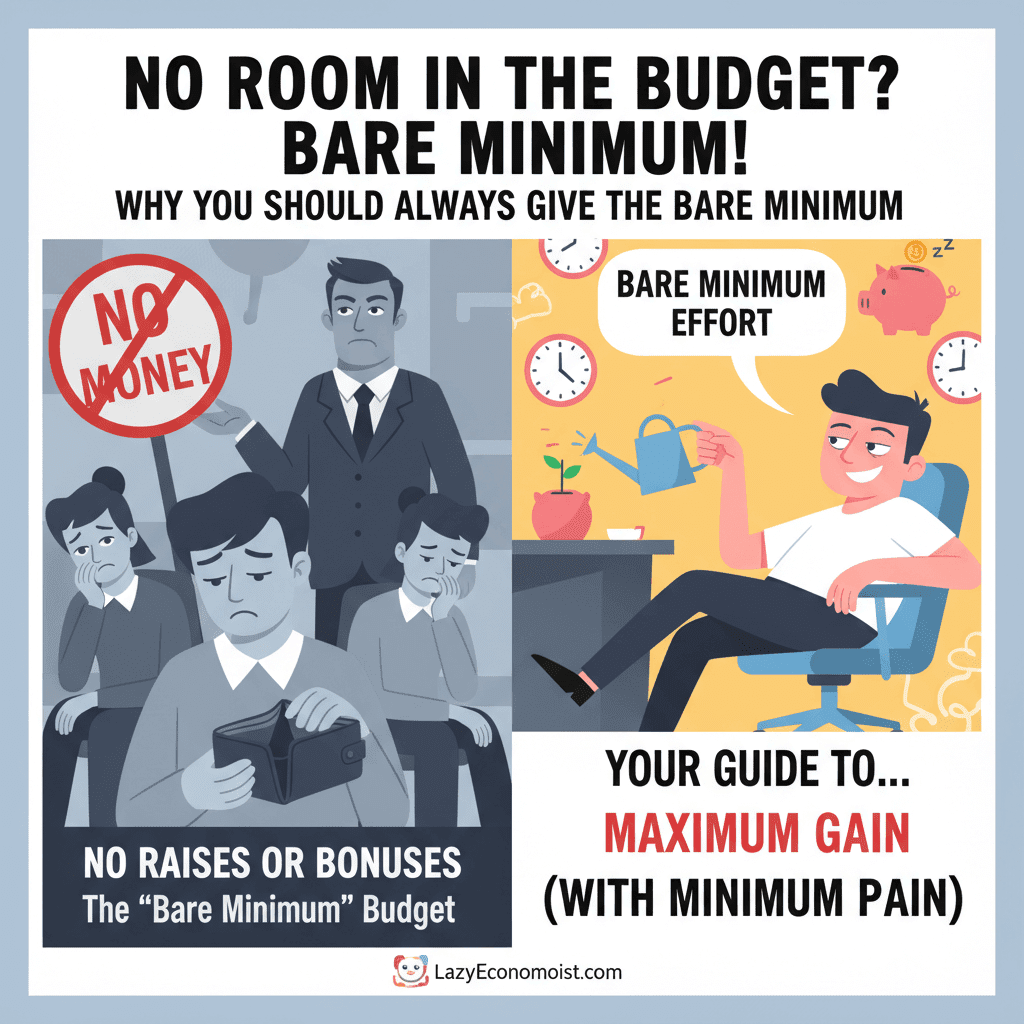
The Meeting That Changed Everything
It was a Wednesday, 4:58 p.m., the kind of hour when bad news gets delivered so it can marinate overnight. Ella’s calendar pinged with an “All-Hands: FYI” and a familiar subject line: “Tough but important update.” She’d slept an average of five hours for the last two months, shipped the quarter’s most visible project, swallowed two weekend deploys and the fallout on Monday mornings. She’d said yes to six “just-one-more” requests and rewritten her performance goals so many times they looked like a ransom note. She expected a delay. She didn’t expect the sentence.
“There’s no room in the budget for raises or bonuses this year.”
The screen stayed quiet. Mics on mute. Cameras off. Chat scrolling with heart emojis and “we got this” platitudes from executives who had—from Ella’s vantage point—plenty of room. The follow-up: “What we can offer is gratitude, visibility, and the opportunity to grow.” Ella closed her laptop and felt the tilt: all the extra she’d given had become the new minimum. The story she’d told herself—that going above and beyond would be recognized—had met the company’s story—budgets, cycles, markets, KPIs—midair. And her body, wiser than both, said no.
That evening Ella wrote one line at the top of a new page: “Match effort to incentives.” Underneath, a second: “Give only the minimum you are paid for—until incentives change.”
This is the pivot. Not cynicism. Not sabotage. Not laziness. It’s a practical recalibration that thousands of employees quietly make every quarter when promises drift and incentives flatten. And it’s a strategy that can protect your time, your health, and your leverage—while still doing excellent, professional work.
Hook: Discover actionable insights you can use today: how to interpret the “no budget” line, how to define the real minimum of your role, how to renegotiate without burning bridges, and how to build leverage that gets you better outcomes—inside your current role or beyond it.
What “Bare Minimum” Really Means (And What It Doesn’t)
Redefining Minimum: Your Contract, Not Their Comfort
“Bare minimum” has been caricatured as apathy. In real discussions among managers, HR partners, and employees across industries, a more accurate definition emerges: the agreed scope, standards, and pace of work that your role, pay band, and job description warrant—performed reliably and professionally, without unpaid expansion. It’s the work-to-rule principle applied to knowledge work.
In practice, the minimum includes:
- Scope fidelity: Doing the tasks your role is hired to do, not the extra roles quietly added when headcount freezes.
- Standards clarity: Meeting documented quality definitions, SLAs, and timelines—no heroics to save poor planning.
- Time boundaries: Working your contracted hours, with reasonable flexibility for genuine emergencies—not as a default setting.
- Process compliance: Following agreed workflows and approval gates to prevent invisible labor and self-inflicted chaos.
What It Isn’t: Disengagement, Negligence, or Spite
From dozens of manager-employee 1:1 anecdotes and HR roundtables, three misinterpretations cause unnecessary friction:
- Not “phoning it in”: You still care about results. You just stop subsidizing broken systems with personal sacrifice.
- Not weaponized slowdowns: You aren’t torpedoing outcomes; you’re executing the plan as written, not as wished.
- Not a career stall: Many professionals use the minimum strategically while pursuing development, certifications, or a job search with better alignment.
Why the Minimum Works
Across real conversations in employee forums, compensation committees, and team retrospectives, a pattern is clear: systems normalize whatever you repeatedly give. If you consistently donate nights and weekends, the schedule expands to fit your generosity. If you consistently protect scope and hours, plans adapt. The minimum is not punishment; it’s a feedback mechanism that restores honesty to planning, resourcing, and incentives.
There’s also a sanity factor. When rewards flatten, risk should flatten too. If there’s no variable comp, shift your personal risk—burnout, missed family time, reputational exposure—down to the baseline. That alignment is rational, sustainable, and often quietly respected by seasoned leaders who have learned the same lesson the hard way.
Actionable Takeaways
- Write your minimum: List your core responsibilities, quality bars, and standard hours. If it’s not in writing, it’s optional.
- Separate “urgent” from “poorly planned”: Agree to protect true emergencies and push back on habitual chaos.
- Adopt a default “yes, if” stance: Replace automatic yes with yes-if the scope, resources, or timeline are adjusted.
- Communicate professionalism: Tell your manager you’re focusing on consistent, sustainable execution to improve predictability—not withdrawing.
Decoding “No Room in the Budget” (What It Means, What It Hides, What You Can Do)
The Finance Reality Managers Won’t Always Say Out Loud
From conversations with managers and finance partners, here’s what “no budget” often contains:
- Timing mismatch: Salary reviews are locked by cycles. You might be performing at a new level mid-cycle that can’t be recognized until the next window.
- Centralized caps, decentralized exceptions: Company-wide guidance may say “freeze,” but teams can secure exceptions for high-risk retention—usually with clear business cases.
- Compression and equity constraints: HR may be preventing raises that would push you above the band or create inequity with peers, even if your manager wants to pay more.
- Budget is code for priority: There is always budget for existential risks. If there’s truly no budget for you, your role is not currently prioritized.
Common Patterns From Real Discussions
- Selective scarcity: While messaging stays uniform, exceptions get made for roles with quantified business impact and risk of attrition. The consistent differentiator is a crisp, documented case.
- Vague appreciation without commitments: “We value you” lands without specifics. Requests die in ambiguity unless anchored in criteria, timelines, and decision-makers.
- Deferred promises: “We’ll revisit next quarter” becomes a carousel. Without calendar invites, written criteria, and pre-approval plans, revisits rarely materialize.
- Non-cash levers: Title changes, scope, budget for tools/training, improved schedules, or variable comp pilots are more available than base salary mid-cycle.
Questions That Change the Conversation
Instead of absorbing the line, ask for specificity. These questions, shared repeatedly by employees who managed to break through, force clarity without confrontation:
- “Which budget owner would need to approve an exception, and what criteria have qualified exceptions in the past 12 months?”
- “What is the compensation band for my role and level? Where am I within it, and what documented outcomes move someone to the next step?”
- “If base salary is locked, which non-cash levers are available this quarter—title calibration, scope, variable comp, retention bonus, or extra PTO?”
- “Can we schedule a 30/60/90-day plan with specific milestones, decision dates, and approvers for a compensation review?”
- “What risks would justify an exception, and how can I help quantify the risk of attrition or impact loss?”
Actionable Takeaways
- Translate asks into business cases: Tie your request to revenue protected, cost reduced, risk mitigated, or growth enabled—use numbers wherever possible.
- Get it in writing: Summarize agreements with dates, criteria, and names. “If it isn’t written, it isn’t real.”
- Request alternative value: If salary is frozen, negotiate for title alignment, explicit promotion tracks, funded training, or reduced on-call duty.
- Set revisit anchors: Put calendar holds now for the next review; shared visibility creates accountability.
The Strategic Minimum Playbook: How to Protect Your Time, Value, and Leverage
Step 1: Calibrate Your True Baseline
Create a one-page role baseline. It should include:
- Core outputs: 3–5 deliverables you’re explicitly hired to produce.
- Quality bars: Definition of done, SLAs, error thresholds.
- Cadence: Standard timelines and meeting commitments.
- Boundaries: Working hours, response windows, on-call agreements.
Share this with your manager as a clarity tool: “I want to ensure excellence at the core of my role. Here’s how I’m defining the baseline. Can we align?” Alignment turns the minimum from a unilateral withdrawal into a co-authored plan.
Step 2: Prioritize Like a Portfolio Manager
Treat your time as a finite fund. Invest in tasks with the best return for you and the business. A simple triage stack, used by high-performing teams:
- Tier 1: Contractual/critical (must-do per role/SLAs; legal/compliance; production stability)
- Tier 2: Strategic impact (moves top company OKRs; high visibility; unlocks future leverage)
- Tier 3: Good-to-have (nice features, internal favors, vanity metrics)
When you hit capacity, anything below Tier 2 gets scheduled later or declined. Say: “Given our agreed priorities and my current commitments, I can start this on [date], or we can drop [lower-priority task]. Which do you prefer?”
Step 3: Master the “Yes, If” and “No, Because” Scripts
Replace guilt with clarity. Scripts employees repeatedly report as effective:
- Yes, if: “Yes, I can pick that up if we move the timeline to next sprint or swap it with X. Otherwise it risks Y and won’t meet our quality bar.”
- No, because: “No, I can’t take that on this week because I’m at capacity on our agreed objectives A and B. I can help scope it for next cycle.”
- Boundary reset: “I’m off after 6 p.m. If this is a true emergency, please mark it as such and I’ll prioritize it first thing tomorrow.”
- Escalation invitation: “If we need both this and the current priorities within the same timeframe, let’s align with [manager/PM] on resourcing.”
Step 4: Document Impact Ruthlessly
Invisible labor gets normalized; visible impact gets paid. Keep a weekly impact log:
- Action -> Outcome -> Metric -> Stakeholders
- Example: “Refactored alert rules -> 37% fewer false pages -> 112 to 71/wk -> On-call team, SRE lead”
Use this log for performance reviews, negotiation memos, and job searches. In real negotiations, the professionals who bring crisp, quantified impact stories have the highest success rate for exceptions and accelerated promotions.
Step 5: Protect Your Time With Systems
- Time blocks: Reserve focus blocks daily. Decline meetings that lack clear agendas or outcomes.
- Inbox triage windows: Check messages at set times to avoid perpetual partial attention.
- Meeting hygiene: Ask, “What decision are we making?” If none, propose async updates.
- After-hours guardrails: Remove work apps from your personal phone, or mute non-critical channels after hours.
Step 6: Normalize Tradeoffs Publicly
When scope creeps in, make tradeoffs explicit in shared channels: “Picking up Feature B means Feature A slips to 5/28. Confirming that’s acceptable.” Transparency prevents quiet overwork and forces prioritization where it belongs—at the decision-maker level.
Actionable Takeaways
- Build your baseline doc in one hour: Share it with your manager and incorporate feedback.
- Install a weekly “impact log” ritual: 15 minutes every Friday; keep metrics front and center.
- Adopt two scripts this week: Practice “Yes, if” and “No, because” until they’re second nature.
- Calendar-proof your focus: Two 90-minute blocks per day, minimum.
Leverage: Align Effort With Incentives and Create Options
Make the Business Case, Not the Emotional Plea
Most managers don’t control the comp pool; they do influence who gets exceptions. Stories from internal promotion committees show what works:
- Quantification: “This work prevented $250k in renewal risk” beats “I worked very hard.”
- Comparables: “Peers at L5 average $X–$Y; my scope matches L5 responsibilities A, B, C.”
- Risk framing: “If unaddressed, we face A outage risk and B churn. Here’s the minimal investment to mitigate.”
- Planfulness: “Here’s a 90-day plan with milestones. On achievement, we execute the title/comp change on [date].”
Use Non-Cash Levers Strategically
From HR partners and employees who navigated freezes, these levers are often more accessible mid-cycle:
- Title calibration: Align title to scope now, comp later. Titles unlock external options and internal eligibility.
- Variable comp pilot: A small, targeted bonus for specific outcomes funded from project budgets.
- Time currency: Extra PTO, no-meeting days, or rotation off on-call duty.
- Career capital: Training budget, certifications, or conference speaking slots that raise your market value.
Build Your BATNA: Outside Options Change Inside Outcomes
Experienced negotiators across industries highlight the same truth: Your best alternative to a negotiated agreement (BATNA) is leverage. If your internal path is stalled, cultivate external momentum:
- Market check: Refresh your resume and LinkedIn. Take two exploratory interviews per month.
- Skill signal: Earn a relevant certification or publish a case study of your work.
- Warm network: Reconnect with five former colleagues; share a concise value snapshot, not a plea.
- Portfolio proof: Host a sanitized portfolio of outcomes (metrics, dashboards, architecture overviews) without proprietary details.
Real-world note: Many employees report that credible external interest clarifies internal priorities. Use this ethically; never bluff. But don’t hide your growth. “I’m exploring roles that align scope, title, and compensation. I’d love to make that alignment here if we can map a path.”
Manage Up Without Becoming the Hero
Managers juggle noise; become a signal. Provide concise, periodic updates that tie your work to top objectives and highlight tradeoffs. Template:
- What’s on track: Tie to OKRs; include a metric.
- What’s at risk: State the blocker; suggest a solution.
- What I need: A decision, resource, or deprioritization.
This positions you as a professional who drives outcomes within reasonable boundaries—not the person who solves systemic problems by burning out.
Actionable Takeaways
- Draft a one-page business case: Outcome metrics, comparables, and a 90-day plan with milestones and approvers.
- Secure one non-cash lever: Ask for title calibration or a funded certification this quarter.
- Start a light-touch job search: Two conversations per month to calibrate your market value.
- Adopt the weekly manager update: Three bullets: on-track, at-risk, need.
Key Takeaways From Real Discussions (And How to Act on Them Today)
What Employees Say (Patterns Across Teams and Industries)
- Extra becomes expected quickly. Without explicit agreements, last quarter’s heroics become this quarter’s baseline.
- Raises lag performance by cycles. If you’re leveling up mid-cycle, you’ll wait—unless you secure an exception with a business case.
- Silence cements the status quo. If you don’t document and schedule revisits, nothing changes.
- Boundaries breed respect. Professionals who calmly enforce scope and time often become more trusted—because their plans are predictable.
- Leverage lives outside too. External momentum clarifies internal negotiations and gives you choices.
What Managers and HR Say (When They’re Candid)
- We can get exceptions for the right cases. It requires numbers, alignment to priorities, and lead time.
- We need help telling your story. Documented impact makes approvals easier than generalized praise.
- We respect sustainable performers. Reliable, boundaries-aware contributors help us plan; flamethrower heroics break our models.
- We’re constrained by bands and equity. Title and scope can sometimes move faster than cash; use that to your advantage.
Turn Insight Into Action: A 7-Day Plan
- Day 1: Draft your role baseline (scope, standards, cadence, boundaries). Share it for alignment.
- Day 2: Create your impact log; backfill last eight weeks from emails, tickets, dashboards.
- Day 3: Identify three “Yes, if” boundaries and practice the scripts.
- Day 4: Write your one-page business case; include metrics, comparables, and a 90-day milestone plan.
- Day 5: Book a compensation alignment meeting; send the agenda and docs in advance.
- Day 6: Request one non-cash lever (title, training, on-call shift reduction) for this quarter.
- Day 7: Reconnect with two external contacts; schedule one exploratory conversation.
The Mindset Shift That Makes It Stick
Move from “I owe them extra to prove my worth” to “I deliver the value I’m paid for, at a professional standard, sustainably. I earn more by aligning incentives, documenting impact, and creating options.” That shift changes your calendar, your conversations, and, over time, your compensation.
Frequently Asked Frictions (And How to Navigate Them)
- “Won’t this hurt my reputation?” Clarity and consistency help reputations. Frame boundaries as protecting quality and predictability, not avoidance.
- “My peers might resent me.” Share your approach publicly: “I’m focusing on our agreed priorities and protecting time to hit our quality bar.” Normalize tradeoffs; invite others to do the same.
- “What if my manager pushes back?” Ask for prioritization. “Given the options, what should move?” If they insist on extra without tradeoffs, escalate respectfully with documentation—or consider alternatives.
- “Isn’t this just quiet quitting?” Quiet quitting is disengagement. The strategic minimum is high-standards, bounded engagement. It’s the difference between neglect and professionalism.
Signals It’s Time to Move On
- Perpetual “no budget,” no matter your impact or business case.
- Chronic scope creep without authority or compensation.
- Retaliation for boundaries or pressure to work unpaid hours as a norm.
- Broken promises repeated across multiple cycles with no structural changes.
When these persist, the minimum becomes a bridge to better, not a permanent address.
Actionable Takeaways
- Pick your non-negotiables: Write three. If they’re violated repeatedly, prepare to exit.
- Build a runway: Save 3–6 months of expenses if possible; it increases your negotiation power.
- Tell a coherent story: In interviews, describe your scope, your impact, and how you protect quality with clear boundaries—employers who value this are your fit.
Call to Action: Choose Alignment Over Overgiving
If you’ve heard the line—“There’s no room in the budget for raises or bonuses this year”—take it as an invitation to recalibrate, not a cue to martyr yourself. The system won’t set your boundaries for you. Incentives won’t realign themselves. But you can choose, starting today, to deliver professional excellence at a sustainable baseline and to only escalate your effort when the incentives catch up.
Here’s your next step:
- Book a 30-minute meeting with yourself this week.
- Write your baseline, your three scripts, and your one-page business case.
- Schedule the compensation alignment conversation, and put two external check-ins on your calendar.
Do the minimum—beautifully, consistently, and on your terms—until the system meets you with the maximum you’ve earned. And if it won’t, take your minimum, your impact log, and your leverage somewhere that will.
Where This Insight Came From
This analysis was inspired by real discussions from working professionals who shared their experiences and strategies.
- Source Discussion: Join the original conversation on Reddit
- Share Your Experience: Have similar insights? Tell us your story
At ModernWorkHacks, we turn real conversations into actionable insights.






0 Comments