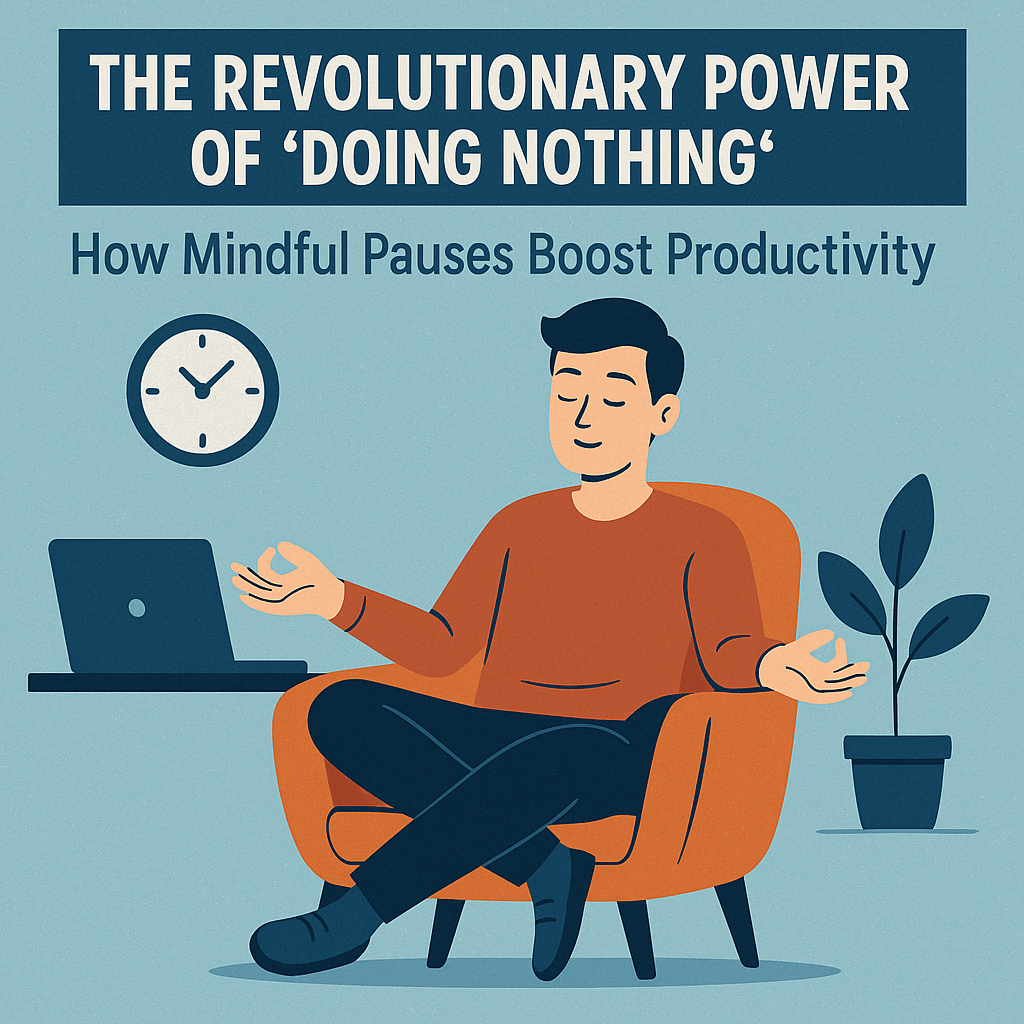
I was on my third cup of coffee, frantically trying to meet a deadline while simultaneously answering emails, when my screen suddenly went black. Power outage. My initial panic quickly gave way to something unexpected – clarity. Forced to step away from my desk, I took a walk outside. Twenty minutes later, when the power returned, I solved a problem that had stumped me for days. That accidental pause changed everything about how I approach productivity.
In our hyperconnected, always-on world, the idea of deliberately doing nothing seems counterintuitive, even irresponsible. Yet a growing body of research suggests that strategic periods of inactivity might be the most productive thing you can do. This isn’t about procrastination or laziness – it’s about intentional mental space that allows your brain to work at its best.
The Neuroscience Behind Productive Pauses
When we step away from active work, our brains don’t actually shut down – they shift into a different mode of processing. Neuroscientists call this the “default mode network” (DMN), a constellation of brain regions that activate when we’re not focused on the outside world.
Default Mode: Your Brain’s Secret Productivity Weapon
Dr. Marcus Raichle, who discovered the DMN, found that this network consumes 20% of the body’s energy despite being active during “rest.” During these periods, your brain:
- Consolidates memories – Strengthening neural pathways that help retain important information
- Makes unexpected connections – Linking seemingly unrelated ideas in ways your focused mind cannot
- Processes emotions – Creating space for emotional regulation that improves decision-making
A 2019 study from the University of California found that participants who took regular 10-minute breaks showed a 30% increase in creative problem-solving compared to those who worked continuously. This wasn’t just subjective – brain scans showed increased activity in regions associated with insight and innovation.
The Attention Restoration Theory
Psychologists Rachel and Stephen Kaplan developed Attention Restoration Theory, which explains why mental fatigue occurs and how strategic pauses can reverse it. Their research demonstrates that our directed attention (the kind we use for focused work) is a finite resource that depletes over time. Without restoration, we experience:
- Decreased ability to concentrate
- Increased error rates
- Diminished creative thinking
The solution isn’t pushing through – it’s stepping back. A 2018 study published in the Journal of Applied Psychology found that employees who took regular mindful breaks reported 40% fewer errors and 25% higher satisfaction with their work quality.
Strategic Idleness: Types of Productive Pauses
Not all breaks are created equal. The most effective pauses are intentional and aligned with how our brains naturally function. Here are three evidence-backed approaches:
Microbreaks (1-5 minutes)
These brief pauses work within your natural attention cycle. Research from the Draugiem Group found that the most productive people work in focused sprints of 52 minutes followed by 17-minute breaks. While that exact formula may not work for everyone, the principle holds: short, intentional breaks refresh cognitive resources.
How to implement microbreaks effectively:
- Set a timer to remind yourself to pause briefly every 25-50 minutes
- Look away from screens and focus on something distant to reduce eye strain
- Take three deep breaths while consciously relaxing your shoulders and jaw
Nature Pauses (10-30 minutes)
Exposure to natural environments has a powerful restorative effect on attention. A groundbreaking study from the University of Michigan showed that just 20 minutes in a park improved attention performance by 20%.
James, a software developer I interviewed, implemented “park programming” sessions where he would walk to a nearby green space when stuck on difficult coding problems. “I return with solutions I couldn’t see when staring at my screen,” he told me. “What seemed like wasted time actually saved me hours of frustrated trial and error.”
Making nature breaks work:
- Schedule outdoor walks between challenging tasks
- Leave your phone behind to avoid digital distractions
- Focus on sensory experiences – notice sounds, smells, and textures
Deep Recovery Periods (60+ minutes)
Longer periods of disengagement allow for deeper cognitive restoration. These extended breaks are particularly valuable for complex creative work and strategic thinking.
Sara Mednick, a cognitive neuroscientist at UC Irvine, found that REM naps improved creative problem-solving by 40% compared to quiet rest and 200% compared to no break at all. Similarly, extended periods of mind-wandering can lead to breakthrough insights.
Implementing deeper recovery:
- Block one afternoon per week for “strategic thinking” with no meetings or deliverables
- Consider a 20-30 minute nap during your natural afternoon energy dip
- Practice “productive walking” – taking a long walk with a complex problem in mind but no pressure to solve it
From Theory to Practice: Real-World Implementation
Understanding the science is one thing; implementing it in a busy workplace is another. Here’s how organizations and individuals are making productive pauses work:
Corporate Success Stories
Google’s famous “20% time” policy, where employees spend one day per week on projects of their choosing, has led to innovations like Gmail and Google News. While not exactly “doing nothing,” this approach creates mental space away from immediate pressures.
At Hubspot, “no-meeting Wednesdays” give employees uninterrupted time for deep work or strategic thinking. The company reports this single change increased employee satisfaction by 23% and reduced stress by 17%.
Buffer, the social media management company, implemented “Buffer Unplugged,” encouraging employees to take regular digital detox periods. CEO Joel Gascoigne reports: “We’ve seen a 22% increase in innovative ideas brought to our product meetings since implementing this practice.”
Individual Implementation Strategies
Elena, a marketing executive I interviewed, described her “10/10/10 method”: “I take 10 minutes of silence before starting work, 10 minutes of walking after lunch, and 10 minutes of reflection before ending my day. My productivity has increased dramatically, but more importantly, I make better decisions.”
Personal implementation tactics:
- Start small with 5-minute breaks, gradually increasing as you see benefits
- Use environmental triggers (like finishing a cup of tea) as reminders to pause
- Track your energy and attention patterns to identify optimal break timing
Overcoming Resistance: The Psychology of Pause
Despite the evidence, many of us resist taking breaks. Understanding this resistance is the first step to overcoming it.
The Productivity Paradox
Our culture equates busyness with importance and value. A 2020 survey found that 65% of professionals feel guilty when taking breaks during work hours. This “productivity guilt” creates a self-defeating cycle where we avoid the very thing that would make us more effective.
Cognitive psychologist Atsunori Ariga explains that this resistance stems from what he calls “cognitive momentum” – the mistaken belief that continuing to work will maintain productivity, when in fact the opposite is true after a certain point.
Reframing Rest as Productivity
The key to implementing productive pauses is reframing how we think about them. Rest isn’t the opposite of productivity – it’s an essential component of it.
Dr. Alex Soojung-Kim Pang, author of “Rest: Why You Get More Done When You Work Less,” argues that we should view rest as a skill to be developed rather than an indulgence. His research shows that the most prolific scientists, writers, and artists throughout history have typically worked intensely for just 4-5 hours per day, using the remainder for walks, naps, and other restorative activities.
Techniques for reframing:
- Track outcomes rather than hours – measure what you accomplish, not time spent
- Schedule breaks in your calendar with the same commitment as meetings
- Share your approach with colleagues to normalize strategic pausing
The Future of Productive Rest
As our understanding of cognitive science advances, the importance of mental space is becoming increasingly clear. Forward-thinking organizations are already designing work environments and policies that support this approach.
Microsoft Japan tested a four-day workweek and saw productivity jump by 40%. Rest isn’t just beneficial for individuals – it makes economic sense for organizations too.
The pandemic has accelerated this shift, forcing a reconsideration of traditional work patterns. As we rebuild our work lives, we have an unprecedented opportunity to incorporate what neuroscience has been telling us all along: the mind works best when it has space to breathe.
Your Personal Pause Revolution
The most powerful productivity tool might be the simplest: strategic moments of nothing. I challenge you to experiment with intentional pauses for one week. Start with three five-minute breaks each day, gradually increasing as you observe the effects.
Document how these pauses affect your energy, focus, and creative thinking. Pay attention not just to what you accomplish, but to the quality of your work and your experience of doing it.
In a world that constantly demands more, faster, the revolutionary act might be to occasionally do less. Your brain – and your work – will thank you.
Where This Insight Came From
This analysis was inspired by real discussions from working professionals who shared their experiences and strategies.
- Share Your Experience: Have similar insights? Tell us your story
At ModernWorkHacks, we turn real conversations into actionable insights.
![[Workflow Included] A simple 5-node Instagram posting workflow for beginners](https://modernworkhacks.com/wp-content/uploads/2026/04/workflow-included-a-simple-5-node-instagram-posting-workflow-for-beginners-1024x675.png)



0 Comments