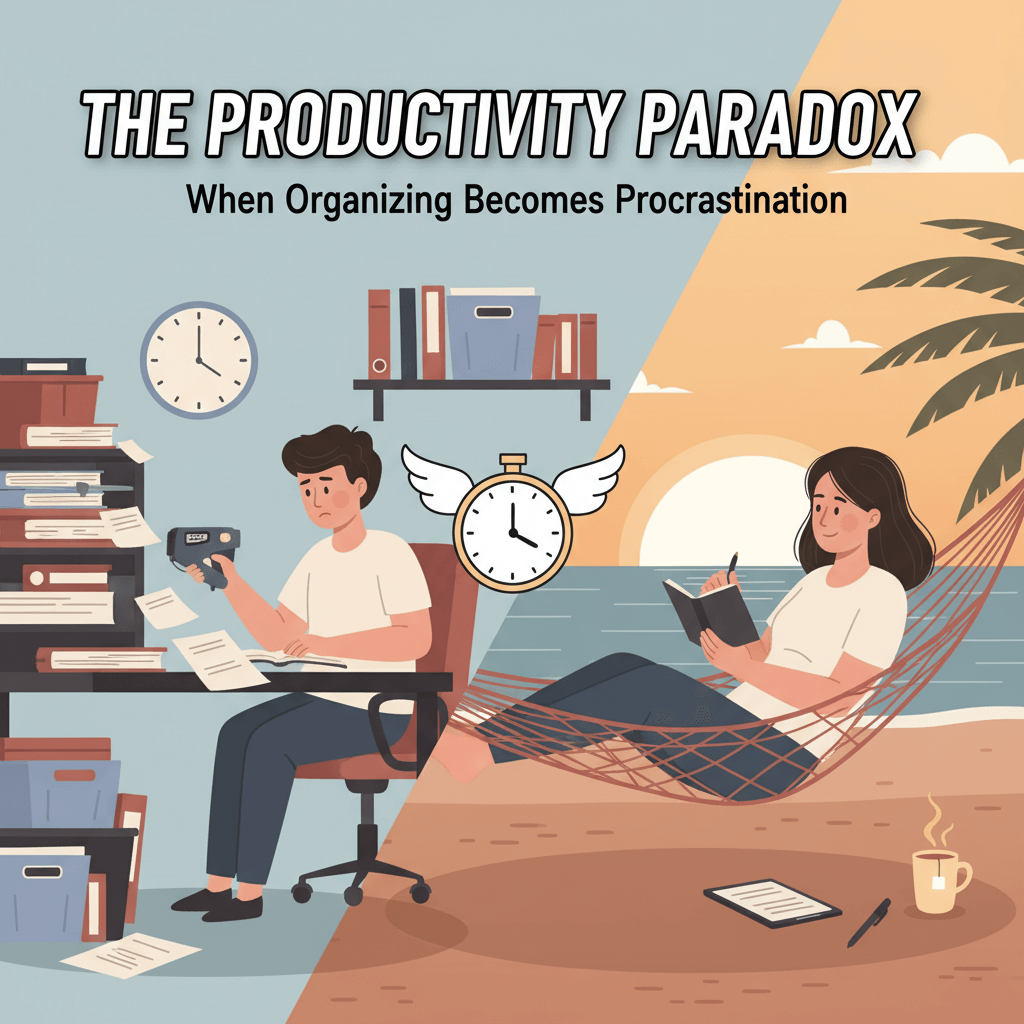
I once spent an entire Sunday reorganizing my digital workspace. I color-coded folders, renamed files, archived old projects, and even created a new task management system to replace the one I’d been using for three weeks. When Monday arrived, my workspace looked pristine. My to-do list looked impressive. And the most important project—the one with the looming deadline—had not moved forward at all.
That moment forced an uncomfortable realization: I hadn’t been productive. I had been busy avoiding the work that mattered most.
This is the productivity paradox at its most seductive. In a world obsessed with optimization, organizing can feel like progress—even when it’s actually a sophisticated form of procrastination. In this article, I’ll unpack why so many of us fall into this trap, what psychology and research reveal about pseudo-productivity, and how to tell when organizing supports real work versus when it quietly replaces it.
The Rise of Pseudo-Productivity
Why “Looking Busy” Feels Like Working
We live in an era where productivity is both a personal value and a public performance. Open-plan offices, shared dashboards, and online workspaces subtly reward visible effort. Organizing fits perfectly into this culture because it is:
- Observable: A tidy desk or meticulously planned Notion board signals effort.
- Low-risk: Organizing rarely leads to failure or criticism.
- Immediately rewarding: You get a sense of completion fast.
A widely discussed Reddit thread in r/productivity captured this perfectly. One user admitted to spending hours reorganizing their task list instead of writing a thesis chapter, noting that “it feels like work, so my brain lets me off the hook.” Thousands of upvotes later, it was clear this wasn’t an isolated experience.
The Dopamine Loop of Order
Neuroscience helps explain why organizing is so tempting. Completing small, structured tasks triggers dopamine—the brain’s reward chemical. According to research published in the journal Neuron, dopamine reinforces behaviors that feel predictable and controllable. Organizing offers both.
Deep work, by contrast, is uncertain. Writing, problem-solving, or creative thinking often comes with friction, ambiguity, and the risk of producing something imperfect. Our brains naturally gravitate toward the path of least psychological resistance.
Actionable Takeaways
- Name the behavior: When you catch yourself organizing, ask, “Is this enabling work—or replacing it?”
- Time-box organization: Limit setup tasks to a fixed window (for example, 15 minutes).
- Track output, not motion: Measure progress by completed deliverables, not hours spent “preparing.”
The Psychology Behind Organizing as Avoidance
Fear Disguised as Efficiency
One of the most uncomfortable truths I’ve learned is that organizing often masks fear. Fear of starting. Fear of doing something poorly. Fear of discovering we’re not as competent as we hope.
Psychologist Dr. Piers Steel, a leading researcher on procrastination, describes this as task aversion. When a task threatens our self-image, we subconsciously delay it—even if we rationalize the delay as “getting ready.”
I once coached a marketing manager who spent weeks refining campaign folders and naming conventions. When we finally unpacked it, she admitted she was afraid her ideas wouldn’t perform well in front of leadership. Organizing gave her a sense of control without exposure.
Perfectionism’s Silent Partner
Perfectionism doesn’t always look like obsessing over details in the final output. Sometimes, it appears earlier—at the organizational stage. We convince ourselves that once everything is perfectly arranged, then we’ll begin.
Research from the University of Ottawa found that socially prescribed perfectionism—believing others expect flawless performance—is strongly correlated with chronic procrastination. Organizing becomes a way to postpone judgment.
Actionable Takeaways
- Ask what you’re avoiding: Identify the emotional discomfort beneath the organizing behavior.
- Lower the bar to start: Commit to a deliberately imperfect first step.
- Separate identity from output: Remind yourself that a draft or attempt is not a verdict on your competence.
Real-Life Stories from the Productivity Trenches
The Startup Founder Who Optimized Himself into a Corner
A Reddit user in r/Entrepreneur shared a story that stuck with me. As a first-time founder, he spent months refining workflows, building elaborate project trackers, and researching productivity systems. His startup, however, had no paying customers.
Eventually, a mentor asked him a simple question: “Which of these tasks puts you closer to revenue?” The answer was none of the organizational ones.
Once he stripped his to-do list down to three daily priorities—customer outreach, product improvement, and feedback analysis—his business gained traction within weeks.
The Student Who Cleaned Instead of Writing
Another common anecdote comes from students. A graduate student posted about deep-cleaning her apartment every time she sat down to write. The pattern repeated until she realized cleaning was her way of avoiding the vulnerability of putting her ideas on the page.
Her breakthrough came when she reframed writing as exploration rather than performance. The organizing urge faded as the emotional stakes dropped.
Actionable Takeaways
- Identify your “revenue tasks”: Clarify which actions directly create value.
- Limit active projects: Too many systems often signal avoidance.
- Reframe the work: Shift from outcome-focused to process-focused thinking.
When Organizing Is Actually Productive
The Difference Between Strategic Setup and Avoidance
Not all organizing is bad. In fact, strategic organization can dramatically improve focus and execution. The difference lies in timing, proportion, and intent.
Organizing is productive when it:
- Directly reduces friction for a specific task.
- Is proportionate to the complexity of the work.
- Has a clear endpoint.
For example, a surgeon preparing an operating room or a software engineer setting up a development environment is engaging in necessary preparation. The key distinction is that these activities are finite and clearly linked to execution.
A Simple Litmus Test
I use a personal rule I call the “next action test.” After organizing, I ask: “Is the next meaningful action now easier and clearer?” If the answer is no, I’ve likely crossed into procrastination.
Actionable Takeaways
- Define the purpose: Before organizing, state what task it supports.
- Set a stopping rule: Decide in advance when organization ends.
- Transition immediately: Move directly from organizing into execution.
Breaking the Cycle of Pseudo-Productivity
Designing for Action, Not Aesthetics
Many productivity tools emphasize visual appeal—beautiful dashboards, perfectly nested folders, elegant planners. While these can be motivating, they can also become a distraction.
Research from the Harvard Business Review suggests that simpler systems are more likely to be used consistently. Complexity often invites tinkering instead of doing.
I intentionally keep my task system slightly “ugly.” It’s functional, but not endlessly tweakable. That friction nudges me toward action rather than refinement.
Practicing Discomfort on Purpose
One of the most powerful habits I’ve adopted is starting before I feel ready. I open the document, make a mess, write a bad sentence. The discomfort is a signal that I’m doing real work.
Ironically, once I’m engaged, the urge to organize disappears.
Actionable Takeaways
- Simplify your tools: Use the minimum system that gets the job done.
- Start with friction: Begin the task that feels most uncomfortable.
- Reward completion, not preparation: Celebrate finished work, not tidy plans.
A Challenge for the Reader
The productivity paradox isn’t about laziness. It’s about misdirected effort in a culture that equates activity with value. Organizing can be useful, even necessary—but only when it serves the work instead of replacing it.
Here’s my challenge to you: For the next week, notice every time you organize. Pause and ask whether it moves you closer to a meaningful outcome. If it doesn’t, take one imperfect step on the real task instead.
You may feel resistance. You may feel exposed. That’s the point.
Real productivity isn’t always tidy, comfortable, or Instagram-worthy. Sometimes, it looks like a messy draft, a difficult conversation, or an unfinished idea bravely brought into existence. Choose that version of productivity—and let organizing take its rightful place as a tool, not a hiding place.
Where This Insight Came From
This analysis was inspired by real discussions from working professionals who shared their experiences and strategies.
- Share Your Experience: Have similar insights? Tell us your story
At ModernWorkHacks, we turn real conversations into actionable insights.


0 Comments