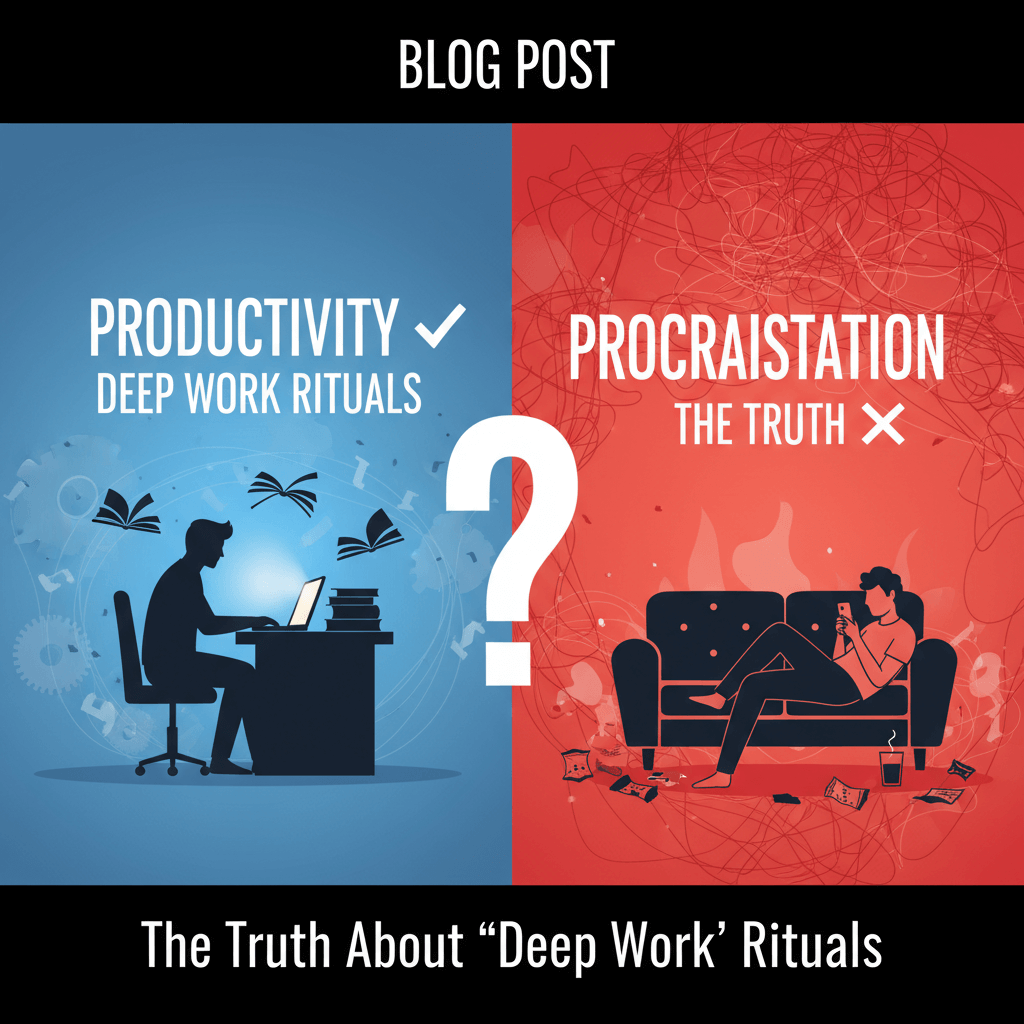
Is your productivity habit secretly your biggest procrastinator?
I still remember the January morning when I spent nearly two hours preparing to write. I cleaned my desk until it gleamed, brewed a specific single-origin coffee, queued up my “deep focus” playlist, and carefully reviewed my goals for the year. By the time everything was perfect, my energy was gone. I closed my laptop, telling myself I would “start fresh tomorrow.”
That day forced an uncomfortable realization: what I called productivity might have been procrastination in disguise.
This article explores that tension—between legitimate productivity rituals and the subtle ways they can become avoidance behaviors. Drawing from research, real-world examples, and high-engagement community discussions (especially around New Year’s resolutions), I’ll unpack how “deep work” rituals help us focus, when they quietly sabotage us, and how to strike a healthier balance.
The Rise of Deep Work Rituals—and Why We Love Them
Deep work, popularized by computer science professor Cal Newport, refers to focused, distraction-free effort on cognitively demanding tasks. In an era of endless notifications, the idea feels almost sacred.
Communities like Reddit’s r/productivity and r/getdisciplined explode every January with posts about new systems: morning routines, Notion dashboards, time-blocking templates, and elaborate pre-work rituals. The enthusiasm is genuine—and understandable.
The Psychological Comfort of Ritual
Rituals give us a sense of control. According to research published in the Journal of Personality and Social Psychology, rituals can reduce anxiety and increase confidence by creating predictability.
When facing a hard task—writing a proposal, learning a new skill, or planning a career shift—rituals feel like armor.
Actionable takeaways:
- Name the fear. Before starting a ritual, ask: “What discomfort am I trying to avoid right now?”
- Limit setup time. Cap preparation rituals at 10–15 minutes to prevent drift.
- Track output, not ambiance. Measure success by work completed, not how ideal the conditions felt.
Community Insight: When Rituals Become Identity
One Reddit user wrote, “I’ve spent six months optimizing my productivity system and zero months actually building my app.” The post received thousands of upvotes—not because it was funny, but because it was familiar.
Rituals can become part of our identity: “I’m someone who does deep work.” That identity feels productive even when the work itself never happens.
Actionable takeaways:
- Separate identity from tools. You are not your Notion workspace.
- Ask for evidence. What tangible result did this ritual produce last week?
- Adopt a beginner’s mindset. Focus on progress, not polish.
Productive Preparation vs. Elegant Procrastination
Not all preparation is bad. In fact, some planning dramatically improves performance. The challenge is distinguishing between preparation that enables action and preparation that replaces it.
The Science of Planning Fallacy
Psychologists Daniel Kahneman and Amos Tversky identified the planning fallacy: our tendency to underestimate how long tasks will take. Excessive planning often emerges as a response to this anxiety.
A 2020 study from the University of Waterloo found that people who over-planned felt productive but completed fewer meaningful tasks.
Actionable takeaways:
- Plan in outcomes. Write “draft 500 words” instead of “prepare writing environment.”
- Use time-boxing. Plan briefly, then execute immediately.
- Schedule friction. Start before you feel ready.
Case Study: The Perpetual Optimizer
I worked with a marketing consultant—let’s call her Lisa—who rebuilt her task system every month. Each new app felt like a breakthrough. Revenue, however, stayed flat.
When we audited her week, only 12% of her time went to client-facing work. The rest went to organizing, learning, and “strategizing.” Once she committed to starting client work before checking her system, her income increased within two months.
Actionable takeaways:
- Audit your time. Where does your energy actually go?
- Define a “minimum viable action.” What’s the smallest real step forward?
- Delay optimization. Improve systems only after consistent execution.
New Year’s Resolutions and the Deep Work Trap
January is fertile ground for deep work rituals—and for disappointment.
Gym memberships spike. Productivity apps see record downloads. Reddit threads fill with ambitious daily schedules that leave no room for reality.
Why Resolutions Fail
According to a study by the University of Scranton, only 8% of people achieve their New Year’s resolutions. One major reason: we focus on ideal behavior instead of sustainable behavior.
Deep work rituals often assume perfect days—no interruptions, unlimited willpower, and steady motivation.
Actionable takeaways:
- Design for bad days. What does progress look like when energy is low?
- Reduce scope. One deep work session per week beats zero.
- Attach rituals to existing habits. Stack deep work after something automatic, like morning coffee.
Reddit Voices: Realistic Wins
One highly upvoted comment stood out: “I stopped chasing four-hour deep work blocks and started doing 45 minutes a day. My novel is halfway done.”
The lesson wasn’t about discipline—it was about realism.
Actionable takeaways:
- Shorten the ritual. Make starting embarrassingly easy.
- Celebrate consistency. Track streaks, not intensity.
- Public accountability. Share progress in a community thread.
When Deep Work Rituals Truly Work
Despite the risks, deep work rituals can be transformative when used correctly.
Conditions That Support Real Focus
Research from Harvard Business School shows that structured focus time improves output quality—but only when paired with clear goals and constraints.
Effective deep work rituals share three traits:
- Clear starting trigger (time, location, or cue)
- Defined end point (task or time limit)
- Immediate transition to work
Actionable takeaways:
- Create a work-first ritual. Start the task, then refine conditions.
- End with a review. Note what actually helped.
- Use constraints. Fewer options increase focus.
Case Study: The Focused Engineer
A software engineer I interviewed blocked two hours every morning for deep work—but with a twist. He started coding immediately, then adjusted music, lighting, or notes only if needed.
His rule: “No optimization in the first 20 minutes.” His productivity metrics improved by 30% over a quarter.
Actionable takeaways:
- Delay comfort. Earn optimization through momentum.
- Standardize rituals. Fewer decisions mean faster starts.
- Review weekly. Keep what works, discard the rest.
Red Flags: Signs Your Ritual Is Actually Procrastination
Sometimes the truth is uncomfortable. Here are common warning signs your deep work ritual may be avoidance in disguise.
Behavioral Warning Signs
- You constantly tweak tools but avoid the core task.
- You feel productive but can’t point to concrete output.
- You delay starting until conditions are “perfect.”
A 2019 study in Psychological Bulletin linked procrastination to emotional regulation, not laziness. We avoid tasks that threaten our self-image.
Actionable takeaways:
- Notice emotional cues. What feeling arises before you optimize?
- Start imperfectly. Lower the stakes of the first step.
- Time-track rituals. Awareness alone can change behavior.
Language Clues
Listen to your internal dialogue. Phrases like “I just need to set this up first” or “I’ll be more productive once…” often signal delay.
Actionable takeaways:
- Replace conditional language. Use “I will start now.”
- Interrupt the loop. Act before finishing the thought.
- Practice self-compassion. Avoidance is human, not failure.
Designing a Deep Work Practice That Actually Delivers
The goal isn’t to abandon rituals—but to design them in service of action.
The 80/20 Rule of Focus
Roughly 20% of your habits produce 80% of your results. Identify the small actions that reliably move work forward.
Actionable takeaways:
- Identify your keystone action. What single behavior matters most?
- Build rituals around output. Let results dictate routines.
- Review monthly. Adjust based on evidence, not aesthetics.
A Simple Deep Work Framework
- Decide: One task, one session.
- Start: Within five minutes.
- Stop: On time, not on perfection.
This framework consistently appears in successful community stories—not because it’s flashy, but because it’s doable.
Actionable takeaways:
- Print it. Keep the framework visible.
- Test for two weeks. No changes allowed.
- Reflect honestly. Did it move the needle?
Conclusion: The Courage to Begin
Deep work rituals aren’t the enemy. Fear is. Fear of wasting time. Fear of failing. Fear of discovering that the work is harder than the preparation.
The most productive people I know aren’t those with the prettiest systems—they’re the ones willing to begin before they feel ready.
Here’s my challenge to you: tomorrow, skip one part of your ritual and start anyway. Write the messy paragraph. Open the blank file. Make the imperfect call.
Then notice what happens. You might discover that the deepest work doesn’t come from perfect conditions—but from the courage to begin.
Where This Insight Came From
This analysis was inspired by real discussions from working professionals who shared their experiences and strategies.
- Share Your Experience: Have similar insights? Tell us your story
At ModernWorkHacks, we turn real conversations into actionable insights.
![[Workflow Included] A simple 5-node Instagram posting workflow for beginners](https://modernworkhacks.com/wp-content/uploads/2026/04/workflow-included-a-simple-5-node-instagram-posting-workflow-for-beginners-1024x675.png)



0 Comments