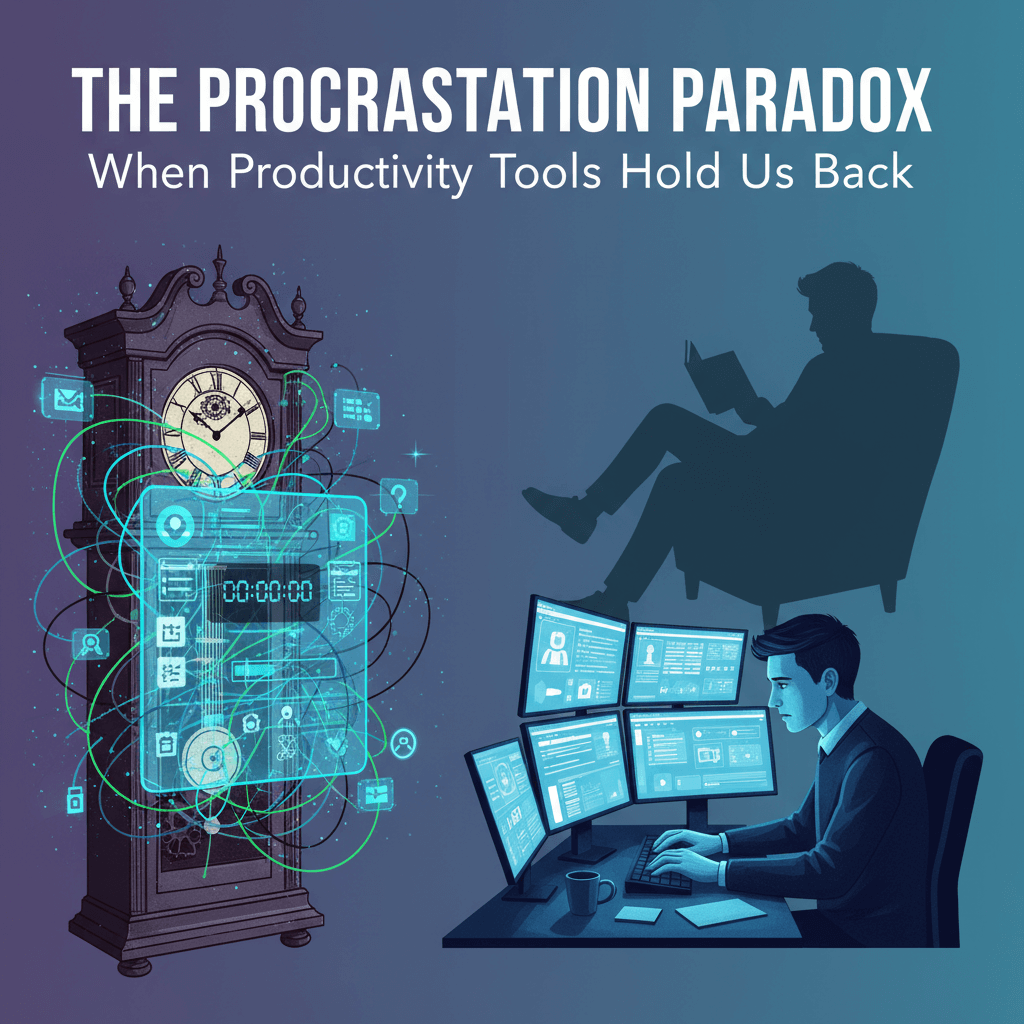
I once spent an entire Sunday afternoon redesigning my task management system. Color-coded tags. Nested folders. A brand-new productivity app everyone on Reddit swore would “change my life.” When I finally leaned back in my chair, satisfied, it was nearly 8 p.m. I hadn’t written a single word of the article due Monday morning. I had optimized my productivity perfectly—and accomplished nothing.
That moment captures a quiet paradox many of us live with every day: are our productivity tools actually helping us work, or are they just a more socially acceptable form of procrastination? From students meticulously organizing Notion dashboards to professionals endlessly tweaking calendar systems, we’re investing enormous energy into preparing to work rather than doing the work itself.
This article explores why that happens, how productivity tools can subtly hold us back, and—most importantly—how to reclaim them as servants rather than masters. The issue resonates deeply because it’s not about laziness; it’s about misplaced effort. And if you’ve ever felt “busy but unproductive,” you’re not alone.
The Rise of Productivity Theater
When looking productive replaces being productive
Productivity theater is the act of performing productivity without creating meaningful output. It’s checking off trivial tasks, reorganizing lists, and polishing workflows while avoiding the harder, more cognitively demanding work that actually moves the needle.
On Reddit communities like r/productivity and r/GetDisciplined, threads with thousands of comments debate the “perfect” system. Ironically, many contributors admit they’ve spent weeks building systems they abandon shortly after. The activity feels productive because it involves structure, intention, and visible progress—just not progress toward the real goal.
Research from the University of Sheffield suggests that humans are drawn to tasks that offer immediate feedback and a sense of completion. Updating a to-do list provides a dopamine hit. Writing a difficult report does not—at least not until much later.
Actionable takeaways:
- Define output before organization. Before opening a productivity app, write down what “done” looks like for the day in plain language.
- Limit system tinkering to a fixed window. For example, allow 30 minutes once a week for tool adjustments—never during prime work hours.
- Track outcomes, not activity. At day’s end, ask: “What did I create or complete?” rather than “How busy was I?”
Why Our Brains Love Productivity Tools
The psychology of control and avoidance
At a neurological level, productivity tools feel good because they give us a sense of control. When work feels ambiguous or overwhelming, organizing it reduces anxiety—even if it doesn’t reduce the workload itself.
Psychologists call this avoidance coping: choosing low-stress tasks to escape high-stress ones. Updating your task list is emotionally safer than starting a project that could expose your limitations or invite failure.
A 2019 study published in Psychological Bulletin found that procrastination is strongly linked to emotion regulation, not time management. We procrastinate to avoid negative feelings, not because we don’t know what to do. Productivity tools, when misused, become emotional shields.
Actionable takeaways:
- Name the emotion behind the delay. Ask yourself, “Am I avoiding this because it’s boring, scary, or unclear?”
- Start with discomfort, not clarity. Begin work even if the task feels messy; clarity often follows action.
- Use tools as containers, not crutches. Their role is to hold tasks, not soothe anxiety.
The Hidden Cost of Over-Optimization
How systems steal time, energy, and focus
Every tool promises efficiency, but each one carries a cognitive cost. Switching between apps, maintaining integrations, and remembering rules drains mental energy. Productivity expert Cal Newport refers to this as “context overhead”—the invisible tax on attention.
I worked with a marketing manager who used six different tools: one for tasks, one for notes, one for goals, two for communication, and one for tracking habits. She spent nearly an hour each day just maintaining the system. When we audited her workflow, we found she completed fewer high-impact tasks than colleagues using a simple notebook.
According to a McKinsey report, knowledge workers already spend about 28% of their workweek managing email and tools. Adding more systems without reducing complexity compounds the problem.
Actionable takeaways:
- Audit your tools quarterly. Ask which ones directly support your most important outcomes.
- Default to fewer tools. One robust system beats five specialized ones.
- Measure tool ROI. If a tool doesn’t save more time than it costs, eliminate it.
Case Studies: When Tools Backfire
The student with the perfect dashboard
A university student I interviewed built an elaborate Notion dashboard for her coursework. It included progress bars, motivational quotes, and daily checklists. She spent hours refining it. Yet her grades slipped. Why? She was tracking studying more than actually studying.
Once she switched to a simple rule—three concrete study tasks per day written on paper—her focus improved dramatically. The dashboard became optional, not central.
The startup founder drowning in systems
A startup founder shared on Reddit that he rebuilt his task system every month, convinced the next version would unlock peak productivity. In reality, the constant resets prevented habit formation. After committing to one simple kanban board for six months, his execution stabilized.
Actionable takeaways:
- Beware of “fresh start” fantasies. New systems feel promising but often delay consistency.
- Commit before you customize. Use any tool as-is for 30 days before tweaking.
- Stability beats novelty. Long-term productivity comes from boring consistency.
Reclaiming Tools as Means, Not Ends
Designing systems that disappear
The best productivity systems fade into the background. You don’t think about them; you just work. This requires designing tools around behavior, not aspiration.
Author James Clear emphasizes that environment shapes behavior more than motivation. If your tools require constant attention, they’re poorly aligned with human psychology.
I’ve found success with what I call the “minimum viable system”: the smallest setup that reliably gets me to start. For writing, that’s a single document and a timer—not a dashboard.
Actionable takeaways:
- Optimize for starting, not tracking. Ask which setup makes it easiest to begin.
- Reduce friction ruthlessly. Fewer clicks, fewer rules, fewer decisions.
- Let systems be boring. Excitement should come from the work, not the tool.
Breaking the Procrastination Paradox
From meta-work to meaningful work
The paradox isn’t that productivity tools are bad. It’s that they’re seductive. They promise transformation without discomfort. Real work, however, is uncomfortable by nature.
High engagement on Reddit threads shows how universal this struggle is. People aren’t failing because they lack discipline; they’re drowning in options. The path forward is not another app, but a mindset shift: tools exist to support action, not replace it.
Actionable takeaways:
- Adopt a bias toward action. When unsure, do the work instead of organizing it.
- Set a “no tools” hour. One daily block where you only create.
- Judge days by output. One meaningful result beats ten optimized lists.
A Final Challenge
I’ll leave you with a challenge I give myself regularly. Tomorrow, before opening any productivity app, ask one simple question: What is the most important thing I can make progress on today? Then start—messily, imperfectly, without optimization.
If your tools help you do that, keep them. If they don’t, let them go. Productivity isn’t about having the best system; it’s about doing the work that matters. And no tool can do that part for you.
The real upgrade isn’t your app. It’s your courage to begin.
Where This Insight Came From
This analysis was inspired by real discussions from working professionals who shared their experiences and strategies.
- Share Your Experience: Have similar insights? Tell us your story
At ModernWorkHacks, we turn real conversations into actionable insights.


0 Comments