Discover actionable insights.
Three consults, five options, one anxious patient: a story of variability we can’t ignore
Elena is 46. She’s an active nurse, mother of two, and—until a sudden, radiating pain began shooting down her left leg—someone who rarely missed a shift. After weeks of conservative care and a new MRI, she sought specialist opinions. The first spine surgeon recommended a single-level decompression. The second proposed a fusion, citing Elena’s mild scoliosis and instability on flexion-extension films. The third believed endoscopic decompression would be enough.
Elena isn’t a clinical trial. She’s a real person sitting at the junction of anatomy, risk, life goals, surgeon training, and institutional incentives. Each consult felt reasonable. Each had a convincing narrative and a plan for what could go wrong. But the gap between the recommendations wasn’t a rounding error—it was a different care pathway, recovery timeline, and financial and functional outcome.
What happened next is familiar. Elena delayed the decision—uncertain which trade-off matched her goals. She asked for outcome data. She was shown revision rates and generic complication risk, but not her expected pain relief trajectory versus time off work, or how each option compared for someone like her. She wanted to understand not just the average effect across a population, but the likely outcome for people like her under different choices.
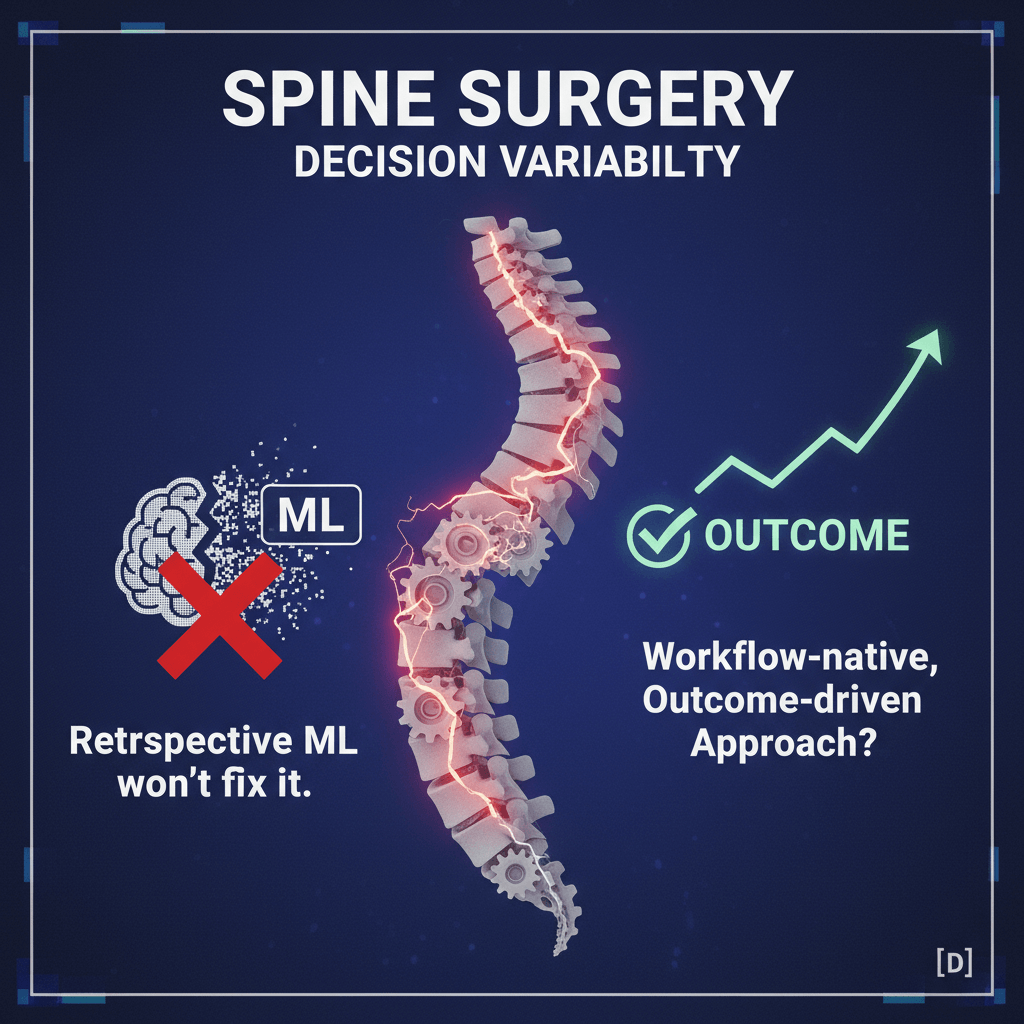
Elena eventually chose the decompression. It went well. Still, the process felt like a high-stakes coin toss. Her story isn’t an indictment of any clinician; it’s a signal. Spine surgery exhibits massive decision variability. Much of it is warranted because patients differ. Much of it isn’t. And the tools we’ve built to reduce unwarranted variability—especially retrospective machine learning models trained on old data—aren’t solving the right problem.
Why retrospective ML won’t fix decision variability (and sometimes makes it worse)
It optimizes for what’s easy to measure, not what matters
Retrospective models often predict labels like “30-day readmission,” “length of stay,” or “revision within 12 months.” These are available in claims or EHR data, so they become the default targets. But patients like Elena care about functional recovery, pain relief, return to work, durability, and life impact. Those outcomes live in patient-reported measures and longitudinal follow-up—datasets that are sparse and noisy in many centers. When models train on the wrong targets, they guide attention away from what matters most.
It bakes in confounding by indication
Observational data reflects the decisions surgeons already made. If higher-risk patients tend to receive one procedure over another, naive models learn those associations and call them “risk.” The result? A model that “proves” what the practice patterns already believed, a self-fulfilling feedback loop. Even with propensity matching and doubly robust estimators, many datasets lack the depth (e.g., granular imaging features, bone quality, instability nuance, social context) to properly adjust for the clinical factors that actually drive decisions and outcomes.
It suffers from label noise and silent leakage
Outcomes like “success” are messy. A patient might avoid revision but remain in chronic pain. If a model uses post-operative notes, unrecognized data leakage can inflate apparent accuracy while failing catastrophically in real time. Meanwhile, class labels like “complication” depend on billing practices, documentation habits, or follow-up patterns that vary widely across systems and time.
It breaks on the edge cases—precisely where decisions are hard
Static retrospective models struggle with distribution shift. New implants, approaches (e.g., endoscopic techniques), perioperative protocols, and patient demographics change the data-generating process. Edge cases—multilevel disease with sagittal balance issues, smokers with osteopenia, overlapping neuropathic pain—are where advice is most needed and where models trained on yesterday’s averages provide the least useful signal.
It doesn’t change the moment of decision
Even a good model will fail if it lives outside the workflow. If guidance sits in a separate portal or returns results in 48 hours, it won’t shape the conversation when Elena is in the room. Retrospective ML is typically report-centric rather than workflow-native. It produces insights but doesn’t rewire the steps, scripts, and shared artifacts that make decisions reproducible and teachable.
It’s not designed for counterfactuals
The heart of variation is a question about counterfactual outcomes: What happens to this patient if we do A versus B? Off-policy evaluation is hard; it requires careful causal framing, explicit modeling of treatment assignment, and, ideally, prospective data collection that enriches the covariates we can’t see in structured fields. Retrospective ML, built without causal intent, tends to predict “what usually happens” rather than “what would happen if we changed the decision.”
What would a workflow-native, outcome-driven approach look like?
The solution isn’t a shinier model. It’s a learning workflow that captures the right data where it’s generated, supports decisions in the moments they’re made, and closes the loop with outcomes that matter. The model is an ingredient—useful only if embedded in tools, rituals, and feedback mechanisms that clinicians trust.
Define the target: patient-centered outcomes first
- Anchor decisions to function and durability. Standardize PROMs (e.g., ODI, PROMIS Physical Function, leg/back NRS), return-to-work status, and meaningful clinical milestones (walking tolerance, opioid independence).
- Make outcomes time-bound. For example: pain relief trajectory at 6 weeks, 3 months, and 12 months; percent back to baseline activity; patient-defined success statements (“I can lift my toddler without fear”).
- Collect complications and revision, but don’t let them be the only north stars.
Redesign the decision moment, not just the dashboard
- Use structured decision templates embedded in the EHR: indication, levels, approach, key risks, and the explicit alternatives considered.
- Auto-populate baseline risks (age, comorbidities, bone quality proxies, prior surgery, smoking) and flag missing context (e.g., instability metrics, sagittal balance parameters, depression screening) before recommending a plan.
- Surface counterfactual outcome estimates in plain language: “For patients like Elena, option A is associated with faster early pain relief but higher risk of recurrent symptoms at 12 months compared with option B.”
- Make the output actionable: order sets, prehab referrals, shared decision handouts generated in one click.
Capture the data that confounds decisions
- Integrate imaging summaries (stenosis grade, foraminal compromise, sagittal alignment) via structured radiology templates or validated NLP with human oversight.
- Include nonoperative care history (PT duration, injections, medications, response) to contextualize surgical timing.
- Track social determinants and readiness factors (job demands, caregiver support, transportation, nicotine status) that modulate outcomes.
- Instrument surgical variables: approach, levels, implant type, navigation use, blood loss, operative time—captured as a byproduct of normal documentation.
Support shared decision-making with transparency
- Generate a Decision Dossier for the patient: options, expected timelines, trade-offs, and what recovery typically looks like for similar profiles.
- Use confidence bands, not just point estimates. If the model is uncertain, escalate to case conference or second opinion.
- Record patient preferences (speed vs durability, aversion to implants, time off work constraints) and ensure they influence the recommendation.
Close the loop with outcomes that update the system
- Automate PROM collection via SMS/app at set intervals.
- Create living registries at the service-line level with pragmatic governance: who sees what, how updates are validated, and how changes roll out.
- Run small, rapid experiments (e.g., prehab A vs B) with pre-registered metrics, backstopped by ethics and QA oversight.
- Review variation and outcomes in monthly learning meetings—not to shame, but to discover and standardize what works.
Make the model humble and monitored
- Frame the algorithm as a counterfactual explorer, not an oracle. Use uplift modeling or causal forests where appropriate, and present the “why” in human terms (features driving the recommendation).
- Continuously monitor performance by subgroup (age, sex, race, comorbidity, insurance) to detect fairness drift.
- Guard against automation bias. Require an explicit clinician attestation when overriding or following a recommendation, and capture the reason.
- Version the model and alert users to meaningful updates; don’t silently change decision logic midweek.
What we’ve heard: key takeaways from real discussions
From surgeons
- “My biggest issue isn’t a lack of guidelines—it’s that my patients aren’t guideline patients.” Surgeons want patient-specific trade-offs that reflect complexity: osteopenia, multi-level disease, mixed pain generators, and psychosocial factors.
- “I’ll use it if it saves me time and helps me explain choices.” Workflow friction kills adoption. The tool must reduce clicks, generate patient handouts automatically, and integrate with existing dictations.
- “Show me the evidence and the uncertainty.” Credibility comes from transparent inputs, side-by-side options, and clear uncertainty ranges—not black-box “scores.”
From patients
- “I need to see what life looks like in 6 weeks and 6 months.” Static risk numbers feel abstract. Patients want time-phased expectations matched to their goals.
- “I’m not average.” They want to know how they compare to typical cases and whether a second opinion is wise when the model is uncertain or the plan is high-variance.
- “Give me a plan, not just a probability.” Actionable next steps—prehab, nicotine cessation support, employer notes, transport planning—reduce anxiety and improve follow-through.
From administrators and quality leaders
- “Variation is expensive and often invisible.” Unwarranted variability drives cost, length of stay, readmissions, and revisions—but it also erodes trust when outcomes diverge within the same service line.
- “We need a learning system, not a dashboard.” Success looks like monthly improvement rituals, standardized templates, and leading indicators that predict downstream outcomes.
- “Start small, prove value, then scale.” A focused pilot—one indication, a handful of surgeons, a tight metric set—beats system-wide launches that stall under their own weight.
From data scientists and informaticians
- “Retrospective models get you to baseline.” Without prospective capture of key confounders, causal questions stay murky.
- “Beware silent failure.” Continuous monitoring, holdout cohorts, and pre-registered evaluation plans prevent misguided confidence.
- “Explainability is a feature, not an afterthought.” Feature importance, case-based reasoning, and clinically meaningful units (weeks, pain points, walking distance) increase trust and actionability.
A practical blueprint: transform variability into a learning advantage
Step 1: Pick a single decision and define success
Choose a high-volume, high-variance decision point—e.g., decompression alone vs decompression plus fusion for single-level degenerative spondylolisthesis. Co-create a success definition with surgeons and patients: pain relief (NRS), function (ODI or PROMIS), return-to-work by 12 weeks, and 12-month durability.
Step 2: Instrument the workflow
- Embed a decision template in clinic notes with structured fields for indication, instability markers, sagittal balance, prior nonoperative care, and patient goals.
- Trigger a pre-visit triage form to capture PROMs, job demands, and social support so the clinic encounter starts with context.
- Auto-generate a Decision Dossier summarizing options with evidence and expected trajectories for signature by clinician and patient.
Step 3: Collect outcomes without adding burden
- Automate PROMs at 6 weeks, 3 months, 6 months, and 12 months via SMS/app; nudge non-responders; allow phone capture for accessibility.
- Leverage OR data feeds to populate approach, levels, implants, and intraoperative details without extra clicks.
- Integrate claims or billing data for revisions and readmissions while prioritizing clinically meaningful outcomes.
Step 4: Build a humble causal engine
- Model treatment effect heterogeneity (uplift models, causal forests) with rigorous validation and domain-informed feature curation.
- Present counterfactuals as ranges with drivers: “For similar patients, fusion adds 4–6 weeks to return-to-work but reduces 12-month recurrence risk by 8–12%. Contributors: instability on flexion-extension, BMI, nicotine status.”
- Pre-register an evaluation plan with fixed metrics, subgroup analyses, and guardrails for deployment.
Step 5: Create a cadence of learning
- Hold monthly variation reviews: examine cases with large divergence between recommendation and choice; discuss outcomes without blame.
- Run micro-experiments: e.g., prehab protocol change with cluster randomization across clinic days; evaluate with defined endpoints.
- Publish a service-line playbook: updated indications, checklists, and shared phrases for patient conversations, versioned and transparent.
Step 6: Govern for safety, equity, and trust
- Set override norms: encourage clinician judgment when patient context demands it; capture rationale for learning.
- Monitor equity metrics (PROM completion rates, model performance across subgroups, access to second opinions).
- Communicate openly about limitations, updates, and known blind spots; invite feedback in real time.
What to measure (and celebrate)
- Process: percent visits with completed decision templates, PROM completion rate, dossier generation rate, time added per visit (aim for zero).
- Outcome: improvement in ODI/NRS at 3 and 12 months, return-to-work by 12 weeks, complication and revision rates, patient satisfaction with decision quality.
- Variation: reduction in unwarranted variance across similar clinical profiles; increased deliberate variance aligned to patient preferences.
- Trust: clinician adoption rates, override patterns and reasons, participation in learning meetings.
Pitfalls to avoid and how to sidestep them
Optimizing what’s measurable rather than what matters
Don’t let data convenience drive your target. If you can’t capture PROMs yet, invest there first. A working outcome pipeline beats a sophisticated model on the wrong signal.
Adding clicks and cognitive load
Make the workflow better for clinicians on day one. Use auto-population, one-click dossiers, and smart defaults. If it slows the clinic, adoption will falter regardless of model quality.
Black-box recommendations without narrative
Wrap every recommendation in a clinically literate explanation—drivers, uncertainty, and trade-offs—so surgeons can use it to teach, not just to decide.
Once-and-done deployments
Treat the system as a product with a roadmap. Version models, publish changes, and solicit structured feedback. Without a learning cadence, drift will erode value.
Ignoring equity and access
If some patients complete PROMs less often, your model will underserve them. Monitor response rates, provide alternate capture methods, and audit performance by subgroup.
A 90-day pilot plan you can start next quarter
Days 1–15: Align and scope
- Pick one decision (e.g., single-level degenerative spondylolisthesis).
- Define outcomes with surgeons and patient advisors.
- Design the decision template and dossier layout.
- Set evaluation metrics and governance (privacy, access, override norms).
Days 16–45: Build and instrument
- Embed the template in the EHR with auto-populated fields.
- Turn on PROM collection via SMS/app; dry-run the nudge protocol.
- Draft v1 of the counterfactual explorer using historical data with clear disclaimers; prepare to update prospectively.
- Create clinician and patient onboarding materials (2-minute videos, one-pagers).
Days 46–75: Go live and learn
- Launch with 3–5 surgeons; hold weekly check-ins.
- Track process metrics daily; fix friction fast.
- Review 10 dossiers as a group; refine explanations and defaults.
Days 76–90: Evaluate and decide
- Assess process adoption, early outcome signals, and clinician/patient feedback.
- Decide to iterate, expand, or pivot; publish a short internal report.
- Set the agenda for the next 90 days (e.g., second decision point, prehab experiment).
Do this next: actionable takeaways for leaders and teams
- Start with one decision. You’ll move faster and learn more than with a diffuse, system-wide push.
- Define success in patient terms. PROMs and time-to-function as primary outcomes; revisions and readmissions as important but secondary.
- Instrument the decision. Make indication, alternatives, and patient preferences explicit in the note and the order set.
- Close the loop. Automate PROMs at standard intervals; review results in a monthly learning meeting.
- Make models humble. Use counterfactual framing, uncertainty ranges, and plain-language drivers; monitor drift and equity.
- Reduce clicks. If it adds burden, fix the workflow first; trust follows convenience and usefulness.
- Publish your playbook. Versioned indications, checklists, and patient scripts build a culture of consistency and improvement.
- Celebrate overrides. When clinicians deviate for good reasons, learn from them. Those stories refine the model and the workflow.
Why this matters now
Spine surgery is a bellwether for modern medicine: complex pathophysiology, high-stakes choices, real heterogeneity of patient preferences, and strong institutional pressures. Variability is inevitable. The question is whether we let it stay opaque—or make it measurable, interpretable, and useful. Retrospective ML has taught us something valuable: our data is rich but misaligned to the decisions we care about. The next wave is not another retrospective leaderboard. It’s a workflow-native, outcome-driven system that learns at the speed of clinic and OR, speaks the language of patient goals, and continuously earns clinician trust.
Elena deserved more than three divergent recommendations and a shrug. She deserved a clear view of the road ahead under each choice, matched to what she valued. Building that view doesn’t require perfect data or a grand AI. It requires a disciplined workflow, humble causal tools, and a commitment to learn together.
Call to action: turn variability into value—pilot an outcome-driven spine workflow
If you lead a spine service, quality program, or data science team, pick one decision and run a 90-day pilot. Get surgeons, nurses, rehab, and data together. Design the decision template, collect the right outcomes, and make a counterfactual explorer that’s good enough to start a better conversation.
- Choose the focus (one indication, one fork in the road).
- Define metrics that patients feel (function, pain, time-to-life).
- Embed the workflow (templates, dossiers, order sets).
- Automate follow-up (PROMs, nudges, dashboards).
- Meet monthly, learn, iterate, and publish your playbook.
Curious if a workflow-native, outcome-driven approach could reduce unwarranted variability and improve patient outcomes in your spine program? There’s only one way to know: build it into the work, measure what matters, and let the system learn with you.
Let’s make the next Elena’s decision clearer, faster, and more aligned to what she values—starting now.
Where This Insight Came From
This analysis was inspired by real discussions from working professionals who shared their experiences and strategies.
- Source Discussion: Join the original conversation on Reddit
- Share Your Experience: Have similar insights? Tell us your story
At ModernWorkHacks, we turn real conversations into actionable insights.
![[Workflow Included] A simple 5-node Instagram posting workflow for beginners](https://modernworkhacks.com/wp-content/uploads/2026/04/workflow-included-a-simple-5-node-instagram-posting-workflow-for-beginners-1024x675.png)


0 Comments