Discover actionable insights.
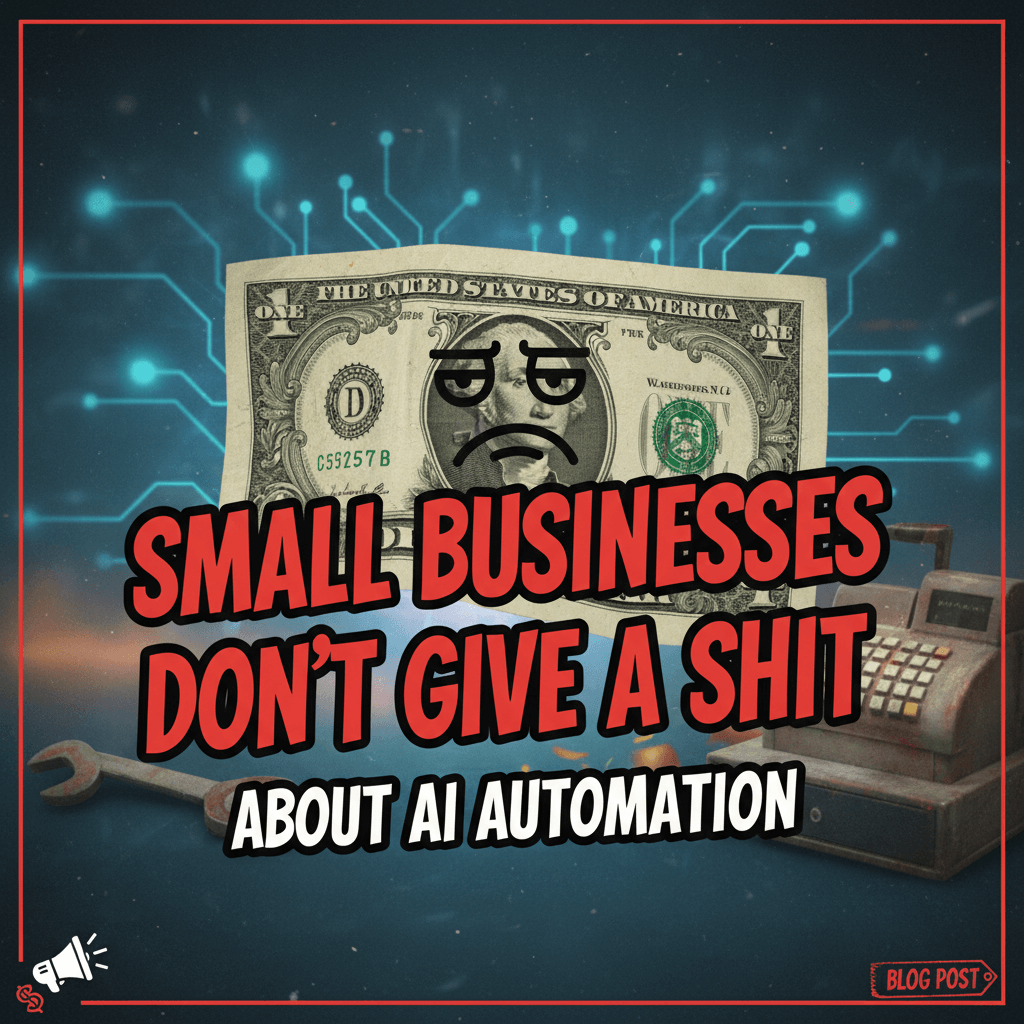
It was a Tuesday afternoon at a cramped sandwich shop wedged between a nail salon and a hardware store. The lunch rush had thinned to a quiet hum, and the owner, Mia, was rolling silverware into paper napkins while watching her POS like a hawk. I had come to talk about “AI automation”—a phrase that had earned me exactly zero attention on six previous cold visits that morning. Before I could get through my line about reducing administrative load, the walk-in beeped, two DoorDash bags went missing, and a supplier called to say he was out of the gluten-free rolls that anchor her most profitable combo.
Mia didn’t care about AI. She cared that a coach bus of high school athletes might show up unannounced in 20 minutes and that her part-time cashier had texted, “Can’t make it, sorry,” with no follow-up. Profit today. Payroll Friday. Inventory by Thursday. Staffing whenever the stars align. When we finally sat down on milk crates by the back door, I shelved the pitch and asked her what would make the rest of her week easier.
“Tell me when I’m about to run out of stuff that sells,” she said. “Stop my staff from scheduling each other into chaos. And make my phone stop ringing with the same damn question we answered on the menu page last week.”
There it was. Not a request for a neural anything. Not a craving for a chatbot revolution. Just the blunt edge of small-business reality: cash, customers, and time. We built a simple system on what she already had—POS exports, Google Calendar, an IVR that routed FAQs before the phone touched a human—and it earned her a quiet Thursday afternoon for the first time in months. She didn’t care what we called it. She cared that it worked.
This is the gap that keeps killing well-intentioned “AI automation” pitches: people selling magic beans to operators who live by dollar-weighted priorities in 7-day cycles. If you want to help small businesses, stop leading with AI. Lead with problems they actually have—and solve them so fast they forget to ask what’s under the hood.
The reality behind small-business priorities
Most small business owners I’ve met in the past year share a simple decision framework: Does this help me make or save money this week without making my life harder? If the answer is yes, we’re in business. If not, it’s dead on arrival. Fancy ROI models may impress enterprise buyers, but an owner who works open-to-close will judge you on a different curve: cash flow, risk, reliability, and the time tax of learning something new.
Three truths shape nearly every small-business technology decision:
- Today beats tomorrow. Owners live in short cycles. They measure by shifts, weekends, and payroll runs. A payoff in six months is less compelling than a small win by Friday.
- Simplicity beats sophistication. A good-enough workflow that staff actually uses will outperform a brilliant system that sits unused because it’s confusing or brittle.
- Trust beats features. They don’t have IT departments. They have cousins, neighbors, and vendors who either deliver or don’t. Your reputation and response time matter more than your deck.
When you lead with “AI automation,” you’re telling an owner to care about your means, not their ends. They won’t. Owners care about fewer no-shows, tighter inventory, faster invoices, happier customers, and easier reporting come tax time. They care about not reinventing the wheel every time a seasonal rush hits or a key employee quits.
That doesn’t mean AI has no place. It means AI is just a power tool you bring out once you’ve measured the wall and marked the studs. Your mission isn’t to evangelize; it’s to install. Translate your capabilities into frictionless changes in their day-to-day. Invisible beats impressive.
Consider how owners mentally price decisions. They weigh:
- Cash outlay: Can I afford this without sweating rent?
- Time to first win: How quickly do I see a benefit I can feel?
- Operational risk: What breaks if this fails? Who fixes it?
- Adoption cost: Will my team actually use it without extra training or hand-holding?
- Vendor reliability: Will you answer the phone when it matters?
If your solution clears these bars, they’ll call it “great.” If it doesn’t, they’ll call it “another thing to babysit.” Note how none of these filters require them to understand LLMs, embeddings, or model updates. You are the butcher, the baker, and the candlestick-maker of workflows—paid to make problems disappear, not to conduct a seminar.
What owners actually said: key takeaways from real discussions
In dozens of conversations with owners and managers—from a two-chair barbershop to a 12-vehicle HVAC outfit—patterns showed up fast. Here are the words they use and the priorities they reveal. These are not hypotheticals. These are the sentences that guided what we built, and why it worked.
- “I want my phone to ring less with basic stuff. If they just knew our hours, pricing range, and whether we do walk-ins, we could serve more people in person.” — Barber shop owner
- “If you can stop double-booking and catch cancellations earlier, we can fill those slots and make up two grand a month easy.” — Dental office manager
- “We run out of the same five things. I need a text that says ‘Order buns now’ before Saturday, not a dashboard.” — Food truck operator
- “I spend Sundays chasing invoices. Can you make it so they go out automatically with a reminder that doesn’t sound like a robot?” — Landscape services owner
- “Our leads die sitting in my inbox. I need a system that calls back in five minutes and books an estimate without me.” — HVAC contractor
- “Staff keeps swapping shifts on Instagram. If we could lock rules and get alerts for coverage gaps, I’d sleep.” — Gym manager
Takeaways that consistently turned into wins:
- Automate the first mile of communication. FAQs, hours, directions, service menus, minimums, and simple triage (“reschedule, new booking, billing question”) via phone, SMS, or web chat reduce interruptions and improve response time.
- Guard the calendar. Syncing calendars, enforcing rules (no back-to-back long jobs without buffer, no single closer on Fridays), and auto-confirming appointments 24 hours out prevents empty chairs and truck roll chaos.
- Protect stock-outs on top sellers. Predictive inventory is overkill. Simple re-order thresholds and “nudge before busy periods” on the top 10 SKUs is often all that’s needed.
- Get paid faster with empathy. Friendly, branded reminders linked to click-to-pay reduce awkward calls and shrink DSO. “Sounds human” matters more than “sounds smart.”
- Respond before competitors do. Lead speed is a revenue lever. Even a semi-automated “We got you—here are three times we can come out” wins deals that would otherwise vanish.
The meta-lesson: start where interruptions steal attention and where simple omissions leak money. Owners don’t want a “system.” They want fewer fires. When in doubt, shadow them for a morning. Count the interrupts. Each interrupt is a candidate for automation—if and only if the solution can run quietly in the background and fail gracefully.
Another theme: no one wants a new login. The fastest path to adoption is working with what they already have. Bind to their POS, pair with Google Workspace, live inside their CRM or booking app, and notify via SMS or email they already use. If you force a context shift, you’ll pay a tax in training and trust.
Where AI helps—and where it wastes time
AI is powerful when it speaks the customer’s language, classifies messy inputs, or orchestrates repetitive tasks across tools. It’s wasteful when it answers questions no one is asking, forces owners to babysit edge cases, or tries to replace the human touch that customers want from a local business.
Jobs worth automating today
These tasks hit the sweet spot: high frequency, predictable patterns, tolerant of partial automation, and easy to measure in dollars or hours saved.
- FAQ triage over phone/SMS/web: Route “what are your hours,” “do you take walk-ins,” “what’s the price range,” and “how do I reschedule” to self-serve answers. Escalate only when context is missing.
- Appointment confirmations and reminders: Auto-text 48/24 hours before with simple Y/N confirmation, collect reschedule requests, and backfill open slots with a waitlist.
- Lead capture and instant follow-up: Create a lead from every call/form, respond within minutes, qualify with 2–3 questions, and propose times or a quote range.
- Invoice and payment nudges: Send invoices immediately after service, follow up with friendly sequences, and offer one-click payment links with branded language.
- Top-SKU re-order nudges: Watch units sold and days-of-week patterns. When an item hits a threshold before a busy period, ping the owner with a one-tap re-order suggestion.
- Shift rule enforcement: Auto-apply rules (“no one under 18 closes,” “two baristas before 9am”) when staff submit swaps. Flag gaps before they become emergencies.
- Review capture and response: Text happy customers for reviews and draft human-sounding replies that owners can approve in one tap.
- Routing and batching for field teams: Batch nearby jobs, suggest optimal routes, and pre-check parts to reduce return trips.
These win because they “disappear” into operations. They don’t replace the human moments that customers value; they create more room for them. The language model is a means to clarity and speed, not the product itself.
Jobs to leave alone (for now)
Some tasks are mission-critical, emotionally loaded, or too variable to trust to automation without intense oversight. Automating them too soon backfires.
- Price negotiation in bespoke services: A script can collect scope, but the quote dance is where trust is built. Keep a human in the loop with suggested ranges, not autopricing.
- High-stakes complaint resolution: Drafts can help, but owners should make the final call. A tone-miss on a heated issue can cost loyal customers.
- Complex scheduling with on-site constraints: Jobs that hinge on access windows, permits, or multiple dependencies often need a dispatcher’s judgment.
- Employee performance conversations: Do not let a bot deliver coaching or discipline. Use AI to prepare notes and summaries; let humans lead.
- Inventory forecasting beyond top sellers: Leave the long tail alone until you’ve nailed the core. Fancy models rarely beat simple thresholds on low-volume items.
- “Voice of the owner” marketing copy without review: Drafts are fine. Publishing without owner approval is a brand risk.
Resist the urge to automate everything. The goal is to compress drudgery and protect human judgment, not replace it. When in doubt, pilot with a “suggest, don’t send” mode. Graduate to full automation only after owners nod “yep, that’s right” a dozen times in real life, not just in demos.
Cost math that wins
Owners won’t read your 12-month LTV model. They will respond to blunt math that maps to their week. Make your case in minutes saved, jobs recovered, or stock-outs prevented. Back it with a guarantee simple enough to understand at a red light.
- No-shows: If they average 40 appointments a week with 10% no-shows, and reminders cut that in half, that’s 2 extra appointments. At $80 per slot, that’s $160/week or $640/month. Price under that and you’re convincing.
- Lead speed: If they close 30% of leads but lose half to slow responses, even saving 3 extra leads a month at $400 each is $1,200. A $200/month tool that guarantees 5-minute responses is cheap.
- Invoice follow-up: If 20 invoices/month slip past 7 days and a gentle sequence pulls 10 forward, that’s cash flow plus fewer awkward calls—worth real time and fees saved.
- Top-SKU re-orders: Preventing one weekend stock-out on a $300-margin item pays monthlies instantly. One nudge can be the entire business case.
- Dispatch efficiency: Two fewer return trips per week at $50 labor + $20 fuel + opportunity cost is $200–$300/week back.
Always tie costs to outcomes that owners feel. Then stand behind it. Offer a 30-day kill switch or a “we’ll do it for you until it works” setup. If you bet on your math, they’ll bet on you.
A no-buzzword playbook to earn trust and deliver value
You don’t need to rename the toolbox. You need a street-level playbook that starts small, delivers in days, and grows only where owners feel the win. Here’s what has worked repeatedly.
- Start with a one-shift audit. Shadow for 3–4 hours. Count interrupts by source: phone, walk-ins, staff questions, systems friction. Categorize each as “deflectable,” “automatable,” or “needs judgment.”
- Pick two wins: Choose one communication fix (e.g., confirmations, FAQs, lead follow-up) and one operations fix (e.g., inventory nudge, schedule rule). Promise results in 7 days.
- Implement with what they have: Connect to existing tools—POS exports, Google Calendar, current CRM/booking. Use SMS or email for notifications. No new logins unless absolutely necessary.
- Make it visible but quiet: Owners need to feel the change without fighting it. Show a concise daily digest: what ran, what saved, what’s next. No dashboards unless asked.
- Fail gracefully: Build a human safety net. If a message is uncertain, draft it for approval. If a rule conflicts, alert with options. Owners forgive misses they control.
- Prove value in a week: Quantify in their language: “We filled 3 cancellations,” “You prevented one stock-out,” “You got paid 4 days sooner on 6 invoices.”
- Expand by consent: Only add a third area after two are stable and owners ask for more. Growth follows trust, not slides.
Messaging that lands: Replace hype with outcomes. A few lines that consistently open doors:
- “We’ll make your phone ring less with basic questions—without losing business.”
- “We cut no-shows by half using your existing calendar.”
- “We’ll stop weekend stock-outs on your top five items with a simple text.”
- “You’ll get paid faster with reminders that sound like you wrote them.”
- “No new logins. We build on what you already use. Cancel anytime.”
Implementation checklist (lightweight and repeatable):
- Map systems: POS, booking/calendar, invoicing, phone/SMS, CRM/spreadsheet.
- Define the two wins in exact terms: trigger, message, rule, success metric.
- Draft language in the owner’s voice. Get two thumbs-up before automating.
- Set thresholds and buffers. Err on the side of caution for week one.
- Enable daily summary via SMS at close: “What ran, what saved, what’s pending.”
- Schedule a 15-minute review after 7 days. Decide: keep, tweak, or cut.
Maintenance without becoming IT: Owners fear being trapped in vendor-dependence. Disarm that fear.
- Document in one page: what it does, where it connects, how to pause.
- Train one staff member in 10 minutes to approve drafts and read summaries.
- Offer office hours by text. Fast answers beat portals.
- Version with restraint. Don’t surprise them with new behavior during peak hours.
Field-tested takeaways
- Write like a human, not a product manager. “We’ll stop double-bookings” beats “We optimize scheduling conflicts with predictive models.”
- Sell outcomes, price by wins. Consider a flat monthly fee tied to one or two KPIs you can actually control.
- Use “suggest, then send.” Start with drafts. Promote to auto-send after 10 correct approvals. Owners relax when they feel in control.
- Adopt their vocabulary. It’s a “chair,” a “truck roll,” a “close,” a “no-call-no-show.” Mirror their world to earn insights you can’t Google.
- Respect their time window. Install before open, after close, or on dead afternoons. Never steal prime time for setup.
- Don’t chase features. Chase frictions. Every feature should remove a friction you observed, not an imagined one.
- Prove, then propose. After one week of visible wins, ask, “What else drives you nuts?” Momentum will write your roadmap.
To anchor this with a concrete flow, consider a three-part starter bundle that repeatedly pays for itself within 30 days:
- Smart confirmations: Text confirmations 48 and 24 hours out with reschedule links. Fill openings from a waitlist, prioritized by customers who’ve been turned away recently.
- FAQ deflection: Update phone menu and website chat with live info pulled from Google Business, hours, pricing bands, and service notes. Route true sales calls to the owner; push routine queries to self-serve.
- Invoice nudge sequence: Automatically send invoices right after service with a branded note, then two friendly reminders spaced 3 and 7 days later, softening language as you go.
If you implement only these three, you’ll likely see fewer no-shows, fewer interruptions, and faster cash. Most owners will ask, “What else can we clean up?” That’s your permission to add a fourth lever—often inventory nudge or lead speed.
Call to action: talk to five owners this week
If you’re selling or building “AI automation” for small businesses, stop trying to convert anyone to your worldview. Convert their interruptions into outcomes. The next seven days can reset how you work and how you’re perceived.
Your five-owner sprint:
- Pick five businesses within walking distance: a salon, a café, an auto shop, a clinic, and a home services shop with trucks in the lot.
- Ask one question: “What are the top two things that waste your team’s time every week?” Then shut up and write.
- Shadow for an hour if they allow it. Count interrupts. Identify one communication win and one operations win.
- Propose a 7-day trial that uses their existing tools, with zero new logins, cancel anytime.
- Deliver the two wins, send a daily SMS summary, and meet on day 7 for keep/tweak/cut.
- Price simply. “$199/month, cancel anytime. If we don’t save you at least that this month, we eat it.”
Small businesses don’t give a shit about AI automation. They give a shit about fewer fires, steadier cash, and a little more breathing room. Bring tools that make that happen, quietly and reliably, and you won’t need to say “AI” at all. You’ll have the only thing that matters in their world: trust earned by results.
Start today. Put your slides away, put your shoes on, and go ask an owner what would make Friday easier. Build that. Then build the next thing they ask for. That’s the only roadmap that lasts.
Where This Insight Came From
This analysis was inspired by real discussions from working professionals who shared their experiences and strategies.
- Source Discussion: Join the original conversation on Reddit
- Share Your Experience: Have similar insights? Tell us your story
At ModernWorkHacks, we turn real conversations into actionable insights.
![[Workflow Included] A simple 5-node Instagram posting workflow for beginners](https://modernworkhacks.com/wp-content/uploads/2026/04/workflow-included-a-simple-5-node-instagram-posting-workflow-for-beginners-1024x675.png)



0 Comments