
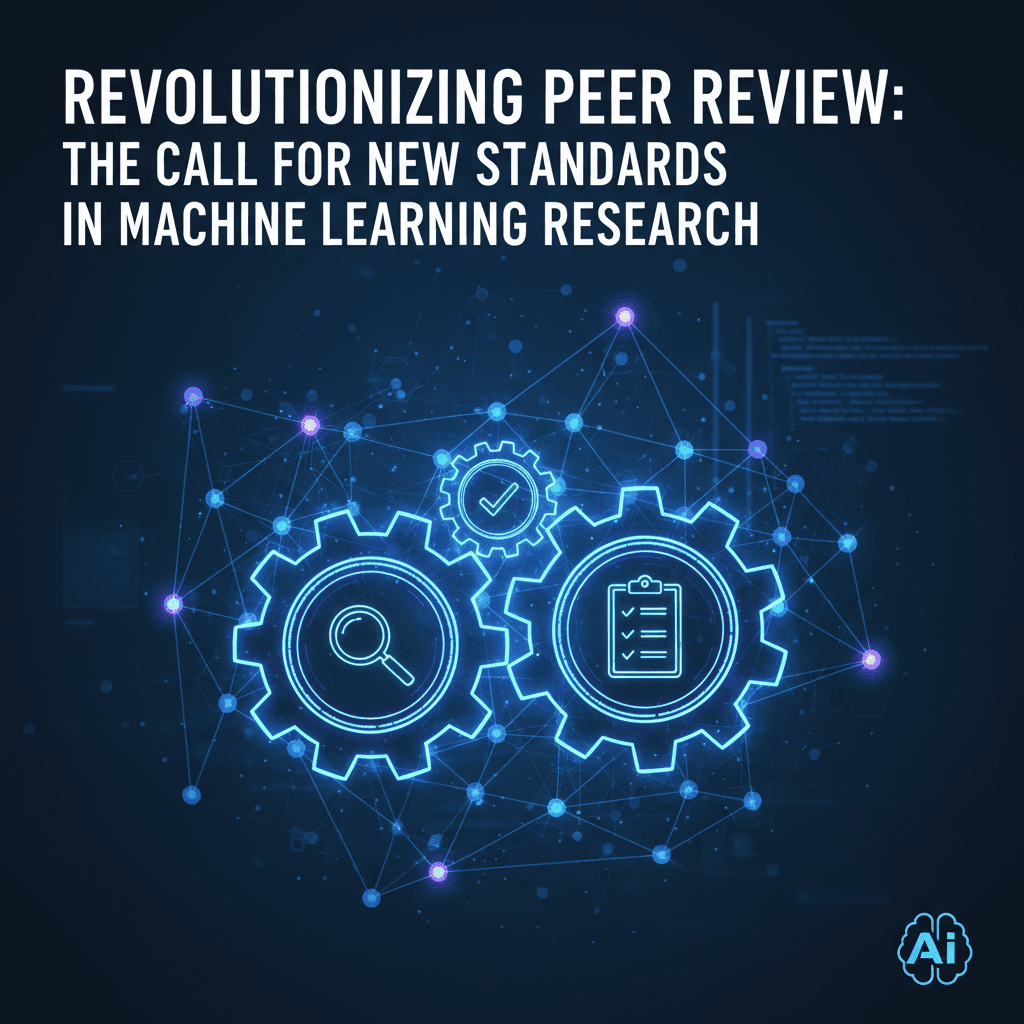
I still remember the first time a close colleague called me, equal parts frustrated and exhausted, after receiving peer reviews on a machine learning paper they had spent two years developing. One reviewer misunderstood the core contribution. Another demanded experiments that would have required an entirely different research grant. The third recommended rejection with a single vague sentence. Months of work, judged in weeks—sometimes hours—by an opaque system that rarely explains itself.
That experience is far from unique. Behind every successful innovation lies a fair chance to be evaluated, improved, and shared. Yet as machine learning accelerates at a breathtaking pace, its peer review process remains rooted in assumptions designed for a slower, smaller, and less interdisciplinary era. This article explores why reform is urgently needed, what innovative alternatives are emerging, and how the research community—fueled by high engagement and debate on platforms like Reddit—is calling for change to keep pace with modern machine learning research.
The Growing Mismatch Between Machine Learning and Traditional Peer Review
Why the System Is Struggling to Keep Up
Machine learning research today moves at a speed that traditional peer review was never designed to handle. Conferences like NeurIPS, ICML, and ICLR receive tens of thousands of submissions annually. NeurIPS alone surpassed 13,000 submissions in recent years, compared to fewer than 1,000 two decades ago. The result is reviewer overload, superficial feedback, and increased randomness in acceptance decisions.
Traditional peer review assumes that reviewers have the time, incentive, and expertise to deeply evaluate each submission. In practice, reviewers are often junior researchers juggling deadlines, teaching, and their own publications. The mismatch isn’t about competence—it’s about capacity.
- Actionable takeaway: Conference organizers can reduce reviewer burden by capping review assignments and expanding reviewer pools through structured mentorship programs.
- Actionable takeaway: Authors should write clearer, more modular papers, explicitly stating assumptions and limitations to reduce misinterpretation.
Complexity and Interdisciplinarity Raise the Stakes
Modern machine learning papers often combine theory, large-scale systems engineering, ethics, and domain-specific knowledge. A single reviewer rarely has deep expertise across all dimensions. This leads to fragmented reviews where important contributions are undervalued simply because they fall outside a reviewer’s comfort zone.
In Reddit discussions within r/MachineLearning, researchers frequently share stories of papers rejected for being “too applied” for theory tracks or “too theoretical” for applied venues. The boundaries are blurring, but review criteria are not.
- Actionable takeaway: Journals and conferences should encourage multi-reviewer specialization, where different reviewers explicitly assess theory, experiments, and societal impact.
- Actionable takeaway: Authors can preempt confusion by clearly mapping contributions to specific evaluation criteria.
Bias, Opacity, and the Human Cost of the Current System
When Anonymity Helps—and When It Hurts
Double-blind review was introduced to reduce bias related to author identity, institution, or reputation. While it has helped in many cases, it is not a cure-all. Experienced reviewers can often infer authorship based on writing style, datasets, or citations, especially in niche subfields.
Studies have shown mixed results on whether double-blind review significantly reduces bias, particularly in elite venues. Meanwhile, the anonymity of reviewers can sometimes encourage dismissive or unconstructive feedback, with little accountability.
- Actionable takeaway: Conferences could experiment with optional signed reviews, offering recognition and accountability for high-quality feedback.
- Actionable takeaway: Review quality metrics—scored by authors or area chairs—can incentivize thoughtful engagement.
The Emotional and Career Impact on Researchers
Peer review is not just a technical process; it shapes careers. For early-career researchers, repeated rejections with unclear reasoning can lead to burnout, imposter syndrome, or leaving academia altogether. On Reddit, threads discussing “toxic reviews” routinely attract hundreds of comments, highlighting a shared emotional toll.
When acceptance decisions feel arbitrary, trust in the system erodes. That erosion doesn’t just harm individuals—it undermines the credibility of machine learning research as a whole.
- Actionable takeaway: Institutions should provide mentorship on interpreting reviews and resubmission strategies.
- Actionable takeaway: Review guidelines should explicitly require constructive, actionable feedback.
Innovative Proposals Reshaping Peer Review
Open Review and Transparent Dialogue
Open review models, such as those pioneered by ICLR, publish submissions and reviews publicly. This transparency changes reviewer behavior, often leading to more thoughtful and civil feedback. It also allows the broader community to learn from the review process itself.
Data from ICLR suggests that open discussions can improve paper quality through iterative feedback, even when papers are ultimately rejected. Transparency turns peer review into a collaborative process rather than a gatekeeping ritual.
- Actionable takeaway: Researchers can engage respectfully in open discussions to clarify misunderstandings early.
- Actionable takeaway: Conferences should provide moderation tools to maintain constructive discourse.
Continuous and Post-Publication Review
Another promising idea is shifting peer review from a one-time event to a continuous process. Platforms like OpenReview allow papers to evolve over time, incorporating feedback even after initial publication. This mirrors how machine learning systems themselves are iteratively improved.
Post-publication review acknowledges a simple truth: no paper is perfect at submission. What matters is the trajectory of improvement and impact.
- Actionable takeaway: Authors can treat publication as the start of a conversation, not the end.
- Actionable takeaway: Funding agencies and hiring committees should recognize revised and living papers as legitimate scholarly contributions.
Rethinking Incentives and Evaluation Metrics
From Acceptance Rates to Research Impact
Machine learning has long fetishized low acceptance rates as a proxy for quality. Yet high rejection rates often reflect capacity constraints rather than rigor. Meanwhile, some highly cited and influential papers were initially rejected multiple times.
Research from bibliometrics shows weak correlation between conference acceptance and long-term citation impact. This raises an uncomfortable question: are we optimizing the wrong metric?
- Actionable takeaway: Institutions should evaluate researchers based on impact, reproducibility, and community contribution—not just venue prestige.
- Actionable takeaway: Conferences can publish impact retrospectives highlighting influential papers regardless of initial reception.
Rewarding Reviewers as First-Class Contributors
Reviewing is essential labor, yet it is largely invisible and unrewarded. Some proposals suggest formal citation of reviews, reviewer reputation systems, or even micro-compensation models.
In Reddit discussions, many reviewers express willingness to invest more time if their efforts were acknowledged in meaningful ways.
- Actionable takeaway: Platforms can issue verifiable reviewer credits linked to ORCID profiles.
- Actionable takeaway: Senior researchers should model high-quality reviewing as a professional norm.
What the Machine Learning Community Is Saying
Reddit as a Barometer of Grassroots Sentiment
Unlike formal surveys, Reddit provides raw, unfiltered insight into how researchers feel. Threads questioning peer review fairness regularly reach the front page of r/MachineLearning, with practitioners from academia and industry sharing similar frustrations.
What stands out is not cynicism, but a desire for constructive reform. Many commenters propose solutions, from lottery-based acceptance for borderline papers to decoupling dissemination from evaluation.
- Actionable takeaway: Conference organizers should monitor community forums to identify recurring pain points.
- Actionable takeaway: Researchers can channel frustration into pilot programs and workshops on review reform.
Signs of Momentum, Not Just Complaint
The conversation is evolving. More conferences are experimenting with new formats, and more researchers are willing to question long-held assumptions. This moment feels less like a crisis and more like an inflection point.
Change will be uneven and imperfect, but the status quo is no longer defensible in the face of exponential growth.
- Actionable takeaway: Support venues and initiatives that experiment with alternative review models.
- Actionable takeaway: Participate in meta-research that studies peer review itself.
A Call to Redefine Fairness and Progress
Peer review is not broken because people are malicious or incompetent. It is broken because it has not evolved alongside the field it serves. Machine learning thrives on iteration, feedback, and data-driven improvement—values that should apply equally to how we evaluate research.
If behind every successful innovation lies a fair chance, then reforming peer review is not a bureaucratic concern; it is a moral and scientific imperative. I challenge readers—authors, reviewers, organizers, and institutions alike—to treat peer review as a living system. Question it. Measure it. Improve it.
The future of machine learning depends not just on better models, but on better ways of deciding which ideas deserve to shape the world.
Where This Insight Came From
This analysis was inspired by real discussions from working professionals who shared their experiences and strategies.
- Share Your Experience: Have similar insights? Tell us your story
At ModernWorkHacks, we turn real conversations into actionable insights.




0 Comments