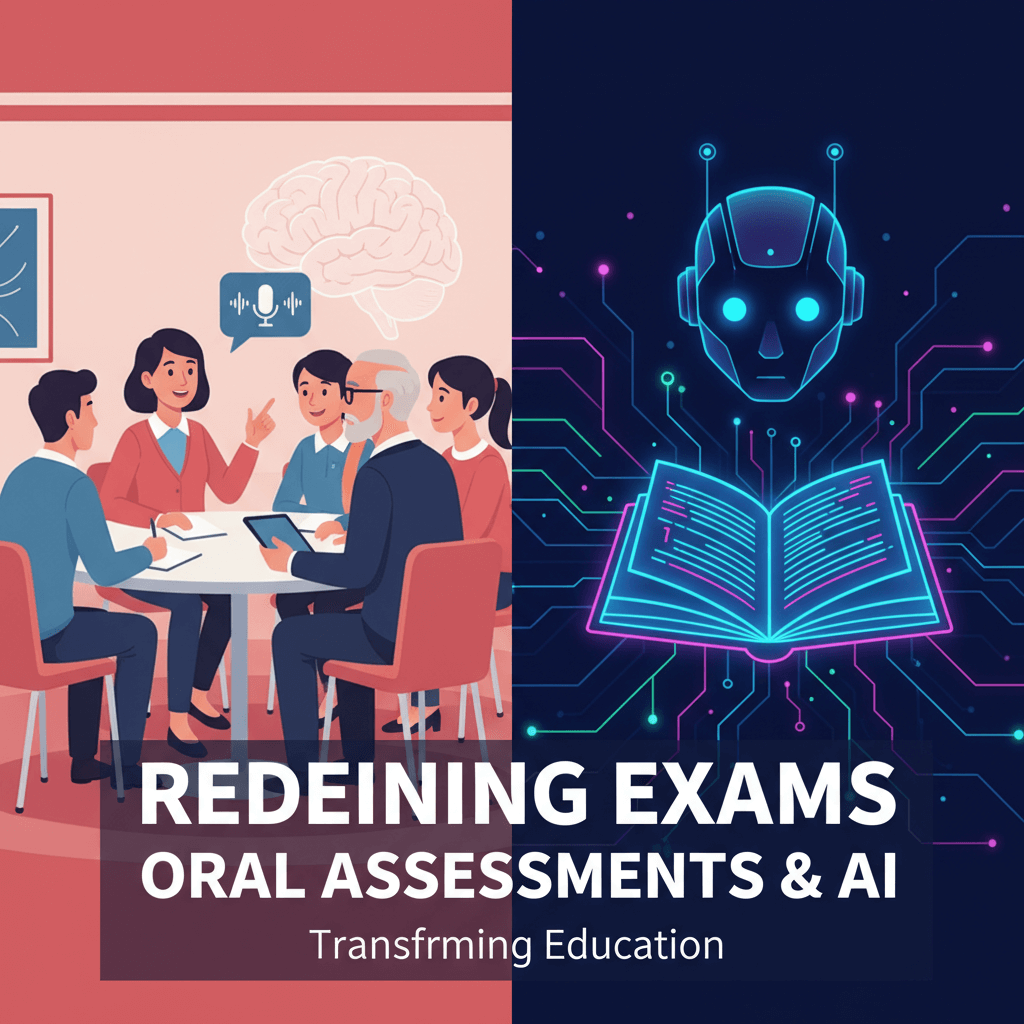
Professor Elena Martinez sat across from her student, Jamie, in her small office at Berkeley. “So tell me about the ethical implications of machine learning in healthcare,” she prompted. As Jamie began to articulate his understanding, Professor Martinez observed something she rarely saw in written exams—genuine intellectual engagement. Jamie’s eyes lit up as he connected concepts, paused thoughtfully when challenged, and even acknowledged areas where his understanding was still developing. This 20-minute conversation revealed more about Jamie’s grasp of the material than any written exam could have shown.
This scene is increasingly common in higher education institutions across the country. As AI tools like ChatGPT make it easier than ever to generate essays and written responses, educators are rediscovering the value of one of academia’s oldest assessment methods: the oral exam. What was once considered outdated is now at the cutting edge of educational innovation.
In an era where AI can write convincing essays in seconds, educators are facing an existential question: how do we truly assess what our students know? The answer may lie not in more sophisticated technology, but in the timeless practice of face-to-face dialogue.
The Renaissance of Oral Examinations
Oral examinations have deep historical roots in education. From the Socratic dialogues of ancient Greece to the rigorous vivas of medieval universities, the practice of testing knowledge through conversation has a rich tradition. Yet somewhere along the way—amid growing class sizes and standardization efforts—written assessments became the norm.
Why Oral Exams Are Making a Comeback
According to a 2023 survey by the Chronicle of Higher Education, 68% of professors report concerns about AI-generated assignments, with 42% already making significant changes to their assessment strategies. Dr. Robert Feldman, a cognitive psychologist at the University of Massachusetts, explains: “We’re witnessing a fundamental shift in how we verify learning. Written assessments alone are no longer sufficient proof of a student’s knowledge.”
The benefits of oral assessments extend beyond AI-proofing:
- Immediate feedback loops allow instructors to probe understanding in real-time, adapting questions based on student responses
- Critical thinking becomes visible as students must articulate their reasoning without the ability to copy or generate content
- Communication skills development occurs naturally, preparing students for professional environments where verbal articulation matters
Stanford University’s Department of Computer Science implemented oral components for final assessments in 2022, with surprising results. “Students initially dreaded the format,” notes Department Chair Dr. Jennifer Liu, “but end-of-term surveys showed 76% felt the oral exams more accurately reflected their knowledge than written tests.”
Beyond AI-Proofing: The Pedagogical Advantages
While concerns about AI-generated content may have accelerated interest in oral assessments, educators are discovering benefits that transcend technological challenges.
Deeper Learning Through Dialogue
Research from the Learning Sciences Institute at Northwestern University demonstrates that the expectation of having to explain concepts verbally leads to different—often deeper—study approaches. In a comparative study of 240 undergraduate students, those preparing for oral assessments showed 34% higher rates of conceptual understanding versus those studying for multiple-choice exams.
Professor Carlos Mendez at the University of Texas implements a hybrid assessment model in his engineering courses. “When students know they’ll need to explain their design decisions verbally, they internalize the principles rather than memorizing formulas,” he says. “I’ve seen remarkable improvements in their ability to apply concepts to novel problems.”
Actionable approaches for educators include:
- Incorporating mini oral check-ins throughout the term, not just as final assessments
- Providing structured rubrics that clarify expectations for verbal articulation
- Recording sessions (with permission) to help students reflect on their communication skills
Reducing Academic Dishonesty
A less discussed but significant benefit is the natural deterrent oral exams pose to various forms of academic dishonesty. Dr. Sarah Williams, who studies academic integrity at the University of Michigan, notes: “It’s considerably more difficult to fake understanding in a dynamic conversation. The spontaneity required makes oral assessments one of the most authentic forms of evaluation.”
At Georgia Tech, physics professor Dr. Alan Ramos implemented oral exams after detecting a pattern of suspicious similarities in online assignments. “The change wasn’t punitive,” he explains. “It was about creating an environment where students’ actual understanding could shine. The side effect was a complete elimination of plagiarism concerns.”
Addressing Equity and Accessibility Concerns
Despite their benefits, oral assessments raise important questions about equity and accessibility that educators must thoughtfully address.
Language Barriers and Communication Differences
For international students or those with communication differences, oral exams can present unique challenges. Dr. Leila Patel, Director of Inclusive Teaching at Columbia University, emphasizes: “We must distinguish between assessing subject knowledge and evaluating communication style or language fluency.”
Successful implementations include:
- Preparation guides that clearly outline expectations and provide practice opportunities
- Modified formats that allow students to prepare key points in advance while still requiring spontaneous responses
- Multilingual options where appropriate to the learning objectives
The University of Washington’s linguistics department created a model worth emulating. They developed a comprehensive framework for oral assessments that includes options for students to request accommodations such as additional preparation time or alternative response formats while maintaining rigorous standards.
Anxiety and Performance Pressure
Test anxiety affects approximately 40% of students, and oral examinations can amplify these feelings for some learners. However, research from the Journal of Educational Psychology suggests that with proper scaffolding, oral assessments can actually reduce anxiety over time by building confidence in verbal articulation.
Dr. Michael Chen, a psychology professor at UCLA, implements a gradual approach: “We start with low-stakes pair discussions, then small group presentations, before moving to one-on-one assessments. By building these skills incrementally, we’ve seen anxiety levels decrease substantially by the final assessment.”
Implementing Oral Assessments Effectively
The shift to oral assessments requires thoughtful implementation to be successful. Educators across disciplines have developed promising practices that balance rigor with fairness.
Designing Meaningful Questions
The quality of oral assessments hinges on question design. Unlike written exams, which often test recall, effective oral questions prompt analysis, synthesis, and evaluation. Dr. Elizabeth Foster, an education researcher at the University of Toronto, recommends:
- Starting with conceptual questions before moving to application scenarios
- Incorporating follow-up probes that respond to student answers
- Including questions that ask students to evaluate competing perspectives
Vanderbilt University’s Center for Teaching has developed a question bank specifically for oral assessments across disciplines. Their framework emphasizes questions that cannot be pre-scripted, such as “How would you modify your approach if [variable changes]?” or “What connections do you see between [concept A] and [concept B] that weren’t explicitly covered in class?”
Practical Logistics and Scaling
One of the most common concerns about oral assessments is their time-intensive nature. Creative approaches to this challenge include:
- Peer-involved models where students participate in assessing their classmates under faculty supervision
- Rotating station formats where students move through a series of brief assessment conversations
- Technology-assisted scheduling that distributes assessment slots efficiently
At Arizona State University, Professor James Rodriguez uses a modified group oral exam for his introductory biology classes of 120+ students. “We conduct 15-minute sessions with groups of three students. Each student answers individual questions but also responds to and builds upon their peers’ answers. This approach reduces the time commitment while still verifying individual understanding.”
The Future of Assessment in the AI Era
As we navigate the rapidly evolving landscape of AI in education, oral assessments represent not a regression to the past but a progressive adaptation that honors the fundamentally human nature of learning.
Blended Assessment Models
The most promising approaches combine multiple assessment methods. Dr. Katherine Lee, an education technology researcher at MIT, advocates for “assessment ecosystems” that include written work, project-based learning, and oral components. “The goal isn’t to abandon written assessment entirely,” she explains, “but to create a more complete picture of student learning through multiple modes of demonstration.”
The University of Pennsylvania’s Wharton School has pioneered a comprehensive assessment framework that includes:
- AI-assisted written assignments where the use of AI tools is explicitly incorporated into the learning process
- Collaborative projects that develop teamwork alongside subject mastery
- Individual oral defenses where students explain their thinking and connect concepts
“This isn’t just about preventing cheating,” notes Dean Thomas Richards. “It’s about preparing students for a world where they’ll need to work alongside AI while maintaining their distinctly human abilities to reason, communicate, and connect ideas in novel ways.”
Conclusion: Embracing the Human Element in Education
As AI continues to transform how we create and process information, education must evolve to emphasize the uniquely human aspects of learning. Oral assessments represent not just a strategic response to technological challenges but a recommitment to education’s deeper purpose: developing minds that can think critically, communicate effectively, and engage meaningfully with complex ideas.
The resurgence of oral examinations reminds us that despite technological advances, learning remains a profoundly human exchange. By creating assessment spaces where students must articulate their understanding through dialogue, we prepare them not just for tests but for a future where the ability to explain, debate, and refine ideas in real-time will be more valuable than ever.
For educators considering this shift, the message is clear: the oldest assessment method may be our most innovative path forward. The future of education in the AI era may depend less on outpacing technology and more on recommitting to the irreplaceable value of human connection and conversation.
Where This Insight Came From
This analysis was inspired by real discussions from working professionals who shared their experiences and strategies.
- Share Your Experience: Have similar insights? Tell us your story
At ModernWorkHacks, we turn real conversations into actionable insights.
![[Workflow Included] A simple 5-node Instagram posting workflow for beginners](https://modernworkhacks.com/wp-content/uploads/2026/04/workflow-included-a-simple-5-node-instagram-posting-workflow-for-beginners-1024x675.png)


0 Comments