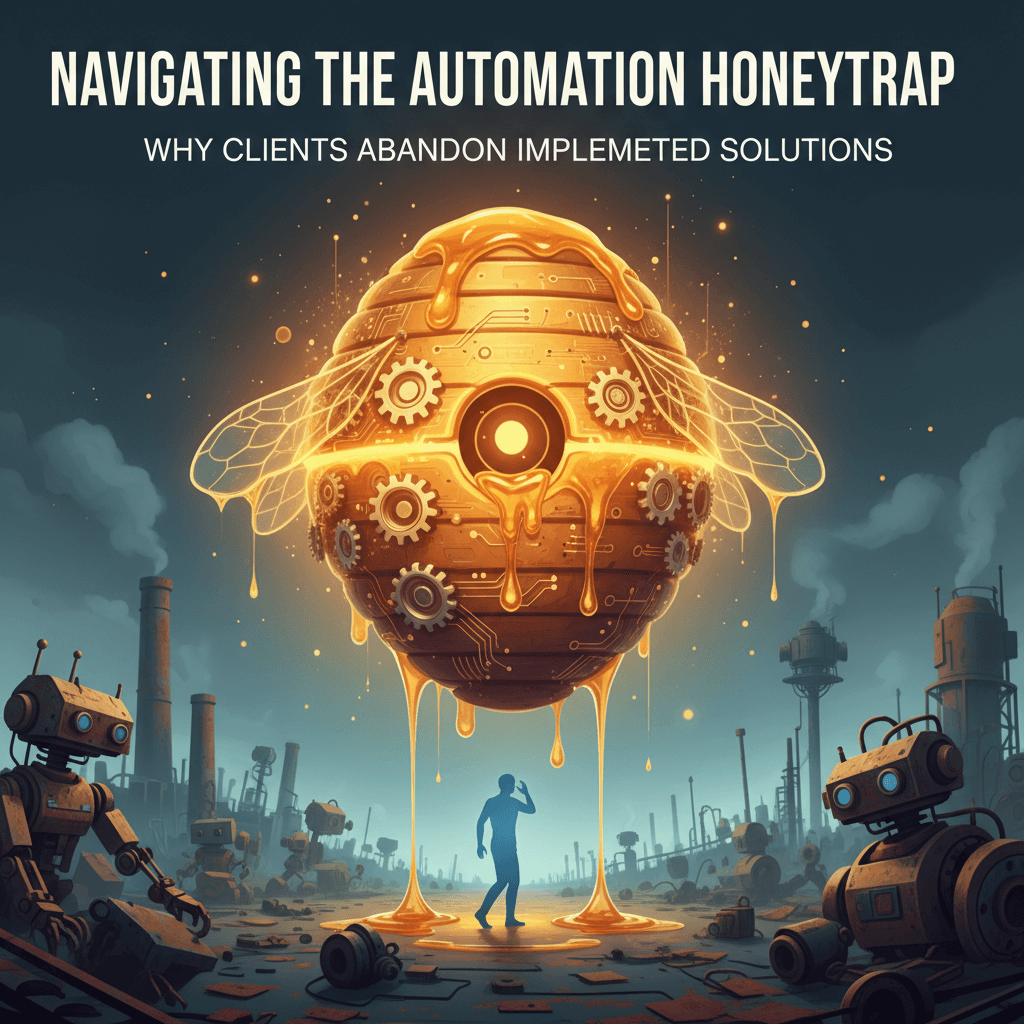
I watched as Marcus, our lead developer, demonstrated the automated workflow system we’d spent six months building for our biggest client. The client’s team nodded appreciatively, asked insightful questions, and left with smiles and handshakes. “This will transform how we operate,” their CTO assured us. Fast forward three months, and our analytics showed barely 10% of the system was being utilized. The brilliant solution we’d crafted was essentially gathering digital dust.
If this scenario sounds painfully familiar, you’re not alone. Across the tech industry, developers and consultants routinely face what I’ve come to call the “automation honeytrap”—the puzzling phenomenon where clients enthusiastically commission sophisticated automation solutions only to abandon them shortly after implementation.
The Psychology Behind Abandoned Automation
To understand why perfectly functional automation solutions get abandoned, we need to first examine the psychological factors at play. These invisible forces often have more impact on technology adoption than the technical merits of the solution itself.
The Novelty-Routine Paradox
Human beings are simultaneously drawn to novelty and resistant to change. Research from the Journal of Organizational Behavior shows that while 87% of employees express interest in new workplace technologies, only 30% successfully incorporate them into daily routines after three months.
A perfect example comes from a mid-size manufacturing firm I consulted with last year. Their management eagerly invested in an inventory automation system, but warehouse staff quietly reverted to manual processes within weeks. When interviewed, many admitted they found comfort in familiar workflows, despite acknowledging the new system was more efficient.
To overcome this paradox:
- Implement gradual transitions rather than abrupt cutoffs from old systems
- Create “habit bridges” that connect new processes to existing routines
- Establish regular check-ins during the crucial 90-day adoption window
The Ownership Gap
When solutions are perceived as being imposed from outside, psychological resistance naturally follows. A 2021 McKinsey study found that technology initiatives where end-users participated in the design process had 76% higher adoption rates than those designed without user input.
“We built exactly what they asked for,” lamented a colleague after a failed CRM implementation. The problem wasn’t functionality—it was that the people who would use the system daily hadn’t been part of defining what success looked like.
Technical Barriers That Sabotage Adoption
Beyond psychology, practical technical issues can quickly transform an exciting new solution into an abandoned project. Even minor friction points can derail adoption when multiplied across daily use.
The Invisible Learning Curve
As technical experts, we often underestimate how challenging new systems appear to non-technical users. What seems intuitive to us can be deeply intimidating to others.
Consider the case of a legal firm that invested in document automation. The system reduced document preparation time by 70% in testing, but adoption plateaued at just 15% of the staff. Investigation revealed that most users struggled with the initial setup process, which developers had considered “basic” but which created significant anxiety for legal professionals unfamiliar with configuration interfaces.
Strategies to address the learning curve include:
- Creating contextual help that appears at the moment of need rather than in separate documentation
- Developing “quick win” workflows that deliver immediate value with minimal learning
- Identifying and empowering internal champions who can provide peer support
Integration Friction and Workflow Disruption
Even technically sound solutions can fail when they don’t seamlessly integrate into existing ecosystems. A 2022 survey by Deloitte found that 63% of abandoned enterprise software suffered from poor integration with other critical systems.
I witnessed this firsthand with a healthcare provider that implemented an advanced patient scheduling system. Despite its sophisticated features, staff abandoned it because it couldn’t easily share data with their electronic medical records system, effectively doubling their data entry work.
The Communication Disconnect
Many automation projects fail not because of technical shortcomings, but because of gaps in understanding between developers and clients. These communication breakdowns can occur at multiple points throughout the project lifecycle.
Misaligned Expectations
When clients envision one outcome and developers deliver another—even if technically superior—disappointment inevitably follows. Research from the Project Management Institute shows that 37% of project failures stem from unclear requirements and expectations.
A financial services firm I worked with commissioned an automated reporting solution, expecting it to completely eliminate manual reporting work. The development team delivered a system that reduced reporting time by 80%—an impressive achievement, but the client considered it a failure because their expectation of “zero manual intervention” wasn’t met.
To prevent expectation misalignment:
- Document and validate specific success criteria before development begins
- Create visual prototypes that allow clients to “experience” the solution before building
- Establish regular reality-check meetings to reassess expectations as the project evolves
The Training Gap
Even the most intuitive solutions require proper knowledge transfer. According to LinkedIn Learning, companies that excel at training see 53% higher adoption rates for new technologies.
Yet training is often treated as an afterthought. One retail client allocated just two hours for training on a complex inventory management system that transformed their entire supply chain process. The predictable result: store managers created workarounds rather than using the new system.
Building Solutions That Stick
After witnessing countless automation projects fall into disuse, I’ve identified several strategies that dramatically increase the likelihood of sustained adoption. The key insight: successful automation requires as much focus on human factors as on technical excellence.
Start With Pain, Not Features
The most successful automation projects begin by deeply understanding the specific pain points users experience. Rather than leading with technical capabilities, focus relentlessly on how the solution alleviates genuine frustration.
A B2B software company I advised completely reimagined their approach to client onboarding automation. Instead of showcasing all possible features, they identified the three most painful aspects of their clients’ current processes and designed solutions specifically targeting those pain points. Adoption rates increased from 35% to 89% within six months.
Practical approaches include:
- Conducting “day in the life” observations of potential users before designing solutions
- Creating pain-point heat maps that prioritize which problems to solve first
- Developing “before and after” scenarios that clearly illustrate how life improves with the new solution
Implement Progressive Complexity
Successful automation solutions often follow a “crawl-walk-run” approach to feature introduction. Research from the User Experience Professionals Association shows that systems introducing features gradually achieve 62% higher long-term engagement than those that present full complexity upfront.
A manufacturing client successfully implemented a complex production scheduling system by initially deploying only basic functionality that delivered immediate value. As users became comfortable, additional capabilities were gradually introduced, with each new feature building on established usage patterns.
Create Accountability Structures
Without formal accountability, even the most promising automation initiatives can fade away. According to Gartner, technology implementations with defined accountability frameworks are 2.5 times more likely to achieve sustained adoption.
One particularly effective approach comes from a logistics company that established a formal “automation benefits realization” process. Department heads were required to report monthly on utilization metrics and realized efficiency gains. This simple accountability mechanism transformed their approach to technology adoption.
The Path Forward: From Implementation to Integration
The ultimate goal isn’t merely implementing automation but integrating it so deeply into organizational processes that it becomes indispensable. This requires shifting focus from the technical handoff to the human transition.
When a regional bank implemented a loan processing automation system, they dedicated 30% of the project budget to post-implementation activities. This included dedicated user success managers, weekly optimization sessions, and a formal benefits tracking program. The result: 94% adoption after six months, compared to industry averages below 40%.
As developers and consultants, we must recognize that our responsibility extends beyond delivering functional code. The true measure of success is not implementation but integration—not what the system can do, but what people actually do with it.
The Continuous Engagement Model
Rather than viewing automation projects as having distinct start and end points, successful implementations follow a continuous engagement model. This approach recognizes that technology adoption is a journey rather than an event.
To implement this model:
- Schedule regular value-assessment reviews with clients after implementation
- Create user communities that share best practices and success stories
- Develop usage analytics dashboards that highlight both adoption wins and opportunity areas
Conclusion: Beyond the Honeytrap
The automation honeytrap—where promising solutions sit unused—isn’t inevitable. By understanding the psychological, technical, and communication factors that lead to abandonment, we can design implementation strategies that lead to genuine transformation rather than digital shelf-ware.
The most successful automation initiatives I’ve witnessed share a common thread: they’re treated not as technology projects but as change management initiatives with a technological component. They recognize that sustainable automation isn’t about replacing human work but augmenting human capability.
As you approach your next automation project, I challenge you to measure success not by the elegance of your solution but by its integration into daily work. Ask not “Does it work as designed?” but rather “Is it being used as intended?”
The true test of our work as developers and consultants isn’t what we build—it’s what others do with what we build. And that requires us to be not just technical experts but also students of human behavior, organizational dynamics, and the subtle art of change.
Where This Insight Came From
This analysis was inspired by real discussions from working professionals who shared their experiences and strategies.
- Share Your Experience: Have similar insights? Tell us your story
At ModernWorkHacks, we turn real conversations into actionable insights.
![[Workflow Included] A simple 5-node Instagram posting workflow for beginners](https://modernworkhacks.com/wp-content/uploads/2026/04/workflow-included-a-simple-5-node-instagram-posting-workflow-for-beginners-1024x675.png)




0 Comments