Discover actionable insights.
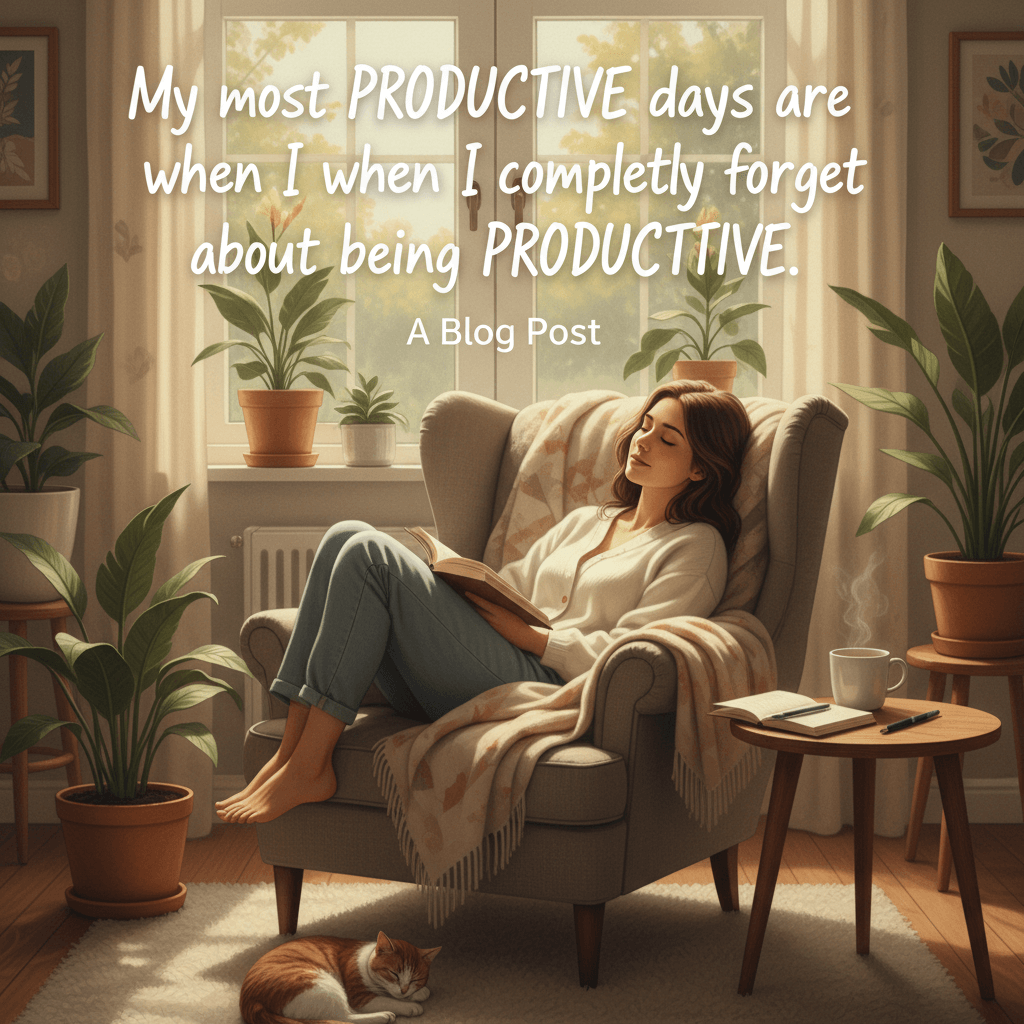
The morning I forgot to be “productive”
On a Tuesday that was supposed to be “optimized,” I overslept. My phone had died overnight, so there was no alarm, no morning playlist, no habit-tracking streaks to preserve. The carefully color-coded calendar I’d curated the night before was suddenly useless. The only thing I had was a notebook and a pen on my kitchen counter. I wrote one line: “Get the draft out.” It was a project I’d delayed across five perfect but empty days—each filled with planning, tweaking templates, and tinkering with tools. That morning, with no digital scaffolding and no appetite to rebuild it, I made coffee, sat down, and began.
There was no to-do list to consult, no productivity video to queue up, no 47-minute pomodoro timer to negotiate with. I didn’t even check the “best practices” cheat sheet I usually flip through when I’m trying to be diligent. The plan was aggressively simple: write the messy version, then make it readable, then send it. I told myself that if the draft wasn’t good, at least it would exist—which is more than could be said for any of the gorgeous, hypothetical drafts in my head.
Time slipped. I forgot to optimize. I forgot to worry about focus. I forgot—this is the important part—to be productive. And without that constantly self-monitoring soundtrack, I finished the draft, cut it down, found the hook, and sent it to the team by noon. It wasn’t heroic. It was just done.
By evening, I’d closed a loop on something that had lived rent-free in my brain for a week. I’d returned two calls, tidied the notes on my desk, and wrote down three things to explore tomorrow. When I finally checked my phone, I realized what had felt like “flow” wasn’t about hacks or tricks or even discipline. It was about forgetting the performance of productivity long enough to do the work. That accidental discovery became a deliberate practice—and it changed how I plan days, run meetings, and coach teams.
This article unpacks what I learned, and what others have taught me in real conversations—founders, nurses, teachers, engineers, and artists—about why our best days often happen when we stop trying to have “best days.” Hidden inside the paradox is a practical method you can use today.
The trap of chasing productivity
Productivity is a seductive goal because it masquerades as progress. You can count it, calendar it, and celebrate it. You can click it, swipe it, even wear it on your wrist. But there’s a difference between doing productive things and producing valuable outcomes. The pursuit of productivity, as a state, often keeps us just one meta-layer above the work we intend to do. We end up managing our sense of efficiency more than we move the needle.
The brain has a limited budget for attention. When we ask it to execute a task and simultaneously judge how efficiently it’s executing that task, we tax ourselves twice. We introduce friction in the form of self-surveillance. A little meta-awareness helps—checking your direction every hour or two is wise. But constant monitoring burns energy we could have used to solve the problem, write the sentence, or call the client.
In real discussions with small business owners and team leads, a pattern keeps emerging: the most “productive” days, by output, rarely feel productive. They feel quiet. Focused. Almost boring. They lack the panicky sprints, the app-hopping, the dopamine of crossing off a dozen low-impact tasks. Instead, they feature a few high-impact moves and a body that remembers moving in one direction for a while. Performance follows presence.
Signals you’re in the productivity trap
- You spend more time arranging tasks than executing them.
- Your day is full of micro-decisions that feel urgent but leave nothing important finished.
- You constantly switch tools or frameworks because the current one “isn’t quite right.”
- Breaks turn into “maintenance time” for inboxes and notification feeds.
- You end the day exhausted but can’t point to a single meaningful outcome.
These are not moral failings; they’re design problems. Our devices, workflows, and expectations often privilege responsiveness over results. We use tools built to catch attention and then wonder why attention gets caught.
The antidote is not to become stricter about productivity. It’s to lower the cognitive overhead of getting started and staying with the work. It’s to design a day where the default is doing the thing, not thinking about doing it. And paradoxically, you get there by forgetting to be productive—by stopping the constant evaluation of your own efficiency and orienting yourself toward a clear, real outcome.
What works when you stop trying: insights from real conversations
Over the past few years, I’ve listened to hundreds of people across roles and industries describe their best days. The details differ, but the contours rhyme. Here are abbreviated snapshots of those discussions and what they reveal:
“I cut the soundtrack.” — A founder’s reset
A startup founder told me their most effective day in a quarter began after a night of poor sleep. They cancelled the morning standups, booked a room for themselves and their COO, and wrote the next quarter’s one-page narrative. No slides. No OKR gymnastics. No dashboards. “We turned off Slack and just wrote what we believed was true. Once we saw it on paper, the plan wrote itself.” The key moment wasn’t a hack—it was removing the backchannel of constant coordination.
“Care first, chart second.” — A nurse’s shift
A senior nurse in a busy hospital explained that their best shifts happen when they stop watching the clock and start listening for what they called “the next needed thing.” “Once I step into the room, I forget about everything else and focus on the person in front of me. The charts get done because they have to, but the shift goes better when I’m not trying to be efficient; I’m trying to be present.” Ironically, that presence reduces downstream fires.
“One scene, one lens.” — A teacher’s class
An English teacher shared that their most effective class was the day they ditched a complicated lesson plan and spent the hour on one paragraph from a novel. Students read, then read again, then argued the meaning of a single metaphor. Attention sharpened because the goal shrank. The teacher wasn’t performing productivity; they were curating depth.
“Ship the smallest version.” — A developer’s sprint
A developer told me their breakthrough day came when a teammate suggested cutting a feature in half and shipping the smaller version by lunch. Once they shipped, the feedback clarified the path for the full build. “We felt lighter. The rest of the day had momentum because something was already out in the world.”
Stripped of circumstance, these stories share a spine:
- Attention > optimization. Turning down internal and external noise frees energy to do the work.
- One real outcome. A concrete, visible finish line eclipses the need for elaborate tracking.
- Small, shippable units. Shipping creates momentum that planning can’t simulate.
- Friction removal. It’s easier to run downhill. Reduce tool-switching and decision clutter.
- Presence resets. Brief, intentional pauses (a walk, a breath, a page) re-center the system.
Key takeaways from real discussions
- Best days start with one sentence that names the real outcome—not a list of tasks.
- People who “forget productivity” don’t ignore time; they shape it into a few clear blocks.
- Teams that produce more have fewer coordination channels open at once.
- Depth beats breadth: doing one thing fully is faster than doing five things partly.
- Avoid perfection traps by shipping a draft or “smallest useful version” early in the day.
Notice how actionable these are: they don’t require new software, just new defaults. They’re less about adding habits and more about removing resistance.
A simple framework: The Unproductivity Protocol
If forgetting to be productive creates our best days, how do we forget on purpose? The answer is to build a light scaffolding that holds you to the outcome and releases you from the performance. Think of this as a protocol you can run today, adjustable to your role and circumstances.
Step 1: Name a single outcome the day before
At the end of today, write one sentence starting with a verb and ending with a visible deliverable. Example: “Send the proposal draft to Alicia,” “Publish the bugfix,” “Outline Chapter 3,” “Call three lapsed clients.” If you must write more, add up to three enabling tasks beneath it. But keep the headline clear and concrete.
- Make it visible. Write it on paper and leave it where you’ll see it first thing.
- Time-box it. Roughly estimate how many 45–60 minute blocks it will take.
- Pre-decide constraints. Decide in advance what you’ll ignore to make this happen.
Step 2: Start without the scoreboard
Begin your day without opening email, chats, or analytics. Give yourself a 10-minute arrival ritual: water, stretch, one page of notes. Then start the first work block immediately. No timer if timers stress you; if you like them, set a soft one in the background. The principle is to remove the “am I doing this right?” soundtrack for the first hour.
- Two-minute proof. Produce a tiny artifact right away (a file, a sketch, a paragraph). Momentum loves evidence.
- Single window. Use one app or one physical setup per block to reduce context switching.
Step 3: Work in tempo blocks
Use three to four blocks of 45–60 minutes with 5–10 minute intermissions. Blocks are for making; intermissions are for moving. Not scrolling, not “quickly” checking chat. Movement resets your attention and keeps your body from becoming a chair-shaped complaint.
- Intermission rules. Stand up, breathe, look far away, write down the next micro-step, then return.
- Protect the edge. The last 5 minutes of a block are for deciding exactly how you’ll spend the first 5 minutes of the next block.
Step 4: Build a friction firewall
Friction is everything that makes it harder to begin or continue. Build a simple wall around your blocks.
- Device diet. Disable non-essential notifications. Put your phone physically away.
- Work surface reset. Clear your desk except for the tools relevant to the current block.
- Someday pad. Keep a cheap notebook to catch every stray thought. If it matters, it will still matter after the block.
- Communication contract. Let colleagues know you’re in blocks; offer specific times you’ll respond.
Step 5: Ship a small version before lunch
Even if the final outcome will take longer, find a shippable unit by midday. It could be a draft to a colleague, a pull request, a client check-in, or a decision document. Shipping early buys feedback and creates momentum that drags you through the afternoon.
- Define “ship.” It’s not perfect; it’s a meaningful handoff to the next step.
- Announce it. Tell the relevant person what you shipped and what input you need.
Step 6: Close loops lightly
At the end of the final block, take five minutes for a micro-retrospective:
- What moved today?
- What felt heavy? What lightened it?
- What’s the one sentence for tomorrow?
Resist the urge to build a complete system out of one good day. Let good days repeat before you formalize them.
Role-specific variations
For managers
- One decision per day. Identify the single decision that unlocks others and move it forward by noon.
- Batch coordination. Cluster meetings into two windows. Keep one long maker block sacred.
- Default to docs. Replace real-time back-and-forth with a brief written proposal others can comment on.
For makers (designers, writers, developers)
- One artifact per block. Treat each block as a unit that ends with something concrete—even a rough sketch counts.
- Reference island. Keep all references in one place (one doc, one tab, or a single physical folder) to reduce wandering.
- Silent starts. Begin the day with 60 minutes of uninterrupted making before you check anything.
For students
- One concept, one page. Summarize a concept by hand in one page after each block.
- Active recall over review. Close the book, write what you remember, then check gaps.
- Study with constraints. Use a simple timer and a clear question you’re trying to answer each block.
Actionable takeaways you can try today
- Write one sentence for tomorrow’s outcome and place it on your keyboard before you leave.
- Schedule three 55-minute blocks and one 20-minute block for admin. The rest can be flexible.
- Turn off notifications you don’t intend to answer within the hour.
- Prepare a “Someday pad” for captures and a “Done list” to record outcomes—skip the elaborate tracker.
- Decide right now what you will ship before lunch tomorrow.
Why forgetting works: the underlying principles
Forgetting to be productive is not forgetting your responsibilities. It’s forgetting the self-consciousness that makes work heavier. Three principles explain why this works and how to harness it.
1) Attention is a scarce resource—spend it on doing, not monitoring
Your brain’s executive system is powerful but limited. When you allocate bandwidth to self-evaluation every 30 seconds, you steal it from problem-solving and creation. A day that reduces meta-cognition during key blocks will feel easier and produce more.
- Design implication: Only check direction at natural seams—between blocks—not in the middle of them.
2) Momentum beats motivation
One small win creates propulsion that no pep talk can match. Initiating a task is costly; continuing is cheap. That’s why the “two-minute proof” and “ship before lunch” rules are so powerful—they convert intention into motion and motion into completion.
- Design implication: Front-load your day with a small shippable artifact to tilt the entire day forward.
3) Constraints create clarity
When everything is possible, nothing is obvious. Constraints—time boxes, a single outcome, one tool—narrow the field and reveal the next move. The less choice you have in mode and method, the more energy you can devote to the work itself.
- Design implication: Pre-commit to the first tool you’ll use and the first micro-task you’ll tackle. Don’t shop for options mid-block.
Common objections—and responses
- “My job is reactive.” Then carve out one or two short “maker” blocks and declare them a standing meeting with yourself. Let the rest of the day be responsive on purpose.
- “I can’t ignore my inbox.” Don’t. Batch it. Two 20-minute inbox windows are enough for most roles. Use a template folder for fast replies.
- “I need to track progress.” Track outcomes, not activity. Keep a daily “shipped” list; let that be your metric.
- “My team expects instant answers.” Set a service-level expectation: “I respond within two hours during the day.” Then honor it.
Micro-experiments to test the principles
- Silent Start Challenge: For three mornings, start with 60 minutes of no-input focus. Track how much you ship by 11 a.m.
- Single-Tool Day: Choose one tool (e.g., a text editor) for core work and don’t leave it during blocks.
- Ship-By-Noon Rule: For one week, ship something meaningful by noon every day. Observe the compounding effect.
Making it stick in teams and in life
One person forgetting to be productive can have a great day. A whole team doing it can have a great quarter. The key is to create simple, shared agreements that reduce friction collectively.
Team-level practices
- Shared outcome of the day. Each person posts a one-sentence outcome in the morning. Keep it in a single channel or document. No commentary needed—just declarations.
- Block-aware calendars. Use calendar holds for maker blocks to signal availability. Respect holds as you would any meeting.
- Asynchronous defaults. Start conversations with short written briefs. Reserve meetings for decision-making or conflict resolution.
- Quiet hours. Agree on one or two daily windows when messages are minimized. Batch announcements accordingly.
- Retro-light. End the week with a 15-minute “What moved?” share. Focus on outcomes, not hours.
Personal routines that support forgetting
- Evening seed. Plant tomorrow’s one sentence before you log off. This reduces morning indecision.
- Arrival ritual. Keep the first 10 minutes identical every day to create an on-ramp your brain recognizes.
- Environment anchors. A tidy desk, a closed door, or headphones can be a signal to your brain that it’s time to do, not decide.
- Recovery slots. Protect a small block for logistics and admin, so they don’t spill into your maker blocks.
Actionable takeaways for teams and individuals
- Start next week with a team “outcome board”—one sentence per person, updated daily.
- Institute two “quiet hours” per day where meetings and chat are discouraged.
- Adopt a “ship before lunch” policy for drafts, decisions, or demos.
- Replace one recurring meeting with an asynchronous brief and a 15-minute decision call.
- Track outcomes shipped per week, not hours logged—celebrate the list every Friday.
A one-week experiment: The Unproductivity Week
If you want to try this without rebuilding your entire workflow, run a seven-day experiment. The rules are simple, the data will be honest, and the results will be obvious.
- Day 0 (Sunday): Write one sentence for each weekday’s primary outcome. Block three focus windows on your calendar.
- Day 1–5: Start with a silent hour. Work in three blocks. Ship something by noon. Record one outcome per day.
- Day 6 (Saturday): Review your “shipped list.” Note the days you forgot to be productive—and how much moved.
Most people who try this are surprised by two things: how much they finish and how light the work feels. The paradox resolves itself: by forgetting productivity as an identity, you become more productive as a matter of course.
Call to action: Design your next best day
Today, before you log off, write one sentence that names tomorrow’s real outcome. Put it where you’ll see it first. In the morning, skip the scoreboard and begin. Protect three blocks. Ship something by lunch. Close loops lightly, then leave evidence of progress for yourself to find.
You don’t need a new app or a four-hour morning routine. You need a clear outcome, a few protected windows, and the courage to forget the performance long enough to do the work. The days that move your life forward won’t always feel productive—but they will be the days you remember.
- Start now: What will you ship by noon tomorrow?
- Share it: Tell a teammate or a friend your one-sentence outcome.
- Repeat it: Run the Unproductivity Protocol for one week and measure outcomes, not hours.
When you stop trying to be productive and start practicing presence, you make space for the work that matters. That’s the quiet secret behind those unforgettable days—the days that look unremarkable from the outside, but change everything from the inside.
Where This Insight Came From
This analysis was inspired by real discussions from working professionals who shared their experiences and strategies.
- Source Discussion: Join the original conversation on Reddit
- Share Your Experience: Have similar insights? Tell us your story
At ModernWorkHacks, we turn real conversations into actionable insights.
![[Workflow Included] A simple 5-node Instagram posting workflow for beginners](https://modernworkhacks.com/wp-content/uploads/2026/04/workflow-included-a-simple-5-node-instagram-posting-workflow-for-beginners-1024x675.png)




0 Comments