
Discover actionable insights.
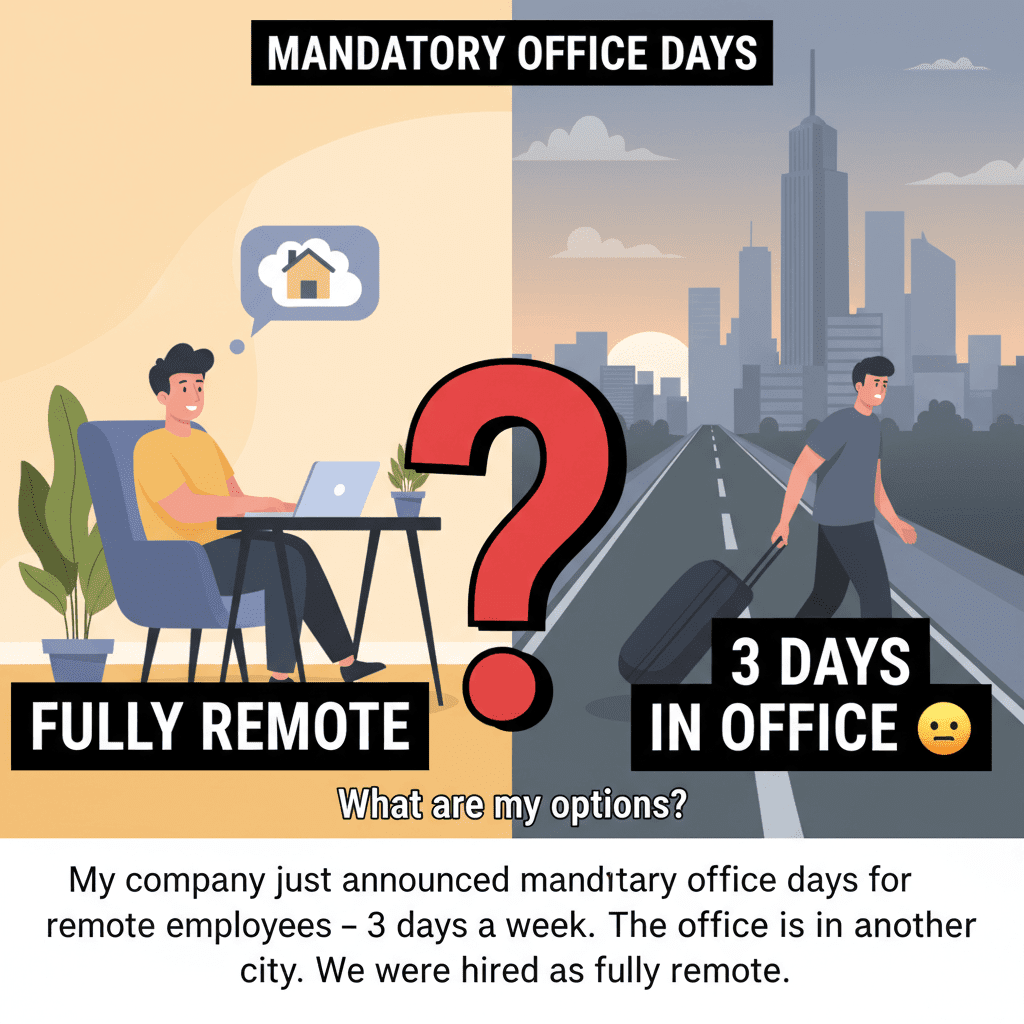
Two months after signing a lease in a different city, Alex got the calendar invite: “Return-to-office update: 3 days per week.” It felt surreal. The job that was pitched as fully remote—with messaging about “work from anywhere”—now demanded a weekly trek that would burn six hours in transit, unspool childcare routines, and bleed hundreds of dollars a month. Alex wasn’t alone. Slack channels lit up. Some coworkers vented. Others quietly asked HR for clarity. A few updated their resumes. One manager said, “Hang tight, it might change again.” But waiting without a plan can be costly.
If you were hired as fully remote and your employer now requires three in-office days in another city, you’re facing a complex matrix of legal nuance, practical logistics, and career strategy. This guide distills what thousands of employees have debated across forums and team chats into structured, concrete actions you can take right now. It’s not legal advice—but it will help you ask the right questions, evaluate real options, and build a 30-day plan that protects your time, money, and momentum.
1) First, diagnose what actually changed—and how it affects you
Before you react, get specific. Many employees discover that once the policy is written down, there’s more flexibility than the headline suggests—or less. Your first job is to understand the policy and your constraints with precision.
Clarify the policy terms
- Get the policy in writing. Ask HR or your manager for the official document. Avoid relying on verbal updates or team rumors.
- Note the exact requirement. Is it “3 days per week,” “Tues–Thurs,” or “12 days per month”? Are there grace periods or ramp-up timelines?
- Look for exceptions and criteria. Many RTO memos mention exemptions for far-distance employees, client travel, caregiving, disability, or critical roles.
- Confirm enforcement. How is attendance tracked? What constitutes non-compliance? Is performance impacted? Are there progressive steps (warning, PIP, termination)?
- Ask about expense policy changes. Are commuting, lodging, parking, or meals reimbursed? If not, who approves exceptions? What about equipment in both locations?
Calculate your real costs and constraints
- Money: Add up transit fares, fuel, tolls, parking, lodging (if needed), meals, pet care, childcare, and incidental costs. Multiply by 12 for your annual expense delta.
- Time: Commute time impacts rest, family, and productivity. Tally weekly hours spent and determine your true workday length.
- Health and logistics: Consider fatigue, disability, or medical accommodations that commuting could exacerbate. Save documentation.
- Tax and payroll: Working in another state or city part of the week can trigger tax withholding and registration issues—for you and the company. Ask payroll if your situation changes.
- Lease and housing: Note constraints: lease length, mortgage, roommate agreements, or school calendars that limit relocation options.
Decide your objective range
- Green zone (ideal): A negotiated hybrid tailored to your distance (e.g., monthly presence or quarterly onsites) with travel covered.
- Yellow zone (acceptable): Short-term compliance while exploring transfers, accommodations, or market options.
- Red zone (deal-breaker): Unreimbursed 3-day commute that is financially or medically unsustainable.
Write down your lines. Clarity here will anchor every conversation that follows.
2) Know your rights and risks: contracts, jurisdictions, and compliance
RTO policy changes sit at the crossroads of employment contracts, local labor law, and company policy. Your leverage depends on what you signed and where you work. While this isn’t legal advice, here are patterns to guide your fact-finding.
What to check in your offer and contract
- Work location clause: Does it specify “fully remote,” name your state as the place of work, or leave location at company discretion?
- Onsite requirements: Any language about periodic travel, onsites, or “business needs” that may require presence?
- Modification clause: Can the company unilaterally change terms like location or schedule? Is there notice required?
- Relocation language: If relocation is mandated, does the company provide assistance or buyout options?
- Expense and travel policy: Does it address commuting vs. business travel? Is overnight lodging considered?
Jurisdiction matters
- United States (at-will): Employers often have broad discretion to change policies, but contracts and documented promises can influence outcomes. Some states require reimbursement for necessary business expenses (e.g., California). Local ordinances may protect caregiving or predictability in scheduling.
- Canada: Significant changes to a fundamental term (e.g., location) could be “constructive dismissal” in some provinces, potentially entitling you to notice or severance. Document reliance on remote terms.
- United Kingdom: Changing location can trigger consultation duties and, in some cases, redundancy or constructive dismissal claims if change is unreasonable. Flexible working requests have statutory frameworks.
- European Union: Works councils, collective agreements, and local laws may limit unilateral changes and require consultation. Remote status may be codified in addenda.
- Australia/NZ: “Genuine operational reasons” are often required for significant changes. Flexible work request processes and protections can apply.
Key principle: If you were explicitly promised “fully remote” and relied on it (moved, caregiving plans), that promise may carry weight, especially outside at-will contexts. Preserve documentation (offer letters, hiring emails, job postings, and internal messages).
Immigration, tax, and compliance ripple effects
- State/city tax nexus: Working in a different jurisdiction can create withholding obligations. Get HR/payroll answers in writing.
- Visa/immigration: If you’re on a work visa, location changes could have compliance implications. Ask your legal/immigration contact before commuting across borders or relocating.
- Health and safety: Fatigue and long commutes can raise risk. If you need accommodations, engage your employer’s interactive process with supporting documentation.
Bottom line: Don’t assume you must accept the change as-is. Equally, don’t assume you can refuse without consequences. Ground your next moves in what your contract and local laws allow—and leverage that to propose alternatives.
3) Your actual options on the table—how to choose and execute
Below are the real pathways employees have used. Not all fit every situation; pick your shortlist and move fast with a calm, documented approach.
Option A: Negotiate a distance-based hybrid or cadence that works
If your biggest obstacle is frequency, propose a cadence that balances visibility with feasibility.
- Anchor days vs. anchor weeks: Suggest one “anchor week” per month/quarter instead of three weekly days. Pair with high-visibility meetings, trainings, and cross-team sessions.
- Goal-based presence: Tie in-office time to project phases, sprints, releases, or client milestones—where face time adds value.
- Seasonality: Offer heavier onsite presence during critical quarters and lighter the rest of the year.
- Trial period: Propose a 60–90 day pilot with clear KPIs to evaluate outcomes.
Script to start the conversation:
“I was hired as fully remote and relocated based on that. With the new policy, a 3-day weekly commute from [City] is financially and logistically unsustainable. I want to align with team goals. Could we pilot one onsite week per month aligned to [projects/sprint reviews], with travel covered per policy? I’ll provide weekly metrics to confirm performance and engagement.”
Option B: Secure reimbursement or a travel budget
Even if frequency stays the same, many companies will cover some or all costs for far-distance employees—especially during transition periods.
- Ask for policy exceptions: If you’re outside a reasonable commuting radius, request travel classification (rather than “commute”) so lodging and transport are reimbursable.
- Bundle a cost analysis: Present a clear monthly/annual cost estimate. Offer cost-saving alternatives (e.g., one overnight instead of two round trips).
- Escalate thoughtfully: If your manager is supportive but blocked, ask them to sponsor an exception request to HR/finance with your proposal attached.
Pro tip: Some companies will not change the policy but will quietly approve manager-funded travel. Get approvals in writing and save receipts.
Option C: Request a medical or caregiving accommodation
If you have a disability, medical condition, or caregiving duty that commuting would significantly impact, you may qualify for accommodations.
- Initiate the interactive process: Contact HR to start an accommodations request. Provide documentation from a healthcare provider about limitations related to commuting.
- Propose effective alternatives: Remote-first with defined onsite windows, or fewer but longer onsite visits.
- Maintain privacy: Share functional limitations, not diagnoses, unless required by process.
Note: Caregiver protections vary. Some jurisdictions prohibit discrimination based on family status; others provide flexible work request mechanisms.
Option D: Transfer internally to a team aligned with your location
If your company has hubs or fully remote teams, a lateral move can solve the policy issue without starting over elsewhere.
- Map internal roles: Identify teams explicitly labeled “remote” or based in your city/state.
- Confidential inquiry: Ask HR or a trusted leader about internal mobility windows and how RTO applies across orgs.
- Highlight continuity: Pitch your domain knowledge as a retention win: “By transferring, I remain productive without commute constraints.”
Option E: Seek a relocation package—or compensation offset
If relocation is realistic for you, turn it into a negotiation for support that offsets disruption.
- Relocation assistance: Moving stipend, temporary housing, lease break coverage, partner support, and move logistics.
- Compensation adjustments: If moving to a higher-cost city, ask for cost-of-living review or a market adjustment.
- Timing flexibility: Request a long runway (e.g., 6–12 months) to align with leases, school years, or housing market cycles.
Option F: Design a sustainable commute strategy (if you try compliance)
Sometimes a short-term compliance period stabilizes your position while you negotiate or job-search. Make it survivable.
- Batch days with an overnight: Travel once, stay two nights, compress your in-office days to minimize fatigue and cost.
- Transit optimization: Compare rail vs. driving vs. bus for cost, time, and reliability. Factor parking and last-mile time.
- Work while traveling: Use transit time for deep work, async updates, and 1:1s. Pack a mobile setup to protect ergonomics.
- Set boundaries: If you’re giving up personal time to commute, protect off-days for recovery to prevent burnout.
Option G: Prepare an exit—deliberately
When the policy is a non-starter and negotiations stall, pivot to a structured exit that preserves income and bridges to your next role.
- Quiet job search: Update your resume and portfolio, activate your network, and target companies with clearly documented remote policies.
- Severance scenarios: In some jurisdictions or companies, if the role’s fundamental terms are changed, you may negotiate an exit package. Ask neutrally: “If I’m unable to comply due to location, what separation options are available?”
- Mind your timing: Secure an offer before resigning if possible. Avoid emotional emails; keep records factual and professional.
Option H: Refuse—and accept the risk
Some employees take a principled stand and refuse. Understand the consequences.
- In at-will contexts: Refusal can lead to discipline or termination without severance, unless protected by contract or law.
- Where constructive dismissal applies: Refusing may be part of establishing that the change is unreasonable. Seek local legal advice before acting.
- Documentation is everything: Save the job post, offer letter, policy emails, your proposals, and any statements showing reliance on remote terms.
4) Key takeaways from real discussions: what employees learned the hard way
Across countless team chats, community forums, and professional groups, certain patterns stand out. Here are distilled lessons from those real-world conversations.
- Silence signals consent. Employees who waited for clarity often found that leaders assumed compliance. Early, respectful pushback opens doors to exceptions.
- Distance matters. Those living beyond a “reasonable commute” radius were often granted different rules—if they asked and documented their address change aligned to hiring promises.
- Manager advocacy is the swing factor. Policies are corporate; exceptions are managerial. Invest in getting your manager onside with a data-backed plan tied to outcomes.
- Frame it as business, not preference. “I prefer remote” gets less traction than “Here’s how my plan preserves team coverage, customer outcomes, and budget.”
- Expense policy is negotiable—even when policy says it isn’t. Employees reported success getting travel classified as “business” rather than “commute” when living in another city pre-policy change.
- Pilots beat debates. Short trial periods with KPIs convert skeptics. Leaders are more comfortable granting exceptions after a 60–90 day proof-of-concept.
- Accommodations protect you. Employees who engaged the formal accommodations process (with documentation) often secured sustainable arrangements and legal safeguards.
- Internal transfers are underrated. Staying in the company but switching to a remote-friendly org satisfied both policy and personal needs.
- Documentation wins disputes. Screenshots of job posts stating “fully remote,” offer letters, and onboarding emails were pivotal in negotiations and, where applicable, legal claims.
- Market reality cuts through noise. Teams that lost key talent due to rigid RTO often reversed or relaxed policies. If you are high-scarcity talent, your leverage is higher—use it respectfully.
- Don’t burn bridges. Even those who left on short notice benefited from staying factual, helpful, and open to contracting. Refs matter.
- Cost-sharing is common sense. Several employees secured partial subsidies (e.g., transit passes, lodging caps) that made short-term compliance viable while they planned the next step.
- Ask about retroactive support. Some companies quietly reimburse lease-break fees or relocation if you moved based on written hiring representations.
Pitfalls to avoid
- Venting in public channels. It can backfire. Keep negotiation details to private, professional threads.
- Assuming your manager knows the policy. Many don’t—HR may be the source of truth. Politely push for written answers.
- Accepting verbal assurances. Get every exception, accommodation, and reimbursement in writing.
- Over-explaining personal life. Keep it focused on work impact and documented constraints. Use formal processes when personal details are relevant (e.g., accommodations).
- Rushing a resignation. Secure the next role first, or negotiate terms, to avoid gaps and preserve leverage.
5) Build your 30-day action plan (templates, scripts, and checklists)
You don’t need to solve everything today. You do need momentum and documentation. Use this timeline to move from uncertainty to a firm plan.
Days 1–3: Gather facts and quantify impact
- Request the written policy from HR/your manager. Ask specifically about exemptions, expense coverage, and enforcement.
- Pull your documents: Offer letter, job post, onboarding emails, any messages stating “fully remote” or location terms.
- Cost/time calculator: Estimate weekly and annual commute cost and time. Include hidden fees (parking, pet care, meals).
- Tax/payroll check: Ask payroll: “If I work 3 days/week in [City/State], how do taxes and registration apply to me and the company?”
Days 4–7: Shape your proposal and secure manager sponsorship
- Choose your ask: Frequency change (anchor days/weeks), expense coverage, accommodation, internal transfer, or runway to relocate.
- Draft a one-page proposal: Business rationale, your plan, KPIs, timeline, and cost comparison (e.g., you in-office monthly with covered travel vs. weekly unreimbursed commutes).
- Meet your manager: Share your proposal and ask for their support in escalating to HR/leadership.
Email template to your manager:
Subject: Proposal to align RTO with role outcomes
Hi [Manager],
When I joined, my offer and role were defined as fully remote. I’ve since established my home base in [City], which makes a 3-day weekly commute to [Office City] unsustainable.
I want to maintain strong team outcomes. Attached is a concise proposal: [one anchor week/month tied to X deliverables], with travel classified as business (or subsidized), and clear KPIs. I’d like your support to review this with HR and leadership and, if possible, run a 60–90 day pilot.
Thanks for considering—happy to adjust to ensure team coverage.
[Your Name]
Days 8–14: Escalate professionally and explore parallel paths
- HR meeting: Ask how exceptions are granted and what documentation is needed. If relevant, initiate the accommodations process.
- Internal mobility: Quietly map teams that remain remote-first. Reach out to leaders or HR about transfer feasibility.
- Market scan: Refresh your resume and start applying to roles with clear remote policies. Early interviews build leverage and options.
Days 15–21: Pilot, negotiate, or lock in a transition
- If a pilot is approved: Execute immaculately. Share weekly metrics: deliverables, response times, stakeholder feedback.
- If reimbursement is on the table: Clarify caps, booking rules, and approval flows. Get it in writing.
- If a transfer is possible: Align timelines and document how knowledge will transition smoothly.
- If doors close: Step up your external search and quietly ask HR about separation options if compliance is impossible.
Days 22–30: Decide and confirm in writing
- Confirm the agreement: Email HR/your manager to summarize the approved cadence, expenses, and review date. Ask for a policy addendum if possible.
- If exiting: Secure your new offer first. Then give notice professionally, ask about garden leave or accrued PTO payout, and document final terms.
- Protect your future: Keep references strong, hand off work cleanly, and maintain relationships.
Negotiation phrases that work
- “I’m proposing a solution that preserves availability, customer response times, and team rituals while addressing the financial impact of a multi-city commute.”
- “Given I was hired as fully remote and relocated accordingly, could we classify required in-office days as business travel to align incentives?”
- “Let’s run a 90-day pilot with clear KPIs and review. If outcomes slip, we can adjust.”
- “If compliance isn’t feasible due to distance and cost, what internal transfer or separation options are available that minimize disruption for the team?”
Checklists you can copy
Policy and documentation checklist:
- Official RTO policy (PDF or email)
- Offer letter and any remote-designation addenda
- Original job posting or internal position description
- Onboarding communications about remote work
- Expense and travel policies; approvals in writing
- Proof of residence/location and lease if relevant
- Medical documentation if requesting accommodations
Cost/benefit analysis checklist:
- Weekly commute cost (transport, parking, meals)
- Lodging costs (if batching days)
- Childcare/pet care adjustments
- Time cost (hours/week in transit)
- Productivity impact estimate (what moves slower/faster?)
- Opportunity cost (career, network, quiet time trade-offs)
Risk management checklist:
- Clarify enforcement and consequences for non-compliance
- Understand local employment protections
- Consult a local employment attorney if stakes are high
- Keep communications professional and documented
- Line up external options before making ultimatums
If you need legal clarity
When the difference between “inconvenient” and “career-altering” is a few words in your contract, talk to a local employment lawyer. Bring your documents and a short timeline of events. Ask targeted questions:
- “Does my offer letter’s ‘fully remote’ language limit unilateral policy changes?”
- “What remedies exist if this is a fundamental change to my role?”
- “Should I request written confirmation that my in-office days are business travel for reimbursement?”
- “What’s the best way to protect my position while I propose alternatives?”
Realistic outcomes to expect
- Partial win: You secure a reduced onsite cadence plus expense coverage. This is common and often enough to make the role sustainable.
- Process win: You obtain a medical/caregiver accommodation or internal transfer. Expect to show documentation and tie to business continuity.
- Transition win: You negotiate a graceful exit with a short runway or limited support, while moving to a genuinely remote role elsewhere.
- Policy hold: The company enforces weekly days. You either comply short-term while plotting your move or refuse knowing the risks.
Your move: take control of your work life
The return-to-office wave can feel like it’s happening to you. It doesn’t have to. Your leverage is highest when you act early, present business-grounded alternatives, document everything, and run multiple paths in parallel—negotiate, protect, and prepare.
Start today: quantify your costs, draft a one-page proposal, and book a conversation with your manager. If the answer is yes, you’ve built a sustainable path. If the answer is no, you’ve already launched Plan B and reduced the time you’ll spend in limbo.
Call to action: Choose one action you can complete in the next 24 hours—request the policy in writing, finish your cost calculator, or send the proposal email. Then set a 30-day calendar reminder to evaluate your progress. Your career, finances, and well-being are worth that level of agency.
Where This Insight Came From
This analysis was inspired by real discussions from working professionals who shared their experiences and strategies.
- Source Discussion: Join the original conversation on Reddit
- Share Your Experience: Have similar insights? Tell us your story
At ModernWorkHacks, we turn real conversations into actionable insights.




0 Comments