Discover actionable insights. The sudden rise of distributed work has given teams global reach—and new ways to feel distance, ambiguity, and pressure. In that spread, many professionals report a troubling pattern: colleagues deflecting blame, escalating without context, and undermining each other in channels where visibility equals safety. Is this just a rough edge of remote collaboration or a sign that something deeper is broken? Below, you’ll find a field-tested guide grounded in real-world patterns, with specific steps you can take today to rebuild trust and accountability.
A late-night Slack and a missed deploy: a story about trust at a distance
At 11:58 p.m., a product manager named Talia posted in #release-watch: “The deploy failed again. Engineering didn’t follow the rollout plan.” Twenty seconds later, a senior developer, Marco, replied: “We followed the ticket. Product changed specs after QA. Please review.” The thread ballooned. A director joined, then a VP. People copied screenshots, forwarded emails, and pulled snippets from Jira. Each message was a carefully curated defense—narrow, accurate, and incomplete. By midnight, nobody was fixing the deploy. Everyone was fixing their narrative.
The next morning, customers experienced degraded performance. The postmortem stretched for hours, and so did the feelings. Talia felt exposed; she thought she was protecting the roadmap. Marco felt blindsided; he believed he was safeguarding his team from being scapegoated. Their manager felt frustrated; she had asked for a blameless retrospective, but blame had already soaked into the thread.
What happened? Not a lack of skill—the team was strong. Not a lack of process—docs existed. The real gap was trust, magnified by distance. In distributed work, you can look busy while feeling alone. You can be transparent while being defensive. And you can tell the truth without telling the whole truth. Throwing someone under the bus in a remote context often sounds like “just stating facts.” What’s missing is shared context, psychological safety, and a practice of accountability over accusation.
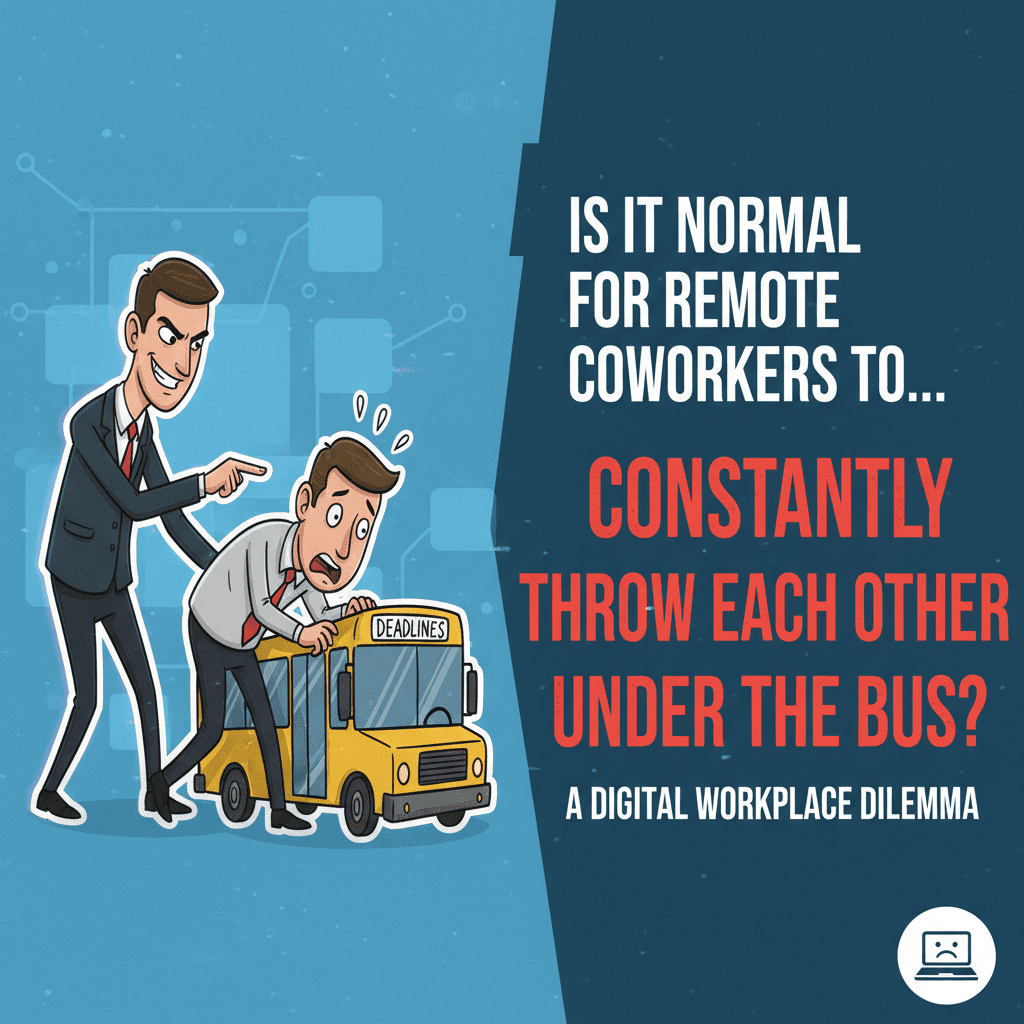
Is it normal? It’s certainly common. But common doesn’t mean healthy, and it doesn’t mean inevitable. If you’re seeing the pattern—backchannel blame, performative escalations, and carefully public “FYI”s that function like warning shots—you’re not alone. You also have leverage. The sections below compile the most consistent takeaways from real discussions across teams, managers, and communities who’ve been there and turned it around.
Is it normal? What real discussions reveal about remote “bus-throwing”
Across candid team retros, leadership roundtables, and private community threads, people describe the same core experiences. While details vary by industry, the motifs repeat so consistently that they form a map.
What professionals report most often
- Visibility anxiety drives performative defensiveness. In office environments, leaders absorb dozens of cues about who is doing what. Remotely, those cues are compressed into tickets, tools, and carefully worded messages. People start to narrate their work publicly to prove diligence—sometimes by clarifying what isn’t theirs.
- Ambiguity around ownership creates fertile soil for blame. When responsibilities overlap or shift, accountability can feel like a hot potato. Rather than admit uncertainty, teammates preemptively disclaim ownership: “As noted in comment 32, this was a product decision.”
- Async channels freeze misinterpretations into evidence. A hasty message becomes a screenshot. A partial metric becomes an exhibit. Remote records amplify selective storytelling when context isn’t curated intentionally.
- Escalations become a brand strategy. Some employees learn that being the first to escalate makes them look decisive. The behavior is rewarded with attention, so it repeats.
- Well-meaning leaders unintentionally reinforce it. Leaders who ask “Who dropped the ball?” instead of “What was hard about this?” teach teams to optimize for personal safety rather than collective learning.
How common is it—really?
The modal takeaway from practitioners: it’s common enough to feel universal, especially in fast-scaling organizations and hybrid environments where norms are still in flux. But high-trust remote teams demonstrate that the pattern isn’t destiny. Where explicit norms are built and maintained, the temperature drops: escalations shrink, postmortems get faster, and people volunteer context instead of hoarding it.
Key takeaways from real discussions
- It’s not “normal,” it’s unaddressed. Leaders who name the behavior, show a different pattern, and rewire incentives see marked improvements within 1–2 quarters.
- Language is the earliest signal. Frequent “for visibility” messages that distance the sender from outcomes correlate with later conflict if left unchallenged.
- Process beats personality. Teams that rely on ad hoc heroics fuel blame. Teams that codify decision rights, handoffs, and incident etiquette reduce “bus-throwing” without needing culture sermons.
- Safety and standards can co-exist. Blameless doesn’t mean consequence-free. The combination that works: compassionate retros, precise accountability, and learning-based follow-through.
If you’re seeing bus-throwing in your remote team, assume it is a system reaction to uncertainty and incentive gaps. Fixing the system changes behavior faster than lecturing individuals.
Root causes and how to diagnose your team’s dynamics
Before you rush into solutions, identify which drivers are active on your team. The same symptom—public blame—can emerge from different roots. Diagnose first, intervene second.
Four common root causes
- Ambiguous ownership: People are unsure who decides, who executes, and who approves. Without a shared model like RACI, responsibility shifts with every crisis.
- Asymmetric visibility: Leadership sees outcomes but not constraints. Frontline contributors see constraints but not priorities. Each side misreads the other’s choices.
- Latency and tone loss: Async channels strip tone and cadence. By the time friction surfaces, people are frustrated and the easiest path is defensive clarity.
- Incentives that reward theatrics: Performance systems praise “impact” without defining how impact is created. Acting bold under pressure looks like leadership—even when it inflames the fire.
Quick diagnostic: five questions to ask this week
- Can everyone explain how decisions are made? If your team can’t say who has DRI (directly responsible individual) for each area, expect future blame gymnastics.
- Are handoffs documented or improvised? If handoffs depend on a particular person’s memory, you’ve built a system that blames people for being human.
- How does your team run postmortems? If the first 10 minutes focus on “who knew what when,” you have an accountability design problem, not a communication issue.
- What language patterns show up in public channels? Count how often messages include “for visibility” plus a disclaimer (“not my area”). That’s a warning light.
- What gets celebrated? If heroics during a crisis earn more praise than quiet prevention, you’re training bus-throwing as a survival skill.
Map the gap with a Clarity Grid
Use a simple Clarity Grid to surface friction. On one axis, list critical workflows (planning, execution, QA, incident response). On the other, list roles (IC, lead, PM, QA, SRE, legal). For each cell, define three things:
- Decision right (who decides)
- Obligation (what is expected by when)
- Evidence (how others will know it’s done)
When you do this collaboratively, you’ll notice the cells where “everyone thought someone else owned it.” Those are your bus-throwing hotspots. Fix them first.
The practical playbook: stop blame, build accountability
Here’s a structured set of actions you can pick from today. Start with the lowest friction change that addresses your biggest root cause, then layer in the others.
For individual contributors
- Shift from disclaimers to commitments. Replace “FYI, not my area” with “Here’s what I can own next.” Example: “Noted the error. I can reproduce and document steps by 2 p.m. Who can pair on the rollback?”
- Counterperformative escalation with context enrichment. Before you escalate, add the missing context someone else would need to act: current state, constraints, proposed path. You’ll look decisive and collaborative.
- Use the two-minute tone buffer. If you feel the urge to post defensively, draft, wait two minutes, and add one sentence of shared purpose: “We’re aligned on restoring service. Here’s the piece I’ll tackle.”
- Invite shared ownership explicitly. Tag roles, not just people. “Looping in QA for test coverage and SRE for rollback guardrails” avoids implying that someone dropped the ball and centers the system.
For managers and team leads
- Introduce a blameless incident code. Publish a short, memorable set of norms for incidents: no accusations, focus on facts and impacts, capture follow-ups with owners and due dates, praise learning and prevention.
- Change the first question you ask. Swap “Who owns this?” for “What is the fastest path to restore health?” Add “Which part is unclear?” to invite context rather than defense.
- Separate process accountability from personal shame. When you enforce standards, be specific about the process. “We missed the handoff checklist” is actionable; “You were careless” is harmful.
- Close the loop publicly with gratitude, not grandstanding. After issues resolve, thank people for constructive behaviors (sharing context, pairing) more than for heroics.
- Maintain a weekly accountability review. Ten minutes to scan action items from retros and status on prevention work. Without this drumbeat, “lessons learned” evaporate.
For executives and culture carriers
- Align incentives with learning and prevention. Include preventative wins and collaborative behaviors in performance criteria. If compensation only reflects top-line outputs, you will get more showmanship under pressure.
- Codify decision rights. Publish a simple decision-rights doc for major categories (product roadmap, incident response, compliance). Ambiguity is where blame breeds.
- Model postmortem learning. Share your own mistakes and the system fixes you’ve sponsored. People take their tone from you.
- Fund operational excellence. Invest in QA, observability, and enablement. Under-resourcing operations guarantees more crises and more incentives to deflect.
Scripts you can use in the moment
- When someone throws a teammate under the bus:
- “Thanks for surfacing the issue. Let’s focus on restoring service first. Afterward, we’ll review the handoff points together so we can prevent a repeat.”
- “I hear that ownership felt unclear. I’ll take responsibility for clarifying decision rights by Friday. For now, here’s our immediate plan.”
- When you’ve made a mistake and want to model accountability:
- “I missed the dependency check. I’m taking ownership of the rollback plan by 1 p.m. and I’ll update the checklist to include this step.”
- “I gave conflicting guidance on Tuesday. That created confusion. I’ll publish a single source of truth for this decision and align with leads.”
- When someone escalates performatively:
- “Appreciate the visibility. What decision do you need from leadership? Please summarize options, constraints, and your recommendation.”
- “Let’s move this to the incident channel with a clear owner and timeline so we can act quickly.”
- When tension spikes in a thread:
- “I’m pausing this thread for 10 minutes to align on goals. Our shared goal is X by Y time. Here is the current status. Here are the next two actions.”
Meeting and tooling tweaks that remove friction
- Adopt decision memos with clear DRIs. Every significant decision gets a lightweight memo: problem, options, decision, DRI, date. Reference memos in threads instead of relitigating.
- Introduce a handoff checklist. A 6–10 item checklist for cross-team work (owner, deadline, dependencies, rollback, comms). Keep it visible in your project tool.
- Use norms for channel choice. Sync for tension, async for information. A 10-minute call can defuse what a 40-message thread inflames.
- Template your postmortems. Start with “What went well” and “What was hard.” Include “Contributing conditions,” “Detection,” “Response,” and “Prevention commitments.” Assign owners and dates.
- Deploy a “context-first” incident bot. If possible, use an incident bot that prompts for impact, scope, owner, and next update time. Structure beats defensiveness.
Teach the behaviors with micro-habits
- Commitment sandwich. Lead with what you will do, add the constraint, close with the invitation. “I’ll draft the plan by 3 p.m.; I’m missing the latest usage data; @Ops, can you confirm by noon?”
- One-level-up framing. Before pressing send, ask: “If my VP read this, would it show shared purpose or self-protection?” Tune accordingly.
- Context RSVP. When tagged, respond with your best next helpful action, not your best defense. “I can’t own X, but I can do Y and Z today.”
Actionable takeaways you can implement this week
- Publish a two-paragraph incident etiquette. Share norms, pin it to your incident channel, and reference it during live issues.
- Create a shared DRI map for core areas. One page, updated monthly. If two names appear beside a decision, you don’t have a DRI.
- Convert “for visibility” posts into “for action” posts. Add a template: context, current state, requested decision, options, recommendation, owner.
- Run a 30-minute role-clarity session. Use the Clarity Grid for the top three workflows that cause conflict. Capture the final decisions.
- Celebrate prevention out loud. In your next all-hands, spotlight a quiet, boring fix that averted a big problem. Name the behavior: early risk surfacing, pairing, checklist use.
Build a culture that makes “bus-throwing” unnecessary
Stopping performative blame in the moment is essential. But sustained change comes from structural choices that make cooperation rational and rewarding. When systems are clear and incentives aligned, the impulse to deflect fades because it stops working.
Design principles to bake into your operating system
- Clarity by default. If a project lacks a DRI, a single doc, and a two-sentence problem statement, it hasn’t started. This reduces the ambiguity that powers later disputes.
- Learning over theatrics. Reward thoughtful pre-mortems, early risk calls, and cross-functional pairing just as much as headline outcomes.
- Public responsibility, private correction. Praise publicly when people take ownership. Deliver corrective feedback privately, with specific process improvements.
- High standards, high safety. Hold the bar on quality and timeliness. Pair it with psychological safety so people surface issues early. Both are required for performance.
- Context stewardship as a leadership competency. Expect leaders to curate context—summaries, decision logs, rationale—so contributors don’t have to protect themselves with speculation.
Metrics that matter more than volume
- Time to clarity: How long between project start and DRI definition?
- Retrospective lead time: How quickly after incidents do you run postmortems?
- Prevention ratio: How many postmortem actions address prevention vs. detection or response?
- Escalation quality: Percentage of escalations that include options and a recommendation.
- Cross-team praise signals: Track shout-outs recognizing collaboration and prevention, not just heroics.
Common pitfalls to avoid
- Policy without practice. Publishing a blameless culture doc without modeling the behaviors breeds cynicism.
- Overcorrecting into vagueness. Avoiding any mention of accountability to stay “nice” leads to repeat issues and quiet resentment.
- Process sprawl. Responding to one painful incident by adding ten checkboxes creates fatigue. Keep processes lightweight and outcome-centered.
- Ignoring power dynamics. When senior people deflect, juniors learn to protect themselves. Coach top-down, not just bottom-up.
When you inherit a team with entrenched blame
- Run a short, focused reset. Host a 60-minute session: “What behaviors help us win? What behaviors slow us down?” Co-create norms, publish them, and revisit in 30 days.
- Deliver a visible early win. Pick a chronic friction point (e.g., ambiguous QA sign-off). Solve it decisively and broadcast the before/after.
- Audit incentives. Calibrate performance rubrics to include prevention, pairing, and clarity contributions.
Conclusion: It’s not normal—it’s a solvable design problem
Remote work didn’t invent blame; it simply exposed and accelerated patterns that organizations had tolerated. When coworkers constantly throw each other under the bus, it’s rarely about bad actors. It’s about foggy ownership, mismatched incentives, and too little context at the exact moments people feel the most pressure.
What’s encouraging is how quickly teams can turn it around. Within a few sprints, you can introduce incident etiquette, clarify DRIs, and shift public language from disclaimers to commitments. Within a quarter, you can adjust incentives, refactor your decision rights, and tell a new story about what leadership looks like under pressure. And within a year, you can build a culture where trust is not a poster on the wall but an everyday practice—especially when it’s hardest.
Action now beats theory later. If this article made you recognize patterns on your team, pick one play from the list and implement it this week. Then pick another next week. Momentum compounds, and so does trust.
Call to action
- Run the Clarity Grid. Book a 45-minute session to map decision rights and handoffs for your top three workflows. Publish the results.
- Adopt incident etiquette today. Post your team’s two-paragraph norms in your incident channel and use them in the next issue.
- Refactor “for visibility” posts. Introduce the “for action” template in your main project channel and model it yourself.
- Share and discuss. Send this with your team, pick two scripts you’ll use, and agree on one metric to track for the next month.
Your team doesn’t need to accept bus-throwing as the cost of working remotely. With clear roles, explicit norms, and incentives that reward learning and prevention, you can make trust the rational choice—and the reliable habit.
Where This Insight Came From
This analysis was inspired by real discussions from working professionals who shared their experiences and strategies.
- Source Discussion: Join the original conversation on Reddit
- Share Your Experience: Have similar insights? Tell us your story
At ModernWorkHacks, we turn real conversations into actionable insights.




0 Comments