
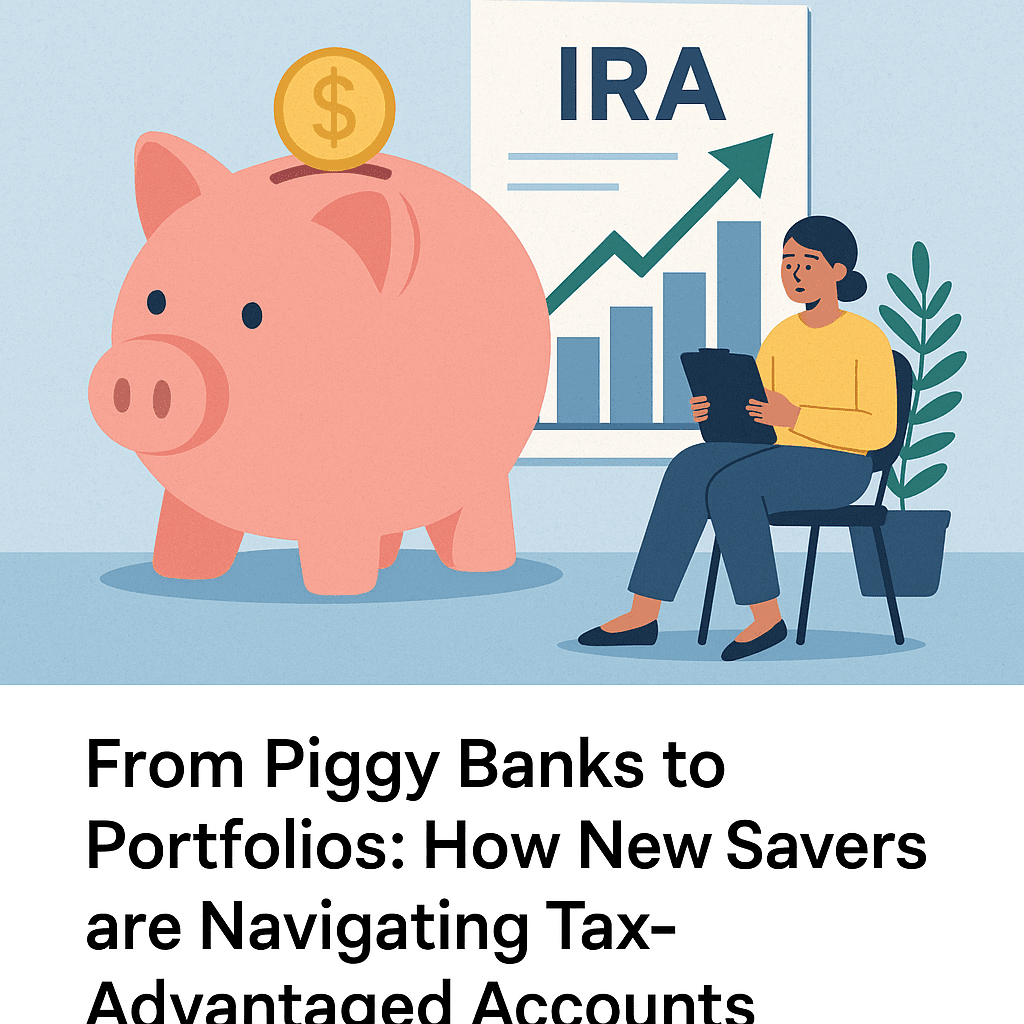
Last year, 24-year-old Torontonian Maya Singh made a decision that would fundamentally alter her financial trajectory. Instead of letting her $10,000 in savings languish in a standard savings account earning negligible interest, she opened her first Tax-Free Savings Account (TFSA). Twelve months later, her portfolio has not only weathered market volatility but grown by 7% – completely tax-free.
“I always thought investing was for people with grey hair and vacation homes,” Maya told me with a laugh. “But my TFSA has completely changed how I think about money. It’s not just sitting there anymore – it’s actually working for me.”
Maya represents a growing cohort of young Canadians who are discovering the power of tax-advantaged accounts earlier than previous generations. With traditional paths to financial security increasingly uncertain – from housing affordability challenges to questions about pension sustainability – millennials and Gen Z are taking control of their financial futures through vehicles like the TFSA.
The TFSA Revolution: Why Young Canadians Are Taking Notice
When the Tax-Free Savings Account was introduced in 2009, it wasn’t immediately embraced by younger Canadians. Fast forward to today, and the landscape has dramatically shifted. According to a 2022 Royal Bank of Canada survey, TFSA adoption among Canadians aged 18-34 has increased by 43% over the past five years.
What’s driving this surge? Three key factors stand out:
- Flexibility in uncertain times: Unlike RRSPs with their withdrawal penalties, TFSAs offer penalty-free access to funds – a crucial feature for a generation facing economic volatility.
- Digital investment platforms: The rise of user-friendly investment apps has democratized access to financial markets.
- Social media financial education: From TikTok to Reddit’s r/PersonalFinanceCanada, financial literacy content is reaching young Canadians where they spend their time.
The TFSA’s core appeal lies in its namesake benefit: tax-free growth. For young investors with decades ahead of them, this advantage compounds dramatically over time.
The Math That’s Changing Minds
Consider two 25-year-olds each investing $6,000 annually with a modest 6% return. The first uses a non-registered account, paying tax on gains each year. The second uses a TFSA. By age 65, the difference is staggering: the TFSA investor will have approximately $173,000 more, simply by sheltering those investments from taxation.
“When I show young clients this projection, it’s often the moment they truly understand the power of starting early with a TFSA,” explains Priya Mehta, a financial advisor specializing in millennial clients. “It’s not just about saving tax – it’s about how that tax savings compounds over decades.”
Beyond the Basics: How New Investors Are Using TFSAs Strategically
Young Canadians aren’t just opening TFSAs – they’re developing increasingly sophisticated strategies for maximizing their potential. Here’s how the savviest new investors are approaching these accounts:
The Hybrid Emergency Fund Approach
Traditionally, financial advisors recommended keeping emergency funds in high-interest savings accounts. Today’s TFSA users are taking a more nuanced approach.
Vancouver-based software developer Raj Patel maintains what he calls a “tiered emergency fund” within his TFSA. “I keep two months of expenses in a TFSA high-interest savings component for immediate access. Another four months’ worth sits in low-volatility ETFs within the same TFSA. This way, I’m getting better returns on most of my emergency fund while still having instant access if needed.”
This strategy reflects a growing trend: using TFSAs as multi-purpose financial tools rather than single-strategy accounts.
Strategic Asset Location
As they develop more complex portfolios, younger investors are becoming savvier about which investments belong in which accounts.
- Growth-focused investments with high appreciation potential often land in TFSAs, maximizing the tax-free growth aspect.
- Dividend-paying investments find a natural home in TFSAs, as dividends that would normally be taxable grow completely tax-free.
- Foreign investments with withholding taxes (particularly U.S. securities) are increasingly being directed to RRSPs instead, where treaties may provide better tax treatment.
“I see young investors making increasingly sophisticated decisions about asset location,” notes financial educator Alex Wong. “Five years ago, most were simply happy to be investing at all. Today, they’re optimizing which investments go into which accounts for maximum tax efficiency.”
Common Pitfalls: Where New TFSA Investors Stumble
Despite their growing financial savvy, young TFSA investors frequently encounter several pitfalls that can diminish the account’s effectiveness:
Contribution Confusion
TFSA contribution limits remain a persistent source of confusion. In 2022 alone, over 50,000 Canadians received over-contribution notices from the CRA, with penalties of 1% per month on excess amounts.
Montrealer Justine Leblanc learned this lesson the hard way: “I withdrew $15,000 from my TFSA to put a down payment on my condo in February, then recontributed that amount in November the same year. I had no idea I couldn’t recontribute until the following calendar year. That 1% monthly penalty added up quickly.”
The takeaway? Track your contribution room meticulously, and remember that withdrawals only create new contribution room in the following calendar year.
The Day-Trading Trap
Some new investors mistakenly view TFSAs as vehicles for active trading, attracted by the prospect of tax-free capital gains. This approach can backfire dramatically.
The CRA has increasingly scrutinized TFSA accounts showing patterns of frequent trading, in some cases reassessing them as business income (which is taxable, even within a TFSA). Additionally, trading losses in a TFSA cannot be claimed as capital losses, creating an asymmetrical risk profile.
“I advise young clients to think of their TFSA as a long-term wealth-building tool, not a tax-free trading account,” emphasizes financial planner Samantha Chen. “The real magic happens through long-term compounding, not frequent buying and selling.”
TFSA vs. RRSP: How Young Canadians Are Deciding
Perhaps no financial decision creates more debate among young Canadian investors than the TFSA versus RRSP question. While previous generations often defaulted to RRSPs, today’s investors are taking a more nuanced approach.
The Income Threshold Approach
Many financial advisors suggest prioritizing TFSAs until reaching higher income brackets, then shifting focus to RRSPs. This conventional wisdom is evolving as young investors develop more personalized strategies.
Ottawa-based engineer Amir Hassan takes a percentage-based approach: “I’m allocating 70% of my investment contributions to my TFSA and 30% to my RRSP, even though I’m not in a high tax bracket yet. This gives me both the flexibility of the TFSA and starts building my RRSP contribution room history, which I’ll need later.”
Other young investors are making decisions based on specific life goals:
- Home purchase planning: Those eyeing homeownership often leverage the RRSP Home Buyers’ Plan, which allows withdrawals of up to $35,000 for a first home.
- Entrepreneurial aspirations: Young Canadians planning potential business ventures typically favor TFSAs for their flexibility during variable income years.
- Early retirement goals: The FIRE (Financial Independence, Retire Early) movement has many adherents using TFSAs to build tax-free income streams accessible before traditional retirement age.
The Future of Tax-Advantaged Saving for Young Canadians
As young Canadians continue embracing TFSAs and other tax-advantaged accounts, several trends are emerging that will shape the future landscape:
The Integration of Digital Tools
New apps and platforms are making TFSA optimization increasingly accessible. Tools that automatically track contribution room, suggest optimal asset location, and project long-term tax savings are becoming standard features of financial apps popular with younger users.
Wealthsimple, Questrade, and other platforms now offer automated contribution scheduling and portfolio rebalancing within TFSAs, removing friction points that previously deterred new investors.
The Rise of Sustainable Investing Within TFSAs
Young Canadians are increasingly aligning their TFSA investments with their values. A 2022 Responsible Investment Association survey found that 72% of investors under 35 were interested in ESG (Environmental, Social, and Governance) investments.
This trend is reflected in TFSA holdings, with younger investors more likely to select sustainable ETFs and funds for their tax-advantaged accounts.
Starting Your TFSA Journey: Practical Next Steps
For Canadians still on the sidelines of the TFSA revolution, taking the first step can seem daunting. Here’s a straightforward approach to getting started:
- Calculate your contribution room: Check your CRA My Account to determine your available TFSA contribution room, which accumulates from age 18 (from 2009 onward).
- Choose the right platform: Compare fees and features of different financial institutions offering TFSAs. Online brokerages typically offer more investment options, while banks may provide simpler but more limited choices.
- Start simple: Consider beginning with a balanced ETF that provides instant diversification across stocks and bonds in a single investment.
“The most important step is simply starting,” emphasizes financial educator Wong. “Even if you begin with just a high-interest TFSA savings account, you’re building the habit of prioritizing your financial future. You can always evolve your strategy as your knowledge grows.”
Conclusion: The TFSA as a Financial Game-Changer
For Maya Singh, that first TFSA opened doors to financial possibilities she hadn’t previously considered. “It wasn’t just about the money growing tax-free, though that’s obviously great,” she reflects. “It was about shifting how I think about my financial future. I went from seeing saving as something boring my parents did to viewing investing as a form of self-care and independence.”
This perspective transformation represents the true power of tax-advantaged accounts for young Canadians. Beyond the mathematical advantages – which are substantial – vehicles like the TFSA are creating a generation of investors who are engaged with their financial futures earlier and more strategically than their predecessors.
As economic uncertainty persists and traditional financial milestones like homeownership become more challenging, the TFSA offers something valuable: a financial tool that rewards long-term thinking while maintaining flexibility for life’s inevitable curveballs.
The journey from piggy banks to portfolios has never been more accessible – or more necessary – for young Canadians. And for many, the TFSA is indeed proving to be the game-changer that transforms saving from a chore into a pathway to financial empowerment.
Where This Insight Came From
This analysis was inspired by real discussions from working professionals who shared their experiences and strategies.
- Share Your Experience: Have similar insights? Tell us your story
At ModernWorkHacks, we turn real conversations into actionable insights.

![[Workflow Included] A simple 5-node Instagram posting workflow for beginners](https://modernworkhacks.com/wp-content/uploads/2026/04/workflow-included-a-simple-5-node-instagram-posting-workflow-for-beginners-1024x675.png)





0 Comments