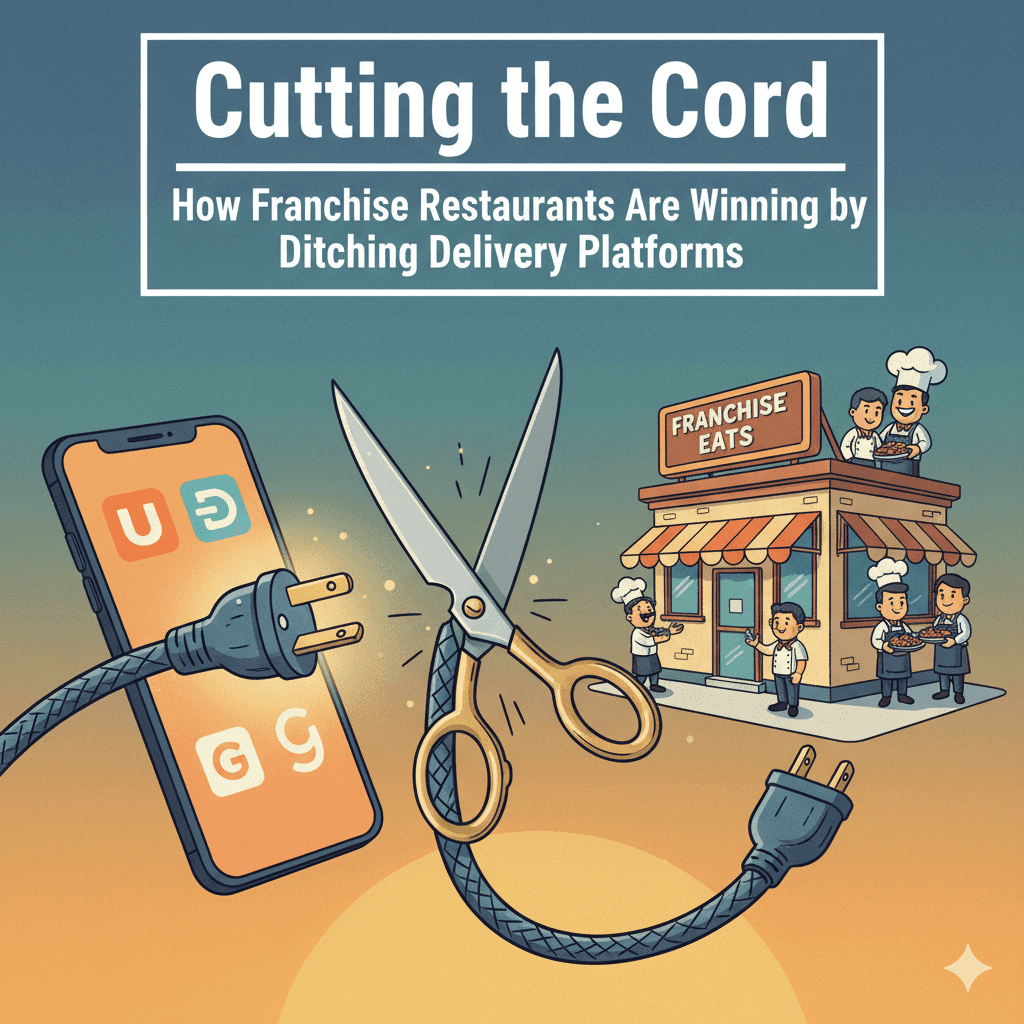
The notification pings on Marcus Hernandez’s phone. Another order from UberEats—his third of the hour at his franchise Mexican restaurant in Phoenix. He should be excited, but instead, he sighs. After the 30% commission fee, food costs, and packaging, he’ll make less than $2 profit on a $22 order. Meanwhile, his kitchen is overwhelmed balancing delivery orders with in-house diners, and a negative review looms if the delivery driver is late—something entirely out of his control.
This scenario plays out thousands of times daily across America’s 200,000+ franchise restaurants. What began as an innovative lifeline during the pandemic has evolved into what many restaurant owners now describe as a “necessary evil” that’s eating away at their already thin profit margins.
But a rebellion is brewing. Franchise restaurants are increasingly cutting the cord with third-party delivery platforms—and discovering they’re not just surviving, but thriving. This isn’t just about pennies and percentages—it’s about restaurants reclaiming their customer relationships, brand experience, and financial independence.
The Real Cost of Convenience: Beyond the Commission Fees
When DoorDash, UberEats, and Grubhub first emerged, they seemed like a win-win: restaurants could reach new customers without hiring delivery staff, while platforms handled the logistics. Fast forward to today, and the picture is more complicated.
The Financial Drain
Commission fees ranging from 15-35% are just the beginning. According to a 2022 study by the National Restaurant Association, restaurants using third-party delivery platforms report:
- Reduced profit margins of 5-15% on delivery orders compared to direct orders
- Increased packaging costs averaging $0.90-$2.50 per order specifically for delivery durability
- Menu price inflation of 20% on average to offset platform fees, potentially alienating customers
James Woo, owner of three Teriyaki Madness franchises in Seattle, calculated that his restaurants were losing approximately $42,000 annually to delivery platforms. “We were essentially paying these companies to access our own customers,” he explains. “Once I saw the numbers laid out, cutting back was a no-brainer.”
The Operational Challenges
Beyond the financial impact, delivery platforms create significant operational headaches:
- Kitchen staff must juggle multiple tablet systems with different interfaces
- Delivery timing issues lead to food quality concerns and negative reviews
- Restaurants have limited recourse when platforms make errors affecting their reputation
Sarah Kellerman, who operates four Smoothie King locations in Dallas, notes: “We’d have perfect in-store experiences, then get one-star reviews because a driver took too long or delivered to the wrong address. These platforms inserted themselves between us and our customers, but we were the ones taking the reputation hit.”
The Independence Movement: Strategies That Work
The good news? Franchisees are discovering they have more leverage than they thought. Here’s how they’re breaking free:
The Hybrid Approach
Rather than cutting ties completely, many franchisees are strategically limiting their platform engagement:
- Limited availability windows – offering delivery only during non-peak hours when in-house capacity exists
- Platform-specific menus – creating simplified, higher-margin items specifically for delivery platforms
- Promotional funneling – using platforms for customer acquisition, then incentivizing direct ordering
Chicken Salad Chick franchisee Robert Patterson implemented this approach across his five Tennessee locations. “We limited DoorDash availability to weekdays between 1:30-4:30 PM when our dining room was slowest. Then we included cards with every delivery order offering 15% off their next direct order. Within three months, our direct orders increased 47%, and our overall profit margin improved by 9%.”
Building Direct Ordering Infrastructure
The most successful franchisees are investing in their own digital ordering capabilities:
- Custom-branded mobile apps with loyalty integration
- Streamlined website ordering systems
- SMS ordering capabilities for regular customers
Jersey Mike’s has become an industry leader in this approach. The sandwich chain invested heavily in its mobile app and rewards program, allowing franchisees to process digital orders without third-party commissions. The result? Digital sales now account for over 40% of their business, with 90% coming through their proprietary channels rather than third-party platforms.
The Data Advantage: Reclaiming Customer Relationships
Perhaps the most underappreciated aspect of delivery independence is the valuable customer data that restaurants reclaim.
The Knowledge Gap
When customers order through third-party platforms, restaurants receive minimal information about their customers. They can’t:
- Track individual ordering patterns and preferences
- Implement targeted marketing campaigns
- Build direct relationships through personalized communication
As Firehouse Subs franchisee Meg Reddy puts it: “With DoorDash, I was essentially renting my customers. I had no idea who was ordering what, how often, or why. Once we built our own system, we discovered we had regulars we’d never even known about—people ordering weekly who’d never set foot in our restaurant.”
Turning Data Into Dollars
Franchisees who’ve reclaimed their customer data report dramatic improvements in marketing effectiveness:
- Personalized promotions based on ordering history increase repeat purchases by 22-38%
- Targeted upselling through direct channels yields 15-25% higher average order values
- Abandoned cart recovery through email/SMS recaptures 8-12% of potential lost sales
Tropical Smoothie Cafe franchisee Michael Johnson implemented a text-based ordering system that captured customer phone numbers and order preferences. “We started sending personalized offers—like ‘$1 off your usual Dragon Fruit Smoothie this Tuesday.’ Our redemption rates are triple what we saw with generic promotions, and our customer database has become our most valuable asset.”
The Delivery Dilemma: Solving the Last Mile
Of course, the biggest challenge in cutting ties with delivery platforms is the actual delivery. Franchisees are finding creative solutions:
In-House Delivery Teams
Some franchisees have calculated that hiring dedicated delivery staff is actually more economical than paying platform commissions:
- Part-time drivers during peak periods only
- Cross-trained staff who can switch between in-store and delivery roles as needed
- Delivery radius limitations to ensure quality and efficiency
Domino’s has long maintained this model, giving its franchisees a significant advantage. While competitors pay 25-30% to third parties, Domino’s franchisees typically spend just 8-12% on delivery costs through their in-house system.
Strategic Partnerships
Other franchisees are forming direct partnerships with delivery providers:
- Local courier services with negotiated flat rates
- White-label delivery services like DoorDash Drive that charge per delivery rather than percentage-based commissions
- Multi-restaurant delivery cooperatives in dense markets
Five franchised Panera Bread locations in Chicago partnered with three other nearby restaurant franchisees to create a shared delivery pool. Manager Alexis Torres reports: “We each contribute to the driver costs based on our delivery volume. Our average delivery cost dropped from 28% with UberEats to just 11% with our cooperative model.”
Making the Transition: A Practical Roadmap
For franchisees considering reducing their platform dependence, a phased approach has proven most successful:
Phase 1: Analysis and Infrastructure
- Conduct a thorough cost analysis of platform orders vs. direct orders
- Invest in user-friendly direct ordering technology
- Train staff on new systems and customer transition strategies
Phase 2: Customer Migration
- Include inserts with all platform deliveries promoting direct ordering benefits
- Implement loyalty incentives that only apply to direct orders
- Consider platform-exclusive surcharges or limited menus
Phase 3: Optimization and Scaling
- Use recaptured data to improve marketing effectiveness
- Refine delivery logistics based on actual order patterns
- Gradually reduce platform dependency as direct ordering increases
McAlister’s Deli franchisee Trevor Collins followed this exact playbook across his seven locations. “We didn’t cut the cord overnight. We spent six months building our infrastructure and migrating customers. By the time we reduced our platform availability to just 10 hours weekly, 85% of our delivery customers had already switched to ordering direct.”
The Future of Franchise Food Delivery
As more franchisees assert their independence, the delivery landscape is evolving rapidly. Industry analysts predict several emerging trends:
- Delivery platforms will likely reduce commission rates to retain restaurant partnerships
- Franchise systems will increasingly build proprietary delivery solutions for their franchisees
- Hybrid models with negotiated rates will become more common than all-or-nothing approaches
The most forward-thinking franchisees aren’t just reacting to current conditions—they’re preparing for future shifts. Wendy’s franchisee group WenPartners has begun testing autonomous delivery robots in partnership with Serve Robotics in select markets, anticipating a future where delivery technology becomes more accessible to restaurant operators.
“The delivery platforms didn’t create consumer demand for convenience—they just capitalized on it,” notes restaurant industry consultant Melissa Warren. “Smart franchisees recognize that the desire for convenient food delivery isn’t going away, but the middlemen might.”
Conclusion: Reclaiming Control in the Digital Age
The pandemic accelerated consumers’ shift toward delivery, but it also forced franchisees to accept unfavorable terms out of necessity. Now, with more options and leverage, restaurant owners are reassessing these relationships and finding that independence is not just possible—it’s profitable.
For franchisees considering similar moves, the message from those who’ve already made the transition is clear: start small, invest in your direct relationship with customers, and recognize that convenience doesn’t have to come at the cost of control.
As Marcus Hernandez, the Phoenix restaurant owner we met at the beginning of this article, puts it: “Six months after reducing our platform presence, our overall sales are up 12%, but more importantly, our profits are up 23%. The platforms didn’t bring us customers we couldn’t reach ourselves—they just charged us for the privilege of serving our own community.”
In an industry where profit margins have historically been thin, this reclamation of the customer relationship isn’t just about financial survival—it’s about restaurants rediscovering their independence in the digital age.
Where This Insight Came From
This analysis was inspired by real discussions from working professionals who shared their experiences and strategies.
- Share Your Experience: Have similar insights? Tell us your story
At ModernWorkHacks, we turn real conversations into actionable insights.
![[Workflow Included] A simple 5-node Instagram posting workflow for beginners](https://modernworkhacks.com/wp-content/uploads/2026/04/workflow-included-a-simple-5-node-instagram-posting-workflow-for-beginners-1024x675.png)


0 Comments