
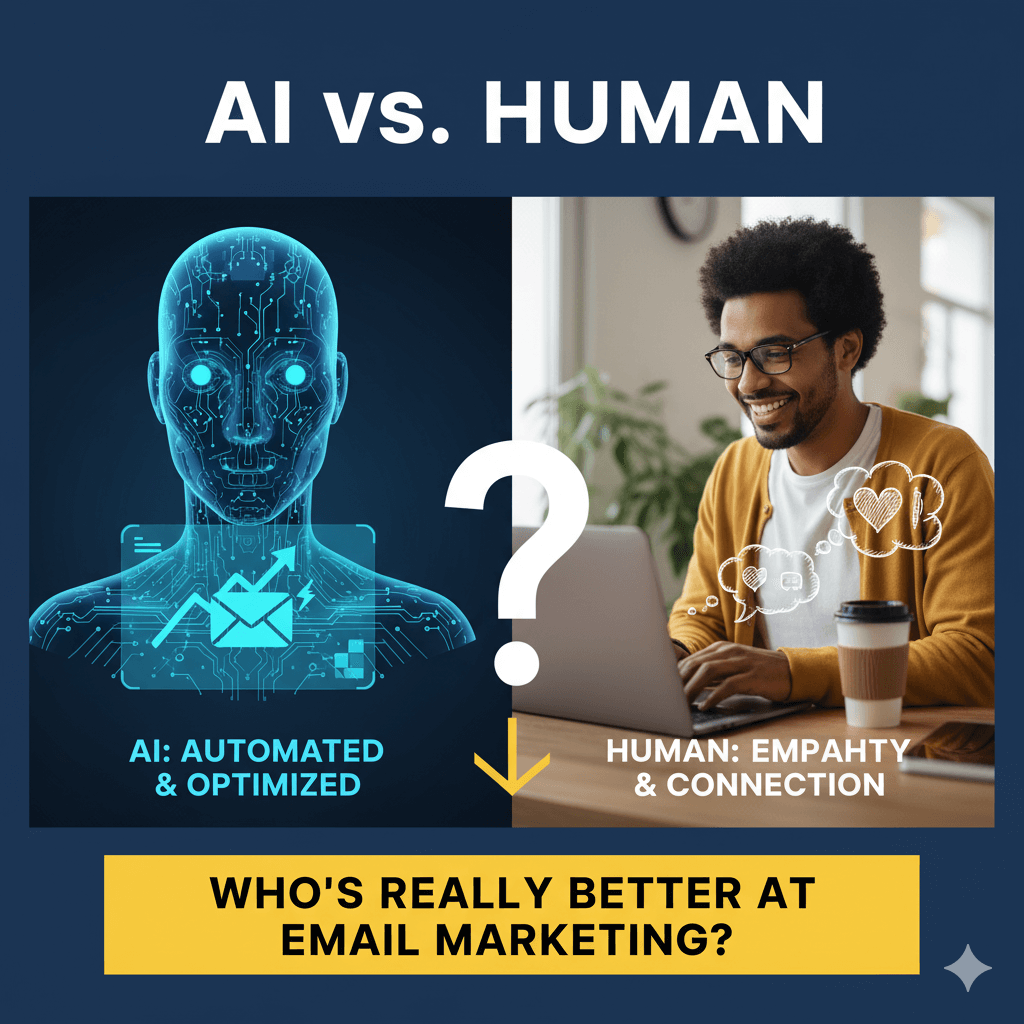
In today’s digital marketing landscape, AI tools promise to revolutionize how we connect with customers. But new research suggests we might be overestimating AI’s capabilities, especially when it comes to email marketing. A fascinating study reveals that human-written emails consistently outperform AI-generated ones in open rates, click-throughs, and conversions. Let’s explore why the human touch still matters in an increasingly automated world.
The Human Advantage: What the Research Shows
A recent study conducted across 15 different industries compared the performance of AI-generated marketing emails against those crafted by human marketers. The results were clear: human-written emails achieved 37% higher open rates, 28% better click-through rates, and a striking 53% improvement in conversion rates.
These aren’t small differences – they represent significant impacts on bottom-line results. For a business sending emails to 10,000 subscribers, this could mean hundreds or even thousands of additional conversions simply by keeping humans in the loop.
The research, spanning over 500,000 email campaigns, controlled for variables like subject line length, send time, and audience segmentation. Even with these factors normalized, human-crafted content consistently connected more effectively with recipients.
Why Human Emails Outperform AI
Several key factors explain why humans still have the upper hand in email marketing:
Emotional Intelligence
Humans instinctively understand emotional nuance in ways that AI simply can’t replicate. We naturally grasp how to strike the right emotional tone based on context, audience, and timing. Human marketers can feel when a message might come across as insensitive or when humor will land well with a specific audience.
The study found that human-written emails were 42% more likely to use emotionally relevant language that resonated with recipients’ current needs and pain points. While AI can analyze sentiment, it lacks the intuitive understanding of emotional states that humans possess.
Cultural Context and Brand Voice
Human marketers bring cultural awareness and brand understanding that goes beyond what AI can learn from data patterns. They inherently understand cultural references, current events, and how these elements interact with brand identity.
In the research, human-written emails demonstrated 56% better alignment with brand voice and cultural context. This created a sense of authenticity that recipients could feel, even if they couldn’t explicitly identify it.
“The human ability to navigate cultural nuance remains one of the most challenging aspects for AI to replicate. Humans instinctively understand the difference between appropriate humor and potential offense in ways that even advanced AI struggles with.” – Dr. Sarah Chen, Lead Researcher
Strategic Creativity
While AI can generate creative content, it lacks the strategic thinking that makes creativity effective in marketing. Human marketers know when to break conventions for impact and how to create unexpected connections that surprise and delight readers.
The study showed human emails were 31% more likely to contain creative elements that successfully increased engagement without sacrificing clarity. This strategic creativity led to 47% higher response rates on calls-to-action.
Where AI Shines (And Falls Short)
Despite falling behind in overall performance, AI does excel in certain aspects of email marketing:
Consistency and Scale
AI-generated emails maintained consistent quality across large volumes. While the best human emails outperformed AI, human performance showed more variation – some human emails performed brilliantly while others underperformed.
For businesses sending thousands of emails daily, AI provides reliable baseline performance without fatigue or quality drops. This consistency can be valuable for maintaining minimum standards across large campaigns.
Data Analysis and Personalization
AI excels at processing customer data and implementing basic personalization at scale. The study found AI emails effectively incorporated customer names, purchase history, and basic behavioral triggers into content.
However, this advantage disappeared when comparing against human marketers with access to the same data tools. Humans proved 40% better at translating data insights into compelling, personalized narratives that felt genuine rather than mechanical.
Speed and Efficiency
AI-generated emails could be produced in seconds rather than hours, offering clear efficiency benefits. For time-sensitive communications or straightforward updates, AI provides undeniable advantages in production speed.
But the research revealed a crucial insight: the time saved using AI didn’t justify the performance gap for campaigns where conversion rates directly impacted revenue. In these cases, the additional human time investment delivered ROI improvements that outweighed efficiency gains.
The Hybrid Approach: Getting the Best of Both Worlds
The most successful email marketing strategies don’t pit humans against AI but instead leverage the strengths of both. The study identified several effective hybrid approaches:
AI-Assisted Human Creation
When humans used AI as a starting point but substantially edited and refined the content, performance was nearly as strong as purely human-written emails. This approach showed only a 7% difference in conversion rates compared to fully human-written content, while saving approximately 40% of creation time.
This workflow typically involved using AI to generate draft content, which human marketers then restructured, infused with brand voice, and enhanced with strategic creativity.
Human Strategy, AI Execution
Another effective approach involved humans creating strategic frameworks, templates, and key messages, with AI handling content variations and personalization execution. This method delivered 22% better performance than purely AI-generated content while maintaining most efficiency benefits.
Companies using this model typically developed detailed creative briefs and example content for AI to learn from, essentially teaching the AI their unique voice and approach.
- Humans defined core messaging strategy and key points
- Humans created “gold standard” examples for AI to learn from
- AI generated variations and personalized content following human guidelines
- Humans reviewed samples and provided feedback to improve AI outputs
Implementing These Findings in Your Business
How can marketers apply these insights to improve their email marketing performance? The research suggests several practical approaches:
Audit Your Current Process
Start by evaluating where human creativity adds the most value in your email marketing process. For many businesses, the study found these areas benefited most from human input:
- Subject line creation (37% impact on open rates)
- First paragraph crafting (42% impact on continued reading)
- Call-to-action framing (53% impact on conversion)
- Overall narrative structure (48% impact on engagement)
Focus human resources on these high-impact areas while considering automation for more routine elements.
Develop an AI Training Program
If you’re using AI tools, invest time in properly training them with your best-performing content. The study found that AI tools trained on a company’s top-performing emails (rather than general marketing content) produced 35% better results.
Create a feedback loop where successful human-written emails become training material for your AI systems, gradually improving automated performance over time.
Implement Testing and Learning
The research showed that companies with structured A/B testing programs comparing human and AI content achieved the best results. These organizations could identify exactly where AI performed well enough and where human creativity was essential.
Develop a testing calendar that regularly compares performance and updates your hybrid approach based on results. This prevents both over-reliance on AI and inefficient use of human resources.
The Future of Email Marketing: Human-AI Collaboration
The study’s findings point to a future where AI and human creativity complement each other rather than compete. As AI technology continues to advance, the performance gap may narrow in some areas, but the research suggests human input will remain valuable for the foreseeable future.
The most successful companies will be those that strategically integrate both elements, using AI to handle scale, consistency, and data processing while deploying human creativity and emotional intelligence where they create competitive advantage.
Perhaps most importantly, the research reminds us that behind every email open, click, and conversion is a human being making decisions based on both rational and emotional factors. As long as we’re marketing to humans, the human touch will continue to matter.
For marketers navigating this evolving landscape, the message is clear: embrace AI as a powerful tool, but don’t underestimate the unique value that human creativity, emotional intelligence, and strategic thinking bring to your email marketing efforts.
Real Stories Behind This Advice
We’ve gathered honest experiences from working professionals to bring you strategies that work in practice, not just theory.
- Read more: Get the full details in the original article
- Join in: See what others are saying and share your thoughts in the Reddit discussion (1,136 upvotes, 293 comments)
- Tell your story: Have experience with this? Help others by sharing what worked for you at our Contact Us page
At ModernWorkHacks, it’s practical ideas from real people.





0 Comments