Hook: Discover actionable insights grounded in real conversations and lived experiences across teams, industries, and roles.
The day overtime became a silent requirement: a story
Maya joined a well-known company with a crisp mission statement, a generous benefits package, and glowing online reviews. During her first week as a product manager, she was told, “We value balance here.” Her team reiterated it: “No heroics, just good process.” That Friday, she closed her laptop at 5:45 p.m., sent a courteous end-of-week update, and went to cook dinner.
Two hours later, Slack notifications lit up her phone. A senior engineer was pushing a feature, a designer was updating specs, and her manager dropped in: “Anyone around? Might need quick approvals.” Maya paused. Should she jump back in? She remembered the onboarding message about balance. She decided not to reply.
Monday’s one-on-one felt normal until the end: “Just a note,” her manager said, “we really appreciate responsiveness, especially when launches are close. Not saying you did anything wrong—just something to keep in mind.”
In the next sprint, Maya replied after-hours. She joined late-night calls. She never said she was available; she simply learned the silent rules. And over time, she watched them spread. New hires moved from cautious optimism to quiet compliance. Overtime wasn’t a policy. It was a culture, enforced not by mandates but by winks, timestamps, and praise for whoever “went above and beyond.”
Months later, turnover spiked. The team was exhausted. Quality dipped. Someone finally asked, “When did things get like this?” The hard answer: they didn’t get like this. They were always like this—just normalized so thoroughly that people stopped calling it toxic.
Why normalization hides toxic work culture
Not all toxic work culture is dramatic. Often, it hides behind politeness, performance, and shared myths about what it takes to succeed. You don’t need an aggressive boss to have an unhealthy organization. You just need a system of quiet expectations and habits that slowly shift what’s considered “professional.”
How toxic behavior gets normalized
- Silent compacts: Nobody writes it down, but everyone knows the real standards—reply fast, look busy, accept shifting priorities.
- Hero worship: Stories of “saviors” who fixed things overnight overshadow investments in sustainable systems.
- Social proof: When peers accept something, dissent feels risky or petty. People copy what’s rewarded.
- Ambiguity: Vague goals and undefined roles make fear a rational strategy. Uncertainty breeds self-protection.
- Survival logic: Individuals do what they need to get by, even if it hurts the group. Over time, survival becomes the culture.
The real costs of normalized toxicity
- Burnout: Over time, silence and overwork degrade energy, creativity, and health.
- Attrition: High performers leave quietly. Replacements cost more and take months to be productive.
- Quality debt: Work done in panic mode creates rework. Firefighting replaces focus.
- Trust erosion: People expect promises to shift and commitments to wobble. Accountability dies.
- Diversity setbacks: Cultures that celebrate constant availability and political games disadvantage caregivers and underrepresented groups.
Early warning signs
- Meeting calendars that consume whole weeks, with no time to think or build.
- Slack or email activity becoming a proxy for actual impact.
- Praise tied to responsiveness, not outcomes or rigor.
- People hedging questions, avoiding direct feedback, or triangulating through trusted allies.
- “We’ll fix it next quarter” becoming a mantra for permanent pain points.
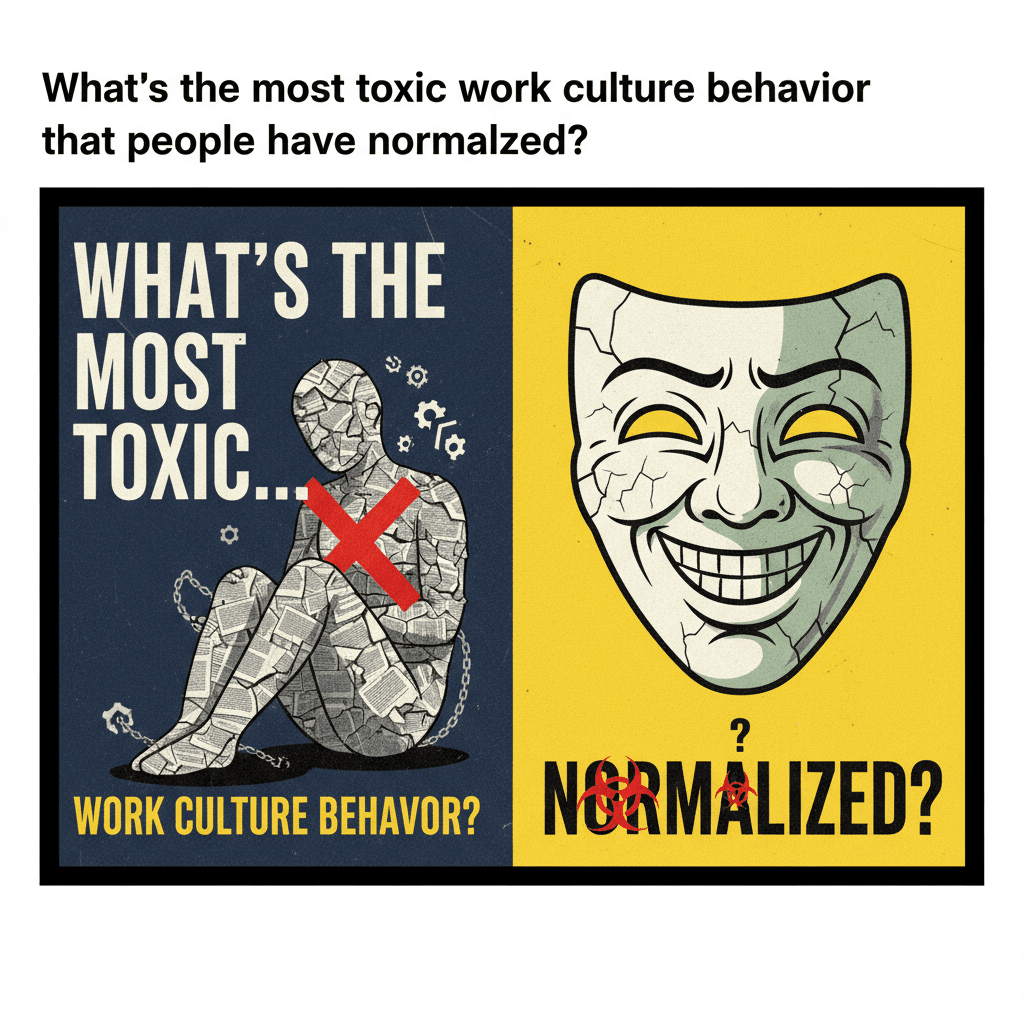
The five most normalized toxic behaviors
From hundreds of conversations in teams and communities, five patterns come up again and again. Each looks reasonable at first glance. Each corrodes culture from within.
1) Overwork as loyalty
The belief that real commitment means answering late-night pings, staying online “just in case,” and treating time off as negotiable. This shows up as weekend “quick checks,” last-minute requests framed as emergencies, and polite praise for people who keep saying yes. No policy demands it; it’s enforced through social pressure and performance signals.
Why it’s toxic: It confuses effort with effectiveness. It punishes boundaries and rewards unhealthy habits. Over time, it trains people to optimize for visibility rather than value.
Spot the pattern: Promotions justified with phrases like “always there when needed.” Leaders publicly thanking night owls more than consistent problem-solvers.
2) Busyness theater and meeting sprawl
Calendars stuffed with recurring meetings, status rituals, and alignment calls that leave little space for deep work. The more full your calendar, the safer you feel—because busyness reads as importance.
Why it’s toxic: It creates the illusion of progress while stealing the conditions required for real progress. Decision latency rises as bodies multiply in rooms. Focus becomes a luxury.
Spot the pattern: Meetings without clear owners, decisions, or pre-reads. Decisions “tabled” repeatedly. People asking, “When can I actually do my job?”
3) Blame-first reflex and fear of owning mistakes
When something breaks, the first move is to find the person, not the failure mode. Emotion spikes, people go defensive, and learning dies. Even without shouting, a subtle chill forms: don’t be the one who admits the issue.
Why it’s toxic: It keeps systems fragile. People hide risks rather than raise them early. You lose the compounding benefits of candid retros.
Spot the pattern: Postmortems that read like courtroom transcripts. “We’ll be more careful” as the fix. The same incidents repeating with new names.
4) Praise for heroics over process
Celebrating all-nighters and last-minute saves while neglecting the unglamorous work of prevention. Firefighting becomes a career path. Planners feel sidelined.
Why it’s toxic: It skews incentives away from systemic improvement. Teams become addicted to adrenaline, and the quiet architects of stability disengage.
Spot the pattern: Slack applause for hotfix marathons, silence for tech debt paydown, QA rigor, or documentation.
5) Passive-aggression and triangulation
Instead of direct conversation, people collect allies and escalate through side channels. Feedback travels in whispers. Conflict feels personal by default.
Why it’s toxic: It drains time and trust. Problems get wrapped in politics, making them harder to solve. People self-censor rather than seek clarity.
Spot the pattern: “A few folks are concerned” with no names. Pre-meetings to rehearse narratives. Decisions arrived at without the people doing the work.
What healthy looks like instead
You can’t fix normalized toxicity with slogans. You need a counter-culture—practical behaviors and measures that demonstrate what “good” actually is, day after day.
Replace overwork-as-loyalty with boundary-respecting productivity
- Set explicit hours norms: Define core hours and expected response windows. Make exceptions truly exceptional.
- Model from the top: Leaders delay-send messages and praise boundary-keeping. Reward outcomes, not presence.
- Protect rest: Normalize coverage plans, handoffs, and real vacations. Rotate on-call duties with compensation.
Replace busyness theater with focus rituals
- Meeting operating system: Every meeting needs an owner, purpose, agenda, pre-reads, and a decision type (inform, discuss, decide).
- Focus blocks: Company-wide deep work windows—no meetings, no pings. Treat them as sacred.
- Decision logs: Write decisions once, share widely. Reduce meetings by codifying how decisions persist.
Replace blame-first reflex with learning loops
- Blameless postmortems: Focus on what and why, not who. Capture contributing factors and fix mechanisms.
- Psych safety audits: Quarterly pulse checks on comfort raising risks. Address hotspots with facilitation, not memos.
- Pre-mortems: Before major initiatives, imagine failure and list risks. Turn fear into foresight.
Replace hero worship with systems thinking
- Reward prevention: Celebrate defect reduction, cycle time improvements, and reduced toil in all-hands.
- Make invisible work visible: Track and elevate documentation, testing, mentoring, and infra upgrades.
- Limit work-in-progress: Flow beats frenzy. Smaller batch sizes reduce emergencies.
Replace passive-aggression with direct, skilled candor
- Feedback contracts: Team norms around how to ask, give, and receive feedback. Practice with role play.
- One-room rules: Decisions happen with the people who will execute. Side-channel lobbying is discouraged.
- Conflict tooling: Use facilitation frameworks (e.g., issue framing, interest mapping) to depersonalize friction.
Key takeaways from real discussions
- Toxicity doesn’t need a villain. It only needs unchallenged norms that quietly punish boundaries and reward theater.
- Overwork, busyness, blame, heroics, and triangulation feel normal because they offer short-term relief—but they compound long-term harm.
- Healthy cultures are built with explicit agreements, visible systems, and leaders who model what they expect.
- Action beats aspiration. Replace vague values with operating practices you can observe, measure, and improve.
- Psychological safety isn’t softness. It’s a performance strategy: faster learning, better quality, stronger retention.
Practical playbooks you can use this week
Here are quick-start actions organized by role. Pick two to three and ship them within seven days.
If you’re an individual contributor
- Set a boundary statement: Add your working hours and response norms to your status or email signature. Example: “Core hours 9–5; async by default; urgent = call.”
- Timebox deep work: Block two 90-minute focus sessions per day. Decline or propose async for meetings that conflict.
- Use the “clarity trio” in requests: When you’re asked to do something, confirm purpose, priority, and “done” criteria.
- Move feedback to the room: If someone triangulates, gently redirect: “Let’s include Alex so we can solve this directly.”
- Run a micro retro: After a sprint or project milestone, share three bullets: what helped, what hurt, what I’ll try next.
If you’re a manager
- Write the after-hours policy: Define when it’s okay to ping, what’s urgent, and the default expectation to delay-send. Review in team meeting.
- Meeting audit: Cancel or convert 30 percent of recurring meetings. Require agendas and owners for the rest. Introduce monthly “no-meeting afternoons.”
- Outcome-based praise: In your next stand-up and one-on-ones, highlight specific outcomes, decisions, or system improvements—not hours online.
- Blameless retro template: Introduce a standard doc with sections: timeline, impact, contributing factors, detection gaps, prevention actions, owners, dates.
- Norm directness: At the start of a contentious discussion, restate the goal, invite candor, and set rules: no interruptions, use “I” statements, debate ideas, decide by X time.
If you’re an executive or HR leader
- Publicly codify cultural standards: Publish norms for availability, decision-making, and accountability. Tie them to performance reviews.
- Install metrics that reward health: Track and socialize leading indicators like cycle time, on-call load balance, PTO usage, rework rate, and employee safety scores.
- Rebalance incentives: Create recognition for prevention work. Promote people who build systems, not just those who fix fires.
- Invest in manager enablement: Train managers in facilitation, feedback, and prioritization. Make it a requirement, not a perk.
- Run listening tours: Structured small-group sessions with anonymous follow-up. Report back with actions, owners, and dates.
Rituals and cadences that reset culture
Culture change accelerates when habits are embedded in the calendar. Replace hope with rituals that reinforce the right behaviors.
Weekly rituals
- Monday focus commitments: Each person states their one or two outcomes for the week. Keep it to outcomes, not tasks.
- Decision digest: A weekly post that lists key decisions made, the context, the owner, and the next checkpoints.
- Meeting hygiene sweep: The last 10 minutes of Friday’s stand-up: remove or redesign one recurring meeting.
Monthly rituals
- Blameless learning review: Pick one project or incident. Document and share improvements. Celebrate what changed.
- Invisible work spotlight: Rotating segment in all-hands to showcase documentation, mentoring, automation, or QA wins.
- PTO champion update: A designated leader reports PTO usage trends and encourages coverage planning.
Quarterly rituals
- Psychological safety pulse: Short anonymous survey with two or three questions. Discuss results in team meetings and agree on one experiment.
- WIP reduction day: A scheduled day to close loops, reduce open threads, and pay down process debt.
- Pre-mortem summit: Before major initiatives, run a structured risk session with cross-functional stakeholders.
Making it measurable
What gets measured gets attention. Measure the things that correlate with health and performance.
Leading indicators
- Response sanity: After-hours message rate and response latency. Goal: fewer pings, longer tolerated response windows.
- Meeting load: Average meetings per person per week, and percentage with agendas and decisions logged.
- Focus time: Percentage of time in blocks over 60 minutes without meetings.
- Rework ratio: Hours spent fixing defects versus new value creation.
- Safety score: Average agreement with “I can speak up about risks” and “Mistakes are treated as learning opportunities.”
Lagging indicators
- Retention of high performers: Track regretted attrition and time-in-role for top contributors.
- Cycle time: From idea to deployment or delivery, measured consistently.
- Customer-impacting incidents: Frequency and severity, with trend lines post-interventions.
Scripts you can borrow
Language shapes norms. Here are phrases to turn intentions into action.
To set boundaries without drama
- “I’m offline after 6 p.m. If something is urgent-urgent, please call.”
- “Happy to help tomorrow during core hours. If this truly can’t wait, who can cover tonight?”
To redirect triangulation
- “I think this deserves a quick chat with all three of us. Can I loop Alex in?”
- “Let’s put this on the agenda for the next working session so we decide together.”
To run a blameless retro
- “Our goal is to understand how our system produced this outcome. What signals did we miss?”
- “What made the right thing hard, and how do we make the right thing easy next time?”
To cut meetings politely
- “Could we try this async with a decision deadline of Wednesday?”
- “What’s the decision we need here, and who owns it? If it’s a status update, I’ll send a written summary.”
30/60/90-day plan to detoxify work norms
Culture change sticks when it follows a sequence: clarify, simplify, then scale.
Days 1–30: Clarify
- Publish availability norms and meeting standards.
- Run a baseline pulse survey on safety, focus time, and burnout signals.
- Audit recurring meetings and identify candidates for cancellation or conversion to async.
- Introduce a blameless retro template and run one small retro.
Days 31–60: Simplify
- Reduce recurring meetings by at least 25 percent. Add company-wide focus blocks.
- Launch a decision log and require agendas for all meetings.
- Train managers on feedback and conflict facilitation. Pair with a short playbook.
- Introduce recognition for prevention work in all-hands.
Days 61–90: Scale
- Institutionalize rituals: weekly decision digest, monthly learning review, quarterly safety pulse.
- Wire metrics into dashboards leaders actually read. Review in operating rhythms.
- Spotlight teams that model the new norms. Share specific practices.
- Plan a second survey to show movement and recommit to next-quarter experiments.
Frequently asked pushbacks—and how to respond
Every change invites objections. Meet them with empathy and specifics.
“We’re in a high-pressure industry. This won’t work here.”
Pressure amplifies the need for good systems. Boundaries, focus, and blameless learning improve response to pressure. They don’t eliminate urgency; they eliminate chaos.
“People should know what urgent means without a policy.”
Ambiguity is where burnout thrives. Clarity lowers cognitive load and speeds decisions. A simple urgency rubric prevents over-escalation and resentment.
“If we cut meetings, we’ll lose collaboration.”
Collaboration improves when time is used purposefully. Clear agendas, pre-reads, and decision types increase participation quality. Async plus decisive sync beats endless sync.
“This feels soft.”
Healthy cultures are performance cultures. They produce better quality, faster learning, and steadier output. Respecting humans is how you get better results from humans.
Design principles for durable culture
As you tune your environment, anchor choices in principles that scale across teams and time.
Explicit over implicit
If you care about it, write it down. Move norms from folklore to artifacts. Review them quarterly.
Systems over saviors
Reward the work that prevents emergencies, shortens cycles, and shares knowledge. Make heroes out of people who remove toil.
Learning over blaming
Invest in mechanisms—postmortems, pre-mortems, pilot tests—that convert mistakes into improvements.
Focus over frenzy
Protect uninterrupted time. Limit work-in-progress. Fewer bets, finished better.
Respect over performative loyalty
Boundaries are not disloyalty. They are how people sustain great work and a good life. Treat rest as a resource.
A checklist to spot normalized toxicity in your team
- Are people praised for hours or outcomes?
- Do we have clear norms for after-hours communication?
- What percentage of meetings have agendas, owners, and decisions recorded?
- When something goes wrong, do we ask “who” or “how”?
- Is prevention work visible and rewarded?
- Do people escalate feedback through side channels rather than direct conversation?
- Do we track focus time and rework, not just velocity and output?
- Can someone take real PTO without being tethered?
Putting it all together
The most toxic work culture behavior isn’t one thing—it’s the quiet acceptance that “this is just how it is.” Overwork as loyalty, meeting sprawl, blame-first reflexes, heroics over systems, and passive-aggression masquerading as professionalism are all symptoms of the same disease: a gap between stated values and operating reality.
The antidote is not performative kindness or abstract values posters. It’s operating practices that make healthy behavior easier than unhealthy behavior, baked into how you plan, meet, decide, and learn. It’s leaders who delay-send their messages, managers who cancel their own meetings, and teams who ask better questions about how work gets done.
When you change the default settings of your culture, you change outcomes. You retain your best people. You build better products. You move faster with less drama. And most importantly, you reclaim work as a place where honesty, respect, and focus create results worth being proud of.
Call to action: run a seven-day culture experiment
Don’t wait for a reorg or a new quarter. Pick one of these experiments and ship it this week:
- After-hours clarity: Publish your team’s availability norms and turn on delay-send by default.
- Meeting reset: Cancel or convert three recurring meetings. Replace with a decision log.
- Blameless learning: Run one 45-minute retro using a template, and implement one prevention action.
- Focus protection: Block two company-wide deep work windows and enforce no-ping rules.
- Direct feedback pledge: Create a team agreement to move conversations to the room and practice it once.
At the end of seven days, ask your team three questions:
- What felt better?
- What was harder than expected?
- What will we keep for the next two weeks?
Small changes compound. Start now, measure visibly, and invite your team into the work of redesigning the defaults. Healthy cultures aren’t accidental. They’re built—one explicit agreement, one improved ritual, one honest conversation at a time.
Where This Insight Came From
This analysis was inspired by real discussions from working professionals who shared their experiences and strategies.
- Source Discussion: Join the original conversation on Reddit
- Share Your Experience: Have similar insights? Tell us your story
At ModernWorkHacks, we turn real conversations into actionable insights.
![[Workflow Included] A simple 5-node Instagram posting workflow for beginners](https://modernworkhacks.com/wp-content/uploads/2026/04/workflow-included-a-simple-5-node-instagram-posting-workflow-for-beginners-1024x675.png)



0 Comments