Hook: Discover actionable insights.
The first time I stopped relying on motivation, it wasn’t because of some productivity epiphany. It was because I had a bad week. On Monday, I waited for the “right feeling” to start a client proposal and procrastinated until 9 p.m. On Tuesday, the gym felt too far away, even though it was two blocks. On Wednesday, I spent 40 minutes picking a podcast episode to accompany a short walk, then didn’t take the walk. By Thursday, I realized something uncomfortable: I was treating every tiny step as a decision—and every decision was a speed bump.
That Friday, I tried something different. I didn’t approach my day with a massive to-do list or a heartfelt pep talk. I made a short set of default choices: what I’d wear, what I’d eat, what I’d work on first, and how I’d transition when I got stuck. No debates, no bargaining. I stopped spending attention on choices I’d already made. It felt mechanical, even boring—but the day was astonishingly productive. I sent the proposal before lunch. I took the walk without negotiating. I slept at a reasonable hour.
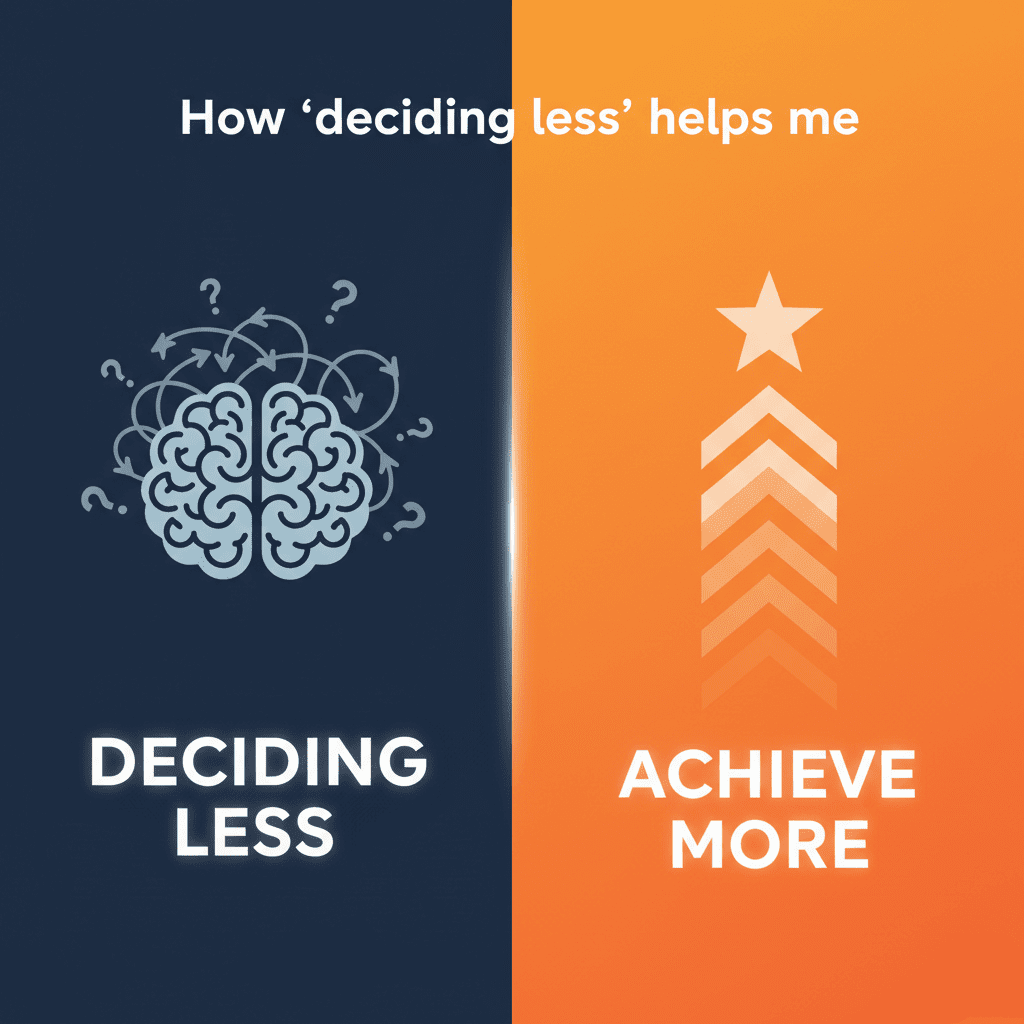
Since then, I’ve had countless conversations with founders, parents, students, and creatives about what actually moves work forward. The patterns are remarkably consistent. Motivation is a spark—it’s real, it matters—but it’s unreliable. The people who consistently produce aren’t more motivated; they just ask their brains to decide less. They don’t eliminate choice; they compress it, front-load it, and automate it. They preserve their energy for the work that truly requires it.
This article distills those patterns into practical steps so you can test them in your own life, today.
Why Motivation Isn’t Enough
We love the idea that motivation is the fuel of achievement. It’s visible, dramatic, and emotionally satisfying. But for most meaningful work—writing a book, launching a project, changing a habit—motivation behaves like weather: influential, unpredictable, and uncooperative right when you need it most.
The slow tax of deciding
Consider the decisions that creep into a single hour of focused work: Which task should I start with? Should I write or outline? Do I need coffee first? Which playlist helps me think? Should I reply to this Slack ping or keep going? None of these decisions feel heavy, but each one costs attention. Each introduces a chance to choose short-term relief over long-term progress. Over enough repetitions, that minor tax compounds until it becomes the main expense.
Decision fatigue isn’t just about feeling tired; it’s about the brain gradually preferring easy, low-friction actions as the day wears on, even when those actions work against your goals. If every move requires a micro-vote, “not now” wins a lot.
Motivation’s failure modes
- It’s volatile: It spikes after inspiration and dips when tasks get repetitive or uncomfortable.
- It’s biased toward novelty: Motivation loves beginnings and hates maintenance. Most progress requires maintenance.
- It’s dependent on context: Sleep, mood, weather, notifications, and social feedback all tug on motivation’s leash.
- It rewards narrative over action: Feeling motivated often masquerades as progress, which satisfies you enough to delay the hard part.
Systems beat surges
The people who perform reliably don’t count on feeling ready; they design their day so that readiness isn’t required. The trick isn’t discipline as a personality trait, but discipline as a design choice: commit once, then reduce the number of chances to renegotiate.
Actionable takeaways:
- Stop asking “How do I feel about doing this?” Ask “What did I already decide, and how do I make the next step frictionless?”
- Identify the first recurring decision that derails you (task order, start time, pre-work rituals) and remove that choice for one week.
- Treat motivation as a bonus, not a precondition. If it shows up, great. If not, your defaults still carry you forward.
The Decide-Less Framework
“Deciding less” does not mean surrendering autonomy or living on autopilot. It means moving the decision to a better time, encoding it clearly, and connecting it to a trigger that removes hesitation. The framework has three layers: Define, Default, and Deploy.
1) Define once
Clarity is a decision saver. When goals are mushy (“get in shape,” “grow my business”), you invite a daily referendum. Define your target compactly and measurably, then pre-select the smallest consistent action that advances it.
- Define the outcome: “Publish one 800-word article per week.”
- Define the action: “Write 200 words at 7:30 a.m., Monday to Friday.”
- Define the standard: “Accept a messy first draft. No editing until the weekend.”
Each definition prevents a different kind of micro-decision. Outcome clarifies where you’re headed. Action makes the step unambiguous. Standard eliminates internal debates about “good enough.”
2) Default the path
Defaults are pre-made choices you follow unless there’s a compelling reason not to. They conserve attention by collapsing branches of your day into one consistent path. Think of them as rails you lay in advance.
- Default schedule: A fixed start window (e.g., 7:30–8:00 a.m.) and task sequence (e.g., write → email → calls).
- Default environment: Same desk, same playlist, same app layout, same lighting. Reduces context-switching friction.
- Default triggers: “When I finish coffee, I open the doc and write 200 words.”
- Default recovery: “If distracted, stand, breathe, and restart the last sentence.”
Defaults do not eliminate freedom; they eliminate unnecessary deliberation. You can always override—but now you have to justify the exception.
3) Deploy with guardrails
Guardrails are the protective edges that keep you on track when conditions change.
- Time caps: “Work in 25-minute blocks; stop after four blocks.” Prevents burnouts that trigger later avoidance.
- Pre-commitments: Calendar invites, shared trackers, scheduled co-working sessions.
- Hard stops: No work after 6:30 p.m. Rest is a decision-recovery tool.
- Fallbacks: If you miss the morning block, the afternoon default is a single 15-minute minimum, not a full catch-up.
When combined, Define-Default-Deploy keeps your day from devolving into constant negotiation. You front-load decisions when you’re calm, then operationalize them as the unremarkable way you move through time.
Actionable takeaways:
- Write one sentence for each layer: “I will [action] at [time] in [place]. If I slip, I will [fallback].” Tape it where you work.
- Limit yourself to three active defaults per quarter: one for work, one for health, one for relationships. Too many defaults reintroduce decision fatigue.
- Review defaults monthly. Keep what’s working; revise what isn’t. You’re optimizing the system, not judging yourself.
Lessons from Real Conversations
Across dozens of candid discussions with people juggling careers, families, studies, and creative projects, the same themes kept appearing. These aren’t theories; they’re field notes from people trying to create consistently in the real world.
Key takeaways from real discussions
- Choice compression beats choice elimination: People resisted “rigid routines” but welcomed compressed choices. For example, they kept two lunch options instead of a seven-option buffet. The reduced variety sped up decisions without feeling restrictive.
- Sequences outperform priorities: Instead of re-ranking to-dos throughout the day, high performers followed a fixed morning sequence: “Deep work → Admin → Meetings.” The sequence turned priorities into a path, not a debate.
- Micro-rituals anchor momentum: A three-step start ritual—water, headphones, open doc—was enough to bypass hesitation. Rituals were simple and repeatable, not elaborate ceremonies.
- Fewer tools, fewer stalls: Tool switching created hidden decisions. The more apps, the more tiny forks in the road. Standardizing on one writing app or one task manager cut down on speed bumps.
- Energy matching mattered more than time blocking: People succeeded when they matched tasks to energy states (creative in the morning, admin mid-day), then locked those matches as defaults.
- “Done anyway” beat “do it right”: In maintenance tasks (workouts, outreach, reading), those who lowered the bar slightly but showed up daily made steady progress while perfectionists stalled.
- Recovery was part of the plan: High performers scheduled wind-downs and offline time as defaults. They decided less by deciding to stop. This protected the next day’s decisions from fatigue.
Mini case snapshots
- The founder with endless ideas: She replaced her “idea board” with a weekly idea review default every Friday at 3 p.m. During the week, new ideas went into a single inbox without evaluation. Output increased because she stopped evaluating ideas during build time.
- The parent writing a novel: He wrote 200 words every weekday at 6 a.m. before the kids woke up. The default was “open the doc at 5:58 a.m.” No plotting or editing allowed. He finished a draft in six months.
- The student drowning in readings: She pre-decided: read 20 pages after lunch in a quiet library seat. She used a timer and a single pen color for margin notes. Grades improved with less stress because the reading decision happened once, not daily.
- The designer’s health reset: He prepped two breakfast options on Sundays and put workout clothes near the door. The default was “put on shoes after shutting the laptop at 5:30 p.m.” He worked out more with less negotiation.
Actionable takeaways:
- Pick one place where you over-decide (tools, time blocks, routines). Reduce options to two for 30 days.
- Write your morning sequence on a sticky note. Follow it before checking messages.
- Install a decision “inbox”: capture ideas or requests without triaging them in the moment. Process them at a set weekly time.
Tactics You Can Apply Today
Here are concrete ways to decide less across key areas of life. Customize, test, and keep only what sticks.
Time: Sequence beats sorting
- Three-block day: Morning deep work (90–120 minutes), mid-day admin (60 minutes), afternoon collaboration (meetings, calls). Repeat daily.
- Fixed start window: Commit to a 30-minute window (e.g., 7:30–8:00 a.m.) to begin your first block, not a single brittle timestamp.
- Standards, not aspirations: Define a “minimum viable block” (25 minutes) and a “successful day” (2 blocks completed). Prevents all-or-nothing thinking.
- Transition trigger: At the end of each block, write the next action for tomorrow at the top of your doc. Tomorrow starts already decided.
Work: Reduce tool friction
- One tool per job: Choose one writing app, one task manager, one cloud drive. Hide the rest from your dock and phone home screen.
- Default templates: Save templates for emails, agendas, briefs, and updates. Start from a template every time to bypass formatting decisions.
- Daily “power hour” default: One hour of uninterrupted work on the highest leverage task, scheduled at your peak energy time. Protect it like a meeting with your future self.
- Decision log: Maintain a simple list of “decisions made” for projects (e.g., file structure, naming conventions, review cadence). Refer before re-litigating.
Health: Arrange, don’t persuade
- Environment first: Put the foam roller by the couch, the vitamins next to the coffee, the shoes by the door. Design beats willpower.
- Two-option meals: Create two default breakfasts and two lunches that meet your nutrition goals. Rotate. Decide on Sundays, not at noon.
- Movement minimum: 10-minute non-negotiable movement immediately after your workday ends. If you want more, you’re free to continue.
- Sleep guardrail: Screens off at a fixed time. Place your charger across the room to default to stopping.
Home and digital: Fewer choices by design
- Capsule wardrobe: Pre-choose a handful of mix-and-match outfits. Morning decisions vanish.
- Phone home screen: Only four apps: messaging, maps, camera, calendar. Everything else in a single folder on the second page.
- Notification norms: Decide which channels are synchronous (calls) and which are asynchronous (email). Turn off the rest.
- Family defaults: Weekly menu themes (e.g., pasta Mondays), a standard grocery list, and a default “quiet hour” where everyone reads or plays quietly.
Focus: Start and restart rituals
- Start ritual: Water, headphones, open doc, write one sentence. Keep it to three to four steps—fast and consistent.
- Restart ritual: When stuck, stand, breathe, and type “What is the next tiny step?” Then do it. Momentum is the goal, not brilliance.
- Context containment: Keep all materials for one project in one folder with a single “Start Here” document listing the next action. Fewer clicks, fewer choices.
- Shutdown script: End your day by listing tomorrow’s first task, closing all tabs, and placing any physical item you need (notebook, charger) where you’ll start. You’re deciding the start while you still have clarity.
Actionable takeaways:
- Choose one area (time, work, health, home) and implement two defaults today.
- Write your start and restart rituals on a small card and keep it in view.
- Make one decision “invisible” by changing the environment (move an app, place a tool in your path).
Your One-Week Experiment and Call to Action
Reading about deciding less won’t change anything. Testing it will. Here’s a compact, one-week experiment to prove to yourself that you can produce more with less internal debate.
The Decide-Less Sprint: 7 days
- Before you start: Pick one meaningful target (work or personal) and one supporting habit (health or focus). Example: publish a 600–800 word article by Sunday; walk for 15 minutes daily.
- Define once (Sunday night, 20 minutes):
- Outcome: “Publish 600–800 words by Sunday 6 p.m.”
- Action: “Write 150 words at 7:30 a.m., Mon–Fri.”
- Standard: “First draft only; revisions Saturday.”
- Health: “Walk 15 minutes at 5:45 p.m., daily.”
- Default the path:
- Schedule five writing blocks and seven walks on your calendar.
- Prepare a template doc titled “Draft – Week X.”
- Place shoes near the door; place headphones and water on your desk.
- Set your phone to Do Not Disturb during writing.
- Deploy guardrails:
- Time caps: 25-minute blocks, maximum of four per day.
- Fallbacks: If you miss a morning write, do 10 minutes at lunch.
- Hard stops: No work after 6:30 p.m. to protect recovery.
- Accountability: Tell one person your plan and send them a Sunday summary.
- Daily flow (Mon–Sun):
- Start ritual: water → headphones → open doc → write one sentence.
- Write until your 150 words are done; stop. Momentum matters more than heroics.
- Record completion with a simple X on a paper calendar.
- Evening walk at the default time. If missed, do a 5-minute “micro-walk” before bed.
- Shutdown script: list tomorrow’s first sentence, close tabs, place notebook on keyboard.
- Weekly review (Sunday, 15 minutes):
- Did the defaults carry you even when motivation was low?
- Where did decisions creep back in (tools, timing, standards)?
- Adjust one default—not all—and run it again next week.
What to expect
- Day 1–2: Feels easy and structured. You’ll notice fewer internal negotiations.
- Day 3–4: Friction might return. You’ll want to “improve the system.” Don’t indulge. Stability first, optimization later.
- Day 5–7: You’ll realize your output is up, and the effort felt smaller. That’s the point: you decided less, so you had more energy to execute.
Common concerns and how to respond
- “I’ll get bored.” Use “variety slots”: keep two options per category (two lunches, two routes, two playlists). Variety, but constrained.
- “What about creativity?” Defaults protect creative time by reducing overhead. Creativity thrives with constraints and protected attention.
- “Doesn’t this make me rigid?” You’re not forbid from change—you’re saving change for review time. Iterate weekly, not moment-to-moment.
- “What if emergencies happen?” That’s what fallbacks and guardrails are for. The system anticipates imperfect days.
Final actionable checklist:
- Write one sentence that defines your key outcome this month.
- Decide the smallest daily action that advances it.
- Choose where and when it happens; block it on your calendar.
- Prepare the environment tonight (place tools, open the doc, set the playlist).
- Pick one fallback for missed days.
- Tell one person what you’re doing.
- Start tomorrow, no pep talk required.
Call to action: For the next seven days, stop asking whether you’re motivated and start trusting your defaults. Choose one outcome, one action, one time, one place. Decide once. Then let the system carry you. At the end of the week, share your results with someone you respect—and decide what one adjustment you’ll keep for the next week. Less deciding, more doing. You’ll be surprised how far that takes you.
Where This Insight Came From
This analysis was inspired by real discussions from working professionals who shared their experiences and strategies.
- Source Discussion: Join the original conversation on Reddit
- Share Your Experience: Have similar insights? Tell us your story
At ModernWorkHacks, we turn real conversations into actionable insights.
![[Workflow Included] A simple 5-node Instagram posting workflow for beginners](https://modernworkhacks.com/wp-content/uploads/2026/04/workflow-included-a-simple-5-node-instagram-posting-workflow-for-beginners-1024x675.png)




0 Comments