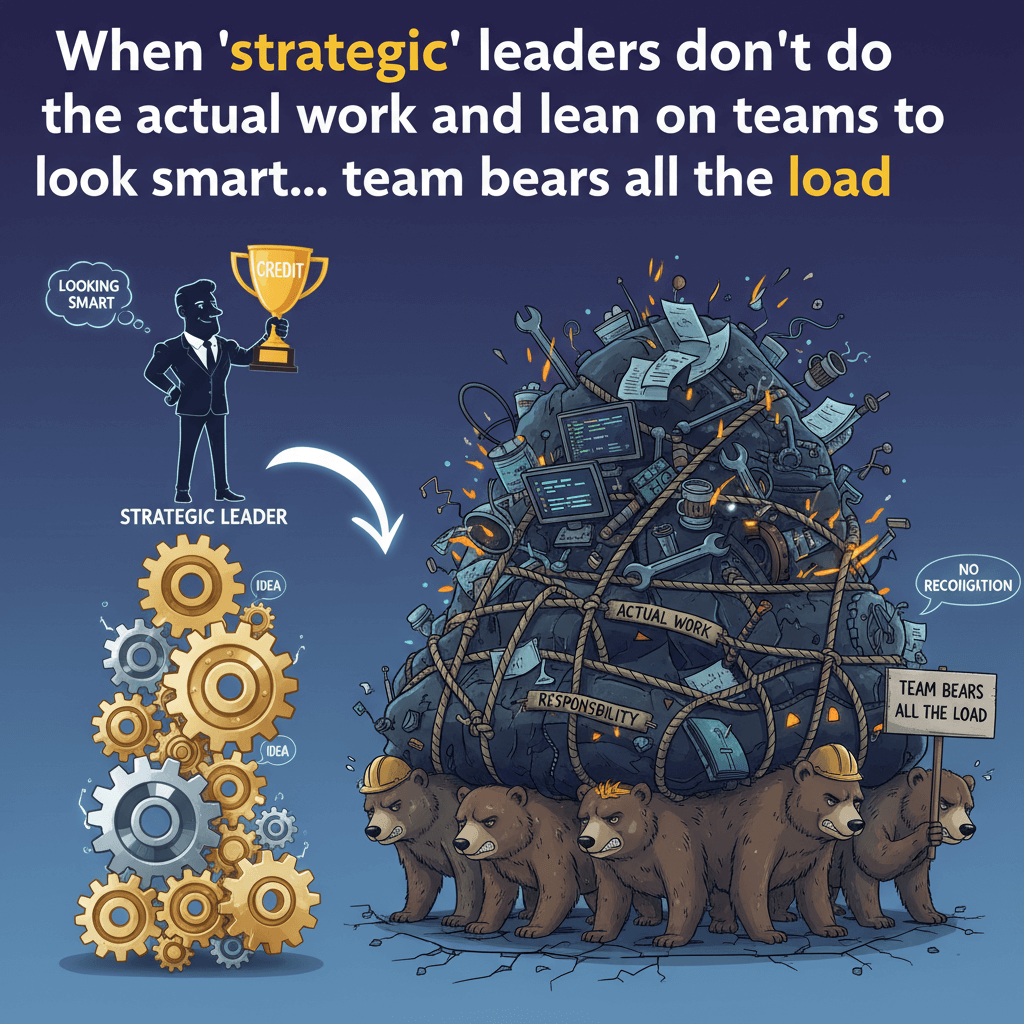
Discover actionable insights. This is not another rant about bad bosses; it’s a field guide for anyone who’s lived through “strategy” that never touches the actual work. If you’ve carried the deck, the demo, the data, and the damage control—while leadership basked in the glow of “vision”—this is for you. You’ll find practical steps to reset expectations, fix the flow of work, and build a culture where strategy and execution are partners, not rivals.
A Tuesday standup that said it all
The story starts on a Tuesday, seven minutes into what was supposed to be a fifteen-minute standup. The team was launching a cross-product experiment: two weeks of data collection, a modest success metric, and a plan everyone had finally aligned on after months of misfires.
Enter the “strategic” leader—let’s call him Adrian—who joined mid-sprint with a new directive. No one had seen him in a retro or a demo. He was known for his sharp slides, his connections with senior execs, and his penchant for “tie-ins” to large initiatives. He listened to three updates and then said, “To be truly strategic, we should expand the experiment to three customer segments and integrate with our AI pipeline. I’ll flag this in the steering meeting.”
The room went quiet. Mira, the product manager, glanced at her tech lead. Two engineers pinged each other privately, asking whether to push back. The designer stared at the Miro board, already calculating what would be tossed to accommodate the new scope. Someone asked, politely, “What gets cut to make room for that?” Adrian responded with a warm smile: “Let’s not get bogged down. Think big. We’ll figure out the details later.”
After the meeting, the fallout started. The team pulled an impromptu huddle to estimate the new work. It was easily two weeks of effort. The data scientist noted they’d need new pipelines and approvals. The tech lead said it would break the integration test suite. Mira knew that steering meetings favored slick updates, so she crafted a narrative that made the expansion sound like an “accelerator,” not a tradeoff. The team did what good teams do: they made it work. Nights got longer. The demo worked. The steering committee applauded the “bold move.”
Two weeks later, the experiment failed. Not because the idea was bad, but because execution had become a scramble. Three segments diluted the signal. The AI integration throttled performance. The retro was brutal but honest. The deck to leadership, however, framed it differently: “We learned at scale. The team moved fast. Next step: invest more.” Everyone looked smart. Everyone except the people who were tired.
In the next quarter’s engagement survey, the team scored low on “clarity of priorities” and “ability to say no.” Two engineers left within a month. Their reasons: “We were doing a lot of work; it didn’t feel like the work.”
What went wrong? It wasn’t a lack of strategy. It was the absence of a leader who would take responsibility for the consequences of strategy—time, tradeoffs, budgets, and morale. Execution had become someone else’s problem, and that someone else was the team.
Why it happens—and what it costs
Misaligned incentives reward visibility over accountability
Many organizations measure leaders by how often they present, how many projects they touch, or how closely they align with senior messaging. In that environment, it’s rational to add scope, attach to high-profile efforts, and speak in the language of “visions.” None of these are inherently bad. They become toxic when the cost of those decisions doesn’t land on the decision-maker’s desk. When leaders stay abstract, the work becomes the team’s burden—which means the organization never learns the true price of its choices.
Ambiguity masquerades as empowerment
“I don’t want to micromanage” can be a noble stance. It can also be a way to avoid committing to a tradeoff. Teams then try to guess the path that will impress leadership. Ambiguity shifts cognitive load to the people doing the work: more Slack threads, more alignment meetings, more time spent generating options for a leader who never picks one. Empowerment without clear outcomes is abdication in disguise.
Success theater and meeting inflation
When strategy lives in meetings, leaders get high-status participation. But decisions made in rooms full of presentations are optimized for persuasion, not clarity. Teams compensate with “success theater”—polished updates, incremental wins framed as momentum, risks muted until they’re undeniable. The calendar fills up. The work gets thinner. True progress hides under a layer of optics.
Distance from customers and code
Leaders who don’t spend time with users or in the systems where work happens lose the calibration that anchors strategy to reality. If your understanding of the product comes only from dashboards and decks, you’ll recommend ideas that look smart at altitude and fail on contact with the ground. That distance also makes it hard to grasp the difference between “hard” and “impossible” for a given team and timeframe.
Hidden taxes on the team
When strategy floats above execution, the team pays in ways that don’t show up on a roadmap. These are the hidden taxes that compound quietly until a project collapses or people burn out.
- Decision latency: Work stalls while teams wait for approvals that never come, or they proceed and get reversed later. The cost is rework and demoralization.
- Scope creep: “Just one more thing” multiplies complexity. Each addition isn’t simply additive; it adds interactions and risk.
- Context switching: As priorities shift with each steering meeting, the team spends more time re-orienting than creating.
- Quality debt: Shortcuts taken to hit dates accumulate. Fixing them later is harder and often deprioritized because the next big bet is already in motion.
- Glue work overload: The same few people end up coordinating across teams, writing the follow-ups, and smoothing over social friction. It’s invisible—and it’s exhausting.
- Erosion of trust: When leaders don’t own tradeoffs, teams learn that commitments are provisional and praise is performative.
How to measure the cost, not just feel it
You can’t fix what you can’t see. Before changing behaviors, quantify the tax.
- Decision cycle time: Track the average time from proposal to decision for medium-size choices. If it’s over two weeks, you have a bottleneck.
- Rework ratio: Count story points or hours spent on rework versus net-new progress. A ratio higher than 20% is a warning sign.
- Meeting-to-making ratio: For each role, compare hours in meetings to hours in focused work. Ratios greater than 1:1 for ICs indicate success theater.
- WIP (work in progress): Audit how many concurrent efforts a team carries. More than three per team is usually a drag on throughput and quality.
- Escalation frequency: Log how often conflicts or ambiguities require senior intervention. An upward trend signals unclear ownership.
- Attrition and sentiment: Pair exit reasons with pulse survey items like “clarity of priorities.” If both trend negative, strategy is out of sync with execution.
What good looks like: strategic leaders who pull their weight
Great strategic leaders don’t escape the work; they change its shape. They act as force multipliers, trading in clarity, focus, and shielded execution. They still think big, but they translate ambition into specificity the team can ship.
Define outcomes, not tasks
Set a measurable target and the constraints that matter: “Increase weekly active users by 8% in Q3 via activation improvements, without increasing support tickets by more than 5%.” That gives teams creative freedom within guardrails. Outcomes reduce second-guessing and enable tradeoff decisions without constant escalation.
Pick a lane and own tradeoffs
When stakes are material, decide. Don’t “let the team figure it out” if the real answer requires executive air cover. A good leader says, “We are not doing the third integration this quarter. I will explain why and take the hit.” That single act can save weeks of churn.
Model thinking in writing
Write short memos that show your logic, constraints considered, and why you believe this will work. Invite critique on the reasoning, not the theater of slides. Writing slows you down just enough to refine your thinking and speeds the team up because they don’t have to infer intent.
Meet where the work happens
Spend time in the artifacts: PRs, dashboards, Figma files, customer interviews. You’re not there to micromanage; you’re there to understand the texture of reality. Ten minutes with users or logs beats an hour of speculative debate.
Protect focus and reduce WIP
Fewer tracks, finished stronger. If the team has six concurrent priorities, kill three. Commit to sequencing. Close doors so the team can close loops. Focus is a leadership decision, not a team miracle.
Align ambition with capacity
Attach budget, headcount, or time to your vision. If you can’t, shrink the vision until it fits in the box you control. Strategy that ignores capacity is a wish. Here’s the sanity check: “What will we not do as a result of this new priority?” If the answer is “nothing,” that’s not strategy—that’s noise.
Close the loop and share credit
Update stakeholders on what you decided, what changed, and why. Name the people who did the work. Make the invisible visible. When results are mixed, own your part. When they’re great, point to the team first.
Actionable playbook: fix it in 30-60-90 days
Days 0-30: See the work and name reality
- Run a calendar and meeting audit: Cancel or consolidate anything that doesn’t change decisions. Cap status meetings at 15 minutes with pre-reads.
- Start a decision log: A simple document with date, decision, owner, rationale, and reversal criteria. Share it with the team and stick to it.
- Declare three priorities: Identify the top three outcomes for the next 30 days. Publish them. Tie every new ask to one of the three—or say no.
- Establish office hours: A weekly block where anyone can bring blockers. This reduces ad-hoc pings and lowers the cost of raising risks early.
- Shadow the work: Sit in on a customer call, review a PR, walk through a prototype. Not to direct—just to understand enough to make better tradeoffs.
- Write a one-page strategic intent: Problem, why now, desired outcome, constraints, and how we’ll know we’re done. Invite edits from the team.
- Instrument the hidden taxes: Baseline decision cycle time, rework ratio, and meeting-to-making ratio. You’ll use these to prove improvement.
Days 31-60: Fix the flow and clarify ownership
- Implement lightweight RACI: For each initiative, define who’s Responsible, Accountable, Consulted, and Informed. Publish it. Revisit when the cast changes.
- Reduce WIP by half: Freeze new starts. Finish. Create a visible “Parked” column to hold good ideas until capacity exists.
- Re-baseline OKRs: Translate vague objectives into outcome metrics with explicit ceilings on acceptable negative side effects.
- Move to pre-read culture: Send memos at least 24 hours before discussions. Use the meeting for decisions, not presentations.
- Create a weekly “no surprises” review: Leaders and leads review risks, decisions due, and changes in assumptions. Keep it to 30 minutes.
- Standardize experiments: Require a hypothesis, minimal viable scope, and a kill rule for every test. If it doesn’t change a decision, don’t run it.
- Fund the strategy: Attach time or headcount to the top priorities. If you can’t, cut scope until it fits. Announce what was cut and why.
Days 61-90: Institutionalize accountability
- Publish a leader’s operating system: How decisions are made, how conflicts are resolved, which metrics matter, and how to escalate. Clarity scales.
- Adopt a cadence of written updates: Weekly progress, risks, and decisions in one page. Ban slideware unless visualizing data adds meaning.
- Introduce change review: Any scope or date change above a threshold requires a short memo with tradeoffs, impact, and alternatives considered.
- Celebrate finishes, not starts: Tie recognition and reviews to finished outcomes. Show before-and-after metrics.
- Close the loop on failures: Hold blameless postmortems that produce one systemic fix per incident. Track closure.
- Audit role clarity quarterly: Check if RACI still matches reality. Adjust early before friction becomes attrition.
If you’re the IC carrying the load: protect your energy and your work
You can’t change the system overnight, but you can shift how work lands on you. These moves create clarity, surface tradeoffs, and protect your focus without burning bridges.
- Send a weekly one-pager: Three sections: What we shipped, what’s blocked and why, decisions needed (with options and your recommendation). This makes invisible work legible and forces decision-makers to act.
- Name the tradeoff: When a new ask lands, respond with “Here are the two things we can pause to make space, plus the risks.” You’re not saying no; you’re making the cost explicit.
- Use a personal RACI: Publish what you own, where you consult, and what’s outside your scope. Reference it when boundary creep appears.
- Keep a risk register: A simple list of risks, owners, and mitigation. Share it. When something blows up, you’ve already documented the early warning.
- Timebox and batch: Cluster meetings, set maker time blocks, and negotiate focus hours with your manager. Protect at least 10 hours of deep work weekly.
- Ask for decisions in writing: “Can you confirm which option we’re taking by Friday? I’ll proceed based on that.” It shortens decision latency.
- Escalate with intent: If you must escalate, frame it as a choice with consequences, not a complaint. “Option A meets the date but risks quality; Option B hits quality but misses by one sprint. Which should we choose?”
Templates you can copy-paste into your workflow
Weekly one-pager
- Shipped: [Feature/Outcome] → [Metric impacted or user story closed]
- Blockers: [Issue] → [Impact] → [Owner] → [Help needed]
- Decisions needed by [date]: [Option A/B/C] → [Recommendation] → [Risk]
Decision memo
- Context: [What changed or what we’re deciding]
- Goal: [Outcome we want, constraints we must respect]
- Options considered: [A/B/C], with pros/cons
- Recommendation: [Option] because [reasoning]
- Reversal criteria: [When we’d change course]
Change request
- Change: [Scope/date/approach]
- Reason: [Incoming dependency, new information, risk realized]
- Impact: [On users, quality, timeline, cost]
- Alternatives: [Two options we considered]
- Decision needed by: [Date]
Key takeaways from real discussions
- “Strategy without ownership is just a wish.” Teams repeatedly reported that the most stressful moments weren’t the hard problems, but the leader-free tradeoffs.
- “A two-hour deck can’t fix a two-week decision delay.” Multiple teams found that shortening decision cycle time unlocked more throughput than adding people.
- “We don’t need more vision; we need fewer priorities.” In roundtables, high-performing teams consistently tied success to ruthless WIP reduction.
- “Writing changed our culture.” Leaders who moved from slides to short memos reported clearer decisions, faster onboarding, and fewer misunderstandings.
- “Make hidden work visible.” Once teams tracked glue work and context switching, leaders could finally justify cutting meetings and adding coordination time to plans.
- “Protect the finish line.” Teams that ritualized completion—kill switches for experiments, clear definitions of done—escaped the endless spin of “almost done.”
- “Clarity scales; charisma doesn’t.” Charismatic leaders can rally people once; clear leaders help them win repeatedly.
- “If everything is a priority, nothing is.” Teams felt more energized after cutting scope than after adding headcount. Focus beats staffing when the system is overloaded.
- “Shadowing beats status.” Leaders who spent one hour a week in the work (customer calls, PRs, prototypes) made fewer disruptive asks and gave more pragmatic guidance.
- “Share the credit, absorb the blame.” The fastest trust-builder cited in dozens of conversations: leaders who publicly own missteps and privately advocate for their teams.
Your move: If you recognize your team in this story, take one concrete step in the next 48 hours.
- Leaders: Publish three crystal-clear priorities for the next 30 days and start a decision log. Cut one meeting this week and replace it with a pre-read.
- Managers: Run a WIP audit. Put half your “in flight” work into a Parked column. Challenge every new request to find what drops.
- ICs: Send a one-page weekly update and ask for a written decision on your top blocker. Use boundary language to surface tradeoffs without being adversarial.
Call to action: Schedule a 30-minute “work-to-strategy audit” with your team this week. Bring the calendar, the top three priorities, and the decision log (or start one in that meeting). Leave with one thing you will stop, one decision you will make, and one outcome you will commit to measuring. Then close the loop publicly. Strategic leaders who do the actual work of clarity, focus, and accountability don’t weigh teams down—they make teams unstoppable.
Where This Insight Came From
This analysis was inspired by real discussions from working professionals who shared their experiences and strategies.
- Source Discussion: Join the original conversation on Reddit
- Share Your Experience: Have similar insights? Tell us your story
At ModernWorkHacks, we turn real conversations into actionable insights.
![[Workflow Included] A simple 5-node Instagram posting workflow for beginners](https://modernworkhacks.com/wp-content/uploads/2026/04/workflow-included-a-simple-5-node-instagram-posting-workflow-for-beginners-1024x675.png)




0 Comments