
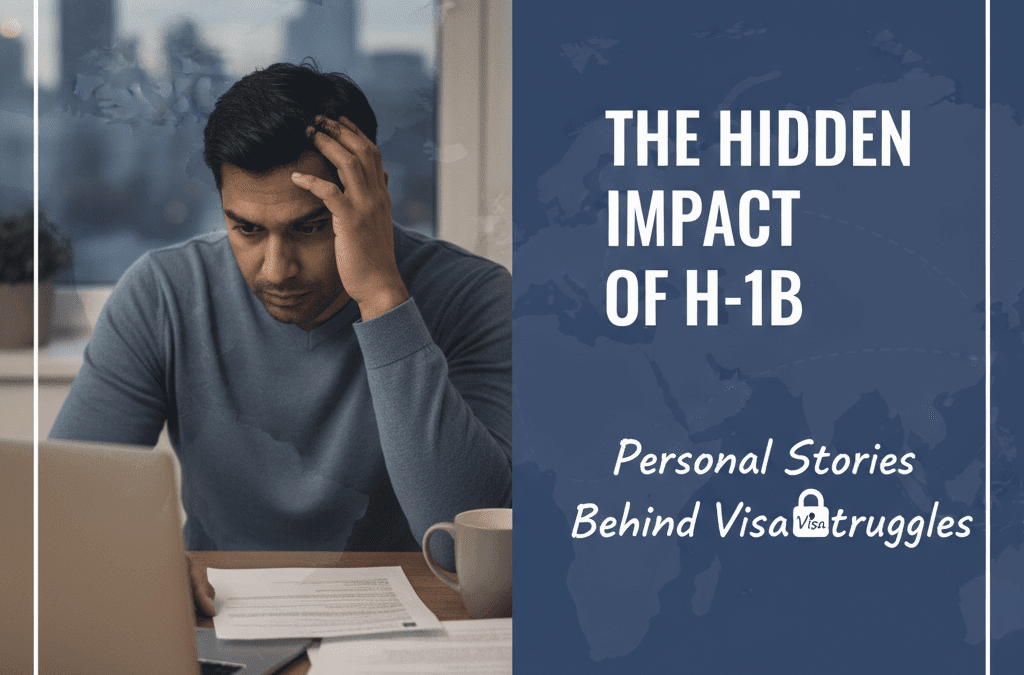
Priya stared at her resignation letter for the fifth time that morning. After six years building a career at a leading Silicon Valley tech firm, contributing to groundbreaking projects, and establishing deep professional relationships, she was walking away. Not for a better offer. Not for a career change. But because after two H-1B extensions and a stalled green card application, the uncertainty had become unbearable. With a young family and dreams of homeownership perpetually on hold, she’d accepted a position in Toronto—where a path to permanent residency was clear and defined.
“I never wanted to leave,” she told me, voice catching slightly. “But at some point, you have to choose stability over possibility.”
Stories like Priya’s are playing out with increasing frequency across America’s innovation hubs. When policy forces skilled talent abroad, who really pays the price? The answer is far more complex—and the costs far more substantial—than most Americans realize.
The Human Element: Beyond Statistics and Policy Debates
The H-1B visa program, designed to allow U.S. companies to employ foreign workers in specialty occupations, has become a political football tossed between competing narratives. Critics claim it displaces American workers; supporters argue it fills critical skills gaps. Lost in this debate are the human stories and hidden costs that ripple through companies, communities, and the broader economy.
Living in Perpetual Limbo
For H-1B holders, life becomes a series of contingencies. Every decision—from starting a family to buying a home—is qualified by visa status uncertainty. This psychological burden creates what researchers at the University of California have termed “immigration precarity”—a constant state of stress that affects not just professional performance but personal well-being.
Real-world impact: Sanjay, a software architect at a Boston fintech company, described turning down a promotion because it would require a new H-1B application. “The risk was too high,” he explained. “I couldn’t jeopardize my status when my son was starting high school here.”
This limbo extends to families as well. Spouses on H-4 visas often face work restrictions, creating households where highly educated partners are sidelined from their careers. Children who grow up in the U.S. may face the prospect of “aging out” of dependent status, creating impossible family decisions.
The Emotional Toll of Temporary Belonging
Beyond practical limitations, many H-1B workers describe a profound sense of conditional belonging—of building lives on shifting sand. This manifests in hesitancy to fully integrate into communities or make long-term commitments.
“I’ve been here twelve years,” says Wei, a data scientist who recently relocated to Vancouver after his third H-1B renewal. “I paid taxes, volunteered at local schools, and contributed to three patents. But I always felt like a guest who might be asked to leave at any moment.”
This psychological burden creates measurable effects:
- Higher rates of anxiety and depression among visa holders compared to permanent residents
- Decreased willingness to take entrepreneurial risks
- Reduced civic engagement despite strong desire to contribute
The Corporate Calculus: Hidden Costs to American Innovation
When companies lose talent due to visa constraints, the impact goes far beyond the immediate recruitment costs. Institutional knowledge, team cohesion, and innovation continuity all suffer in ways that rarely appear on balance sheets.
The Ripple Effect of Departures
According to research from the National Foundation for American Policy, replacing a specialized technical worker costs an average of 90-200% of their annual salary when accounting for recruitment, training, and productivity gaps. But even this substantial figure fails to capture the full impact.
“When we lost Aditya to visa issues, we didn’t just lose a senior engineer,” explains Jennifer Reyes, CTO at a Seattle-based cloud computing firm. “We lost his five years of understanding our architecture, his relationships with key clients, and his mentorship of junior team members. Some of that is simply irreplaceable.”
These departures create cascading effects:
- Project delays and quality issues as new team members come up to speed
- Knowledge silos when documentation can’t replace experiential understanding
- Team morale challenges as colleagues lose valued collaborators
Strategic Uncertainty and Global Repositioning
As visa uncertainty persists, companies are adapting in ways that may permanently alter America’s innovation landscape. A 2022 survey by the Silicon Valley Leadership Group found that 78% of responding tech companies had either established or expanded international operations specifically to accommodate talent that couldn’t secure stable U.S. work authorization.
“We’ve essentially created a Canadian subsidiary as our visa backup plan,” admits the HR director at a Boston AI startup who requested anonymity. “When we find exceptional talent we can’t secure visas for, we now have an alternative to losing them entirely. But this means jobs, tax revenue, and innovation that should be happening here is happening elsewhere.”
This strategic shift has accelerated the rise of global innovation hubs in Toronto, Vancouver, and beyond—cities explicitly positioning themselves as destinations for talent unwelcome or uncertain in the U.S.
The Broader Economic Impact: Contributions Lost
When skilled professionals leave due to visa constraints, they take with them not just their talents but their economic contributions—from tax payments to entrepreneurial potential.
Innovation and Entrepreneurship Diverted
The data on immigrant contributions to American innovation is compelling:
- Over 55% of America’s billion-dollar startups have at least one immigrant founder
- Foreign-born inventors account for approximately 25% of all U.S. patents
- Immigrants are twice as likely as native-born Americans to start businesses
Yet the H-1B program’s restrictions on entrepreneurship mean many potential founders take their ideas elsewhere. Unlike countries with specific startup visas, the U.S. system often forces would-be entrepreneurs to remain employees rather than employers.
Miguel, who developed a promising healthcare AI application while working for a major tech company, ultimately launched his startup in Portugal after his H-1B renewal faced uncertainty. “I wanted to build this company in California, where I’d spent eight years. But I couldn’t risk my immigration status on a venture that might take years to succeed.”
The missed opportunity: His company now employs 27 people and recently closed a €8 million funding round—economic activity that could have benefited the U.S. economy.
Tax and Social Contributions
H-1B workers are predominantly high-earners who contribute substantially to tax bases and social systems. A 2019 analysis by the New American Economy Research Fund estimated that H-1B households contribute over $85 billion in federal, state, and local taxes annually while receiving far fewer benefits than citizens.
When these workers leave, they take with them not just their tax contributions but their consumer spending, housing investments, and community engagement.
Global Competition: The Beneficiaries of American Uncertainty
As the U.S. visa system creates friction, other countries are rolling out the welcome mat for precisely the talent America is struggling to retain.
The Rise of Talent Magnets
Countries like Canada, Australia, and the UK have implemented immigration programs specifically designed to attract skilled professionals, often with pathways to permanent residency measured in months rather than decades.
Canada’s Express Entry system, which can grant permanent residency in as little as six months, has seen applications from U.S.-based tech workers increase by over 40% between 2019 and 2022. Toronto’s tech sector has grown by 85% in the past five years, with former H-1B holders representing a significant portion of that growth.
The competitive advantage: “Our immigration message is simple,” says Harjit Singh of Toronto’s Economic Development Office. “If you have the skills, we have a clear, predictable path to permanent residency and citizenship. No decades-long backlogs, no constant uncertainty.”
The Boomerang Effect on American Competitiveness
Perhaps most concerning for U.S. interests is that these international tech hubs increasingly compete directly with American companies—often using talent trained and developed in the U.S.
“I spent eight years at [major U.S. tech company], learned from the best, and built my network,” explains Lin, now CTO at a rapidly growing Toronto startup. “Now I’m building products that compete directly with my former employer. The irony isn’t lost on me that they invested in my development but couldn’t keep me because of visa issues.”
This transfer of human capital represents a double loss: the initial investment in talent development and the competitive challenge that same talent now presents from abroad.
Finding a Better Way Forward
The current H-1B system creates lose-lose scenarios for workers, companies, and the broader economy. But workable alternatives exist that could transform this dynamic.
Policy Innovations Worth Considering
Several approaches could address current system failures:
- Decoupling work authorization from employer sponsorship to increase mobility and reduce vulnerability
- Creating dedicated pathways for entrepreneurship that allow visa holders to found companies without jeopardizing status
- Implementing transparent, merit-based permanent residency processes with predictable timelines
- Exempting advanced degree holders in strategic fields from annual visa caps
These approaches have garnered bipartisan support in various forms but remain stalled in America’s broader immigration debate.
What Companies Can Do Now
While policy changes move slowly, forward-thinking companies are implementing strategies to better support international talent:
- Providing dedicated immigration counsel and support for employees and families
- Creating flexible global employment options that allow valued team members to remain with the company even if they must relocate
- Advocating collectively for policy reforms through industry associations
- Developing clear internal career paths that account for visa considerations
The Path Forward: Reframing the Conversation
The debate around skilled immigration needs to move beyond simplistic arguments about jobs competition to recognize the complex ecosystem of innovation, economic growth, and human potential at stake.
When we force talented contributors to leave due to bureaucratic constraints rather than merit, everyone loses. Companies lose valuable team members. Communities lose engaged residents. The economy loses contributors and potential job creators. And individuals lose the lives and dreams they’ve built.
The question isn’t whether America wants to welcome global talent—we already do, through our universities, companies, and innovation ecosystems. The question is whether we’re willing to let that talent put down roots and fully contribute to American prosperity.
For Priya, Wei, Sanjay, and countless others, the answer came too late. But for the next generation of innovators looking toward America’s shores, we still have time to build a system that works—one that recognizes talent as the precious resource it is, rather than a temporary commodity to be regulated into uncertainty.
The real cost of leaving isn’t just measured in departure statistics or recruitment expenses. It’s measured in unrealized potential, in innovations never brought to market, in communities diminished by unnecessary loss. It’s a cost America can no longer afford to bear.
Where This Insight Came From
This analysis was inspired by real discussions from working professionals who shared their experiences and strategies.
- Share Your Experience: Have similar insights? Tell us your story
At ModernWorkHacks, we turn real conversations into actionable insights.




0 Comments