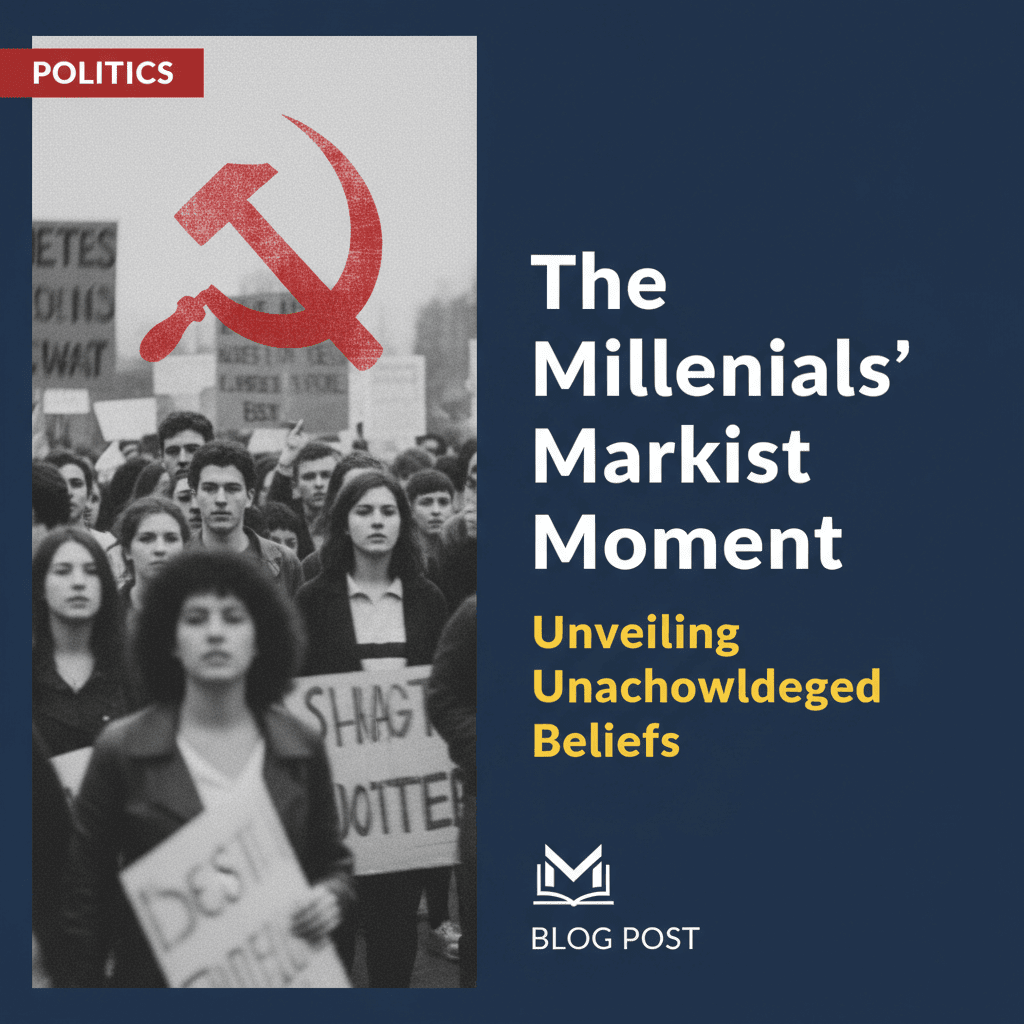
“Wait, am I… a Marxist?” The TikTok video showed a twenty-something woman looking bewildered as she stared into her phone camera. The comments section erupted with variations of “Same!” and “Me realizing this at 26.” This wasn’t an isolated incident—across Reddit, Twitter, and other platforms, millennials and Gen Z are having collective epiphanies about their political and economic beliefs, often with a mix of humor, surprise, and newfound solidarity.
What’s happening is remarkable: a generation raised in the aftermath of the Cold War, taught that Marxism was a failed ideology, is independently arriving at conclusions that align with Marxist principles—often without recognizing the connection until someone points it out. This isn’t about Soviet-style communism, but rather about questioning fundamental assumptions about capitalism, labor rights, and economic justice that previous generations took for granted.
The Accidental Marxists: How Economic Reality Shapes Ideology
When Alex, a 29-year-old graphic designer, posted on Reddit about feeling exploited at work, he didn’t expect the top comment to read: “Congratulations, you’ve just discovered surplus value theory.” The thread that followed became a crash course in Marxist economic concepts, with hundreds sharing similar experiences.
“I always thought Marxism was this extreme, dangerous ideology,” Alex told me. “But when people explained concepts like labor exploitation and alienation, I realized these theories were just putting names to things I’d felt my entire working life.”
Economic Conditions Driving Ideological Shift
This awakening isn’t happening in a vacuum. Consider these realities shaping millennial and Gen Z perspectives:
- Wage stagnation – While productivity has increased 62% since 1979, wages have only grown 17.5% according to the Economic Policy Institute.
- Skyrocketing costs – Housing prices have outpaced income growth by 121% since 1965, making homeownership increasingly unattainable.
- Debt burden – The average student loan debt has reached $37,693 per borrower, creating a generation that starts adult life financially underwater.
These aren’t just statistics—they represent lived experiences that shape political consciousness. When people work harder for less reward while watching corporate profits soar, Marxist critiques of capitalism suddenly don’t seem so theoretical.
From Theory to Reality: Everyday Marxism
What’s particularly interesting is how these realizations manifest in everyday thinking:
Action point: Recognize that questioning whether your compensation reflects your contribution to company profits isn’t radical—it’s a rational economic assessment.
Action point: Consider tracking the gap between your productivity and compensation over time to understand your personal “exploitation rate.”
Action point: Discuss compensation openly with colleagues to combat information asymmetry that benefits employers—a practical application of class solidarity.
Social Media as the New Communist Manifesto
In 2021, a Reddit post titled “I think I might be a Marxist and I’m scared” received over 15,000 upvotes and 3,200 comments. The poster described growing up in a conservative household where “communist” was practically a slur, only to realize in adulthood that many Marxist principles aligned with their values.
This pattern repeats across platforms, with hashtags like #AccidentalMarxist and #MarxWasRight gaining traction. What’s notable is the tone: not revolutionary fervor, but a kind of bemused self-discovery.
The Meme-ification of Marxism
Humor plays a crucial role in this ideological shift. Memes about “seizing the means of production” or jokes about “being radically left but only because reality shifted right” create accessible entry points to complex economic theories.
Case study: The subreddit r/LateStageCapitalism grew from 100,000 members in 2016 to over 1 million today, using humor and shared experiences to critique capitalism’s excesses. What makes this community significant isn’t just its size but its function as an educational space where members connect personal struggles to systemic issues.
Action point: Explore how humor can make complex political concepts more accessible and less threatening in conversations with others.
Action point: Look for online communities where economic experiences are discussed openly to better understand systemic patterns.
Action point: Practice identifying the difference between individual failures and structural problems in your own economic challenges.
Labor Rights Renaissance: From Theory to Workplace
When Starbucks workers began organizing in Buffalo, New York in 2021, they sparked a movement that spread to over 300 stores nationwide. What’s notable is how many organizers explicitly connected their efforts to broader questions about economic justice.
“I never thought of myself as political,” said Jamie, a 24-year-old barista who helped organize her store. “But once we started talking about our working conditions, I realized everything—our schedules, our pay, even our bathroom breaks—was political. It was about power.”
The Great Resignation as Class Consciousness
The pandemic-era “Great Resignation” represents another manifestation of changing attitudes toward work. When 47.8 million Americans voluntarily quit their jobs in 2021 alone, they weren’t just changing employers—they were collectively rejecting a system that demanded sacrifice without adequate compensation.
Research from MIT found that toxic workplace culture was the single biggest predictor of attrition—10.4 times more important than compensation. This suggests a shift from viewing work as merely transactional to demanding dignity and respect, concepts central to Marxist critiques of alienated labor.
Action point: Evaluate your workplace not just for compensation but for how it treats you as a human being with inherent dignity.
Action point: Research your legal rights as a worker and identify areas where collective action might improve conditions.
Action point: Practice solidarity by supporting colleagues facing workplace challenges, recognizing that individual problems often have collective solutions.
Beyond the Label: Substance Over Semantics
Perhaps the most interesting aspect of this phenomenon is how many people embrace Marxist ideas while rejecting or feeling uncomfortable with the label itself—a testament to how effectively Cold War-era messaging demonized the term.
A 2019 Pew Research study found that 65% of Americans have a negative view of “socialism,” yet when asked about specific policies like universal healthcare or higher minimum wages, support jumps significantly. This suggests many Americans may be more aligned with leftist economic thinking than they realize or are willing to admit.
The Vocabulary Gap
This disconnect creates what I call the “vocabulary gap”—where people lack the terminology to describe their own economic and political beliefs accurately. Without this vocabulary, it becomes harder to connect individual experiences to systemic patterns or to build coalitions around shared interests.
Consider how differently these statements land:
- “We should seize the means of production” (sounds radical)
- “Workers deserve a fair share of the profits they create” (sounds reasonable)
Yet they express essentially the same principle.
Action point: Focus on specific policies and outcomes rather than labels when discussing economic issues with others.
Action point: Explore the actual definitions and principles of different economic theories rather than relying on cultural stereotypes.
Action point: Practice articulating your economic values clearly, separate from political labels that might carry baggage.
From Realization to Action: What Comes Next?
As more millennials and Gen Z recognize the Marxist underpinnings of their economic critiques, the question becomes: what happens next? Historical Marxism emphasized collective action and systemic change, not just individual awakening.
We’re seeing early signs of this transition. Union approval reached 71% in 2022—the highest since 1965. Workplace organizing is increasing across sectors from tech to retail. Political candidates openly questioning capitalist orthodoxy are winning elections at local and national levels.
Beyond the Digital Sphere
The challenge now is translating online realizations into material change. Digital spaces have proven effective for consciousness-raising but less so for sustained organizing that impacts economic realities.
Case study: When Amazon workers in Staten Island successfully unionized in 2022, organizer Chris Smalls emphasized the importance of person-to-person connections: “You can’t organize a warehouse on Twitter. You have to be there, talking to people, building trust.”
Action point: Look for local organizations working on economic justice issues where you can contribute beyond social media engagement.
Action point: Practice discussing economic issues with people across generational lines to build broader coalitions.
Action point: Consider how your professional skills might support movements for economic change, whether through direct organizing or supporting roles.
Conclusion: The Personal Is Political—And Economic
The “accidental Marxist” phenomenon reveals something profound: economic theories aren’t abstract academic exercises but attempts to explain lived experiences. When millennials and Gen Z discover Marxist concepts that explain their economic reality, they’re not being indoctrinated—they’re recognizing patterns that classical economics often obscures.
Whether this recognition develops into a sustained political movement remains to be seen. What’s clear is that younger generations are questioning economic assumptions their parents took for granted, driven not by ideology but by the growing gap between promised prosperity and lived experience.
Perhaps the most revolutionary act isn’t calling yourself a Marxist but simply asking: Why do I work so hard yet struggle to afford basics? Who profits from my labor? And most importantly: Could things be different?
These questions, once asked, can’t easily be unasked. And in that persistent questioning lies the potential for real change—whatever label we give it.
Where This Insight Came From
This analysis was inspired by real discussions from working professionals who shared their experiences and strategies.
- Share Your Experience: Have similar insights? Tell us your story
At ModernWorkHacks, we turn real conversations into actionable insights.


0 Comments