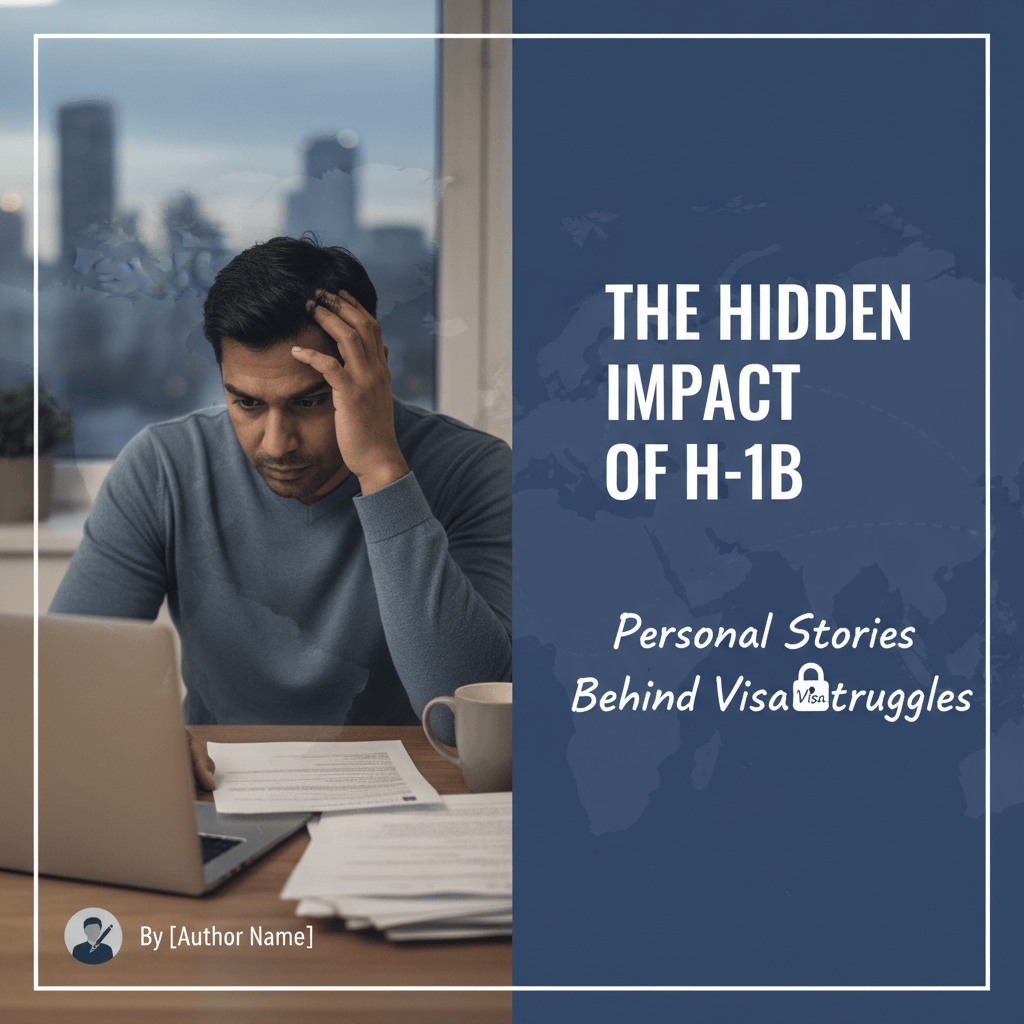
“I’ve been in the U.S. for 13 years now. I’ve paid over $300,000 in taxes, created jobs by starting a small business, and yet I still don’t know if I’ll be able to stay here permanently,” says Raj, a software engineer from India who came to America on an H-1B visa with dreams of building a life here. His voice cracks slightly as he describes missing his father’s funeral because traveling home might have jeopardized his visa status.
Behind the political debates and economic analyses of the H-1B visa program lies a profound human reality: millions of skilled professionals living in a perpetual state of uncertainty, building lives on shifting ground. Their stories reveal a complex picture of ambition, sacrifice, and untapped potential that rarely makes headlines but profoundly shapes both personal lives and America’s economic landscape.
Living in Limbo: The Emotional Toll of Visa Uncertainty
For many H-1B visa holders, life becomes measured in increments of validity periods, extension applications, and the ever-present fear of denial. This constant uncertainty creates a unique psychological burden that affects every aspect of their lives.
The Psychological Impact of Temporary Status
Anita, a biomedical researcher who has been working on cancer treatments for eight years in Boston, describes the sensation as “permanent impermanence.” “I can’t buy a house because I don’t know if I’ll be here in three years. I’ve delayed having children because of the insecurity. Even getting a dog feels like too much of a commitment,” she explains.
Mental health professionals have noted patterns of anxiety and depression among long-term visa holders. Dr. Lakshmi Ramarajan, who counsels immigrants in Silicon Valley, reports that over 70% of her H-1B clients experience significant anxiety related to their visa status, with many showing symptoms of what she calls “visa stress syndrome” – a persistent state of hypervigilance and planning limitation.
Actionable strategies for managing visa-related stress include:
- Building community with others in similar situations who understand the unique challenges
- Working with employers to ensure clear communication about visa sponsorship and renewal processes
- Developing contingency plans for various immigration outcomes to reduce uncertainty anxiety
Family Separation and Difficult Choices
The human cost extends beyond the visa holders themselves. Carlos, a Venezuelan engineer working in Texas, hasn’t seen his aging parents in four years. “If I leave, I might not get back in. My mother had surgery last year, and I couldn’t be there. This is the sacrifice that doesn’t show up in any economic report.”
For spouses on H-4 dependent visas, the situation often means surrendering professional identities. Until recent policy changes, many couldn’t legally work despite holding advanced degrees. Priya, who holds a master’s degree in computer science, spent six years unable to work while her husband progressed in his career. “I watched my skills become outdated while fighting depression. People don’t understand how it feels to have your identity reduced to ‘dependent.'”
The Green Card Backlog: A System at Breaking Point
For many H-1B holders, especially those from India and China, the path to permanent residency has become nearly impassable due to per-country caps in the immigration system.
The Mathematics of Waiting
According to USCIS data and analysis from the Cato Institute, Indian nationals in the employment-based green card backlog face wait times that can exceed 150 years – effectively making permanent residency impossible within a human lifetime. For Chinese nationals, the wait often exceeds 20 years.
“I entered the queue in 2012,” explains Vikram, a data scientist in Seattle. “Based on current processing rates, I might become eligible around 2048 – when I’ll be 73 years old. My entire productive career will be spent in temporary status, always vulnerable to policy changes or economic downturns.”
The backlog creates practical consequences that affect career decisions and limit contributions:
- Restricted job mobility, as changing employers can reset the green card process
- Reluctance to start businesses despite entrepreneurial potential
- Limited ability to negotiate salaries or working conditions
Children Aging Out: The Documented Dreamers
Perhaps the most heartbreaking consequence of the backlog affects children of H-1B holders. When these “documented dreamers” turn 21, they age out of dependent status and must secure their own visas or leave – despite having grown up entirely in America.
Suraj came to the U.S. when he was seven with his parents. Now 20, he faces the prospect of self-deportation to India – a country he barely remembers. “I’m more American than Indian in every way except my passport. I’m applying to graduate schools knowing I might have to leave halfway through if I can’t get my own work visa.”
Organizations like Improve the Dream estimate that over 200,000 children face this predicament, creating a generation of young people raised American but forced to take their talents elsewhere.
Beyond the Stereotypes: The Diverse Reality of H-1B Holders
Public perception of H-1B visa holders often centers on young Indian males in tech jobs, but the reality encompasses a far more diverse population contributing across numerous fields.
Beyond Silicon Valley: H-1B Impact in Unexpected Places
While technology companies are significant employers of H-1B talent, these skilled professionals fill crucial roles across the American economy. Dr. Elena Gonzalez came to rural Minnesota on an H-1B visa, becoming the only Spanish-speaking pediatrician in a county with a growing Hispanic population. “I serve families who previously had to drive two hours for medical care with a doctor who could understand them,” she says.
According to Department of Labor data, H-1B visas support critical workforce needs in:
- Healthcare, with over 27% of physicians in some specialties being foreign-born
- Education, particularly in STEM fields and at rural universities
- Research institutions working on everything from climate change to disease prevention
Women on H-1B: Double Barriers
Women on H-1B visas often face compounded challenges. Aisha, an architectural engineer from Egypt, describes navigating both gender bias and immigration uncertainty: “In meetings, I’m already working harder to be taken seriously as a woman in a male-dominated field. Add the visa question, and it sometimes feels impossible to be seen as a permanent team member.”
For female H-1B holders married to other visa holders, career decisions become even more complex. “If my husband’s visa application is denied, we both have to leave, regardless of my own status or career progress,” explains Min, a pharmaceutical researcher. “This creates a power dynamic that affects everything from which job offers we can accept to where we can live.”
The Innovation Gap: Contributions Left on the Table
The limitations placed on H-1B visa holders create what economists call an “innovation gap” – potential contributions to the American economy that remain unrealized due to visa restrictions.
The Entrepreneurship Paradox
A 2022 National Foundation for American Policy study found that immigrants have founded 55% of America’s billion-dollar startups, yet the H-1B visa program makes entrepreneurship nearly impossible for current visa holders.
Deepak, who holds patents in renewable energy technology, explains: “I have investors interested in my ideas, but I can’t start my own company because I need an employer to sponsor my visa. The technology I’ve developed could create dozens of green jobs, but instead it sits in a filing cabinet.”
This entrepreneurship barrier represents significant lost opportunity:
- Potential job creation for American workers is delayed or prevented
- Innovation that could address critical challenges remains undeveloped
- Tax revenue and economic growth are diminished
The Talent Competition: Global Implications
As other countries develop more streamlined paths to permanent residency for skilled workers, America’s complicated system increasingly puts it at a disadvantage in the global talent competition.
“I’ve watched colleagues give up and move to Canada, where they received permanent residency within months,” says Wei, a machine learning specialist who has been waiting for a green card for nine years. “The U.S. educated us, we want to stay and contribute here, but the system makes it so difficult that many talented people are simply leaving.”
Countries actively recruiting skilled immigrants include:
- Canada, with its Express Entry system that can grant permanent residency in 6-12 months
- Australia, offering pathways to permanent status based on skills and education
- Germany, which has streamlined immigration processes for qualified professionals
Moving Forward: Potential Solutions and Individual Agency
While systemic immigration reform requires political action, H-1B visa holders and their advocates have found ways to navigate the current system while working toward meaningful change.
Policy Proposals With Bipartisan Potential
Immigration experts point to several reforms that could address key problems without complete system overhaul:
- Eliminating or modifying per-country caps for employment-based green cards
- Creating a specific visa category for children who have grown up in the U.S. on dependent visas
- Developing entrepreneurship pathways that allow H-1B holders to start businesses
These targeted changes could significantly improve the system while broader immigration reform discussions continue.
Finding Voice and Building Allies
Increasingly, H-1B visa holders are sharing their stories and finding American allies who understand the economic and human importance of their contributions.
“When I finally explained my situation to my American colleagues, they were shocked,” says Miguel, a software developer in Austin. “Most had no idea that I’d been here for 11 years but still couldn’t plan to stay permanently. Several have now contacted their representatives about the issue.”
Advocacy organizations report that personal stories from constituents have the greatest impact on lawmakers’ understanding of the issue. “Statistics don’t change minds the way personal connections do,” explains immigration advocate Sarah Johnson. “Americans need to hear these stories to understand what’s at stake.”
Conclusion: The American Dream on Hold
The stories of H-1B visa holders reveal a profound paradox in America’s relationship with immigrant talent: actively recruiting the world’s brightest minds while keeping them in perpetual uncertainty. Behind the policy debates and visa categories are real lives – researchers developing vaccines, engineers designing sustainable infrastructure, doctors serving rural communities, and entrepreneurs with world-changing ideas.
These individuals represent not just their own dreams but America’s tradition of renewal through immigration. Their struggles highlight both the enduring appeal of the American dream and the bureaucratic barriers that increasingly place that dream out of reach. As the global competition for talent intensifies, addressing these challenges becomes not just a moral imperative but an economic necessity.
For Americans concerned about maintaining innovation leadership, the H-1B story offers a clear call to action: look beyond the visa category to see the humans behind it, understand their contributions, and consider what might be possible if their potential were fully unleashed.
Where This Insight Came From
This analysis was inspired by real discussions from working professionals who shared their experiences and strategies.
- Share Your Experience: Have similar insights? Tell us your story
At ModernWorkHacks, we turn real conversations into actionable insights.

0 Comments