
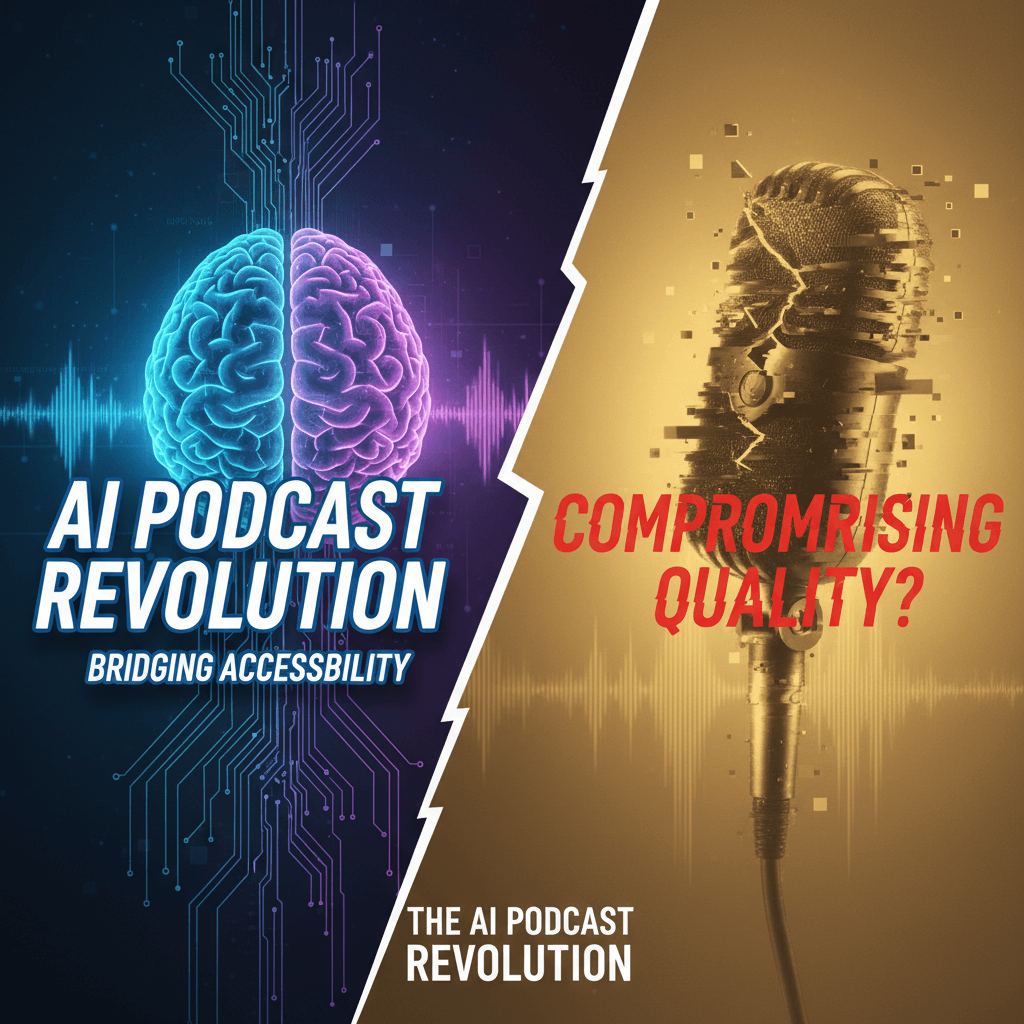
The first time I heard an AI-generated podcast, I couldn’t quite place what felt off. The voice was smooth and professional, the content seemed well-researched, but something intangible was missing. That subtle human quality—the occasional breath, the natural enthusiasm, the imperfect yet authentic delivery—had been replaced by an uncanny perfection. As I later discovered, this podcast was produced by a team of just eight people using AI voice synthesis, automated content generation, and algorithmic editing. They were creating more content in a week than traditional podcast studios produce in a month.
This scenario is increasingly becoming our reality as AI-generated podcasts flood the audio content landscape. A small tech company with fewer than a dozen employees has managed to produce thousands of podcast episodes across hundreds of “shows,” capturing millions of listeners and a staggering market valuation. But the fundamental question remains: Is this democratization of audio content creation a breakthrough for accessibility, or are we trading human creativity for algorithmic mediocrity?
The Rise of AI Podcast Production
In less than two years, AI-generated podcasts have evolved from novelty experiments to a legitimate industry disruptor. The technology has advanced rapidly, with synthetic voices becoming increasingly difficult to distinguish from human ones, and content generation systems capable of producing coherent, topic-specific scripts at scale.
The Economic Proposition
The business model is undeniably attractive. Traditional podcasts require human hosts, recording equipment, editing expertise, and significant time investment. By contrast, AI podcast production companies operate with skeletal crews:
- A team of 8-12 people can oversee hundreds of “shows”
- Production costs are reduced by approximately 85% compared to traditional podcasting
- Content creation speed increases tenfold, with some AI systems capable of generating and publishing multiple episodes daily
One standout example is Whispercast, a startup that launched in 2022 with $3.5 million in funding and a team of just eight engineers and content supervisors. Within 18 months, they were producing content across 340 different podcast “shows,” covering everything from cryptocurrency analysis to parenting advice. Their valuation reached $120 million by early 2023, despite significant criticism regarding content quality.
The Technical Framework
Modern AI podcast production typically involves three core technologies:
- Large Language Models (LLMs) that generate scripts based on trending topics, news feeds, and audience engagement metrics
- Voice synthesis technology that converts text to increasingly natural-sounding speech
- Audio production AI that handles mixing, adds background music, and creates a polished final product
The most sophisticated systems now incorporate feedback loops, where listener engagement data informs future content creation, essentially learning what topics and presentation styles perform best with specific audience segments.
The Accessibility Revolution
Perhaps the strongest argument for AI-generated podcasts is their potential to dramatically expand content accessibility across multiple dimensions.
Serving Underrepresented Topics
Traditional media economics often can’t support niche content creation. If only 5,000 people worldwide are interested in the historical linguistics of Proto-Indo-European languages, producing a high-quality podcast on the subject rarely makes financial sense. AI changes this equation entirely.
Podmatrix, another AI podcast startup, specifically targets micro-niches. Their “Long Tail Audio” division creates content for audiences as small as 2,000 listeners. “We’ve created podcasts about obscure medical conditions, hyperspecific hobbyist communities, and academic subjects that would never get mainstream attention,” explains Podmatrix founder Elena Kazan. “For listeners with these interests, this content is invaluable, even if they recognize it’s AI-generated.”
Language and Geographic Barriers
AI podcasts are breaking significant barriers to information access:
- Multilingual content creation allows simultaneous release in dozens of languages
- Regional customization adapts content for different cultural contexts
- Accessibility features like automatic transcription and adjustable playback speeds come standard
Research from the Global Digital Access Project indicates that AI-generated audio content has reached over 14 million listeners in regions traditionally underserved by English-language media, particularly in Southeast Asia and parts of Africa.
Economic Accessibility
The vast majority of AI-generated podcasts are free to listeners, supported by targeted advertising or minimal subscription fees. This removes financial barriers to specialized information that might otherwise be locked behind paywalls or professional associations.
The Quality Conundrum
Despite these accessibility benefits, concerns about quality persist and appear well-founded. A 2023 study by the Audio Content Research Group found that listeners consistently rated AI-generated podcasts lower on several key metrics:
- Emotional resonance (32% lower than human-hosted shows)
- Perceived authenticity (47% lower)
- Entertainment value (28% lower)
- Trust in information presented (39% lower)
The Hallucination Problem
Perhaps most concerning is the tendency for AI-generated content to include factual errors or completely fabricated information—what AI researchers call “hallucinations.” While human podcasters certainly make mistakes, AI systems can confidently present entirely fictional statistics, studies, or events as factual.
This issue became particularly evident when Factcast, an AI news podcast, reported on a non-existent summit between world leaders that never occurred. Despite the fabrication being obvious to informed listeners, the episode was downloaded over 40,000 times before being removed.
To combat this problem, companies are implementing various safeguards:
- Human fact-checkers who review scripts before production
- Source citation requirements programmed into content generation systems
- Topic restrictions that prevent AI from addressing subjects prone to misinformation
The Missing Human Element
Beyond factual concerns lies something more subjective but equally important: the human connection. Traditional podcasts often succeed because of the authentic personality, lived experience, and genuine passion of their hosts.
Comedy writer and podcast critic Jordan Mendelsohn puts it bluntly: “AI can simulate expertise, but it can’t simulate having actually lived through something. When I listen to a podcast about parenting or mental health or even cooking, I want to hear from someone who’s been in the trenches, who’s made the mistakes, who’s felt the emotions. AI can approximate the information, but it can’t approximate the wisdom.”
The Hybrid Future
As the industry evolves, we’re seeing the emergence of hybrid models that attempt to capture the benefits of both approaches.
AI-Assisted Human Creation
Rather than replacing human hosts entirely, some of the most promising applications use AI as a production assistant:
- Research automation that compiles information for human hosts to interpret
- Script suggestions that human creators can refine and personalize
- Post-production tools that streamline editing while preserving human delivery
The podcast “Tech Horizons” exemplifies this approach. Host Mira Chen uses AI to research technical topics outside her expertise, generate interview questions, and even create first-draft scripts. “The AI does the heavy lifting on research and structure,” Chen explains, “but I rewrite everything in my voice, add my perspectives, and of course, record it myself. The result is much better than either pure AI or what I could do alone with my limited time.”
Transparency and Audience Expectations
Perhaps the most crucial development is the growing consensus around transparency. Industry leaders are increasingly advocating for clear disclosure when content is AI-generated or AI-assisted.
The Podcast Ethics Consortium, representing over 200 production companies, recently published guidelines recommending that:
- AI-generated voices should be explicitly identified as synthetic
- Content primarily written by AI should be labeled accordingly
- Hybrid productions should clarify which aspects involve AI assistance
This transparency allows listeners to adjust their expectations and make informed choices about the content they consume.
Finding Balance in the AI Audio Landscape
As we navigate this evolving medium, several principles can guide both creators and listeners:
For Content Creators
- Use AI as an amplifier of human creativity, not a replacement for it
- Implement rigorous fact-checking systems when using AI-generated content
- Be transparent about production methods and AI involvement
For Listeners
- Develop media literacy specific to AI-generated content
- Support human creators in areas where personal experience and authenticity matter most
- Provide feedback to platforms about content quality and transparency
The most promising path forward isn’t an either/or proposition. Rather than asking whether AI will replace human podcasters, we should focus on how these technologies can complement each other, expanding access to information while preserving the human connection that makes audio content so powerful.
Conclusion: The Human-AI Partnership
Can an AI team of eight redefine podcasting? The evidence suggests they already have, fundamentally altering the economics and accessibility of audio content. But the question of whether they should—or whether the result serves listeners well—remains more nuanced.
The future of podcasting likely belongs neither to pure AI production nor to traditional human-only methods, but to thoughtful combinations that leverage the strengths of each. AI can handle research, transcription, translation, and distribution at scales humans cannot match. Humans bring lived experience, emotional intelligence, creative connections, and ethical judgment that AI cannot replicate.
As listeners, we have the power to shape this evolution through our choices and feedback. By demanding both accessibility and quality, transparency and connection, we can help ensure that the AI podcast revolution enhances rather than diminishes the rich audio landscape we’ve come to value.
The most successful podcasts of the future may well be those that use AI to handle the mundane aspects of production while amplifying uniquely human voices and perspectives—not replacing them. In this partnership lies the potential for a truly revolutionary media landscape: one that’s more inclusive, more diverse, and still profoundly human.
Where This Insight Came From
This analysis was inspired by real discussions from working professionals who shared their experiences and strategies.
- Share Your Experience: Have similar insights? Tell us your story
At ModernWorkHacks, we turn real conversations into actionable insights.






0 Comments