Discover actionable insights.
The midnight page that changed my automation map
It was 12:47 a.m. when my phone lit up with a chorus of notifications. Customers in three countries had just received “payment failed” emails—despite successful charges clearing minutes earlier. Our refunds microservice, triggered by a conditional branch in an automation, had collided with a rare edge case: a retry storm that fired in parallel and double-booked an update to the ledger. Nothing corrupt, but messy enough that a routine Tuesday became a war room.
I’ve built a lot of my operations around n8n for years—receiving webhooks, fanning out notifications, transforming payloads, calling APIs, enriching CRM entries, and automating back-office tasks. It’s a power tool: fast to prototype, easy to share, auditable, and self-hostable. But on that night, one part of my stack needed something different: ironclad state management, time-based coordination that lasts days, exactly-once semantics under chaos, and a workflow definition that behaved like source code with tests and rollbacks, not just an editable canvas.
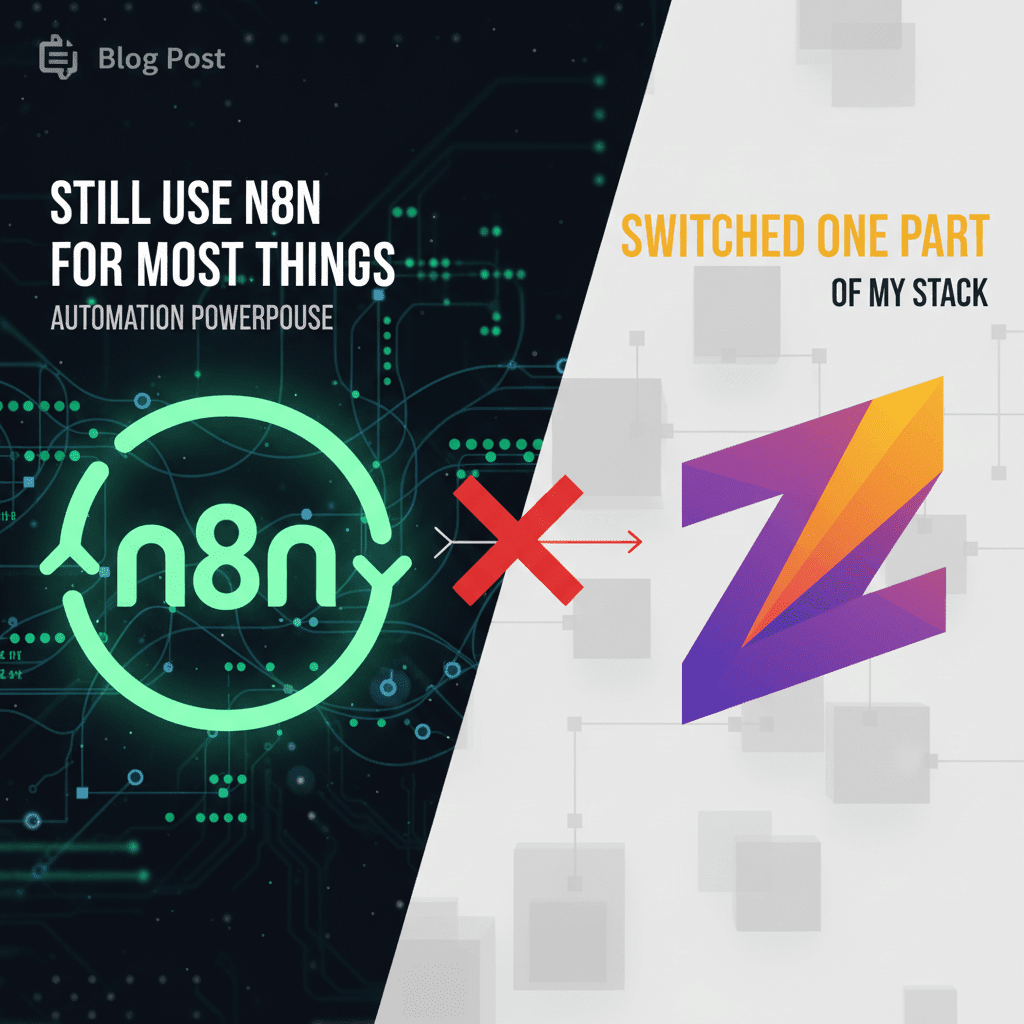
By sunrise we had contained the issue. By Friday we had a plan. I would still use n8n for most things, but the small, fault-intolerant, long-lived slice of my automation—payments and refunds orchestration—would move to a code-first, durable workflow engine. I chose Temporal.
The punchline isn’t “replace n8n.” It’s “pick the right tool for each job.” If you’re building an automation-rich business, your architecture will be healthier when you let n8n do what it does best and offload a narrow class of deterministic, state-heavy workflows to a system designed for that exact profile. This article distills what I learned, including key takeaways from real discussions with engineers who made similar tradeoffs, and turns them into a practical playbook you can adopt today.
What this article delivers
- Clear criteria for when n8n is the right fit—and when it isn’t.
- A concrete example of switching one slice to Temporal while keeping n8n everywhere else.
- Actionable checklists and migration steps you can apply immediately.
- Distilled insights from community threads, Slack/Discord groups, and postmortems.
Why n8n still does the heavy lifting
Before the switch, and after, n8n remains my day-to-day engine. It excels where speed, visibility, and integration breadth matter more than formalized determinism and code-level safety nets. Here’s why.
Strengths that compound
- Rapid integration and prototyping: Hundreds of nodes, webhooks, and built-in auth strategies slash setup time. A new vendor? You can plug it into your ops in an afternoon.
- Human-in-the-loop flows: Approval steps, conditional paths, and manual triggers fit naturally on a canvas where teammates can reason about branching logic without diving into code.
- Self-hosted control: For teams who want to keep data on their infrastructure, n8n provides flexibility, with queue mode and worker scaling for heavier throughput.
- Composable glue: n8n shines as the “glue” that moves data between APIs, normalizes formats, and sequences lightweight tasks with clarity.
- Low-code with escape hatches: Expressions, JavaScript function nodes, and HTTP requests let you mix visual logic with custom code when needed.
Everyday workflows where n8n is ideal
- CRM enrichment: On user signup, call enrichment APIs, score leads, write to CRM, and notify sales.
- Support automation: Ingest tickets, categorize with NLP, route to the right queue, and trigger SLAs/alerts.
- Ops syncing: Mirror subscription events to accounting tools, send Slack alerts, and reconcile nightly reports.
- Content pipelines: Pull CMS updates, transform images, run checks, and publish to channels.
- Internal tooling: Spin up internal webhooks that trigger ad-hoc tasks like regenerating invoices or re-sending onboarding sequences.
In other words: most of your business automation probably fits n8n beautifully. The caveat emerges when your problem space demands a class of guarantees that are hard to bolt onto a general-purpose orchestrator.
Where friction shows up
- Long-running workflows with timers spanning days or weeks: You can model these in n8n, but recovering exactly-once semantics across restarts, redeploys, and retries is nontrivial at extreme reliability targets.
- High-stakes, stateful sagas: Money movement, fraud checks, KYC gating, and inventory reservations benefit from code-level determinism and workflow versioning with strict safety rails.
- Formal testing and reproducibility: While you can test n8n workflows, building a CI loop with determinism and replayable histories is often easier in a code-first engine designed for it.
- Concurrency controls and backpressure at scale: Queue mode helps, but when activities interact in subtle ways across services, a workflow runtime with built-in backoff, cancellation, and idempotency patterns can pay off.
These aren’t knocks on n8n—they’re reminders that no single tool is ideal for everything. Once I accepted that, the architecture almost designed itself.
The one part I switched: durable workflows with Temporal
The slice I moved off n8n handles payment orchestration and refunds—a textbook example of a business-critical, state-heavy process with multiple compensating actions. It needs to be auditable, pause/resume safely, and survive infrastructure hiccups without ambiguous partial progress.
Why Temporal
Temporal is a code-first, open-source workflow engine purpose-built for durable execution. You write workflows and activities using an SDK (Go, Java, TypeScript, Python), Temporal persists the event history, and a worker can crash and come back without losing the thread. It provides:
- Determinism: Workflow code runs as a deterministic state machine. Non-deterministic operations live in activities with clear boundaries.
- Automatic retries and timeouts: Robust per-activity policies with exponential backoff, heartbeats, and circuit-breaker-like behavior.
- Long timers and signals: Sleep for days, wait for external events (“signals”), and coordinate human approvals without polling hacks.
- Replayable history and observability: You can inspect a workflow’s exact path. Debugging is tractable and auditable.
- Versioning: Migrate workflows across code changes with version markers, avoiding breaking old executions.
In short, Temporal turns a brittle series of distributed calls into a controlled, traceable program with well-defined semantics. That’s overkill for most automations—and perfect for a few.
How n8n and Temporal coexist
I didn’t rip out n8n. I adjusted the boundary:
- n8n continues to orchestrate triggers, fan-out notifications, integrations with third-party APIs, and back-office tasks.
- Temporal owns long-lived, high-stakes workflows like payment capture, refund sagas, chargeback handling, and certain inventory reservations with compensating steps.
In practice, a user action or webhook still lands in n8n. The workflow checks routing rules, enriches the payload, and then, instead of trying to manage all stateful steps inline, it makes a clean call to a Temporal worker to start or signal a workflow. When Temporal finishes or reaches a milestone, it emits events that n8n picks up to continue the rest of the business automation: notify teams, update spreadsheets, sync to the CRM, and so on.
The payments/refunds saga, simplified
- n8n receives checkout completion → validates input → logs an audit record.
- n8n calls Temporal “PaymentSaga” with idempotency key.
- Temporal “PaymentSaga”:
- Authorize payment → wait for bank confirmation → capture funds.
- Reserve inventory → if capture fails, release reservation.
- On partial failure, invoke compensating actions (void, refund, ledger reversal).
- Wait for asynchronous risk engine signal; if flagged, cancel capture and release holds.
- Emit milestones to an event bus.
- n8n subscribes to saga milestones → updates CRM, sends Slack alerts, emails receipts, logs metrics, and closes the loop.
This split gave me the best of both worlds: the speed and reach of n8n plus the safety and debuggability of Temporal where it matters most.
Actionable takeaways for choosing a split
- Keep n8n for: Integrations, short-lived tasks, human-in-the-loop approvals, data movement, alerting, enrichment, and “glue” logic.
- Use Temporal (or similar) for: Long-running orchestrations, money movement, inventory locking, idempotency-critical flows, complex retry semantics, and sagas with compensations.
- Boundary design: Have n8n own triggers and side effects; let the workflow engine own the core transaction logic and timing.
- Telemetry first: Forward consistent correlation IDs across n8n and Temporal for unified metrics and traces.
What practitioners say: key takeaways from real discussions
Across community threads, Slack groups, GitHub issues, and conference hallways, a pattern emerges. I’ve sifted the noise into practical signals you can apply.
Common success patterns
- Start with n8n everywhere, then carve out the “spiky” 10%: Most teams discover the hard problems by tripping on them. That’s fine—start simple, then extract the gnarly pieces to a specialized runtime once they reveal themselves.
- Idempotency and deduplication are non-negotiable: Use idempotency keys at the edges (webhooks, queues, Temporal workflow IDs). Never depend on “this will probably only run once.”
- Separate orchestration from side effects: Whether in n8n or Temporal, keep side-effecting operations behind clear commands and compensate explicitly. Don’t hide state mutations inside opaque function nodes without tracing.
- Prefer event-driven handoffs: Emit events from durable workflows, consume with n8n for notifications and enrichments. This decouples timing-sensitive logic from blast-radius-heavy integrations.
- Design for partial failure: Enumerate what can go wrong at each step and write compensations. Then rehearse them in staging with fault injection.
Pitfalls teams warn about
- Monolithic workflows: Massive, everything-in-one canvas designs become unmaintainable. Aim for small, composable flows.
- Hidden global state: Global variables, shared sheets, and ad-hoc caches create spooky action at a distance. Prefer explicit data passing and well-defined stores.
- Retry storms: Layered retries (HTTP client, node retries, platform retries) can multiply. Standardize policies and add circuit breakers.
- Cron sprawl: Cron-based polling across dozens of workflows can hammer APIs and yield inconsistent states. Consolidate polling and prefer webhooks/events.
- “It works when Alice runs it”: Institutional knowledge isn’t resilience. Write runbooks, add health checks, and automate rollbacks.
Cost and scaling perspectives
- n8n scaling: Queue mode with Redis and multiple workers scales well for typical business volumes. For extreme throughput or millisecond SLAs, hand off compute-heavy parts to language-native services or serverless functions.
- Temporal scaling: Excellent for many concurrent long-lived workflows, but comes with operational overhead. Managed offerings can offset this. Reserve it for flows where its guarantees matter.
- Team topology matters: Low-code champions accelerate delivery with n8n; platform engineers codify guardrails and durable logic in Temporal. Together, they ship faster and safer.
Actionable insights distilled
- Define SLOs per workflow: Availability, latency, and correctness targets drive tool choice.
- Instrument end-to-end: Standardize correlation IDs across n8n, your APIs, queues, and Temporal for unified logs and metrics.
- Create a “retry budget” policy: Cap total retries across layers. Prefer dead-letter queues after budget is spent.
- Model compensations first: If you can’t explain how you’ll undo a step, don’t ship it.
- Version deliberately: Treat workflows as artifacts. Review, version, and roll back intentionally.
A practical migration playbook you can copy
You’ve identified a candidate slice to move—perhaps payments, multi-step provisioning, or a KYC pipeline. Here’s the exact sequence I used, with adjustments you can tailor.
1) Classify your workflows
- Green (stay in n8n): Short-lived tasks, low business risk, mostly integrations and notifications.
- Yellow (evaluate): Multi-step with external dependencies, moderate risk, clear compensations possible.
- Red (migrate): Long-lived, high-stakes, exact-once semantics, regulatory or financial exposure.
Tip: Use a simple rubric with scores for duration, financial risk, data sensitivity, retries, and compensations. Anything scoring above a threshold gets a deeper look.
2) Draw the boundary and contracts
- Define the API between n8n and the workflow engine: Inputs, idempotency keys, correlation IDs, and expected signals/events.
- Minimize coupling: Treat the durable workflow as a black box from n8n’s perspective. n8n shouldn’t need to know its internal steps.
- Choose a canonical event schema: Keep payloads consistent; version them with semver.
3) Model the saga and failure modes
- List each step and side effect: Identify what can fail, how to detect it, and how to compensate.
- Write happy-path and unhappy-path narratives: What happens if step 3 fails after step 2 succeeded? What if a human approval is delayed by days?
- Decide timing behaviors: Timeouts, backoff, and how long you’re willing to wait for external systems.
4) Implement in Temporal (or your chosen engine)
- Keep workflow code deterministic: No random calls or direct network I/O in the workflow logic. Put side effects in activities.
- Use workflow IDs for idempotency: Derive them from business keys (e.g., order-1234-payment) to dedupe accidental duplicates.
- Add signals and queries: Signals to receive external events; queries to inspect state without mutating it.
- Version with intent: If you must change logic later, use version markers to keep old executions safe.
5) Integrate back with n8n
- Start or signal workflows from n8n: Wrap Temporal client calls in a function or HTTP bridge service that n8n can invoke.
- Subscribe to milestones: Emit events at key points; have n8n consume them to update CRMs, send messages, and persist audit logs.
- Propagate tracing context: Ensure the same correlation ID appears in n8n execution logs, application logs, and Temporal workflow histories.
6) Test with chaos and time
- Fault injection: Kill workers, drop network calls, and force timeouts. Verify compensations fire and no double-charging occurs.
- Long timers: Simulate days-long approvals and ensure workflows remain resumable after restarts.
- Replay validation: Use the workflow history to confirm deterministic replays succeed after code changes.
7) Roll out safely
- Shadow mode: Run the new workflow in parallel with the old path, but don’t side-effect. Compare outputs.
- Canary by cohort: Migrate a subset of customers or use a feature flag to ramp traffic.
- Clear abort path: Document exactly how to fall back to the previous system if KPIs degrade.
8) Operationalize and hand off
- Runbooks: Step-by-step guides for common incidents and manual interventions.
- Dashboards and alerts: SLO-based alerts on failure rates, retry queues, stuck timers, and worker health.
- Ownership: Name a DRI for the durable workflows; enshrine interface contracts between n8n owners and workflow owners.
Migration checklist (print this)
- Define scope and business case for the slice you’re moving.
- Write the saga with compensations before writing code.
- Choose stable IDs and idempotency keys.
- Instrument everything with correlation IDs.
- Implement retries with budgets, not infinity.
- Test happy, unhappy, and catastrophic paths.
- Plan a reversible rollout and document the rollback.
- Train the team and socialize the new boundary.
- Review quarterly to ensure the split still makes sense.
Actionable n8n hardening (even if you don’t switch)
- Standardize retries: Set consistent max attempts and backoff across nodes and HTTP requests.
- Idempotency at the edges: Add keys to webhook-triggered workflows and dedupe in the first node.
- Queue mode with worker isolation: Separate noisy workflows from critical ones; pin resource-heavy jobs to dedicated workers.
- Centralize secrets and configs: Use environment variables or secret managers rather than hardcoding values in nodes.
- Modularize flows: Break big canvases into callable sub-workflows and reusable components.
- Logging and alerts: Emit structured logs, set alerts on error rates, and send “heartbeat” pings from critical flows.
When not to switch
- Premature optimization: If your pain is hypothetical, ship with n8n first and measure.
- Low-risk domains: If a failure only triggers a Slack message twice, keep it simple.
- Tight teams without platform skills: Owning a workflow engine adds operational overhead. Don’t take it on lightly.
Remember: the right split reduces complexity. The wrong split creates coordination tax. Start small, measure, iterate.
Mini case study: provisioning
A B2B SaaS team automated provisioning: creating a tenant, seeding defaults, issuing API keys, and notifying stakeholders. n8n worked great until customers started with dozens of seats and integrations. Failures at step four required manual cleanup when steps one to three had partially succeeded.
They switched only the central “TenantProvisioning” saga to Temporal: create tenant (activity), seed defaults, attach billing, validate integrations; on failure, clean up created resources. n8n still triggers the process, records status, and sends notifications. Result: a 75% reduction in manual cleanup time, better audit trails, and faster incident recovery. Everything else—the majority of their automations—remained on n8n.
Your first week plan
- Day 1: Inventory workflows; tag green/yellow/red.
- Day 2: Pick one red candidate; write its saga and compensations.
- Day 3: Stand up a Temporal sandbox; build the skeleton workflow and one activity.
- Day 4: Integrate a thin HTTP bridge; trigger from n8n; wire correlation IDs.
- Day 5: Add retries, timeouts, and basic observability; demo to stakeholders.
By the end of week one, you’ll have a working north star and a clear pattern to replicate as needed—without disturbing the bulk of your n8n estate.
FAQ-style quick hits
- Could I use AWS Step Functions instead? Yes. If you’re deep on AWS, Step Functions plus SQS/Lambda is a strong option. The same boundary principles apply.
- What about Airflow or Dagster? Great for data pipelines and batch jobs. For long-lived, event-driven sagas with compensations, prefer a durable workflow engine.
- Isn’t this just microservices overkill? Not if scoped. You’re not rewriting your automations—just moving the 10% that demands stronger guarantees.
- Will my team be able to maintain it? Assign clear ownership, provide runbooks, and start small. The learning curve is real but manageable.
Metrics that matter
- Mean time to recover (MTTR) from partial failures: Should drop after moving critical sagas to a durable engine.
- Double-execution rate: Track and aim for zero with idempotency keys and deduplication.
- Manual intervention count: Trending down indicates the split is paying off.
- Flow lead time: Keep an eye on delivery velocity; if it slows excessively, you may be over-rotating to complexity.
Governance without friction
- Design reviews for red workflows: Lightweight, 30-minute reviews focused on compensations and failure modes.
- Versioning policy: Both n8n and Temporal workflows get semantic versions. Changes require a changelog and rollback notes.
- Security baselines: Centralize secrets, enforce least privilege on credentials, and audit access to both n8n and the workflow engine.
Actionable summary: how to decide in 10 minutes
- If your workflow touches money, locks inventory, or needs days-long waits → favor a durable engine.
- If your workflow mostly calls APIs, enriches data, and notifies humans → keep it in n8n.
- If you can’t write a clear compensation plan → pause and design one before shipping.
- If the team is small and overloaded → delay the switch; harden n8n first.
- If incidents stem from retries/race conditions → carve out just that slice.
I still use n8n for most things. I just stopped asking it to be something it isn’t. That’s where the resilience gains came from.
Call to action: Take one hour this week to map your automations with the green/yellow/red rubric. Pick a single red workflow and outline its saga and compensations. If you’re ready, spin up a Temporal sandbox or your preferred durable engine, connect it to n8n via a thin bridge, and run a shadow test. Share what you learn with your team—and keep what works in n8n. The payoff is a stack that moves fast where it can and moves carefully where it must.
Where This Insight Came From
This analysis was inspired by real discussions from working professionals who shared their experiences and strategies.
- Source Discussion: Join the original conversation on Reddit
- Share Your Experience: Have similar insights? Tell us your story
At ModernWorkHacks, we turn real conversations into actionable insights.







0 Comments