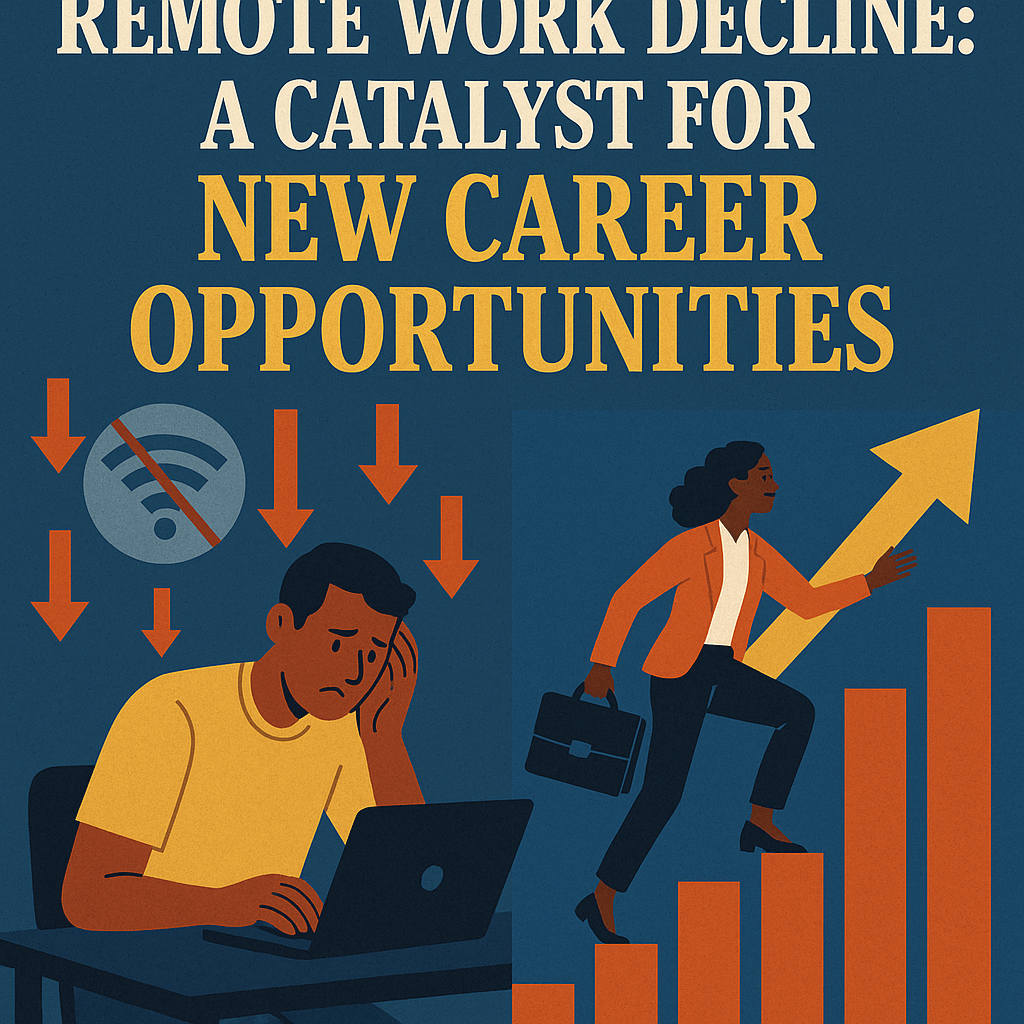
When Sarah, a marketing manager at a tech company, received the email announcing her company’s return-to-office mandate, her stomach dropped. After two productive years working from her carefully designed home office, the thought of returning to a 90-minute commute felt like a step backward. Rather than reluctantly complying, Sarah made a surprising choice: she resigned and pivoted to freelance content strategy, working with clients who valued results over location.
Sarah isn’t alone. As companies like Amazon, Google, and Disney roll back remote work policies, millions of professionals face a pivotal decision: return to the office, or reimagine their careers entirely. What initially appears as a closing door is revealing unexpected windows of opportunity across the employment landscape.
The decline in remote work isn’t just changing where people work—it’s fundamentally reshaping what they do, how they do it, and who they do it for. This shift is becoming a powerful catalyst for career transformation that may ultimately redefine our workforce in ways we haven’t anticipated.
The Great Remote Work Reversal
The pandemic-era expansion of remote work created unprecedented workplace flexibility. According to a Stanford University study, approximately 45% of full-time workers were working from home at the height of remote arrangements in 2020. By early 2023, this number had already declined to around 30% as companies began implementing hybrid or full return-to-office policies.
Major corporations have led this reversal:
- Amazon announced a five-day return to office for corporate employees
- Disney implemented a four-day in-office requirement
- Google reduced remote work approvals by over 65%
- Apple established a three-day minimum office presence
For many workers who reorganized their lives around remote arrangements—relocating to more affordable areas, eliminating commutes, or restructuring childcare—these policy changes represent more than inconvenience. They constitute a fundamental breach of the new working contract that emerged during the pandemic.
The Ripple Effect on Career Decisions
A McKinsey survey revealed that 87% of workers offered the opportunity to work flexibly embrace it. More tellingly, 29% of respondents indicated they would consider changing jobs if required to return to fully on-site work—a figure that rises to 49% among millennials and Gen Z professionals.
“What we’re witnessing isn’t just resistance to commuting,” explains Dr. Alicia Montero, workplace psychologist. “It’s a deeper reassessment of career priorities. When companies revoke remote work, they inadvertently trigger employees to question other aspects of their professional lives they previously accepted without scrutiny.”
Career Pivots: The New Normal
When Jason, a software developer at a financial services firm, faced a return-to-office mandate, he didn’t just look for another remote job in his field. Instead, he leveraged his coding skills to launch a SaaS product he’d been conceptualizing for years. “The ultimatum was the push I needed,” he explains. “I probably would have stayed in my comfortable job for years without making the leap.”
This pattern is emerging across industries as professionals use the remote work reversal as an opportunity to pursue significant career changes:
From Corporate to Entrepreneurship
The U.S. Census Bureau reported that new business applications increased by 24% in 2022 compared to pre-pandemic levels. Many of these entrepreneurs cite corporate return-to-office policies as their tipping point for launching ventures.
Actionable takeaway: Before leaping into entrepreneurship, consider a “side hustle transition” approach. Start your business while still employed, using evenings and weekends to build momentum before making a full transition.
Risk mitigation strategy: Create a financial runway that covers at least 12 months of expenses before leaving steady employment, as most new businesses take 18-24 months to achieve stability.
Industry Hopping: Transferable Skills in Action
Career coach Elena Richards notes a 35% increase in clients seeking guidance for industry transitions rather than similar roles with remote options. “People are realizing their skills have broader applications than they previously considered,” she says. “A product manager from tech can excel in healthcare innovation. A financial analyst can thrive in educational technology.”
Actionable takeaway: Conduct a skills inventory that categorizes your abilities into technical, analytical, creative, and interpersonal competencies. Then research industries with talent gaps matching your strongest categories.
Transition technique: Informational interviews with professionals who have made similar industry jumps can provide realistic expectations and strategies for positioning your experience effectively.
The Rise of Portfolio Careers
Rather than replacing one full-time job with another, many professionals are embracing portfolio careers—combining multiple part-time roles, contract positions, or freelance projects. This approach provides both income diversification and flexibility.
According to Upwork’s 2023 Freelance Forward report, 39% of the U.S. workforce performed freelance work in the past year, with 31% of first-time freelancers citing office return policies as their primary motivation.
Actionable takeaway: Start by securing one anchor client or part-time position that provides approximately 50% of your target income, then gradually add complementary opportunities.
Industries Benefiting from the Career Migration
As professionals reconsider their career paths, certain sectors are experiencing an influx of talent that is transforming their capabilities and culture:
Education and EdTech
Former corporate professionals are bringing business acumen and technological expertise to educational institutions and learning technology companies. Schools facing teacher shortages are creating alternative certification programs to fast-track career-changers into classrooms.
Case study: Michael, a former marketing executive, transitioned to teaching high school business courses through an alternative certification program. “I bring real-world examples into my classroom that textbooks can’t provide,” he explains. “And the schedule alignment with my children’s school calendar gives me the family time I was seeking.”
Healthcare Innovation
The healthcare sector is welcoming professionals from technology, design, and business backgrounds to address challenges in patient experience, operational efficiency, and digital transformation.
Research from the Healthcare Information and Management Systems Society shows that 42% of healthcare organizations have hired professionals from outside traditional healthcare backgrounds in the past two years, with 67% reporting these hires brought valuable fresh perspectives.
Sustainability and Climate Tech
As climate concerns intensify, professionals from various backgrounds are pivoting to roles in renewable energy, sustainable product development, and environmental consulting.
“We’re seeing financial analysts become ESG specialists, engineers transition to renewable energy, and marketing professionals move into sustainability communications,” notes Taylor Jenkins, founder of Green Career Shift, a specialized recruiting firm. “These career-changers often outperform traditional candidates because they bring cross-disciplinary thinking.”
Navigating the Transition Successfully
Career pivots involve inherent challenges, but those prompted by remote work changes can be particularly complex. Here are strategies for managing this transition effectively:
Skill Translation and Enhancement
A successful pivot requires clearly articulating how your existing skills apply to new contexts while strategically addressing knowledge gaps.
- Conduct gap analysis: Compare your current skills with requirements in your target field, then create a focused learning plan.
- Pursue micro-credentials: Short, specialized courses can efficiently build relevant knowledge without requiring extensive time away from work.
- Volunteer strategically: Offer your professional skills to organizations in your target industry to build relevant experience and connections.
Financial Planning for Career Transitions
Career changes often involve temporary income reductions or gaps. Financial preparation is crucial:
Create a transition budget: Calculate minimum monthly expenses and identify areas for reduction during your career shift.
Build a transition fund: Aim to save 3-6 months of expenses before making a significant change, or longer if entering entrepreneurship.
Consider bridge employment: Part-time or contract work in your current field can provide income stability while you build credentials in a new area.
Leveraging the Remote Work Narrative
Rather than hiding your motivation for change, craft a compelling narrative around it:
“The remote work experience demonstrated my ability to self-manage, communicate effectively across digital channels, and deliver results independently. When faced with a return-to-office mandate, I realized I could apply these strengths to [new career direction] where I can create greater impact while maintaining the work-life integration that makes me most productive.”
The Broader Economic Impact
These individual career shifts are collectively reshaping the talent landscape. Organizations with rigid return-to-office policies are experiencing what some economists call a “talent drain multiplier”—losing not just employees who want remote work, but specifically losing their most adaptable, innovative team members who have the confidence and skills to pursue alternatives.
Meanwhile, smaller companies, startups, and traditionally underserved sectors are benefiting from an influx of experienced professionals bringing fresh perspectives and advanced skills.
“We’re seeing a democratization of talent,” explains workforce economist Dr. James Chen. “Regions and industries that previously struggled to compete for top talent are now attracting highly qualified professionals seeking better alignment with their lifestyle preferences.”
Embracing the Opportunity in Disruption
The decline in remote work options represents a significant disruption for many professionals, but history consistently shows that workplace disruptions often accelerate innovation and create unexpected opportunities.
As Sarah, our marketing manager turned freelance strategist, reflected after six months in her new career: “What initially felt like having something taken away became the catalyst for creating something better. I’m earning more, working with clients I respect, and I’ve rediscovered the creativity that had slowly diminished in my corporate role.”
For those facing similar crossroads, the question becomes not just whether to return to the office, but whether this moment of change might be the perfect opportunity to pursue the career you’ve always wanted but never quite found the impetus to chase.
The future of work isn’t just being shaped by company policies—it’s being reimagined by individuals making courageous choices at this pivotal moment. Perhaps the most significant career opportunity isn’t found in any job listing, but in the willingness to envision and pursue a professional path that truly aligns with your skills, values, and aspirations.
Where This Insight Came From
This analysis was inspired by real discussions from working professionals who shared their experiences and strategies.
- Share Your Experience: Have similar insights? Tell us your story
At ModernWorkHacks, we turn real conversations into actionable insights.




0 Comments