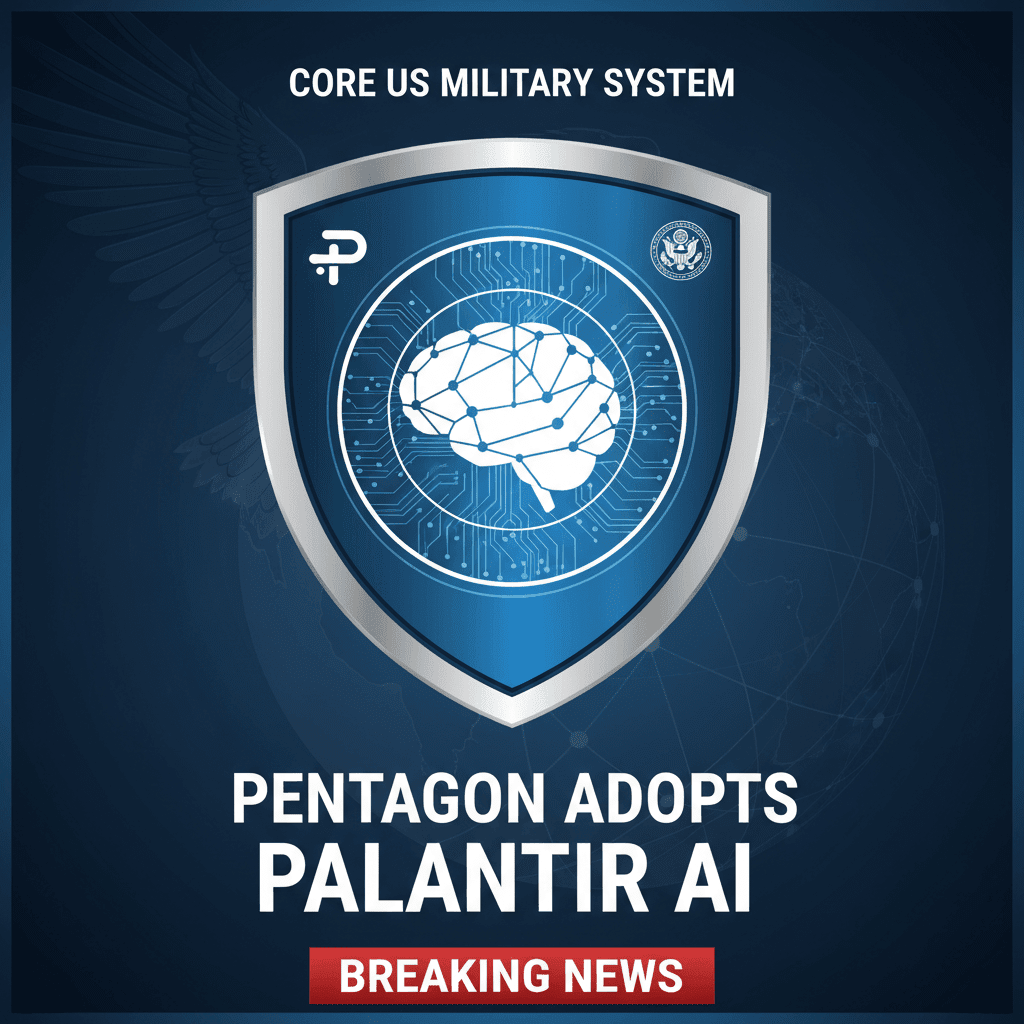
Discover actionable insights. A newly circulated Pentagon memo signals that Palantir’s AI platform is set to become a core element of U.S. military operations—an accelerant for how commanders see, decide, and act across the battlespace. Whether you’re a program manager, operator, engineer, or policymaker, the shift is not about hype; it’s about adopting a repeatable, audited, and secure way to put AI to work where it matters most. What follows distills key takeaways from real discussions across defense forums, public briefings, and industry working groups—and translates them into actions you can take this week.
It’s 03:10 Zulu in a joint operations center. A logistics officer watches supply lines flex under the strain of contested airspace. A swarm of disaggregated sensors reports a dozen partially correlated tracks—some drones, some decoys, and one unidentified surface vessel drifting where it shouldn’t. On a large shared display, a stack of panes lights up in sequence: real-time maritime feeds, satellite imagery, unit readiness, weather, cyber telemetry, maintenance reports, and adversary tactics scraped from open sources—stitched into a single, ranked picture. The AI proposes three courses of action: temporarily reroute fuel convoys via a pre-cleared corridor; retask a maritime patrol aircraft; and stand up a deception plan to absorb adversary ISR bandwidth. A human commander, seeing the assumptions, risk bands, and logistics implications annotated in plain language, approves a modified version. The order is validated against rules of engagement, logged, and disseminated. The system highlights what it does not know—gaps that trigger tasking, not guesses.
That vignette isn’t sci-fi. It’s the kind of workflow many in and around the Department of Defense say they want to make routine—faster OODA loops without losing accountability, interoperability, or control. If Palantir’s AI stack becomes a backbone capability as the memo describes, it will not be because a single model “wins,” but because the Pentagon needs a hardened, governable way to orchestrate many models over trusted data, with humans firmly in command.
What the memo signals—and what changes on Monday morning
The memo points to a material shift: treating Palantir’s AI platform as a core system rather than an isolated pilot or a one-off dashboard. In practice, “core” in defense parlance means three things.
- Institutionalization: A move from ad hoc prototyping to sustained, supported capability in production environments at Impact Levels 5/6, with Authority to Operate, sustainment plans, and budget lines.
- Interoperability by default: Natively integrating with the Pentagon’s data fabric and CJADC2 vision—ingesting and governing data across services and classification domains via approved interfaces and cross-domain solutions.
- Governed AI at mission speed: Clear patterns for model onboarding, validation, continuous monitoring, and human-in-the-loop approvals—so commanders can rely on outputs without outsourcing judgment.
Why now? Senior leaders have emphasized that AI no longer lives in the realm of experimentation. The operational demand signal—perishable targets, dynamic logistics under fire, cyber defense at machine speed—requires systems that close loops, not just produce insights. Palantir’s positioning comes from its track record with data integration (e.g., Gotham in intel, Foundry-style data pipelines, and AI platforms designed to run in secure enclaves and at the edge) and a willingness to align software delivery to operational constraints.
For practitioners, the shift shows up in everyday work:
- Program offices will see streamlined pathways to deploy AI-enabled workflows on top of existing data without replatforming everything. Expect tighter guidance on data contracts, lineage, and model governance.
- Operators and analysts will see fused operational pictures with explainable recommendations and fast ways to interrogate assumptions. Expect “copilot” patterns that draft plans, not decide for you.
- Cyber and accreditation teams will face continuous authorization models—shorter, more iterative releases, with real-time monitoring and automated evidence collection to maintain compliance.
- Contracting officers will need to balance a core platform approach with fair competition at the layer of models, adapters, and mission applications—avoiding lock-in while leveraging standardization benefits.
Immediate actions to align your team
- Identify your top three mission workflows that stall due to data seams, policy friction, or decision latency. Prioritize those for early AI enablement.
- Inventory authoritative data sources, owners, and access constraints. Map them to a draft data contract and lineage plan.
- Define a minimum viable “human-in-the-loop” pattern: who approves what, under which authorities, with what logging and overrides.
- Draft a model onboarding checklist: provenance, training data constraints, test coverage, red-team results, and mission-specific performance thresholds.
Inside the stack: How a “core” AI system actually works
Palantir’s AI approach is often summarized as “bring models to the data, not data to the models,” enforced by a shared data ontology and granular access controls. Under the hood, a core system for DoD-scale AI needs to solve for five hard problems simultaneously: data integration, model orchestration, secure deployment, explainability, and interoperability. Here’s how those pieces fit.
Data fabric and ontologies
Military data is messy: sensor feeds, text reports, imagery, logistics records, maintenance notes, and more. A workable AI platform normalizes that chaos through ontologies—shared definitions for entities and relationships—so that every application “means” the same thing when it says aircraft, convoy, or target package. With governed pipelines, every asset has lineage and policy baked in; classification, need-to-know, and foreign disclosure controls follow the data wherever it goes.
- Action: Establish one ontology for your mission area. Resist bespoke schemas for each app; enforce reuse and evolution.
- Action: Implement data contracts that specify format, quality thresholds, update cadence, and owners for each source.
Model orchestration and evaluation
No single model is sufficient. A core platform routes tasks to the right model for the job—computer vision for ISR imagery, time-series analysis for telemetries, LLMs for translating and summarizing text—then composes outputs into coherent recommendations with traceable citations. Crucially, it tracks mission-relevant metrics (precision/recall by scenario, latency under load, drift over time) and gates model outputs based on confidence and policy.
- Action: Define acceptance criteria by mission effect, not generic benchmarks. Example: “99% recall on small-boat classification in sea state 4” beats “state-of-the-art on dataset X.”
- Action: Stand up continuous evaluation pipelines with synthetic and real data, adversarial tests, and change alerts tied to rollback plans.
Edge-to-enterprise deployment
Operational value happens at the edge—on ships, in aircraft, in forward operating bases—while strategy and fusion happen in secure enterprise environments. A core system must support disconnected operations with smart sync and conflict resolution, optimized models that fit SWaP constraints, and resilient cross-domain transfer mechanisms that preserve chain-of-custody and policy tags.
- Action: Prioritize three edge use cases where latency or connectivity kills value. Co-design models and hardware profiles for those constraints.
- Action: Test cross-domain workflows early. Automate policy enforcement on transfer, not after the fact.
Security, accreditation, and zero trust
At IL5/IL6, security and compliance are features, not footnotes. A core platform needs built-in evidence for continuous authorization: SBOMs for every component, automated STIG checks, signed artifacts, immutable logs, and per-actor least privilege. For AI, it also means defenses against model inversion, prompt injection, data poisoning, and supply chain tampering.
- Action: Integrate security controls into your CI/CD. Every build should produce artifacts your AO can accept without heroics.
- Action: Red-team models the same way you red-team networks. Track vulnerabilities, exploit paths, and mitigation burn-down rates.
Interoperability and standards
Being “core” does not mean being “only.” Expect a hub-and-spoke pattern: a common platform connecting to service-unique systems via open interfaces. Alignment with CJADC2, mission thread standards, and common message formats (and their semantic equivalents) remains non-negotiable.
- Action: Publish and enforce interface specs and semantic mappings. Reward teams that reuse patterns; sunset one-off adapters.
- Action: Bake in exit strategies—data portability, API guarantees, and escrowed deployment recipes—so mission continuity never depends on a single vendor.
Human command and explainability
Trust is earned when users can see why the machine suggests what it suggests. That requires transparent assumptions, citations back to sources, sensitivity analysis, and clear “knobs” to adjust risk tolerance. Successful deployments present decisions as options with pros/cons, not as black-box imperatives.
- Action: Standardize decision briefs: each AI recommendation must show evidence, uncertainty, policy checks, and second-order impacts.
- Action: Capture user feedback inside the workflow; route it to model retraining and product backlog automatically.
Operational impact: From intelligence to sustainment
What changes, concretely, when Palantir’s AI stack becomes a core system? The value is less about a shiny app and more about closing mission threads—end-to-end tasks that used to break on data seams or bureaucratic handoffs.
Intelligence fusion and targeting
Analysts today spend disproportionate time finding, cleaning, and reconciling data. A governed AI platform front-loads that work, letting them test hypotheses, cross-correlate signals, and generate target development packages with traceable chains of evidence. Computer vision models triage imagery faster than humans can click; language models translate, summarize, and surface patterns across multilingual sources; structured ontologies allow automated deconfliction and tip-and-cue cycles.
- Metric to track: time from initial detection to a vetted target nomination, under contested conditions.
- Pitfall to avoid: over-trusting auto-generated target decks without embedded legal and collateral damage checks.
Joint fires and contested logistics
In dynamic fights, every minute counts. AI-enabled mission planning can simulate enemy reactions, reroute convoys against interdiction risks, and recommend decoys that saturate adversary ISR. By tying plans directly to supply, maintenance, and weather, commanders see whether a “brilliant” plan is also logistically executable.
- Metric to track: percentage of fire missions with live logistics feasibility checks; mean time to replan after disruptions.
- Pitfall to avoid: brittle plans that fail when one data feed drops or classification boundaries shift; design for graceful degradation.
Cyber defense and resilience
Cyber is a domain where AI already operates at machine speed. A core platform unifies telemetry, detects anomalies, and automates isolation or recovery steps with human-approved playbooks—reducing dwell time and letting defenders focus on complex hunts rather than repetitive triage.
- Metric to track: median time to detect, contain, and recover; automation coverage by incident class.
- Pitfall to avoid: silent failures when models drift or threat actors adapt; demand drift dashboards and periodic “chaos” exercises.
Maintenance, readiness, and supply chain
Predictive maintenance stops being a science project when data from OEMs, depots, and operators sits under one policy fabric. AI surfaces true failure modes, optimizes spares positioning, and aligns maintenance windows with operational tempo. The payoff is higher mission-capable rates and fewer surprises.
- Metric to track: delta in mission-capable rates and cannibalization events; forecast accuracy of parts demand by platform.
- Pitfall to avoid: models that “optimize” for data-rich fleets while starving edge cases; ensure representative training data and guardrails.
Acquisition and budgeting
AI can accelerate requirements refinement, vendor down-selects, and cost realism by mining historical program data, performance reports, and support tails. For contracting teams, a common platform can cut cycle times while improving oversight—if paired with policy that welcomes iterative delivery and continuous competition at modular layers.
- Metric to track: time to award for modular increments; percentage of contracts with performance telemetry integrated.
- Pitfall to avoid: baking bespoke terms that break interoperability or trap programs in monoliths.
Risks, guardrails, and the discipline to say “no”
Declaring a platform “core” raises legitimate concerns—about concentration risk, model error, cost growth, and escalation dynamics. Treat those as design constraints, not afterthoughts.
Overreliance and vendor lock-in
Single points of failure—technical, contractual, or organizational—are operational risks. The right response is not to shun a core platform, but to engineer for modularity and exit: portable data, open interfaces, and clear roles for alternatives.
- Guardrail: mandate data portability and documented ontologies; require APIs with published SLAs and versioning policies.
- Guardrail: dual-source critical adapters and maintain a “hot spare” integration path for priority mission threads.
Model error, bias, and brittleness
AI fails—sometimes catastrophically—outside its training distribution or under adversarial pressure. Defense use demands demonstrable robustness, transparent limitations, and aligned incentives to report and fix flaws.
- Guardrail: operational test teams own red-teaming of models, not vendors alone; findings tie to release gates and funding.
- Guardrail: every deployment declares “known unknowns” and required human checks; users can throttle autonomy with one click.
Escalation and command responsibility
Speed without judgment can escalate conflicts. Embedding AI in kill chains introduces moral and legal obligations; the standard remains human accountability for decisions, with AI as an advisor.
- Guardrail: codify decision authorities by mission phase; AI can recommend, never authorize, in lethal contexts.
- Guardrail: run pre-mortems for critical workflows—what if the model is wrong, the data is spoofed, or the adversary adapts?
Data sovereignty, privacy, and allied integration
Coalition operations hinge on data sharing that respects national laws and sensitivities. A core platform must enforce siloed control where necessary and seamless fusion where allowed—without manual heroics.
- Guardrail: implement attribute-based access control tied to legal and bilateral rules; log and review cross-border transfers.
- Guardrail: provide “transparent enclaves” for partners—same ontology, separate control planes—so sharing isn’t all-or-nothing.
Cost control and value realization
AI programs can spiral into expensive experiments if not moored to measurable outcomes. The antidote is ruthless focus on mission effects, modular procurement, and continuous de-scope of what isn’t pulling weight.
- Guardrail: tie funding to outcomes with time-boxed, testable increments; instrument cost and performance telemetry from day one.
- Guardrail: sunset pilots that don’t meet predefined thresholds; prioritize work that replaces manual hours or reduces operational risk.
Actionable takeaways from real discussions
Across defense roundtables, public hearings, industry-days, and operator feedback sessions, consistent themes have emerged about making AI useful, safe, and sustainable. Here are distilled, actionable takeaways you can apply now.
For commanders and operators
- Define decision rights: specify which recommendations require your approval, what evidence you need, and how you’ll record rationale.
- Ask for uncertainty: require confidence bands, sensitivity analysis, and alternative COAs with trade-offs—not single answers.
- Practice with friction: rehearse degraded scenarios—lost feeds, stale data, adversarial spoofing—to build muscle memory.
- Embed ethics in ops: integrate ROE, legal reviews, and civilian harm mitigation into the workflow, not as a separate checklist.
For program leaders
- Pick high-value threads: focus your first 120 days on two or three mission threads with measurable payoff and willing users.
- Own the ontology: don’t outsource your data definitions; convene stakeholders, publish, version, and enforce them.
- Instrument everything: bake telemetry, lineage, and performance metrics into the platform and contracts; report them routinely.
- Plan for handoffs: document how new units onboard, how partners connect, and how you will transition from vendor-led to government-sustained.
For engineers and data stewards
- Automate ingestion: build reproducible pipelines with schema validation, PII handling, and classification tagging at source.
- Write model cards: document training data, intended use, known limitations, and test results; keep them current with each release.
- Close the loop: capture user feedback as labeled data; route it into retraining jobs with review checkpoints.
- Harden prompts and inputs: sanitize, constrain, and test against injection and data exfiltration; log prompts as sensitive data.
For test, evaluation, and red teams
- Define mission-grade tests: go beyond accuracy; include latency under load, robustness to spoofing, and performance in edge cases.
- Stage adversarial drills: regularly simulate deception, jamming, and policy edge-cases; publish findings and fixes.
- Gate releases: no production deploys without passing tests tied to operational thresholds and safety cases.
For contracting and oversight
- Contract for outcomes: modularize scope with clear KPIs, open interfaces, and portability; tie payments to demonstrated mission value.
- Ensure competition where it counts: standardize the core, compete adapters, models, and apps to avoid calcification.
- Demand transparency: require SBOMs, audit logs, and evaluation artifacts; reserve rights to independent testing.
For policy, legal, and ethics advisors
- Codify human control: write policies that specify approval points, escalation paths, and audit requirements for AI-assisted actions.
- Protect civil liberties: enforce minimization for domestic data, define retention limits, and monitor for misuse.
- Align with allies: map legal constraints across partners; design access patterns that respect national caveats.
For allies and partners
- Adopt shared semantics: align on ontologies early to reduce integration pain later.
- Pilot within enclaves: start in transparent, partner-controlled environments that mirror the core, then scale sharing where permitted.
- Co-fund interoperability: invest jointly in adapters and testing so coalition ops don’t hinge on last-minute glue code.
For Palantir and industry providers
- Lean into openness: publish interfaces, support data portability, and welcome independent evaluations.
- Co-develop with users: iterate in live environments with mission owners; ship value in weeks, not quarters.
- Price for sustainability: align cost models to outcomes and scale; avoid patterns that penalize success with runaway bills.
What to watch next: 30/90/180-day signals
Core status is a starting gun, not a finish line. The coming months will reveal whether the Pentagon can translate platform decisions into real capability at scale.
Next 30 days
- Designation of flagship mission threads and pilot units for accelerated onboarding.
- Publication of draft ontologies and data contracts for priority domains.
- Standing up of joint governance boards for model approval, telemetry standards, and red-teaming.
Next 90 days
- First operational deployments in IL5/IL6 with measured outcomes (e.g., reduced targeting latency, improved MC rates).
- Initial allied integration patterns tested in transparent enclaves.
- Contracts updated to modularize value delivery and enable continuous competition at the edge and app layers.
Next 180 days
- Expansion from early adopters to broader force elements; formalized training curricula and certification paths.
- Integration into CJADC2 mission threads with cross-service exercises and after-action reviews capturing AI contributions.
- Mature cost and performance dashboards visible to leadership and oversight bodies.
Frequently asked questions leaders are wrestling with
Does “core” mean exclusive?
No. “Core” should mean a common backbone that reduces duplication and accelerates delivery. Competition and diversity flourish at the layer of models, adapters, and mission apps—if interfaces and semantics are clear.
How do we avoid a black box?
Insist on explainability artifacts: citations, model cards, test results, and decision briefs. Require mechanisms to interrogate assumptions and re-run analyses with alternative data or constraints.
What about classified environments and the edge?
Plan for IL6 from the outset: enclave-native deployments, edge optimization, and cross-domain transport with policy enforcement. Test disconnected workflows early; do not assume perfect connectivity.
Will this replace people?
Not in the missions that matter. AI can augment by cutting manual triage and surfacing patterns, but humans remain responsible for judgment, legality, and accountability—especially in lethal and sensitive contexts.
Playbook: Stand up a mission thread in 90 days
Days 1–15: Frame and prepare
- Select a mission thread with a clear owner and measurable outcome.
- Assemble stakeholders: operators, intel, logistics, cyber, legal, and contracting.
- Map data sources, policies, and current handoffs; draft the ontology and data contracts.
- Define success metrics and guardrails; pre-commit to what “good” looks like.
Days 16–45: Build and integrate
- Connect authoritative data with lineage and access controls.
- Onboard baseline models; set up evaluation pipelines and dashboards.
- Design the human-in-the-loop workflow with clear approvals and logging.
- Harden security: SBOM, STIGs, signed builds, and red-team test cases.
Days 46–75: Pilot and iterate
- Run live scenarios with operators; capture feedback and defects.
- Tune models to mission metrics; improve prompts, adapters, and UI ergonomics.
- Exercise degraded ops; validate cross-domain transfers and policy enforcement.
Days 76–90: Certify and scale
- Pass operational test thresholds; document safety cases and ethics reviews.
- Publish onboarding guides and training; prepare handoff playbook.
- Secure sustainment funding linked to outcomes; plan the next thread.
The bottom line
Declaring Palantir’s AI platform a core U.S. military system is not a bet on one algorithm—it’s a bet on a way of working: shared ontologies over data silos, model orchestration over single “silver bullets,” continuous authorization over big-bang ATOs, and human command over automation-for-its-own-sake. If the Pentagon and its partners stay disciplined—measuring value, protecting civil liberties, resisting lock-in, and training people as much as code—the payoff is not just speed, but better decisions, under pressure, with accountability.
Call to action: Make it real this week
- Leaders: pick one mission thread and name an accountable lead; publish the outcome you’ll measure in 60 days.
- Program managers: convene your data owners; draft and sign your first data contract and ontology v0.1.
- Engineers: set up evaluation pipelines; produce your first model card and drift dashboard.
- Operators: schedule a two-hour tabletop that walks through the AI-assisted decision flow with legal and ethics advisors present.
- Contracting: draft a modular performance work statement with open-interface requirements and portability clauses.
- Security: integrate SBOM and automated compliance checks into your build; schedule a red-team window before production.
- Allies: identify a shared use case; stand up a transparent enclave and agree on semantic mappings.
Discover actionable insights by moving from concept to capability. Start small, measure relentlessly, and scale what works. The memo sets a direction; the mission demands delivery. Your next decision can make that future tangible.
Where This Insight Came From
This analysis was inspired by real discussions from working professionals who shared their experiences and strategies.
- Referenced Article: Explore the source material on the source
- Community Discussion: Join the conversation on Reddit
- Share Your Experience: Have similar insights? Tell us your story
At ModernWorkHacks, we turn real conversations into actionable insights.



0 Comments